
◆ Study Hacks
What should a GCSE revision plan cover in the last 12 weeks?
A good GCSE revision plan for the last 12 weeks starts with the exam timetable and works backwards, so that every subject gets repeated, spaced practice rather than one long push in April. This guide uses the published JCQ dates for the 2027 series to lay out a week-by-week plan that works across subjects, and it answers questions students often search, such as whether free videos, notes or past-paper PDFs are enough.
◆ Question 1 / 6 · Start date
When should the last 12 weeks start for the 2027 GCSEs?
Direct answer: For the June 2027 series, the first GCSE exam on the common timetable is on 10 May 2027, so twelve weeks before it is 15 February 2027. The final GCSE exam is on 18 June 2027. Your own papers fall on different days within that window.
The Joint Council for Qualifications publishes the common timetable dates for each series. Its June 2027 table gives 10/05/2027 as the "Date of first examination on common timetable (GCSE GCE)" and 18/06/2027 as the "Date of final examination on common timetable (GCSE)", with 23 June 2027 held as a contingency day (Joint Council for Qualifications, 2026, p. 3). Counting back 84 days from 10 May lands on 15 February 2027, which is also the week of the 21 February entry deadline for the series. That count is our own arithmetic, not a JCQ date.
JCQ also notes that centres should consult awarding body administration documents, because there are variations within and between awarding bodies (Joint Council for Qualifications, 2026, p. 4). Treat the common dates as the outer window and put your own exam timetable from your school on the plan as soon as you have it.
| Milestone | Date |
|---|---|
| Plan starts (week 1) | 15 February 2027 |
| First exam on the common timetable | 10 May 2027 |
| Final exam on the common timetable | 18 June 2027 |
| Contingency day | 23 June 2027 |
| Results to candidates | 19 August 2027 |
◆ Question 2 / 6 · Week-by-week plan
What does the week-by-week plan look like?
Direct answer: Spend weeks 1 to 4 finding gaps and rebuilding weak topics, weeks 5 to 8 on mixed practice questions across all subjects, and weeks 9 to 12 on timed past papers, fixing the marks you keep losing. Reduce new content as the exams get closer.
A 12-week GCSE revision plan in three phases
Tap a phase to see what the weeks are for.
Weeks 1 to 4
Find gaps and rebuild weak topics.
Weeks 5 to 8
Mixed practice questions across all subjects.
Weeks 9 to 12
Timed past papers, fixing the marks you keep losing.
Save this figure
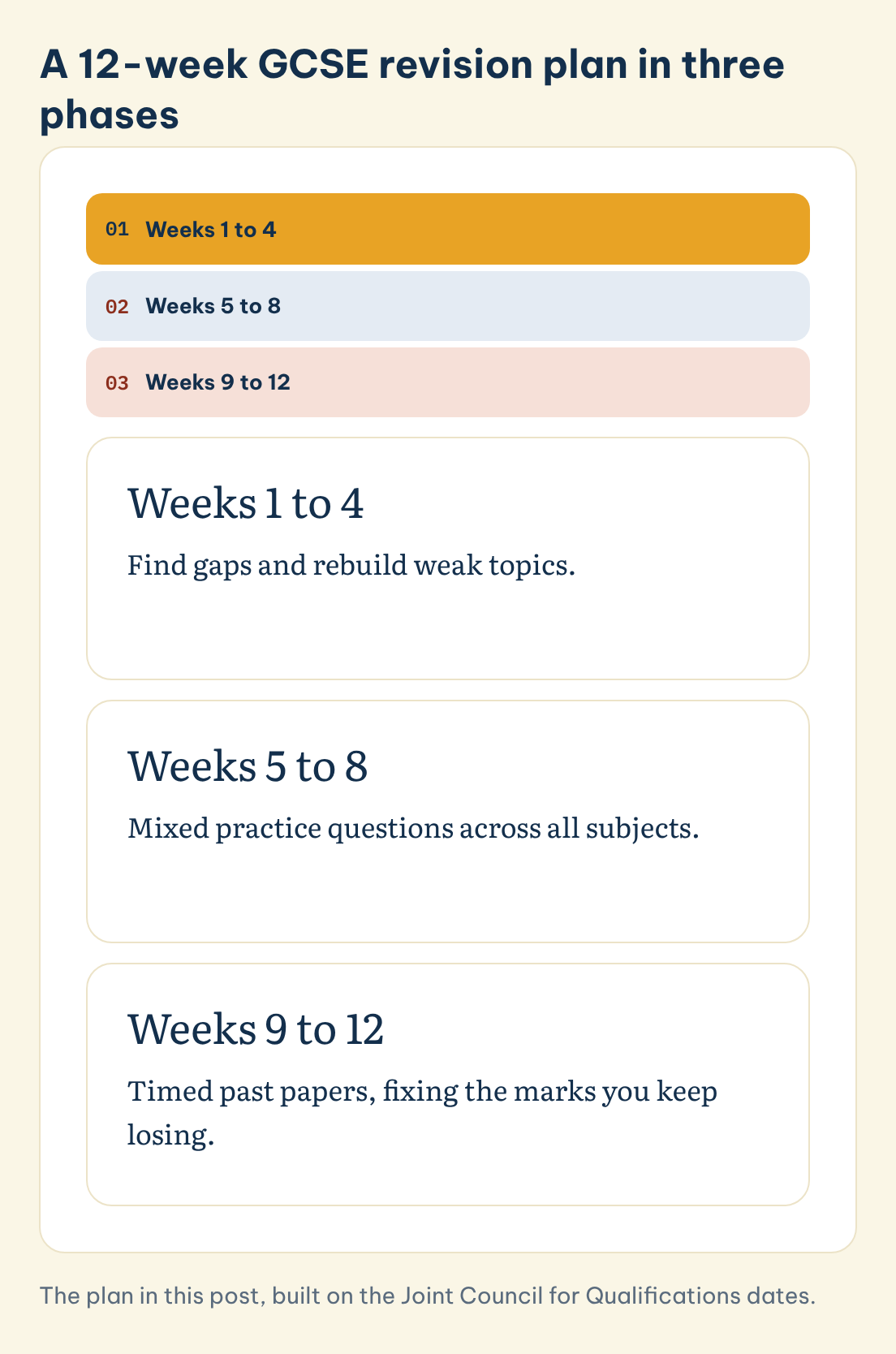
The plan below is a suggested structure, not an official one. It follows the two habits that Dunlosky et al. (2013) rated highly, practice testing and distributed practice, and moves from learning to testing as the exams approach. Adjust the weeks to your own timetable, and give extra time to the subjects with the earliest or the heaviest papers.
| Weeks | Dates | Main job | What it looks like |
|---|---|---|---|
| 1 to 2 | 15 Feb to 28 Feb | Map and diagnose | List every paper, copy the specification topics, mark each topic red, amber or green after a short closed-book quiz |
| 3 to 4 | 1 Mar to 14 Mar | Rebuild red topics | Re-learn the red topics from notes or lessons, then test yourself the next day and again a few days later |
| 5 to 6 | 15 Mar to 28 Mar | Mixed practice | Short question sets that mix topics and subjects, marked against the mark scheme |
| 7 to 8 | 29 Mar to 11 Apr | Second pass | Return to the topics still amber, use a flashcard or question bank, keep one rest day each week |
| 9 to 10 | 12 Apr to 25 Apr | Timed papers | Full papers under timed conditions, then a written list of marks lost and why |
| 11 to 12 | 26 Apr to 9 May | Sharpen and rest | Short recall sessions on the error list, early nights, no new topics |
Four phases are easy to remember, yet the real work is the loop inside each week: attempt a question without notes, mark it, find the gap and come back to it a few days later. A student who follows the table but only rereads notes is repeating the technique that Dunlosky et al. (2013, p. 5) reported does not consistently boost performance. Quizzing yourself is the part to protect when time gets tight.
◆ Question 3 / 6 · Why testing works
Why do practice questions and spacing beat rereading?
Direct answer: Because the exam asks you to recall and apply knowledge without notes, practising exactly that is the best preparation. Dunlosky et al. (2013) rated both practice testing and distributed practice as high utility, and the Education Endowment Foundation found moderate positive effects for retrieval practice against restudy, with low confidence.
Dunlosky et al. wrote that "we rate practice testing as having high utility. Testing effects have been demonstrated across an impressive range of practice-test formats, kinds of material, learner ages, outcome measures, and retention intervals" (Dunlosky et al., 2013, p. 35). On spacing, they wrote that "we rate distributed practice as having high utility: It works across students of different ages, with a wide variety of materials, on the majority of standard laboratory measures, and over long delays" (Dunlosky et al., 2013, p. 39).
The classroom evidence is more cautious. The Education Endowment Foundation review concluded that retrieval practice "is highly relevant across the U.K. education system, for all learners and subjects", while also saying that "the findings in this area are mostly positive, suggesting moderate effect sizes, but there were an appreciable number of neutral or negative results" (Perry et al., 2021, p. 78). The same page notes that one issue has been "the low ecological validity of the studies" (Perry et al., 2021, p. 78). The sensible reading is that testing and spacing are good bets, not magic, so keep them as the core of the plan and watch your own results in practice papers.
For a longer explanation of the techniques themselves, see our guide to how to revise for final exams effectively.
◆ Question 4 / 6 · Free resources
Are free videos, websites, notes and PDFs enough?
Direct answer: Free resources can be enough, if each one has a job. Videos and notes help you rebuild a topic, but they are passive. Past papers and mark schemes from your exam board are what you use to test yourself, so spend most of your later weeks there, not on more input.
Searches such as "GCSE revision videos", "GCSE revision websites", "GCSE revision notes" and "GCSE revision pdf" show how many sources students collect, and the risk is collecting rather than using them. A simple rule helps: in weeks 1 to 4, use videos, books and notes to rebuild the red topics, and from week 5 onward, switch to questions. Free resources are fine when they match your specification, so check the exam board and the subject code before you trust a pack.
Exam boards publish their own material. For GCSE English Language (8700), AQA lists past papers, mark schemes and examiners' reports, sample papers, Exampro (a searchable bank of past AQA exam questions) and exemplar student answers with examiner commentaries (AQA, n.d.). Other boards offer their own versions, which we have not checked, so look at the page for your own board and qualification. The NHS also suggests "drawing up a revision schedule or getting hold of past papers for practice" as a way to help with exam stress (National Health Service, 2023).
◆ Question 5 / 6 · Grades and targets
Why does the old A to G grading system matter for your targets?
Direct answer: GCSEs in England are graded 9 to 1, and Ofqual designed the scale with comparable points to the old letters. The bottom of a grade 4 is comparable to the bottom of the old grade C, and the bottom of a 7 is comparable to the bottom of the old A.
The regulator's guide for parents explains the link between letters and numbers in its own words: "We have designed the grading so that there are comparable points at key grades" (Ofqual, 2018). It adds that "if they previously set entry requirements of at least a grade C, then the equivalent now would be to require at least grade 4" (Ofqual, 2018). This matters for planning because the weekly effort goes first to the subjects where you are closest to a grade your next course asks for. Look up the entry requirements on the websites of the sixth forms or colleges you are applying to, and write the grade next to each subject at the top of your plan.
Marks also differ by paper, so learn the structure of each one. In AQA GCSE English Language, for example, Paper 1 is a written exam of 1 hour 45 minutes worth 80 marks and 50% of the GCSE, and the texts in the examination will be unseen (AQA, 2021, p. 8). A plan that knows each paper's length and weighting can set the right pace in the timed papers phase. Later qualifications have their own rules, which are explained in our guide to UCAS tariff points.
◆ Question 6 / 6 · Sleep and stress
How do you handle sleep, rest and stress in the last 12 weeks?
Direct answer: Protect sleep and a weekly rest day, because revision works best when you can concentrate. The NHS says most teenagers need 8 to 10 hours of sleep a night and that good sleep improves thinking and concentration, so treat sleep as part of the plan.
The NHS page for parents states that "good sleep improves thinking and concentration" and that "most teenagers need 8 to 10 hours' sleep a night", and adds that "exercise can help boost energy levels, clear the mind and relieve stress" (National Health Service, 2023). A plan that fills every evening leaves no room for any of this, so schedule it as you would a lesson. If worry about the exams is affecting your daily life, talk to a parent, a teacher or your GP.
When one subject keeps pulling marks down, short regular sessions with someone who can mark your answers and explain the gap often help more than extra hours alone. Your subject teacher is usually the best person to mark a past-paper answer against the board's scheme. If you later go on to university, MAAS offers 1-on-1 subject tutoring for university modules, with no grade targets or refunds tied to results; if the tutor is not a good fit, you can ask to change tutor.
Frequently asked questions
When should I start GCSE revision for the 2027 exams?
Twelve weeks before the first common-timetable exam on 10 May 2027 is 15 February 2027, but you can start earlier with light, spaced review. Use your own timetable from school as the final guide (Joint Council for Qualifications, 2026).
Are free GCSE revision websites and videos enough?
Free websites and videos can be enough for rebuilding a topic. Use them early, then switch to past-paper questions and mark schemes from your exam board for testing yourself.
Should I use notes or past-paper PDFs?
Use both, in order. Notes help you learn a topic, and past papers show whether you can recall and apply it. Dunlosky et al. (2013) rated practice testing as high utility.
How many hours a day should I revise?
No source read for this guide sets a number of hours. Aim for short, focused sessions, regular rest, and enough sleep, with 8 to 10 hours a night recommended by the NHS for most teenagers.
What should I do in the final two weeks?
Keep to short recall sessions on the errors you listed in your timed papers, avoid new topics, and sleep well. The plan above treats weeks 11 and 12 as a time to sharpen and rest.
Do the same 12 weeks work for every subject?
The structure does, but the content does not. Subjects with more papers or heavier weighting need more time, and practical subjects need practice questions on their own required content.
Related MAAS guides
- How do you revise for exams effectively, final exams included? for the evidence behind retrieval practice and spacing
- How do UCAS tariff points work? for what later qualifications are worth
- 1-on-1 subject tutoring for help with the topics you find hardest
References
AQA. (n.d.). GCSE English Language (8700): Assessment resources. Retrieved October 23, 2026, from https://www.aqa.org.uk/subjects/english/gcse/english-language-8700/assessment-resources
AQA. (2021). GCSE English language (8700): Specification for teaching from September 2015 onwards, for exams in May/June 2017 onwards (Version 1.5). https://filestore.aqa.org.uk/resources/english/specifications/AQA-8700-SP-2015.PDF
Dunlosky, J., Rawson, K. A., Marsh, E. J., Nathan, M. J., & Willingham, D. T. (2013). Improving students' learning with effective learning techniques: Promising directions from cognitive and educational psychology. Psychological Science in the Public Interest, 14(1), 4-58. https://doi.org/10.1177/1529100612453266
Ofqual. (2018, March 2). GCSE 9 to 1 grades: A brief guide for parents. The Ofqual blog. https://ofqual.blog.gov.uk/2018/03/02/gcse-9-to-1-grades-a-brief-guide-for-parents/
Joint Council for Qualifications. (2026). Key dates in the examination cycle: June 2027 examination series [PDF]. https://www.jcq.org.uk/wp-content/uploads/sites/2/2026/05/Key_Dates_June2027_FINAL.pdf
National Health Service. (2023, March 8). Help your child beat exam stress. https://www.nhs.uk/mental-health/children-and-young-adults/advice-for-parents/help-your-child-beat-exam-stress/
Perry, T., Lea, R., Jørgensen, C. R., Cordingley, P., Shapiro, K., & Youdell, D. (2021). Cognitive science in the classroom: Evidence and practice review. Education Endowment Foundation. https://educationendowmentfoundation.org.uk/evidence-summaries/evidence-reviews/cognitive-science-approaches-in-the-classroom/
This guide summarises published sources as read on 23 October 2026. Exam dates and specifications change, so always check your own exam board and school timetable.
Not sure how this guide applies to your own case? Talk it through with MAAS in a free 20-minute consultation.
Book a free consultation ▸