
Direct answer: Beyond testing yourself and spacing your revision, the habits with reasonable evidence are mixing problem types, explaining ideas in your own words, adding concrete examples, pairing words with diagrams, keeping your phone in another room, and sleeping at consistent times. Most are small gains, so pick two and keep them for a month.
◆ Question 1 / 7 · Five best tips
What are the 5 best tips for studying during term?
Direct answer: Five habits are worth trying: interleave topics, explain ideas to yourself, attach concrete examples, draw diagrams beside your notes, and protect your sleep. None is a trick, and the research behind each ranges from strong lab results to modest correlations, so treat them as tested defaults rather than promises.
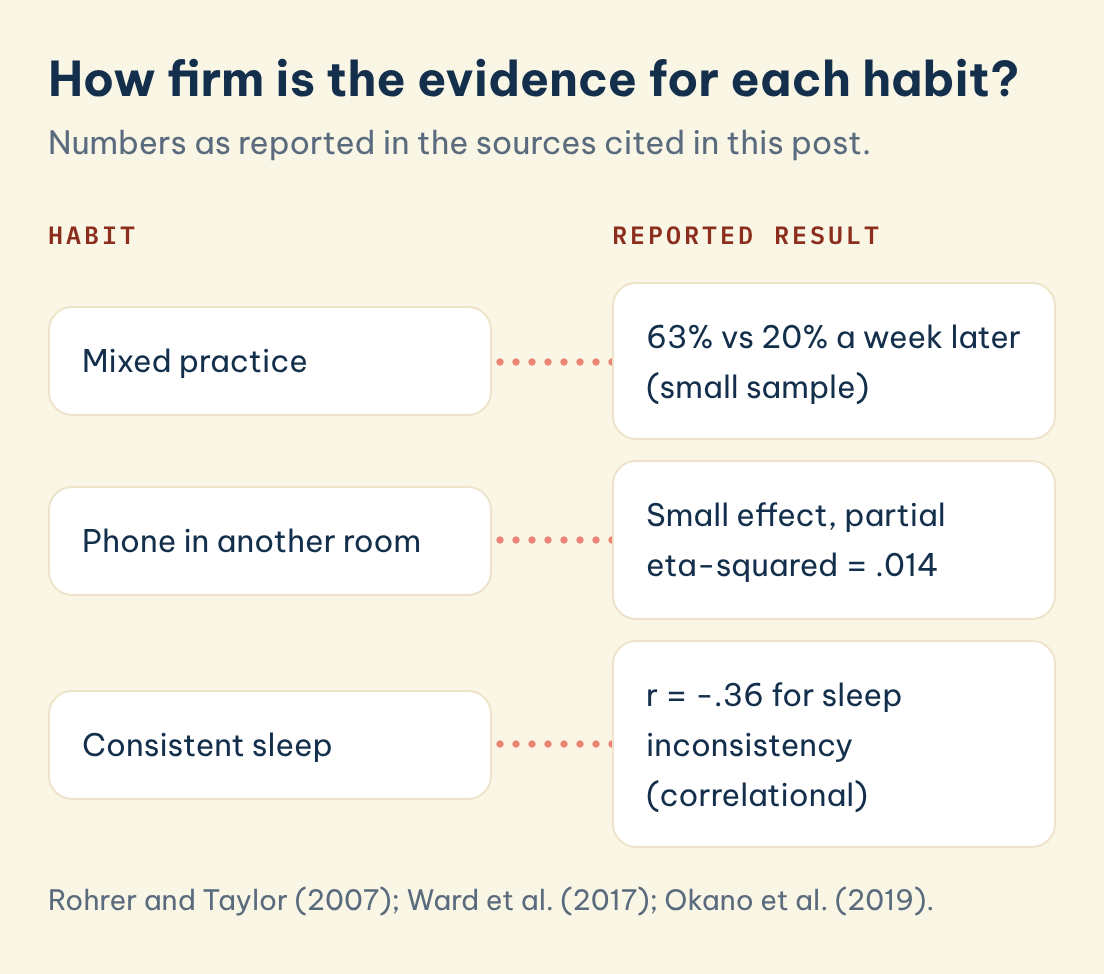
How firm is the evidence for each habit?
Numbers as reported in the sources cited in this post.
Habit
Reported result
Mixed practice
63% vs 20% a week later (small sample)
Phone in another room
Small effect, partial eta-squared = .014
Consistent sleep
r = -.36 for sleep inconsistency (correlational)
Save this figure
Weinstein et al. (2018), in a 17-page open-access review, cover six strategies for learning: spaced practice, interleaving, retrieval practice, elaboration, concrete examples and dual coding. Dunlosky et al. (2013), in a 55-page review, rated interleaved practice and self-explanation as moderate utility, and rated five techniques as low, among them summarisation, highlighting and rereading, while practice testing and distributed practice earned 2 high ratings and 3 techniques earned moderate ones. This guide covers the habits that fit everyday study during term. Testing yourself and spacing your revision are covered in how to revise for exams effectively, so we do not repeat them here. The table below lists each habit with the size of the evidence, so you can see which claims are firm and which are only suggestive.
| Habit | What the evidence shows | How firm it is |
|---|---|---|
| Interleaving | 63% vs 20% on a test 1 week later (Rohrer & Taylor, 2007) | Small lab sample |
| Self-explanation | Rated moderate utility (Dunlosky et al., 2013) | Review of many studies |
| Phone in another room | Small effect on working memory, partial eta-squared = .014 (Ward et al., 2017) | Lab study |
| Consistent sleep | r = .38 for sleep duration, r = -.36 for sleep inconsistency (Okano et al., 2019) | Correlational |
Source: Rohrer and Taylor (2007); Dunlosky et al. (2013); Ward et al. (2017); Okano et al. (2019).
◆ Question 2 / 7 · Mixing topics
Does mixing up topics help you study smarter?
Direct answer: Interleaving means practising different problem types in a mixed order rather than finishing one type before starting the next. It feels harder and slower, yet it improved later test scores in the studies reviewed here. The best-known result comes from a small experiment, so the size of the gain should not be taken at face value.
Rohrer and Taylor (2007) gave college students maths practice either blocked by problem type or mixed together. On a test one week later, the mixed group scored 63% against 20% for the blocked group in a small experiment. Mixed practice also made performance during practice worse, a so-called desirable difficulty. The size of that gap is likely an overestimate for everyday study, because the sample was small and the task was procedural maths. Dunlosky et al. (2013, p. 44) conclude more cautiously: "we rate interleaved practice as having moderate utility." In practice, finish a chapter's problems, then add questions from earlier weeks to the same sitting.
◆ Question 3 / 7 · Explaining ideas
How does explaining ideas to yourself improve learning?
Direct answer: Elaboration means asking why and how, linking a new idea to what you already know, and putting it in your own words. It turns reading into thinking. The evidence rates it as moderately useful, and it costs nothing but a few minutes of silence after each section.
Dunlosky et al. (2013, p. 11) wrote: "We rate elaborative interrogation as having moderate utility." The Learning Center, University of North Carolina at Chapel Hill (n.d.), suggests explaining the material aloud as if you were the teacher, writing your own quiz questions, and deriving examples from your own experience, and it warns that rereading is not studying. For technical courses it advises working problems and explaining why each step works. A simple routine is to close the page after each section and say aloud what it argued and why. Where you stall, you have found the gap, so reopen the text only for that part. Weinstein et al. (2018) report no effect size for elaboration, but describe the evidence for elaborative interrogation as relatively strong. If you are stuck on a subject, a 1-on-1 university subject tutoring session gives you someone to explain it to.
◆ Question 4 / 7 · Examples and diagrams
Why do concrete examples and diagrams help?
Direct answer: Abstract ideas are harder to hold than specific cases, so attach each concept to a real example, then draw it. Pairing words with a picture or diagram gives you two routes back to the same idea. The advice comes from a review of teaching research, so it is guidance rather than a measured effect.
Weinstein et al. (2018, p. 11) argue that, because abstract concepts are harder to grasp than concrete information, "teachers ought to illustrate abstract ideas with concrete examples." The review lists dual coding, combining words with visuals, among its six strategies, though it reports no numbers for it. In an economics course you could attach each term, such as opportunity cost, to a choice from your own week and sketch it as a small supply and demand diagram. In a science course, draw the process rather than copying the paragraph that describes it. The habit takes minutes per topic and replaces lower-rated techniques such as copying slides.
◆ Question 5 / 7 · Focus and phones
How can you focus on studying, and does your phone matter?
Direct answer: Keep sessions short, remove distractions, and put your phone in another room. A lab study found that a phone out of sight left more working memory available than one on the desk. The effect was small and the evidence is a single lab study, so try it as a low-cost experiment.
In a lab experiment, Ward et al. (2017) randomly assigned undergraduates to keep their phone in 1 of 3 places (on the desk, in a pocket or bag, or in another room) while doing a working memory task. Phone location had a small effect on capacity, with partial eta-squared = .014 (about 1.4% of variance), and the other-room group did better than the desk group. The phones were silenced and unused, so it is presence, not use, that was tested. This was one lab study, so treat it as a cheap experiment worth trying. The Learning Center, University of North Carolina at Chapel Hill (n.d.) recommends sessions of 30 to 45 minutes and turning your phone off, since multitasking raises study time and lowers quality.
◆ Question 6 / 7 · Sleep
Does sleep really affect your grades?
Direct answer: Sleep regularity and quality tracked grades in one study of college students, but the link is correlational, so it does not prove that sleeping more raises your mark. The notable finding is that the night before a test mattered little, whereas the weeks before it mattered more.
Okano et al. (2019) tracked 100 students in an introductory chemistry class at one US university with wearable devices; 88 completed the study. Sleep duration (r = .38) and sleep quality (r = .44) correlated positively with overall score (r(86) = .38 and .44, 88 students analysed), and sleep inconsistency correlated negatively (r = -.36), all p < .001. The authors report that "there was no relation between sleep measures on the single night before a test and test performance; instead, sleep duration and quality for the month and the week before a test correlated with better grades" (Okano et al., 2019, p. 1). Mean sleep was 7 hours 8 minutes, and the sleep measures together accounted for nearly 25% of variance in scores. The University of Surrey (2025), in advice dated 18 March 2025, likewise advises eating and sleeping well to support memory, and its exam checklist suggests aiming for 7 to 9 hours of sleep (University of Surrey, n.d.). Fix a wake-up time first, because the data point to irregular sleep across the weeks before a test, not just the night before, as the pattern linked to lower grades.
◆ Question 7 / 7 · The 3-2-1 rule
What is the 3-2-1 rule, and how do you become a top student?
Direct answer: We found no research evidence for the 3-2-1 rule or for becoming a top 1% student by a single formula. Rules with catchy numbers circulate widely, but the habits above are what the sources support. The University of Surrey advises planning your time, including exercise and social time.
The University of Surrey (2025) gives 4 pieces of advice: plan your time, look after yourself, know your learning outcomes, and reflect on what you learn, since reflection helps spot gaps and makes revision easier. That is more modest than the "secret methods" some search results promise. None of the sources we read endorses a named formula such as 3-2-1, so we cannot say whether any version works. A sensible plan for a term is to choose two habits from this guide, for example mixed practice and a fixed wake-up time. Run them for 4 weeks, then keep what helps.
Frequently asked questions
How can I focus 100% on studying?
No one holds full focus for long, but you can reduce interruptions. Use sessions of 30 to 45 minutes and keep your phone in another room, where a lab study found it left more working memory free. The effect was small.
What are the 5 best tips for studying?
Outside retrieval and spacing, five habits have reasonable support: mix problem types, explain ideas in your own words, attach concrete examples, draw diagrams, and sleep at consistent times. The evidence is moderate to small for each, so choose two and test them over a month.
Is interleaving better than studying one topic at a time?
In one small maths experiment, mixed practice scored 63% against 20% for blocked practice a week later. A broad review rated it moderate utility, so expect a real but smaller benefit.
Does sleeping more improve grades?
Sleep duration, quality and regularity correlated with grades in one chemistry class. Because the study was correlational, it cannot show that more sleep causes higher marks.
Does having my phone nearby hurt studying?
A lab experiment found a small drop in working memory when the phone sat on the desk rather than in another room. This was one lab study, so treat it as a cheap experiment worth trying.
Is rereading my notes a good way to study?
Dunlosky et al. (2013) rated rereading, highlighting and summarising as low utility. Replace them with explaining the material aloud or writing your own quiz questions.
Related guides
- How do you revise for exams effectively, final exams included?: retrieval practice and spacing for exam season
- University subject tutoring, 1-on-1: talk through a difficult subject with an expert
References
- Dunlosky, J., Rawson, K. A., Marsh, E. J., Nathan, M. J., & Willingham, D. T. (2013). Improving students' learning with effective learning techniques: Promising directions from cognitive and educational psychology. Psychological Science in the Public Interest, 14(1), 4-58. https://doi.org/10.1177/1529100612453266
- Okano, K., Kaczmarzyk, J. R., Dave, N., Gabrieli, J. D. E., & Grossman, J. C. (2019). Sleep quality, duration, and consistency are associated with better academic performance in college students. npj Science of Learning, 4, Article 16. https://doi.org/10.1038/s41539-019-0055-z
- Rohrer, D., & Taylor, K. (2007). The shuffling of mathematics problems improves learning. Instructional Science, 35(6), 481-498. https://doi.org/10.1007/s11251-007-9015-8
- The Learning Center, University of North Carolina at Chapel Hill. (n.d.). Studying 101: Study smarter not harder. Retrieved October 23, 2026, from https://learningcenter.unc.edu/tips-and-tools/studying-101-study-smarter-not-harder/
- University of Surrey. (n.d.). Exam checklist. Retrieved October 23, 2026, from https://my.surrey.ac.uk/exams/exams/exam-checklist
- University of Surrey. (2025, March 18). Study tips for exam success. https://www.surrey.ac.uk/news/study-tips-exam-success
- Ward, A. F., Duke, K., Gneezy, A., & Bos, M. W. (2017). Brain drain: The mere presence of one's own smartphone reduces available cognitive capacity. Journal of the Association for Consumer Research, 2(2), 140-154. https://doi.org/10.1086/691462
- Weinstein, Y., Madan, C. R., & Sumeracki, M. A. (2018). Teaching the science of learning. Cognitive Research: Principles and Implications, 3(1), Article 2. https://doi.org/10.1186/s41235-017-0087-y
Tools & resources
- The Learning Center, University of North Carolina at Chapel Hill: Studying 101
- University of Surrey: exam checklist
This article is part of the MAAS Journal series for international students. MAAS is an academic support partner: experts guide students through each stage of their own work, and we do not complete assessed work on a student's behalf.
Not sure how this guide applies to your own case? Talk it through with MAAS in a free 20-minute consultation.
Book a free consultation ▸