
Most coursework submitted for 6BUS1035 treats knowledge management and business intelligence as one subject with two names. The module title puts them side by side, the reading list covers both, and it feels natural to write about systems that help organisations use what they know. That instinct is the single most expensive mistake in this module, because a stated learning outcome asks students to discriminate between information systems and knowledge management systems, a distinction submissions often blur.
Author: MAAS Editorial Team
Last updated: 2026-08-08
Category: business-management

What is 6BUS1035 actually about?
Direct answer: 6BUS1035 Knowledge Management and Business Intelligence is a Level 6 module at the University of Hertfordshire worth 15 credits, assessed 100% by coursework and delivered in Semester B. It is optional in Hertfordshire Business School programmes including BA (Hons) Finance and BA (Hons) Accounting, covering how a firm captures and circulates knowledge, and turns recorded data into decisions.
Evidence: These facts come from the programme specifications Hertfordshire publishes openly alongside its course pages, which list each module's code, credit value, semester, and the coursework-to-examination split. The source matters here more than usual. Hertfordshire keeps its Definitive Module Documents behind a student login, so almost everything circulating publicly under this module code has been reposted by assignment-selling sites, frequently for the wrong academic year and occasionally for the wrong university.
Example: A student told her MAAS mentor she had found "the 6BUS1035 brief" and had built an outline around a named retailer, because the version online named one. Her own module handbook let her choose the organisation. She had spent a week researching a company she was not required to study, on the authority of a page that existed to sell her an essay.
Because the module is optional rather than core, the cohort is usually small and mixed: finance and accounting students who chose it, sitting alongside business students. Marking does not adjust for that. An accounting student cannot expect credit for a technically weak treatment of data warehousing simply because it is not their discipline.
Why does the KM and BI distinction carry so many marks?
Direct answer: Because the two fields rest on incompatible assumptions about what knowledge is, and the module is built on that tension. Business intelligence assumes the valuable material has already been recorded: transactions, logs, sensor readings, anything that can be stored, queried and aggregated.
Knowledge management begins from the observation that the most valuable material has not been recorded and often cannot be, since it lives in judgement, experience and professional intuition. A student who writes "KM and BI systems both help organisations make better decisions" has stated something true and analytically empty. The band descriptors move when you show which kinds of decision each is capable of supporting, and where each fails.
Evidence: Polanyi (1966) established the foundational claim that we can know more than we can tell, and it is the reason knowledge management cannot be reduced to a database problem. Nonaka and Takeuchi (1995) built their model of organisational knowledge creation on the conversion between tacit and explicit knowledge, treating the tacit portion as the source of competitive advantage precisely because it resists codification. Alavi and Leidner (2001) then set out why knowledge management systems are therefore a distinct class of information system rather than a variant of one, since their purpose is to support the social processes around knowledge rather than to store knowledge itself. Chen et al. (2012), writing from the other side, trace business intelligence and analytics through its data-warehousing origins into large-scale unstructured analysis, a lineage in which the analytical object is always recorded data.
Example: A student wrote about a bank deploying "a KM and BI platform" to reduce credit losses. His mentor asked him to split the claim in two. The dashboard flagging unusual repayment patterns was business intelligence, working on recorded data. The reason experienced officers overruled the dashboard in certain districts was tacit knowledge about local trading conditions, which no dashboard held. Once he separated them, he had an argument: the bank's real problem was that the two capabilities did not talk to each other. That was the analysis his draft had been missing.
Which frameworks do the most work, and which are decorative?
Direct answer: Use two or three frameworks with precision rather than surveying every model in the reading list. The productive pattern pairs one framework that explains what knowledge is doing with one that explains what the technology is doing, then examines what happens where they meet.
| Framework | The question it answers | Where students go wrong |
|---|---|---|
| Tacit and explicit knowledge (Polanyi; Nonaka & Takeuchi) | Why can some knowledge be stored and other knowledge not? | Presenting it as a simple two-box classification, when the interesting cases sit on the boundary |
| SECI conversion model | How does knowledge move between individuals and the organisation? | Listing the four modes without applying any of them to the case |
| Knowledge management systems as social infrastructure (Alavi & Leidner) | Why do KM systems fail even when the technology works? | Treating adoption failure as a training problem rather than an incentive and culture problem |
| BI and analytics maturity (Chen et al.; Wixom & Watson) | What has to be in place before analytics changes a decision? | Assuming a dashboard produces value on installation, with no account of data quality or governance |
Evidence: Davenport and Prusak (1998) documented how routinely knowledge management initiatives were implemented as technology projects and failed for organisational reasons, a pattern that later research did not overturn. Wixom and Watson (2001) tested the factors behind data warehousing success empirically and found organisational and project-level factors carrying substantial weight alongside technical ones. Both findings point the same way: in this module, an answer that stops at the technology has stopped early.
Example: A student described a firm's knowledge repository as "underused" and recommended more training. Her mentor asked who benefited from contributing to it. Nobody did; the firm promoted people on billable hours, and writing up what you had learned was unbillable. The recommendation changed from training to incentive design, and the essay moved from descriptive to analytical without adding a single new source.
How should the coursework be structured?
Direct answer: Build it as an argument with an organisation attached, not as an organisational profile with theory attached. A structure that holds up at Level 6: an introduction that names one analytical question and states your line, roughly 10% of the words; the conceptual framework and, critically, a justification of why those concepts rather than others, roughly 25%; the organisation examined through that framework, roughly 30%; the point of failure or tension, meaning where the frameworks disagree or the evidence resists your line, roughly 20%; and a conclusion that answers the question and names what remains uncertain, roughly 15%.
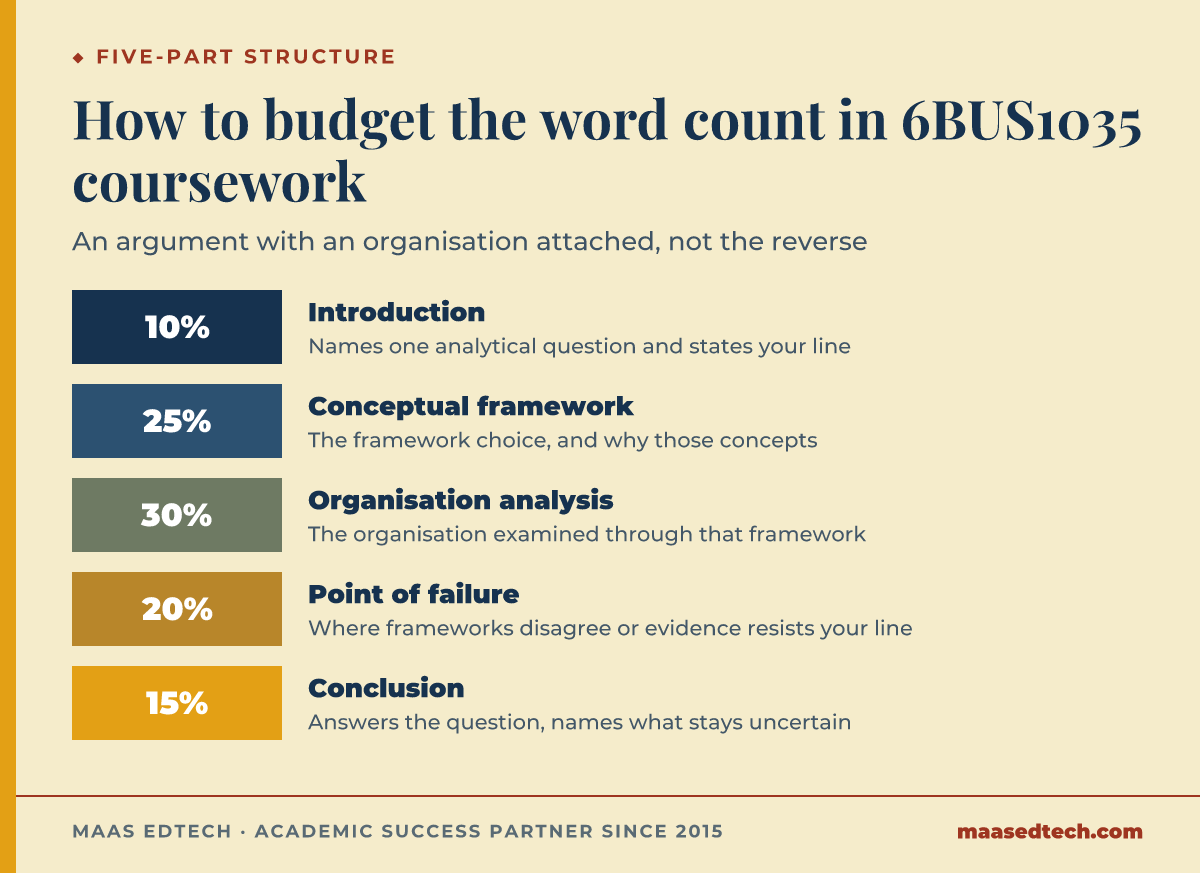
The fourth section is the one most students leave out, and it is the one final-year descriptors reward most directly. In this module it has an obvious home: the place where the tacit knowledge an organisation depends on cannot be fed into the analytics it has invested in.
Evidence: The UK Quality Assurance Agency's descriptor for a bachelor's degree with honours requires "an appreciation of the uncertainty, ambiguity and limits of knowledge" (QAA, 2024), alongside the ability to critically evaluate arguments and evidence. A submission with no section devoted to counter-evidence has structurally removed the criterion it most needs to satisfy.
Example: A student argued that a logistics firm should centralise its route knowledge into a BI system. Her mentor asked what a sceptical dispatcher would say. She found that experienced drivers routinely departed from optimal routes for reasons the system never recorded, such as a market day that closed a road. Rather than weakening her argument, that exception let her narrow the claim to something defensible: centralise the data, but design a channel for the judgement the data cannot hold.
What sources are acceptable, and which are a risk?
Direct answer: Anchor the analysis in peer-reviewed information systems research and in the foundational KM literature, and use vendor material and industry reporting only for current facts that you attribute clearly. The specific risk in this module is that business intelligence is a commercial market, so a large share of what a search returns is marketing written by companies selling the systems you are supposed to evaluate. That material describes capability well and evaluates it not at all.
Evidence: The pattern is easy to spot once you look for it. Vendor white papers report implementation successes and rarely implementation failures, which is precisely the evidence a critical evaluation needs. Peer-reviewed studies such as Wixom and Watson (2001) report both.
Example: A student cited a software company's case study as evidence that analytics improved decision quality at a named retailer. His mentor asked who had written it and what a failed deployment would have looked like in the same document. Neither question had an answer, so the citation moved from evidence to illustration, and the analytical weight shifted onto the peer-reviewed work.
The foundational literature behind this module, in brief:
- Polanyi (1966) established that people can know more than they can tell, which is why knowledge management cannot be reduced to a database problem.
- Nonaka and Takeuchi (1995) built their SECI model of organisational knowledge creation on the conversion between tacit and explicit knowledge, naming socialisation, externalisation, combination and internalisation as its four modes.
- Alavi and Leidner (2001) argued that knowledge management systems form a distinct class of information system because they support social processes rather than store knowledge itself.
- Chen et al. (2012) traced business intelligence and analytics from its data-warehousing origins into large-scale unstructured analysis.
- Davenport and Prusak (1998) documented how routinely early knowledge management initiatives were implemented as technology projects and failed for organisational reasons.
- Wixom and Watson (2001) tested the factors behind data warehousing success empirically and found organisational and project-level factors carrying substantial weight alongside technical ones.
- The Quality Assurance Agency for Higher Education (2024) expects a bachelor's honours graduate to appreciate the uncertainty and limits of knowledge in their discipline, which is why a submission needs a counter-evidence section.
What do MAAS mentors actually do on this module?
MAAS works as an academic advisor. A mentor reads your draft against the module's learning outcomes, asks the questions a marker would ask, and shows you where an argument stops short. You write every word that is submitted. The typical sequence on a module like this one runs from clarifying the analytical question, to reviewing your framework selection, to a structural read of the full draft with the marking criteria alongside it. Referencing is checked as part of that read rather than as a separate service.
Frequently asked questions
Is 6BUS1035 a compulsory module?
No. The programme specifications list it as an optional Level 6 module within Hertfordshire Business School programmes such as BA (Hons) Finance and BA (Hons) Accounting. Confirm the status on your own programme, since option lists differ between programmes and between academic years.
How is the module assessed?
The published programme specifications record it as 100% coursework with no examination component, delivered in Semester B. Your own module handbook is the authority on the specific task, word count and weighting for your year.
Do I need a technical background to take it?
No, and the marking does not assume one. What it does assume is that you will describe systems accurately, in the terms Chen et al. (2012) and Wixom and Watson (2001) use for the discipline. Vague technical description is penalised as imprecision, not excused as non-specialism.
Can I write about a Vietnamese organisation?
Usually yes, and it often produces a stronger essay, since you have access to context a marker has not read fifty times. Check the brief for any restriction, and be careful that the sources you rely on are verifiable to the reader.
How many sources should the coursework use?
There is no fixed number, and counting is the wrong measure. A Level 6 essay that uses 8 sources precisely, including at least a few peer-reviewed studies engaged with in detail, outperforms one that cites 30 sources in passing.
Related reading
- Critical thinking in academic writing
- How to write a university report
- Academic support from MAAS mentors
Talk to a MAAS mentor about your module
References
Alavi, M., & Leidner, D. E. (2001). Knowledge management and knowledge management systems: Conceptual foundations and research issues. MIS Quarterly, 25(1), 107–136. https://doi.org/10.2307/3250961
Chen, H., Chiang, R. H. L., & Storey, V. C. (2012). Business intelligence and analytics: From big data to big impact. MIS Quarterly, 36(4), 1165–1188. https://doi.org/10.2307/41703503
Davenport, T. H., & Prusak, L. (1998). Working knowledge: How organizations manage what they know. Harvard Business School Press.
Nonaka, I., & Takeuchi, H. (1995). The knowledge-creating company: How Japanese companies create the dynamics of innovation. Oxford University Press.
Polanyi, M. (1966). The tacit dimension. Doubleday.
Quality Assurance Agency for Higher Education. (2024). The frameworks for higher education qualifications of UK degree-awarding bodies. QAA. https://www.qaa.ac.uk/docs/qaa/quality-code/the-frameworks-for-higher-education-qualifications-of-uk-degree-awarding-bodies-2024.pdf
Wixom, B. H., & Watson, H. J. (2001). An empirical investigation of the factors affecting data warehousing success. MIS Quarterly, 25(1), 17–41. https://doi.org/10.2307/3250957