
◆ Writing Tips
How do you synthesise literature with a synthesis matrix?
To synthesise literature, group your sources by shared ideas and show how they relate, instead of describing them one at a time. A synthesis matrix is a table that makes this visible: sources on one axis, themes on the other, and a column for your own interpretation (University of Sheffield, n.d.).
◆ Question 1 / 6 · What is the synthesis
What is the synthesis of literature?
Direct answer: Synthesis of literature means combining ideas from several sources to make a point of your own. Sheffield treats it as sorting sources by where they match and where they part ways (University of Sheffield, n.d.), and Oregon adds that good synthesis shows how sources converse with each other (University of Oregon Libraries, n.d.).
The University of Sheffield (n.d.) states: "Synthesising involves grouping sources based on similarities and differences." The groupings can follow "theory, ideas, research design, findings, interpretations, limitations and other criteria". For each group, Sheffield suggests asking whether the authors agree, whether they disagree, whether they agree on one point but not another, and whether one author develops an idea further. Those four questions turn a pile of notes into relationships.
Webster and Watson (2002) made the same point for the information systems field in 2002. In their words, "A literature review is concept-centric. Thus, concepts determine the organizing framework of a review" (Webster & Watson, 2002, p. xvi). The unit of organisation is the idea, and authors appear as evidence for it. Medaille (2026) gives the same advice to researchers today: "Authors should avoid organizing their literature review as a list of summaries (e.g., Author A found this, Author B wrote this, Author C studied this, etc.)" (Medaille, 2026, p. 2). For the wider task around this skill, our guide to how to write a literature review covers sources, structure and common mistakes.
◆ Question 2 / 6 · What is a synthesis vs
What is a synthesis vs. a summary?
Direct answer: A summary reports what each source says, one source after another. A synthesis organises the same sources around ideas and shows how they connect. Webster and Watson (2002, p. xvi) warn that an author-centric review "essentially present[s] a summary of the relevant articles. This method fails to synthesize the literature."
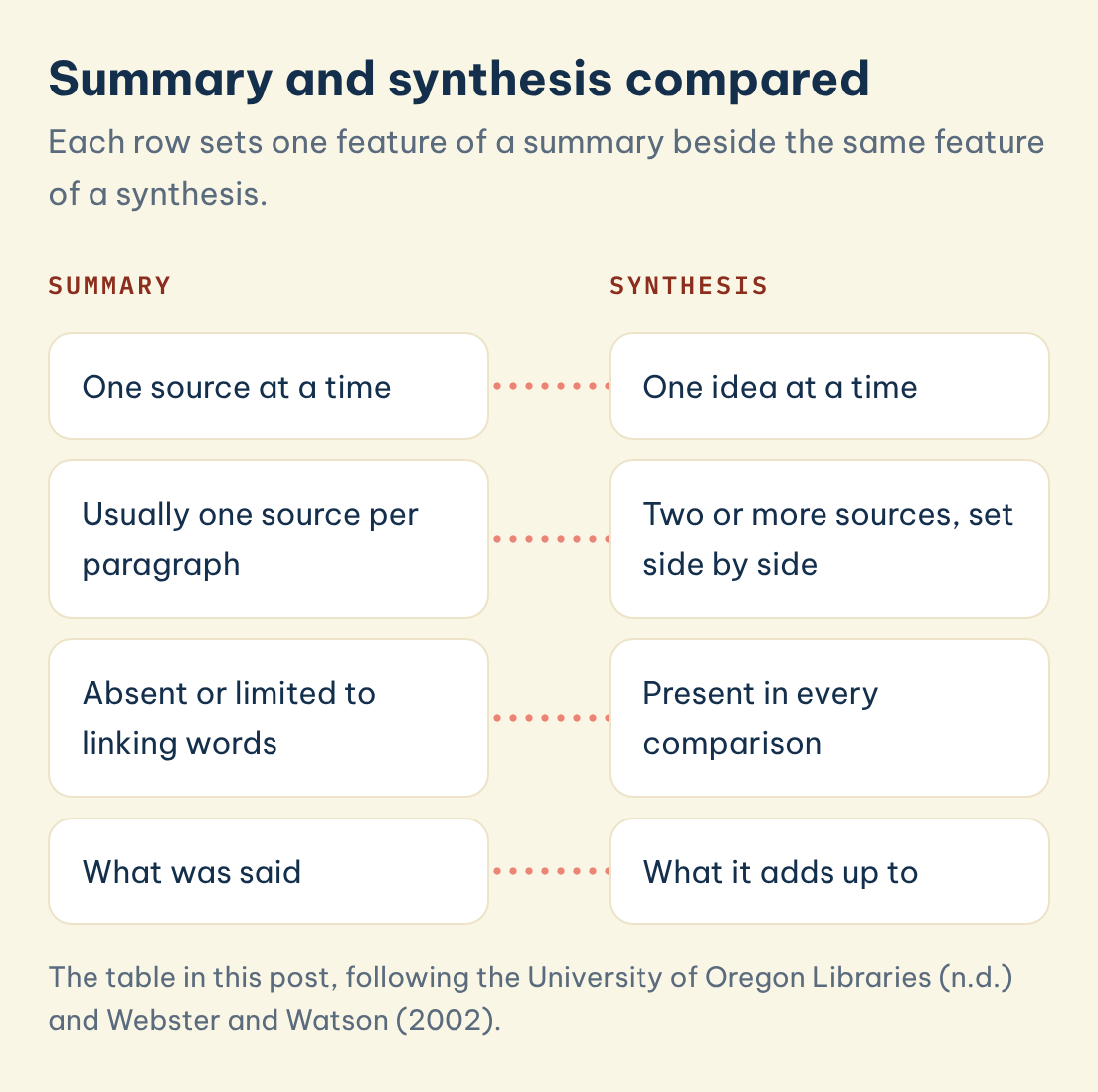
Summary and synthesis compared
Each row sets one feature of a summary beside the same feature of a synthesis.
Summary
Synthesis
One source at a time
One idea at a time
Usually one source per paragraph
Two or more sources, set side by side
Absent or limited to linking words
Present in every comparison
What was said
What it adds up to
Save this figure
The University of Oregon Libraries (n.d.) lists what synthesis is not: critiquing a single source, simply comparing and contrasting, a series of summaries, or direct quotes without your own voice. It is also the place where readers see where you add your own new ideas. In its four student examples, only the one that used five sources, showed how they relate and made its own point counted as good synthesis.
| Feature | Summary | Synthesis |
|---|---|---|
| Unit of organisation | One source at a time | One idea at a time |
| Typical opening | "The author found..." | A claim about what the field shows |
| Sources per paragraph | Usually one | Two or more, set side by side |
| Your voice | Absent or limited to linking words | Present in every comparison |
| What the reader learns | What was said | What it adds up to |
Webster and Watson (2002, Table 1) contrast the two layouts in compact form. The concept-centric version reads "Concept X [author A, author B]", and the author-centric version reads "Author A: concept X, concept Y". If your draft paragraphs begin with author names followed by what they did, you are probably still summarising.
◆ Question 3 / 6 · What is the difference
What is the difference between a literature synthesis and a literature review?
Direct answer: A literature review is the whole piece of writing that surveys published work on a topic. Synthesis is the thinking move inside it, the grouping and comparing that stops the review reading as a list. A review without synthesis is a set of summaries, and synthesis is what marks a review as analytical.
The two terms overlap because many assignments ask for a review but assess the synthesis. Johns Hopkins University Libraries (n.d.) describe the aim as weaving sources together "to create a narrative". The review is the narrative, and the synthesis is the technique that produces it. Our walkthrough of an annotated literature review example shows the technique paragraph by paragraph.
A related format sits close by. An annotated bibliography deliberately treats each source separately, so it is a valid place for summary. A review is where summary has to give way to comparison.
◆ Question 4 / 6 · How do you build a synthesis
How do you build a synthesis matrix? Template and outline
Direct answer: Build the matrix in three steps. First fill each row with one source. Then read down the columns to spot similarities, differences, gaps and themes. Then write up. The University of the Sunshine Coast Library (n.d.) uses exactly this order and tells you to mark verbatim words with quotation marks.
Rows can be sources and columns can be themes, which is the Sunshine Coast layout. Central Michigan University Libraries (n.d.) reverse it, putting main ideas in rows and sources in columns. Both work, so choose the orientation that you find easier to read. The Sunshine Coast guide suggests these column headings as a starting template:
- citation information and URL
- a place for your own analysis
- topic or keywords
- design or methodology
- participants and location
- data collection
- main findings
- limitations
Central Michigan University Libraries (n.d.) advise that once the chart is complete, you should review your notes "to identify common themes, areas of disagreement, or gaps in the literature". Webster and Watson (2002, p. xvii) recommend compiling the matrix "as you read each article", an idea they adapted from earlier work, and then synthesising "by discussing each identified concept". They also suggest an optional extra dimension for the unit of analysis, such as organisational, group or individual, because it makes it easier to notice when a concept strays outside its domain.
An outline for the written review follows from the matrix. Each theme column becomes a section or a paragraph block. Within each block, order the sources by the relationship they have: building on one another, challenging one another, identifying a gap, or filling one (University of Sheffield, n.d.). Our short guide to grey literature helps if some of your rows will hold reports and theses rather than journal articles.
◆ Question 5 / 6 · What is an example
What is an example of a synthesis? A worked matrix
Direct answer: An example is a matrix row set plus the sentence it yields. The table below uses invented sources, labelled Study A to Study C, on a made-up question about study habits, so you can see the mechanics without borrowing anyone's real findings. The synthesis column is where your interpretation sits (University of Sheffield, n.d.).
| Study | Theme 1: Spaced practice | Theme 2: Sample | Limitation | Synthesis (your voice) |
|---|---|---|---|---|
| Study A | Spaced practice improved recall | 120 undergraduates | Single course | Supports spacing in a narrow setting |
| Study B | Spaced practice improved recall | 300 undergraduates, three courses | Self-reported hours | Extends A to more courses, but hours are self-reported |
| Study C | No difference found | 80 postgraduates | Small sample | Challenges A and B, possibly because of a different population |
Reading down Theme 1 gives a synthesised paragraph almost directly. Two sources agree, one disagrees, and the Sample column offers a possible reason for the disagreement. The paragraph might read: "Evidence that spaced practice improves recall comes mainly from undergraduate samples (Studies A and B), while the one postgraduate study found no difference (Study C), which suggests that the effect may depend on the population studied."
Notice what the sentence does that a summary cannot. It makes a claim, uses three sources as evidence, names a pattern and offers a reason for the exception. The Sheffield checklist asks a final question worth applying here: is one source synthesised or otherwise used more than the others? If one row dominates your paragraphs, the matrix has probably become a list again.
◆ Question 6 / 6 · What does literature
What does literature synthesis look like in research writing?
Direct answer: In research writing, synthesis shows up as topic sentences about ideas, paragraphs that compare two or more studies, and an explicit statement of what the comparison establishes. The University of Oregon Libraries (n.d.) say the work "can be messy", so expect to reorganise themes several times before the structure settles.
The University of Oregon Libraries (n.d.) allow several sorting principles: by theme or concept, chronologically, or by methodology. The University of Sheffield (n.d.) links sources that build on one another to a chronological order, sources that challenge one another to a debate, and sources that reveal a gap to an account that ends on what is missing. Choose the order that fits your research question.
Write each paragraph from a column of the matrix. Open with the claim, bring in the sources that bear on it, mark the agreements and disagreements, and close with what your reader should take from the comparison. If you want an expert to read your matrix and flag where it still reads as a list, academic mentoring at MAAS offers that kind of feedback, while the reading and writing stay yours.
Frequently asked questions
What is the synthesis of literature in one sentence?
It is grouping sources by shared ideas and showing how they agree, disagree or build on each other. Sheffield frames it as sorting sources by similarity and difference (University of Sheffield, n.d.).
Is a synthesis matrix the same as a literature grid?
Yes, in practice. The University of the Sunshine Coast Library (n.d.) says a literature grid is also known as a literature matrix or synthesis matrix, a way to organise multiple sources in one table.
Should sources be rows or columns?
Either. The University of the Sunshine Coast Library (n.d.) puts one source per row, while Central Michigan University Libraries (n.d.) put ideas in rows and sources in columns. Pick whichever you can scan quickly.
How many sources should one synthesised paragraph use?
Two or more, set side by side, which is the practical difference from summary. The University of Oregon Libraries (n.d.) describe synthesis as combining elements of several sources to make a point.
Can I include direct quotes in a synthesis?
Yes, sparingly. The University of Oregon Libraries (n.d.) say synthesis is not direct quotes without your own voice, so surround any quotation with your own comparison. In the matrix, mark verbatim words with quotation marks (University of the Sunshine Coast Library, n.d.).
Do I need a matrix for a short essay?
Not always, but it helps once you have more than a handful of sources. For a thesis chapter it keeps themes visible across dozens of readings.
Can a mentor check my synthesis?
Yes. A mentor can read your matrix and draft paragraphs and point out where they still summarise. You do the reading and the writing. See academic mentoring at MAAS for how that works.
References
Central Michigan University Libraries. (n.d.). How to conduct a literature review: Synthesize. https://libguides.cmich.edu/lit_review/LR_synthesize
Johns Hopkins University Libraries. (n.d.). Synthesize. In Write a literature review. https://guides.library.jhu.edu/lit-review/synthesize
Medaille, A. (2026). Telling the research story: Writing the literature review section of a research article. Evidence Based Library and Information Practice, 21(3), 1–4. https://doi.org/10.18438/eblip31240
University of Oregon Libraries. (n.d.). How to write a literature review: 6. Synthesize. https://researchguides.uoregon.edu/litreview/synthesize
University of Sheffield. (n.d.). How to synthesise information. StudySkills@Sheffield. https://sheffield.ac.uk/study-skills/research/approaches/synthesise
University of the Sunshine Coast Library. (n.d.). Using a literature grid to organise evidence. https://libguides.usc.edu.au/c.php?g=972739&p=7174095
Webster, J., & Watson, R. T. (2002). Analyzing the past to prepare for the future: Writing a literature review. MIS Quarterly, 26(2), xiii–xxiii. https://www.jstor.org/stable/4132319
Not sure how this guide applies to your own case? Talk it through with MAAS in a free 20-minute consultation.
Book a free consultation ▸