
◆ Research Methods
What is grey literature and how do you find and cite it?
Grey literature is research and information produced outside commercial academic publishing, such as government reports, theses, working papers and preprints. Schöpfel (2011) traces the term to a definition approved at the 3rd International Conference on Grey Literature in 1997, and a postscript added in 2004 sharpened it to cover bodies whose primary activity is not publishing.
University library guides in the UK and Australia agree on the practical point: these sources exist outside the journal system, so you must search for them differently and judge them differently. This guide covers the definition, examples, why systematic reviewers insist on it, where to search, the AACODS checklist for appraisal, and how to cite it in APA 7. The MAAS guide to writing a university assignment sets research skills like this beside the other assignment genres.
◆ Question 1 / 7 · What it is
What is grey literature?
Direct answer: Grey literature is material produced by government, academia, business and industry in print and electronic formats that commercial publishers do not control (Schöpfel, 2011). The 2004 postscript adds that publishing is not the primary activity of the body producing it. Gray is the American spelling, and sources use both.
The Luxembourg wording is the one most reviews quote. Paez (2017) repeats it and then explains why it matters for evidence synthesis, while Adams et al. (2017) describe the same territory for management research as a diverse and heterogeneous body of material made public outside traditional academic peer review. Peer review is therefore the practical dividing line for many students, although the formal definition turns on commercial control rather than on review.
Two edge cases deserve care. Some theses and dissertations are rigorously reviewed and may be of high quality (Paez, 2017), so grey does not mean weak. Conference material is also mixed: Queen's University Belfast Library notes that some conference proceedings are formally published and so do not count as grey literature, which means you must check the publisher before labelling a source (see QUB Library's grey literature guide).
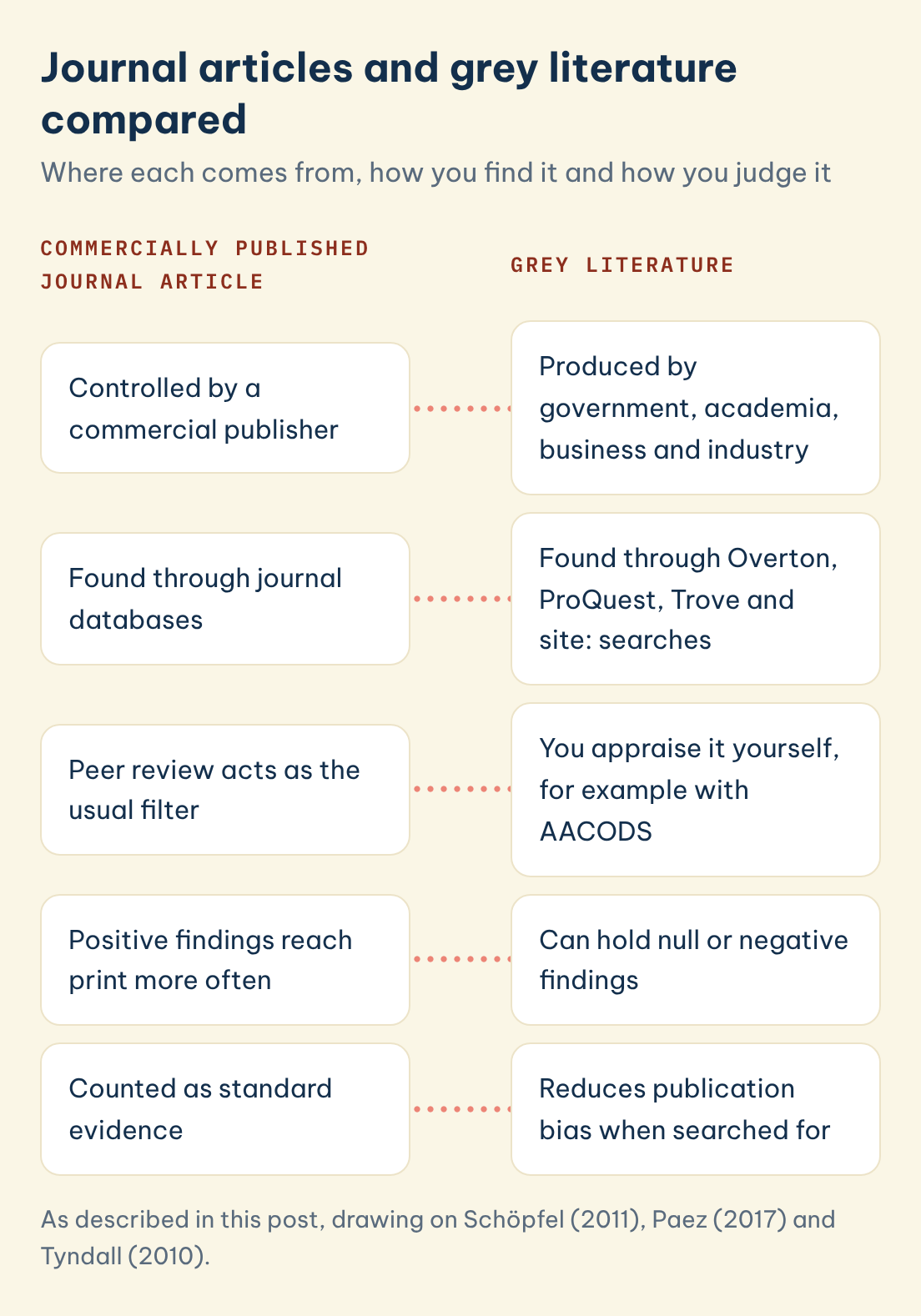
Journal articles and grey literature compared
Where each comes from, how you find it and how you judge it
Commercially published journal article
Grey literature
Controlled by a commercial publisher
Produced by government, academia, business and industry
Found through journal databases
Found through Overton, ProQuest, Trove and site: searches
Peer review acts as the usual filter
You appraise it yourself, for example with AACODS
Positive findings reach print more often
Can hold null or negative findings
Counted as standard evidence
Reduces publication bias when searched for
Save this figure
◆ Question 2 / 7 · Examples
What are examples of grey literature?
Direct answer: Common examples include government and agency reports, policy documents, theses and dissertations, working papers, preprints, company reports, conference abstracts, and blogs or social media posts (Adams et al., 2017; Lefebvre et al., 2025). The table groups them by what each type is typically used for.
| Type | Typical example | Typical use in an assignment |
|---|---|---|
| Government and agency reports | A national statistics release or a regulator's inquiry report | Official figures and policy background |
| Policy documents and guidance | Departmental guidance or a think tank briefing | Current policy positions |
| Theses and dissertations | A doctoral thesis held in a repository | Detailed methods and literature maps |
| Working papers and preprints | A discussion paper or a PsyArXiv preprint | Very recent findings before journal publication |
| Company and industry reports | An annual report or a white paper | Practitioner data and market evidence |
| Conference abstracts | Abstracts from a professional meeting | Early signals of emerging work |
Adams et al. (2017) list dissertations, policy documents, preprints, publications from governmental agencies, blogs and social media, working papers and company reports in their table of grey literature types, drawn from a sample of 140 management systematic reviews. Cochrane authors add reports, dissertations, theses and conference abstracts as the sources reviewers should consider (Lefebvre et al., 2025).
◆ Question 3 / 7 · Why it matters
Why does grey literature matter for your research?
Direct answer: Grey literature reduces publication bias, the tendency for studies with positive findings to reach print more often than null or negative ones. Paez (2017) reports that removing it from some meta-analyses produced 15% larger estimates of treatment effects, so leaving it out can bias conclusions toward whatever got published.
Paez states the problem directly: "Publication bias refers to the propensity for only studies reporting positive findings to be published, and may skew the results of the meta-analysis and systematic review" (Paez, 2017, p. 234). The same review adds that removing gray literature from some meta-analyses results in 15% larger estimates of treatment effects and less precise effect-size estimates (Paez, 2017). The UCL Library guide makes the same point in plain terms, saying grey literature often contains null or negative findings that never reach commercial publication (UCL Library Services, n.d.). The University of Cambridge Subject Libraries (n.d.) warn that leaving it out risks biasing your results.
A fair reading also needs the counterweight. The Cochrane Handbook reports that Hartling et al. found unpublished studies rarely changed the conclusions of the reviews they sampled, although the effect may matter when few relevant studies exist or when questionable vested interests shape the published record (Lefebvre et al., 2025). For a coursework literature review the same UCL guide says your remit might not require it, so ask your supervisor how far your search should reach (UCL Library Services, n.d.). Our guide to writing a literature review explains how many sources a review needs.
◆ Question 4 / 7 · Where to search
Where can you search for grey literature in the UK and Australia?
Direct answer: Start with library-guide databases and targeted web searching. UK guides point to Overton, ProQuest Dissertations and Theses Global, EThOS (check it is currently available) and Google operators such as site:gov.uk (University of Cambridge Subject Libraries, n.d.; UCL Library Services, n.d.). Australian guides add Trove, the Analysis and Policy Observatory and data.gov.au.
| Source | What it holds | Notes from library guides |
|---|---|---|
| Overton | Policy documents, guidelines, think tank publications, working papers | Needs a university login at Cambridge (University of Cambridge Subject Libraries, n.d.) |
| ProQuest Dissertations and Theses Global | Theses in all subjects | Recommended by UCL for theses and dissertations (UCL Library Services, n.d.) |
| EThOS | The British Library's database of doctoral theses | Listed in the Cambridge guide, so confirm it is currently available to you before relying on it |
| Google Advanced Search | Reports and datasets on specific sites or file types | Use site: and filetype: operators |
| Trove | Australian digital theses, magazines and newspapers | Free National Library of Australia service |
| Analysis and Policy Observatory | Research reports, working papers and discussion papers | Specialises in grey literature |
| data.gov.au | Australian open government data | Central source for Australian datasets |
Search operators are the cheapest technique. UCL suggests limiting searches to domains such as site:.gov.uk or site:nhs.uk (UCL Library Services, n.d.), and Queen's University Belfast Library shows how a search such as "coastal erosion" site:gov.uk filetype:pdf can surface government reports and shoreline management plans. Monash University Library lists Trove, the Analysis and Policy Observatory, Overton and data.gov.au in its grey sources guide, and the University of Edinburgh Library adds Policy Commons and BASE in its finding grey literature guide.
Be realistic about coverage. Paez (2017) notes that there is no accepted, gold standard method for conducting rigorous grey literature searches, so record every database, search string and date in your search log. That log is what lets a marker see that your gaps are deliberate.
◆ Question 5 / 7 · Evaluating with AACODS
How do you evaluate grey literature with the AACODS checklist?
Direct answer: Use the AACODS checklist, designed to enable evaluation and critical appraisal of grey literature (Tyndall, 2010). Its 6 criteria are Authority, Accuracy, Coverage, Objectivity, Date and Significance. Ask the questions in the table of every report, thesis or web document before you rely on it.
| Criterion | The checklist's core question |
|---|---|
| Authority | Identifying who is responsible for the intellectual content |
| Accuracy | Read the full prompt in the checklist |
| Coverage | Read the full prompt in the checklist |
| Objectivity | Opinion, expert or otherwise, is still opinion: is the author's standpoint clear? |
| Date | No easily discernible date is a strong concern |
| Significance | Is the item meaningful? (this incorporates feasibility, utility and relevance) |
The Authority, Objectivity, Date and Significance wording above is quoted from Tyndall (2010), and the checklist itself holds the full prompts for Accuracy and Coverage. Queen's University Belfast Library gives the general principle: researchers should critically evaluate the quality, methodology, authority and reliability of each source.
In practice, write 1 short appraisal note per source. A government statistics release will usually score well on Authority and Date, while a campaign group's report may need a clear flag on Objectivity. Noting that weakness in your text, and saying how you handled it, is exactly the critical reading markers reward.
◆ Question 6 / 7 · Citing in APA 7
How do you cite grey literature in APA 7?
Direct answer: Cite grey literature by its document type. APA Style groups reports, white papers and fact sheets under "Reports and Gray Literature", with separate patterns for dissertations and preprints (American Psychological Association, n.d.). Give author, year, title and URL, and omit the publisher when it matches the author.
The omit-the-publisher rule comes from library guides that summarise APA, so treat it as a cross-check against the official examples. The official pages also warn that a report on a government website uses the reports category, whereas a page that is not a report uses the webpages category (American Psychological Association, n.d.).
| Type | APA 7 pattern | Example from APA's own examples |
|---|---|---|
| Report by a group author | Organization. (Year). Title. URL | World Health Organization. (2025). Global report on neglected tropical diseases, then the report URL |
| Report with individual authors | Authors. (Year). Title. Publisher. URL | Winthrop, R., Ziegler, L., Handa, R., & Fakoya, F. (2019). How playful learning can help leapfrog progress in education. Center for Universal Education at Brookings, then the report URL |
| Dissertation from a database | Author. (Year). Title (Publication No.) [Doctoral dissertation, University]. Database. | Horvath-Plyman, M. (2018). Social media and the college student journey: An examination of how social media use impacts social capital and affects college choice, access, and transition (Publication No. 10937367) [Doctoral dissertation, New York University]. ProQuest Dissertations and Theses Global. |
| Preprint | Authors. (Year). Title. Repository. URL | Latimier, A., Peyre, H., & Ramus, F. (2020). A meta-analytic review of the benefit of spacing out retrieval practice episodes on retention. PsyArXiv. https://psyarxiv.com/kzy7u/ |
For the in-text form, use the author-date pattern you already know. A report by a group author is cited with the organisation's full name in place of an author, and a report with individual authors is cited by their surnames. If you are weighing APA against Harvard for your course, read APA 7th vs Harvard referencing first.
◆ Question 7 / 7 · Mentor help
Can a mentor help with a grey literature search?
Most students search for grey literature alone, and the skill is worth building yourself. A mentor can still save time on the parts that are hard to see from inside a project: whether your search strategy covers the right repositories, whether a source you found passes the AACODS questions, and whether your search log would convince a marker. Through thesis and dissertation mentoring at MAAS, the student does the searching, reading and writing, and a mentor guides the strategy and reviews the work you produce. There is no ghost work and no promise about results, because your supervisor and your institution decide those. Share your brief, your supervisor's expectations and your search log in the first session so the mentor can respond to your actual assignment.
Frequently asked questions
What is gray literature?
Gray literature is the American spelling of grey literature. Both refer to material produced by government, academics, business and industry in print and electronic formats that is not controlled by commercial publishers (Schöpfel, 2011).
What is an example of grey literature?
A government report is the classic example. Others include a doctoral thesis, a working paper, a preprint, a company report or a policy briefing (Adams et al., 2017).
How do I cite grey literature in APA 7?
Follow the pattern for the document type, such as a report, a dissertation or a preprint, and give author, year, title and URL (American Psychological Association, n.d.). Check the official reference examples if your document type is unusual.
Is a thesis grey literature?
Often yes, because theses and dissertations sit outside commercial publishing, and Cochrane lists them among grey literature sources (Lefebvre et al., 2025). Quality varies, but Paez (2017) notes that some are rigorously reviewed and may be of high quality.
Do I need grey literature in a student literature review?
Not always. UCL Library Services (n.d.) notes that a systematic review for an MSc project may have more modest requirements and advises checking with your supervisor.
How do I cite Gray's Anatomy in APA format?
That question is about a textbook title, not about grey literature. Cite a textbook as a book, following the book examples on the APA Style reference examples pages (American Psychological Association, n.d.).
References
Adams, R. J., Smart, P., & Huff, A. S. (2017). Shades of grey: Guidelines for working with the grey literature in systematic reviews for management and organizational studies. International Journal of Management Reviews, 19(4), 432–454. https://doi.org/10.1111/ijmr.12102
American Psychological Association. (n.d.). Reference examples. APA Style. https://apastyle.apa.org/style-grammar-guidelines/references/examples
Lefebvre, C., Glanville, J., Briscoe, S., Featherstone, R., Littlewood, A., Metzendorf, M.-I., Noel-Storr, A., Paynter, R., Rader, T., Thomas, J., & Wieland, L. S. (2025). Chapter 4: Searching for and selecting studies. In J. P. T. Higgins, J. Thomas, J. Chandler, M. Cumpston, T. Li, M. J. Page, & V. A. Welch (Eds.), Cochrane handbook for systematic reviews of interventions (Version 6.5.1). Cochrane. https://training.cochrane.org/handbook/current/chapter-04
Paez, A. (2017). Gray literature: An important resource in systematic reviews. Journal of Evidence-Based Medicine, 10(3), 233–240. https://doi.org/10.1111/jebm.12266
Schöpfel, J. (2011). Towards a Prague definition of grey literature. The Grey Journal, 7(1), 5–18.
Tyndall, J. (2010). AACODS checklist. Flinders University. https://fac.flinders.edu.au/dspace/api/core/bitstreams/e94a96eb-0334-4300-8880-c836d4d9a676/content
University of Cambridge Subject Libraries. (n.d.). Grey literature. Systematic reviews. https://libguides.cam.ac.uk/systematic-reviews/grey-literature
UCL Library Services. (n.d.). Grey literature. Systematic searching. https://library-guides.ucl.ac.uk/systematic-searching/grey-literature
Tools & resources
Not sure how this guide applies to your own case? Talk it through with MAAS in a free 20-minute consultation.
Book a free consultation ▸