
◆ Thesis mentoring
How do you narrow a broad interest into a dissertation topic?
Narrowing a dissertation topic means moving from a broad area of interest to a single, researchable problem, narrow enough to answer within your word count and timeframe and supported by literature and data you can actually reach. The safest route runs through your course reading, a gap you notice in the literature, and an early conversation with a supervisor who can tell you whether the idea is workable before you commit to it.
This guide covers the stage before you have research questions, before you have a proposal: picking and narrowing the subject itself. For turning a chosen topic into a defensible question, see the guide to research questions and objectives; for the document you write once the topic is settled, see the guide to writing a dissertation proposal. Once the topic is fixed, writing the dissertation introduction is where it first appears on the page.
◆ Section 1 / 7 · Where topics come from
Where a workable topic actually comes from
Direct answer: Choosing a dissertation topic means narrowing a broad interest to 1 researchable problem you can answer inside your word count and timeframe. The Australian National University and the University of Hull both frame the test as whether the topic can be analysed rather than merely described, not simply retold.
Most students expect a topic to arrive as a flash of originality, but university guidance treats it as something assembled deliberately from known sources. The University of Suffolk lists lecture-driven personal interest, published research, the "suggestions for further research" many journal articles end with, past students' dissertations, and conversations with staff and peers, adding: "don't wait until you have a fully formed research question before discussing your ideas" (University of Suffolk, n.d.). The University of Hull narrows this to what produces the strongest work: genuine interest over ease, a distinctive personal angle such as a placement or study abroad, and a lecture or guest speaker that left you wanting more (University of Hull, n.d.). The University of Westminster adds mind-mapping and current news coverage (University of Westminster, n.d.).
This guide draws on UK guidance from the University of Suffolk, the University of Hull, the University of Westminster and Heriot-Watt University, alongside Australian guidance from the Australian National University, because the same overlap shows up across all five: what you have already been reading for your course, what a supervisor knows is active in the field, and a question that keeps recurring in your own thinking.
◆ Section 2 / 7 · Workable or not
What separates a workable topic from an unworkable one
Direct answer: A workable topic passes three tests, the same standard Creswell and Creswell (2018) apply. Scope means narrow enough to address with your resources yet not so narrow that literature runs out, per University of Suffolk. Feasibility means data you can actually reach, per Heriot-Watt University. Contribution, per Australian National University, means answering something not already settled.
The three tests a workable topic passes
Tap a test to see what it asks and the source the post credits for it.
Item 1 of 3
Scope
Narrow enough to address with your resources yet not so narrow that literature runs out, per University of Suffolk.
Item 2 of 3
Feasibility
Data you can actually reach, per Heriot-Watt University.
Item 3 of 3
Contribution
Answering something not already settled, per Australian National University.
A topic can be interesting and still be undoable. The University of Suffolk sets out the trade-off: too "broad or vague" and you are "overwhelmed with information," too narrow and you may lack enough scholarly sources, since very recent or niche subjects can lack an evidence base yet (University of Suffolk, n.d.). The Australian National University turns this into a working definition of a sound research question: "clearly defined in terms of what your study is about (scope) as well as not about," "narrow and focused so that it can be addressed adequately with the time and resources available," and able to "analyse something and not just describe something" (Australian National University, n.d.-a). Creswell and Creswell (2018) draw the same line: a researchable problem names both what is already known and what remains genuinely unclear, so a topic that only restates settled knowledge fails this test even when it is well written.
Feasibility is a separate test from scope, and just as often what sinks a topic. Heriot-Watt University is blunt about the first check: "review the availability of material before deciding on a topic," since a subject outside your institution's current teaching or research areas may be poorly covered in its library collections (Heriot-Watt University, n.d.). The University of Westminster extends the same check to primary research, weighing "travel, language skills, ethical considerations" before treating a topic as settled (University of Westminster, n.d.). If your project involves human participants, personal data, or vulnerable groups, build in time for your institution's ethics approval process at this stage, since approval can take longer than topic selection itself and some designs need reworking to pass it.
Contribution is the final test, and the easiest to skip. The Australian National University frames it as answering "what we will learn from it and why that is worth learning," with the strongest projects showing they will "make a significant contribution to disciplinary knowledge, policy and/or practice" (Australian National University, n.d.-b). A well-scoped, feasible topic that only answers an already-settled question still fails this test.
◆ Section 3 / 7 · Narrowing
Narrowing a broad interest into a focused problem
Direct answer: Narrowing runs through three levels of specificity, a broad field of research, a general topic area, and only then the specific topic your dissertation addresses, the sequence Australian National University sets out. Fix a topic running too broad by anchoring it to something concrete, per University of Westminster, and fix one cut too narrow by broadening it within the literature.
Narrowing is a stepwise process, not a single decision. The Australian National University describes three levels of specificity in sequence: a broad field of research, a general topic area within it, and only then the specific topic your dissertation addresses (Australian National University, n.d.-a). Each step should eliminate territory the previous one left open. "Mental health" is a field; "mental health support in higher education" is a topic area; "how final-year students at one university describe barriers to using their institution's free counselling service" is narrow enough to support a research question.
The University of Hull frames narrowing as a direction check: "don't make your topic too wide," but stop before "too narrow," where you can no longer develop the idea or find enough literature (University of Hull, n.d.). The University of Westminster's fix for a topic running too broad is to anchor it to something concrete, "perhaps focusing on a specific sector, country or case study," and for one cut too narrow, to "broaden it by contextualising it within the literature" (University of Westminster, n.d.). Expect to move in both directions at least once before the scope holds.
◆ Section 4 / 7 · Scoping the literature
Scope out the literature before you commit
Direct answer: A preliminary literature scan is a feasibility check, not the literature review chapter in miniature, per University of Hull, and skipping it is how students narrow a topic on guesswork. Reading recent journal articles tells you whether a gap genuinely exists, the alignment Ravitch and Riggan (2017) treat as core to a conceptual framework. Treat the scan as reversible.
A preliminary literature scan is not the literature review chapter in miniature. It is a feasibility check that runs alongside topic selection, and skipping it is how students end up narrowing a topic on guesswork. The University of Hull says this plainly: "scope out the field before deciding your topic" so you know what has already been researched and where the coverage thins out (University of Hull, n.d.). Reading a handful of recent journal articles in the area, most of which end with a short section on directions for further research, does two things at once: it tells you whether a gap genuinely exists, and it stops you narrowing your topic into a question the field has already answered (University of Suffolk, n.d.). This is the same alignment Ravitch and Riggan (2017) treat as the core of a conceptual framework: your personal interest, the topical literature, and the methods available to you all need to point at the same problem.
Treat this scan as reversible. The University of Suffolk stresses that topic selection stays an "ongoing process," and being "prepared to change the focus of your topic as you gather more information" is normal (University of Suffolk, n.d.). The Australian National University makes the same point about the question that follows: it "can develop over time, become more focused or change emphasis based on further research," though a late change costs your supervisor's input and your timeline (Australian National University, n.d.-a).
◆ Section 5 / 7 · Supervisor early
Why the supervisor conversation belongs early, not late
Direct answer: University of Hull, University of Westminster and University of Suffolk all treat supervisor input as a gate before the topic is finalised, not a courtesy afterward. Take an idea or a shortlist to your tutor early, since they can judge quickly whether it is the right size, the same early-check point Ravitch and Riggan (2017) make about a conceptual framework.
Every source here treats supervisor input as a gate before the topic is finalised, not a courtesy after. The University of Hull's advice is to take an idea, or a shortlist, straight to your tutor, since they can judge quickly whether it is the right size for a dissertation (University of Hull, n.d.). The University of Westminster frames the same conversation as a feasibility check: raise the topic early "to ensure that your project is achievable" (University of Westminster, n.d.). The University of Suffolk adds: "don't wait until you have a fully formed research question before discussing your ideas" (University of Suffolk, n.d.).
This sequencing matters because a supervisor's objections are cheapest to act on before substantial reading in the wrong direction, and Ravitch and Riggan (2017) make the same point about a conceptual framework more broadly: the personal, topical and methodological threads that justify a project are meant to be checked against each other early, not stitched together after the reading is already done.
◆ Section 6 / 7 · What sinks a topic
The failures that sink a topic before the research question stage
Direct answer: Five failures, drawn from Australian National University, University of Suffolk, University of Hull, Heriot-Watt University and University of Westminster guidance, sink a topic before it reaches a research question: too broad, too narrow, no available data, purely descriptive, and no contribution because it restates a settled finding.
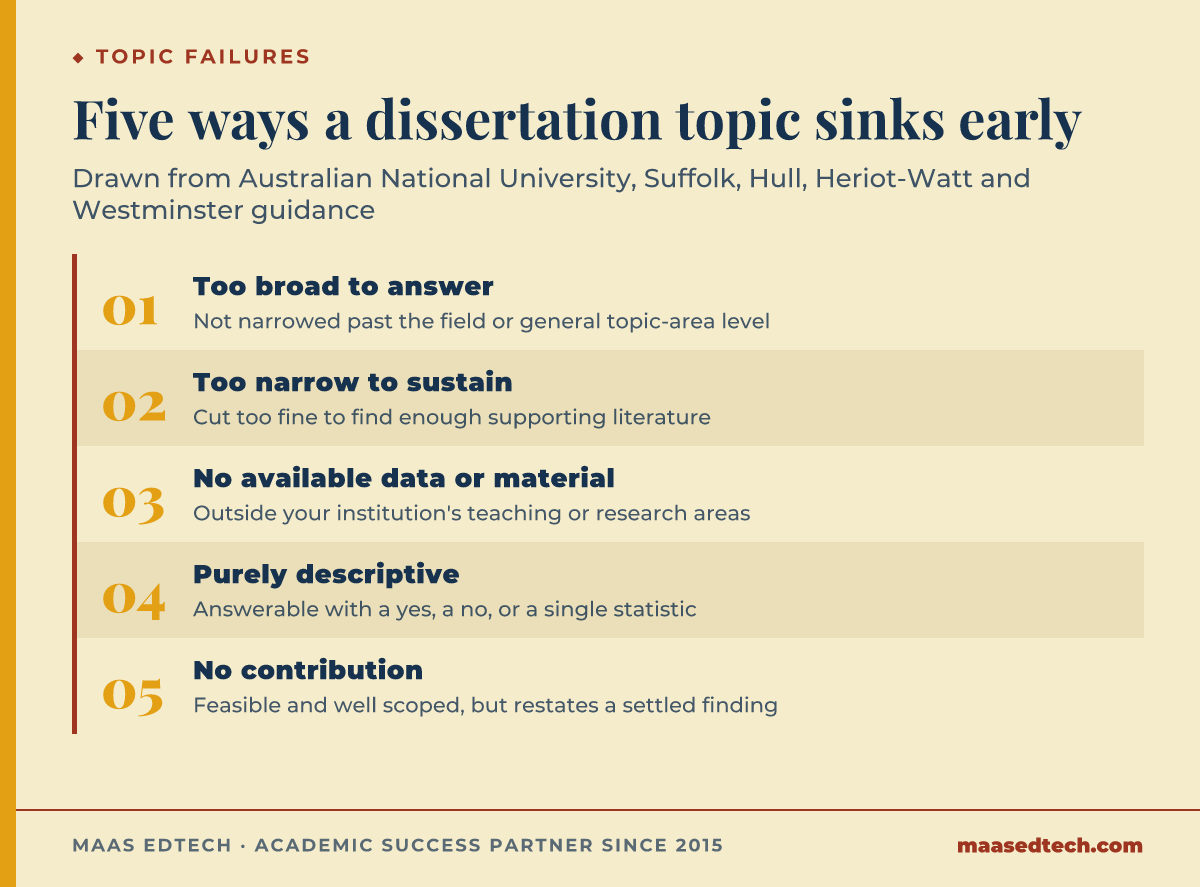
- Too broad to answer. A topic that has not been narrowed past the field or general topic-area level cannot produce a question you can address with the time and resources you have (Australian National University, n.d.-a; University of Suffolk, n.d.).
- Too narrow to sustain. A topic cut too fine leaves you unable to expand the discussion or find enough literature to support the argument (University of Hull, n.d.; University of Suffolk, n.d.).
- No available data or material. Choosing a subject outside your institution's current teaching or research areas, or one requiring data you cannot access in the time available, often surfaces only after you have already committed (Heriot-Watt University, n.d.; University of Westminster, n.d.).
- Purely descriptive, no question to answer. A topic that only asks you to describe something, or that could be answered with a yes, a no, or a single statistic, has not been turned into an analytical problem (Australian National University, n.d.-a).
- No contribution. A topic that is feasible and well scoped but restates a settled finding fails the test of being "worth learning" (Australian National University, n.d.-b).
◆ Section 7 / 7 · After the topic
What comes after the topic is chosen
Direct answer: The topic has to become one or more research questions, with an aim and objectives where they are required, and then a proposal once that question is settled. The University of Hull places the question stage between topic and hypothesis, and Creswell and Creswell (2018) treat the same step as narrowing a problem until it can be answered.
Once your topic holds its shape against these tests, the next task is converting it into one or more research questions and, where required, an aim and objectives, which is a distinct step in the University of Hull's sequence from topic to question to hypothesis (University of Hull, n.d.), and the same move Creswell and Creswell (2018) describe as narrowing a research problem into a specific, answerable question. The guide to writing research questions and objectives covers that conversion in detail, and the guide to writing a dissertation proposal covers the document you submit once the question is settled. If your timeline for getting from topic to submission is still vague, the guide to planning a dissertation timeline sets out how to sequence the stages in between.
WHEN YOU WANT A SECOND OPINION ON WHETHER A TOPIC WILL HOLD
MAAS academic mentoring pairs you with a postgraduate-qualified mentor who reads your shortlist the way a supervisor would, testing each idea against scope, feasibility and available literature, and giving structured feedback before you commit weeks of reading to the wrong angle. The decisions, and the reading and writing that follow, remain your own.
A topic that looks promising in isolation can still fail on scope, data, or contribution once someone with supervision experience presses on it. MAAS academic mentoring pairs you with a postgraduate-qualified mentor who reads your shortlist the way a supervisor would, tests each idea against scope, feasibility, and available literature, and gives structured feedback before you commit weeks of reading to the wrong angle. The decisions, and the reading and writing that follow, remain your own.
Frequently asked questions
How narrow should a dissertation topic be?
Narrow enough to be "addressed adequately with the time and resources available" and analysed rather than merely described, but not so narrow that supporting literature runs out (Australian National University, n.d.-a; University of Hull, n.d.). Creswell and Creswell (2018) frame this as the same scope test any research design applies, regardless of field. Most students reach the right scope by moving from field, to topic area, to a specific topic, checking the literature at each step.
Should I choose a topic based on what interests me or what looks easiest?
Interest, not ease. University of Hull's guidance is explicit that many students choose what looks easiest over what interests them and regret it once they realise no dissertation topic is genuinely easy, while an interesting topic sustains the motivation a lengthy project demands (University of Hull, n.d.).
How do I know if a topic has enough available data or literature?
Run a preliminary scan before committing: read recent journal articles in the area, check whether your library's collections and your institution's current teaching and research areas cover it, and look at the "directions for further research" sections that most journal articles include (University of Suffolk, n.d.; Heriot-Watt University, n.d.).
When should I talk to my supervisor about my topic?
Before it is finalised, and ideally before you have a single fully formed idea. University of Suffolk's guidance is to "talk to experts and peers" and not "wait until you have a fully formed research question before discussing your ideas," since a supervisor can redirect an unworkable topic while it still costs little to change (University of Suffolk, n.d.; University of Westminster, n.d.).
What is the difference between choosing a topic and writing a research question?
Choosing a topic narrows a field down to a specific subject area; the research question is the analytical, answerable problem you carve out of that topic once it is settled (Australian National University, n.d.-a). Ravitch and Riggan (2017) place this hand-off at the point where a conceptual framework starts doing analytical work rather than only descriptive work. The guide to writing research questions and objectives covers that next step.
Can I change my dissertation topic after I have started reading around it?
Yes, and university guidance treats this as normal, not a failure. Topic selection is described as an "ongoing process" where refocusing as you gather more information is expected, though a late change costs your supervisor's input and your timeline, so settling scope earlier keeps you more room (University of Suffolk, n.d.; Australian National University, n.d.-a). Ravitch and Riggan (2017) treat this same revision as a sign the conceptual framework is doing its job, not a sign the original idea was wrong.
Does my topic need to be original, or can it build on existing research?
It needs to make a contribution, which is not the same as needing to be entirely new. The Australian National University frames the test as showing "what we will learn from it and why that is worth learning," which a topic can satisfy by applying an established question to a new population, context, or dataset, not only by inventing an unresearched subject (Australian National University, n.d.-b). Creswell and Creswell (2018) describe this same move as filling a gap in the existing literature, which is a lower bar than inventing an unresearched subject from nothing.
References
- Australian National University. (n.d.-a). Focusing. Retrieved July 4, 2026, from https://www.anu.edu.au/students/academic-skills/research-writing/research-proposals/focusing
- Australian National University. (n.d.-b). Purpose. Retrieved July 4, 2026, from https://www.anu.edu.au/students/academic-skills/research-writing/research-proposals/purpose
- Creswell, J. W., & Creswell, J. D. (2018). Research design: Qualitative, quantitative, and mixed methods approaches (5th ed.). SAGE Publications.
- Heriot-Watt University. (n.d.). Choosing a dissertation topic/research question. Retrieved July 4, 2026, from https://isguides.hw.ac.uk/egis/scoping
- Ravitch, S. M., & Riggan, M. (2017). Reason & rigor: How conceptual frameworks guide research (2nd ed.). SAGE Publications.
- University of Hull. (n.d.). Research questions. Retrieved July 4, 2026, from https://libguides.hull.ac.uk/dissertations/questions
- University of Suffolk. (n.d.). Choosing a topic. Retrieved July 4, 2026, from https://libguides.uos.ac.uk/dissertations
- University of Westminster. (n.d.). Choosing a topic and researching. Retrieved July 4, 2026, from https://libguides.westminster.ac.uk/starting-your-dissertation/choosing-a-topic
A free 20-minute consultation with MAAS Academic Mentoring, to test your shortlist of topics against scope, feasibility and contribution. The decisions, and the reading and writing that follow, remain yours.
Book Free Discovery ▸