
◆ Publishing advisory
How do you write an abstract for a research paper?
Category: research-methods
Last updated: 2026-09-30

The abstract is the part of your paper that most people will read, and in published research it often disagrees with the paper it summarises. When Pitkin, Branagan and Burmeister (1999) checked 44 abstracts in each of six major medical journals, between 18% and 68% contained data that were inconsistent with the article or missing from it. That is the problem this guide is built around.
Direct answer: Write a research paper abstract last, as a complete miniature of the paper: the gap in the literature, what you did to fill it, the main result stated with numbers, and what that result means. Every figure must match the body, and the length and format come from the journal's author guidelines.
Asked on 30 September 2026, Perplexity gave a sound five-part template (background, purpose, methods, results, conclusion) and advised checking the journal's word limit. The answer we received did not mention that published abstracts often misreport their own papers, that abstract conclusions are a common place for spin, or that authors affiliated with institutions in non-English-speaking countries use more promotional words. The sections below cover those three points, which matter most to Vietnamese authors writing in English.
◆ Question 1 / 6 · What it is for
What is an abstract for, and who reads it?
Direct answer: An abstract carries the whole message of the paper for readers who will read nothing else. Mensh and Kording (2017) note that editors want to know whether the paper is significant and reviewers want to know whether the conclusions are justified. The abstract is the first place both judgements start, so it has to answer both.
Mensh and Kording put the stakes plainly: "The abstract is, for most readers, the only part of the paper that will be read" (Mensh & Kording, 2017, Rule 5). Hopewell et al. (2008), writing the CONSORT extension for abstracts, make the same point for clinical trials, observing that readers often base their assessment of a trial solely on the abstract, and that in some regions the abstract is all a health professional can easily access. A reader in that position cannot check your tables. If the abstract overstates the finding, the overstatement is what travels.
An abstract is therefore not a trailer. Andrade (2011) observes that abstracts are sometimes poorly written, often lack important information, and occasionally convey a biased picture. In our view each of those failures costs more in the abstract than anywhere else, because it is the part most readers never check. If your editor needs to decide whether to send the paper out, the most common reasons papers stop at that stage are covered in how to avoid a desk rejection.
◆ Question 2 / 6 · Structure
What structure should a research paper abstract follow?
Direct answer: Follow a context, content, conclusion order. Mensh and Kording (2017) describe it as narrowing from the broad field to the specific gap, stating the approach and the main results, then interpreting those results to answer the question the context raised. Use headings only if the journal asks for a structured abstract.
The five moves of an abstract
Tap a move to see what it states and the typical failure the post lists for it, in the order the post gives them.
Step 1 of 5
Context
States the field, then the specific gap and why it matters. The typical failure is three sentences of textbook background.
Step 2 of 5
Aim
States the question or hypothesis the study tested. The typical failure is "This study examines X" with no question.
Step 3 of 5
Method
States the design, sample, setting and key measures. The typical failure is listing steps in the order you did them.
Step 4 of 5
Results
States the main finding, with the numbers. The typical failure is "Differences were observed".
Step 5 of 5
Conclusion
States what the result answers, and its limit. The typical failure is "Further research is needed" as the ending.
Save this figure
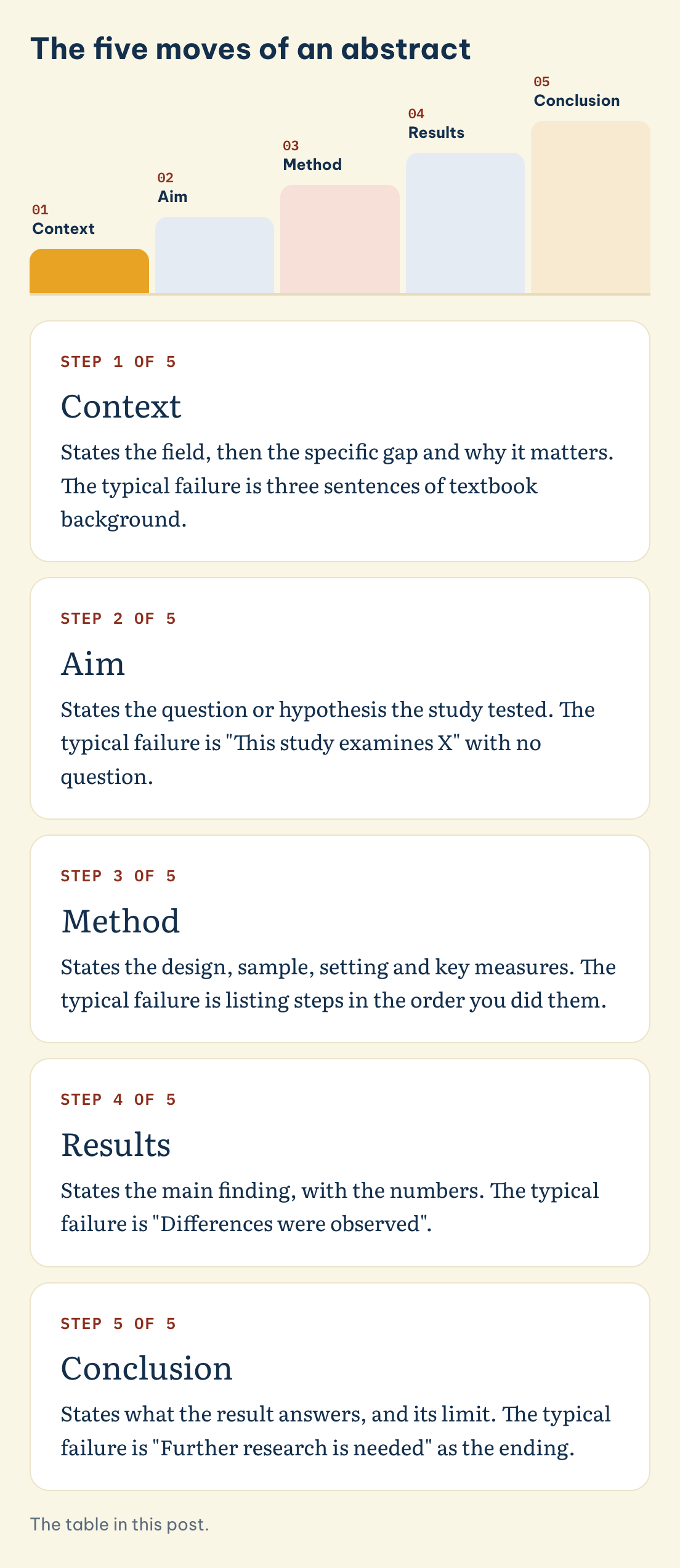
Mensh and Kording (2017, Rule 5) describe the abstract's structure as "highly conserved", and they name the most common abstract mistake as talking about results before the reader is ready to understand them. In practice the order gives you five moves, usually one or two sentences each.
| Move | What it states | Typical failure |
|---|---|---|
| Context | The field, then the specific gap and why it matters | Three sentences of textbook background |
| Aim | The question or hypothesis the study tested | "This study examines X" with no question |
| Method | Design, sample, setting, key measures | Listing steps in the order you did them |
| Results | The main finding, with the numbers | "Differences were observed" |
| Conclusion | What the result answers, and its limit | "Further research is needed" as the ending |
Whether you label these moves depends on the journal. Hopewell et al. (2008) recommend a structured format for abstracts of randomised trials, with items that include the trial design, the number of participants randomised and analysed, the effect on the primary outcome and harms, trial registration and funding. Journals in other fields often ask for one unbroken paragraph instead. The author guidelines of the journal you are submitting to decide the format and the word limit, so read them before drafting rather than after.
◆ Question 3 / 6 · Why they disagree
Why do abstracts so often disagree with the paper?
Direct answer: Mismatches are common even in leading journals. Pitkin, Branagan and Burmeister (1999) found that 18% to 68% of abstracts in six medical journals contained data that differed from the article or did not appear in it. The study did not test causes, but a likely one is an abstract drafted before the numbers were final.
The report opens with the reason the question matters: "The section of a research article most likely to be read is the abstract" (Pitkin et al., 1999, p. 1110). The study examined 44 research articles from each of six general medical journals, including BMJ, JAMA, The Lancet and the New England Journal of Medicine, and checked every datum in each abstract against the body, tables and figures. Across the six journals, the share of deficient abstracts ranged from 18% at the best to 68% at the worst. Pitkin and colleagues (1999) found inconsistency generally more common than omission, and a quarter of the deficient abstracts (25 of 104) had both. Some errors were small: one abstract reported 42 consecutive patients where the body said 44 patients, of whom 42 agreed to take part. Others were not, such as an estimated 15-year survival of 48% in the abstract against 58% in the text.
The practical rule follows directly. Write the abstract after the results, discussion and tables are final, then check it line by line against the body, as a separate task from writing it. Nothing should appear in the abstract that a reader cannot find in the paper, including numbers, comparisons and claims about practice. The abstract summarises a paper you have already written, and how to write a research paper covers the paper itself.
◆ Question 4 / 6 · Results and conclusion
How should the results and conclusion sentences be written?
Direct answer: State the primary result with its size and precision, then draw a conclusion that the primary result supports. Boutron and colleagues (2010) found that among 72 trials with a non-significant primary outcome, 58.3% of abstract conclusions contained spin, and only 12.5% of abstracts reported an effect size with a confidence interval.
Boutron, Dutton, Ravaud and Altman (2010) defined spin as reporting strategies that highlight a benefit despite a non-significant primary outcome, or distract from that outcome. In their sample, spin appeared in the conclusions of 42 of 72 abstracts (58.3%), and only 9 abstracts (12.5%) reported an effect size with a 95% confidence interval. A further 28 of 72 abstracts (38.9%) gave no numerical result for the primary outcome at all, and spin appeared in the abstract results sections of 37.5% of reports. In abstracts, the spin mainly took the form of within-group comparisons and subgroup analyses. Each of these can be defended inside the paper, but in an abstract they replace the answer to the question the study was designed to test.
A results sentence such as "the intervention group improved significantly" tells the reader almost nothing. An illustrative version, "HbA1c fell by 1.2 percentage points more in the intervention group (95% CI 0.9 to 1.5)", tells them the size, the direction and the precision. If the primary outcome was not significant, the abstract says so first, and any secondary finding is labelled as secondary. How to report the numbers themselves is covered in how to report effect sizes and confidence intervals.
◆ Question 5 / 6 · Words and "we"
Should an abstract use words like "novel" or "robust", or the pronoun "we"?
Direct answer: Use evaluative words only when the evidence in the sentence carries them. Vinkers, Tijdink and Otte (2015) found that positive words in PubMed abstracts rose from 2.0% in 1974 to 1980 to 17.5% in 2014, and that authors affiliated with institutions in non-English-speaking countries used significantly more of them. APA Style recommends "we" for co-authors.
The Vinkers study counted 25 positive words across all PubMed titles and abstracts from 1974 to 2014. Vinkers and colleagues (2015) report that positive words appeared at an absolute frequency of 2.0% in 1974 to 1980 and 17.5% in 2014, a relative increase of 880% over four decades, with "robust", "novel", "innovative" and "unprecedented" rising in relative frequency by up to 15,000%, while neutral and random words showed no such rise. The finding on author affiliation is the one Vietnamese researchers should read twice. When English is a second language, words like "novel" can feel like the safe academic register, but an adjective does not show a reviewer what is new, and a clause of evidence does. Replace "a novel approach" with what is new about it, in one concrete clause.
First-person pronouns are a separate question, and the advice to avoid them does not match current style guidance. The American Psychological Association (n.d.) tells co-authors to use "we" to refer to themselves, and warns that referring to yourself in the third person can make it unclear who performed an action. Mensh and Kording (2017, Rule 5) even label the middle of the abstract the "Here we" section. Some journals and disciplines still prefer an impersonal style, so the journal's own guidelines decide, as they do for length.
◆ Question 6 / 6 · Checking it
How do you check an abstract before you submit?
Direct answer: Check it against the paper, not against your memory of the paper. Confirm that every number appears in the body with the same value, that the conclusion answers the question stated in the aim, that the primary outcome is reported before any secondary one, and that length and headings match the journal's guidelines.
A useful test comes from Mensh and Kording (2017, Rule 5): the results should fill the gap "like a key fits its lock". Read only your first two sentences and your last sentence. If the last sentence does not answer the gap named in the first two, the abstract has drifted, often because the paper's argument changed during revision and the abstract did not.
| Check | Question to ask | Source of the rule |
|---|---|---|
| Consistency | Does every number match the body and tables? | Pitkin et al. (1999) |
| Primary outcome | Is it stated with size and precision, before secondary results? | Boutron et al. (2010) |
| Conclusion | Does it follow from the primary result, without spin? | Boutron et al. (2010) |
| Structure | Context, then gap, then approach, results, meaning? | Mensh & Kording (2017) |
| Wording | Is every evaluative word backed by evidence in the sentence? | Vinkers et al. (2015) |
| Format | Word limit, headings, keywords as the journal requires? | Journal author guidelines |
For a thesis rather than a journal article, the expectations differ in length and audience, and how to write a dissertation abstract covers that version.
Frequently asked questions
How long should a research paper abstract be?
There is no universal length. Journals usually set their own limits, which can differ by field and by article type, and some ask for a structured abstract with headings. Read the target journal's author guidelines before drafting, and treat any number you see quoted online as a starting point rather than a rule.
Should I write the abstract first or last?
Write it last. The abstract summarises a finished paper, and numbers often change during revision. Pitkin and colleagues (1999) found that inconsistency between abstract and body was generally more common than omitted data across six leading journals, and an abstract drafted before the final numbers is one plausible route to that mismatch.
Can I include citations or abbreviations in an abstract?
Many journals discourage citations in the abstract, because it has to stand alone. Abbreviations should be defined at first use or avoided, and Mensh and Kording (2017) advise avoiding them where possible so that readers do not have to look elsewhere for their meaning.
Is it acceptable to write "we" in an abstract?
Usually, yes. The American Psychological Association (n.d.) recommends "we" for co-authors describing their own actions, because the third person can make it unclear who did what. A few journals and fields still prefer an impersonal style, so the target journal's guidelines decide.
Can MAAS help me improve my abstract?
Yes. MAAS Publishing Advisory reviews your abstract against the rest of your manuscript, checks that its structure and wording match the journal you are targeting, and explains each change so you can revise it yourself. You remain the author throughout. Book a consultation through our contact page.
Ready to make your abstract match your paper?
An abstract that reports its numbers accurately and draws only the conclusion the data support is easier to write with an adviser who has been through peer review as an author. MAAS Publishing Advisory starts its section review with the abstract, tables and figures, and it runs the international track across 26 one-to-one sessions or the domestic track across 14 sessions. Your adviser holds multiple Q1 or Q2 papers under their own name, and 23% of MAAS experts hold a PhD. MAAS matches you within 48 hours when our network already covers that field. If it does not, MAAS opens a dedicated recruitment round for your case, which usually takes about two weeks. The free 20-minute consultation is the place to start. We coach; you stay the author, every step.
Book a Publishing Advisory consultation with MAAS Academic Mentoring →
Related guides
- How do you write the results section of a research paper?: the numbers your abstract summarises
- How do you write the discussion section of a research paper?: where the meaning in your conclusion sentence comes from
- How do you write the introduction section of a research paper?: the gap your abstract opens with
- What is a desk rejection, and how do you avoid one?: what editors check before peer review
- Publishing Advisory service: full service tiers for Scopus Q1/Q2 support
- Scopus publishing resource hub: guides across the whole submission journey
References
- American Psychological Association. (n.d.). First-person pronouns. APA Style. https://apastyle.apa.org/style-grammar-guidelines/grammar/first-person-pronouns
- Andrade, C. (2011). How to write a good abstract for a scientific paper or conference presentation. Indian Journal of Psychiatry, 53(2), 172–175. https://doi.org/10.4103/0019-5545.82558
- Boutron, I., Dutton, S., Ravaud, P., & Altman, D. G. (2010). Reporting and interpretation of randomized controlled trials with statistically nonsignificant results for primary outcomes. JAMA, 303(20), 2058–2064. https://doi.org/10.1001/jama.2010.651
- Hopewell, S., Clarke, M., Moher, D., Wager, E., Middleton, P., Altman, D. G., Schulz, K. F., & the CONSORT Group. (2008). CONSORT for reporting randomized controlled trials in journal and conference abstracts: Explanation and elaboration. PLoS Medicine, 5(1), Article e20. https://doi.org/10.1371/journal.pmed.0050020
- Mensh, B., & Kording, K. (2017). Ten simple rules for structuring papers. PLOS Computational Biology, 13(9), Article e1005619. https://doi.org/10.1371/journal.pcbi.1005619
- Pitkin, R. M., Branagan, M. A., & Burmeister, L. F. (1999). Accuracy of data in abstracts of published research articles. JAMA, 281(12), 1110–1111. https://doi.org/10.1001/jama.281.12.1110
- Vinkers, C. H., Tijdink, J. K., & Otte, W. M. (2015). Use of positive and negative words in scientific PubMed abstracts between 1974 and 2014: Retrospective analysis. BMJ, 351, Article h6467. https://doi.org/10.1136/bmj.h6467
This article is part of the MAAS Journal series for Vietnamese international postgraduate students and researchers. MAAS Publishing Advisory is an advisory partner; we coach authors through a phase-by-phase delivery model with developmental feedback from PhD-level, Scopus-published mentors. We do not write, submit, or guarantee acceptance of work on an author's behalf.
A free 20-minute consultation with MAAS Publishing Advisory, to talk through your abstract against the rest of your manuscript.
Book Free Discovery ▸