
◆ Admissions
What are the IELTS Writing Task 2 essay types, and how is it marked?
Direct answer: IELTS does not publish five fixed essay types for Writing Task 2. It describes four functions an answer may need to serve, from solving a problem to challenging an argument (IELTS, n.d.-a). You write at least 250 words in about 40 minutes, and examiners mark the script on four criteria.
◆ Question 1 / 10 · What are the IELTS Writing
What are the IELTS Writing Task 2 essay types?
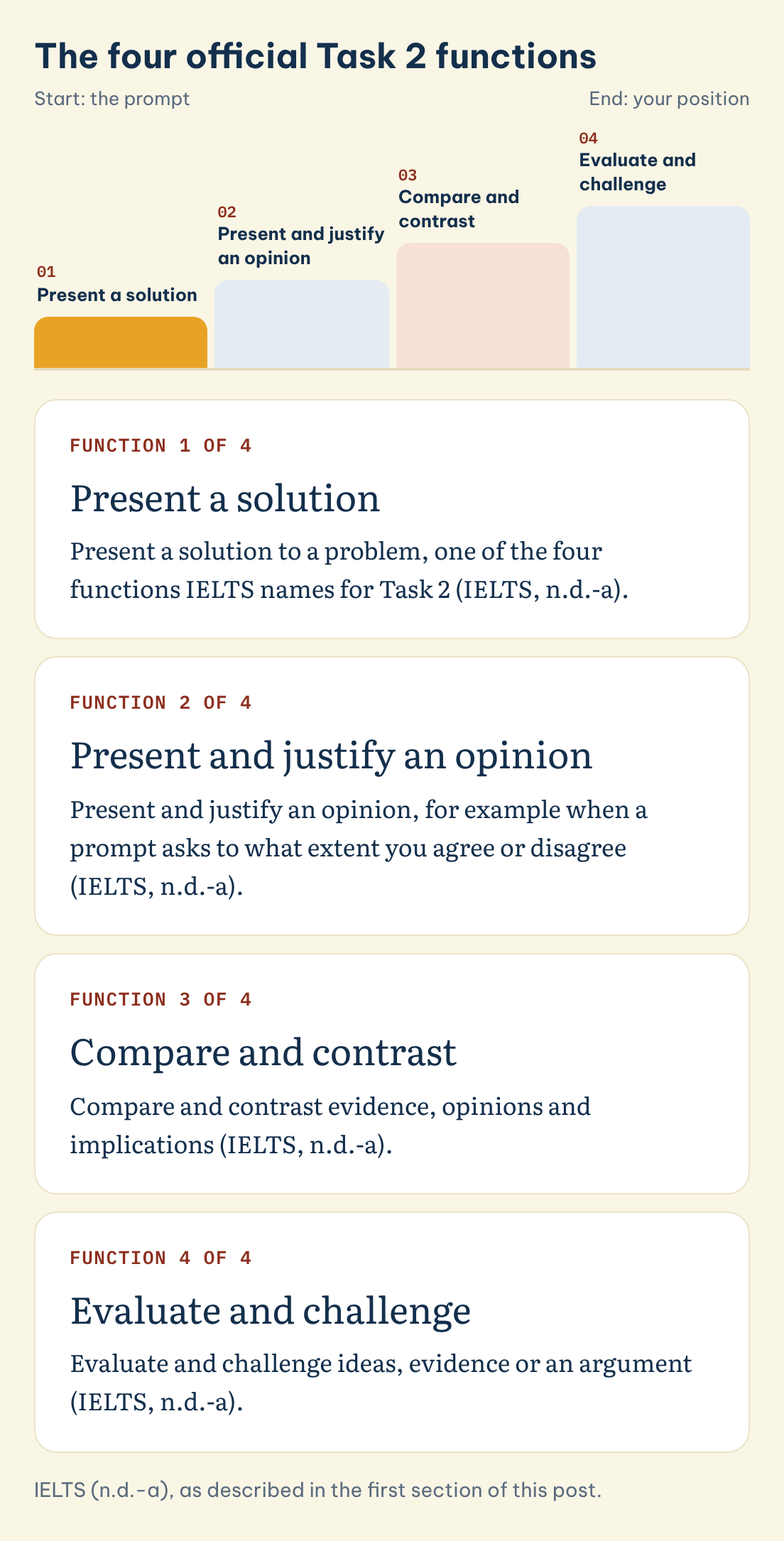
Direct answer: The official answer is four task functions, listed on the IELTS Academic writing page. Depending on the task, you may be assessed on whether you can present a solution to a problem, present and justify an opinion, compare and contrast evidence, opinions and implications, or evaluate and challenge ideas, evidence or an argument (IELTS, n.d.-a).
The four official Task 2 functions
Tap a function to see how IELTS (n.d.-a) words it.
Function 1 of 4
Present a solution
Present a solution to a problem, one of the four functions IELTS names for Task 2 (IELTS, n.d.-a).
Function 2 of 4
Present and justify an opinion
Present and justify an opinion, for example when a prompt asks to what extent you agree or disagree (IELTS, n.d.-a).
Function 3 of 4
Compare and contrast
Compare and contrast evidence, opinions and implications (IELTS, n.d.-a).
Function 4 of 4
Evaluate and challenge
Evaluate and challenge ideas, evidence or an argument (IELTS, n.d.-a).
Save this figure
Search for this topic and you will meet a different list, usually five labels such as opinion, discussion, advantages and disadvantages, problem and solution, and two-part question. Those labels are teaching conventions used by preparation sites, and the pages published on ielts.org that we read for this guide do not use them as official categories. That distinction matters for how you practise. IELTS describes what the task asks you to do with an idea, and the labels describe how a prompt happens to be worded. A prompt can look like a "discussion" question and still ask you to justify your own opinion. IELTS (n.d.-a) also says the task gives you a point of view, argument or problem to discuss, and that examples may come from your own experience. Treat the five labels as a convenient vocabulary for practice, and keep the four official functions in mind when you decide what a given prompt really wants from you.
◆ Question 2 / 10 · Which conventional label
Which conventional label matches which official function?
Direct answer: The mapping below is MAAS's own reading, not an IELTS publication. Each conventional label is matched to the official function it most often calls for, with the wording typical of that kind of prompt. Prompts vary, so read the actual question before you decide which function it needs.
| Conventional label (teacher convention) | Closest official function (IELTS, n.d.-a) | Typical prompt wording |
|---|---|---|
| Opinion, or agree/disagree | Present and justify an opinion | "To what extent do you agree or disagree?" |
| Discussion, or both views | Compare and contrast evidence, opinions and implications | "Discuss both views and give your own opinion" |
| Advantages and disadvantages | Compare and contrast evidence, opinions and implications | "Do the advantages outweigh the disadvantages?" |
| Problem and solution, or causes and solutions | Present a solution to a problem | "What are the causes, and what solutions can you suggest?" |
| Two-part or direct question | Present and justify an opinion, or evaluate and challenge ideas | Two separate questions about one topic |
The table is a map for revision and nothing in it is a rule. The fourth official function, evaluating and challenging ideas, evidence or an argument, has no tidy label in the conventional list, which is one reason the two lists do not line up one to one. A useful habit is to underline the instruction words in the prompt, write down which function they point to, and only then plan your paragraphs. If two labels seem to fit, your plan should answer every part of the question, because the first marking criterion rewards a full response.
◆ Question 3 / 10 · What are the format
What are the format and rules of Task 2?
Direct answer: Expect 40 minutes and 250 words as a minimum, within a Writing test that lasts 60 minutes and has 2 tasks. This essay is worth double the first task. Bullet points and notes lose marks, and copied material is severely penalised (IELTS, n.d.-a).
IELTS (n.d.-a) describes the expected style as academic or semi-formal and neutral, and it says answers that are off-topic can be penalised. Because Task 2 carries twice the weight of Task 1, spending the larger share of your 60 minutes on it is a sensible plan, and the key assessment criteria document confirms that the assessment of Task 2 carries more weight in marking (IELTS, 2023a). A script must also be connected text, so a list of points will not do the job even if every point is good. The same document defines the task in a single sentence: candidates are required to "formulate and develop a position in relation to a given prompt in the form of a question or statement, using a minimum of 250 words" (IELTS, 2023a, p. 2). Notice the verbs, formulate and develop. The test is looking for a position that you build up, with ideas supported by evidence and examples, which may be drawn from your own experience (IELTS, 2023a, p. 2).
◆ Question 4 / 10 · What is the word limit
What is the word limit?
Direct answer: There is a minimum, not a maximum. You must write at least 250 words, and IELTS says a short answer may not give enough evidence of the language features needed for higher bands. Longer answers are not penalised for length, but they leave less time for checking (IELTS, n.d.-a).
That wording changes how to use the number. The 250 figure is a floor under your essay, so a script of 240 words is simply too short. A candidate who aims for 300 words in 40 minutes still has time to plan and check, while a candidate who writes 450 words may run out of minutes before the conclusion is finished. IELTS (n.d.-a) states that you are not penalised for writing more than 250 words, and in the same breath warns that long answers leave less time to review. Practise with a timer for 1 full essay at a time, and note how many minutes you spend planning, writing and checking. The right length for you is the one that lets you answer every part of the prompt, support each main idea and still reread the script before time is called.
◆ Question 5 / 10 · How is Task 2 marked
How is Task 2 marked?
Direct answer: Four criteria apply to your essay: Task Response, Coherence and Cohesion, Lexical Resource, and Grammatical Range and Accuracy (IELTS, 2023a). Examiners use published band descriptors, so the level you reach depends on matching what each descriptor lists, criterion by criterion, and not on a general impression of how good the essay feels (IELTS, 2023b).
Task Response looks at how fully you respond, how adequately your main ideas are extended and supported, and how relevant they are. It also looks at "how clearly the candidate opens the discourse, establishes their position and formulates conclusions" (IELTS, 2023a, p. 3). Coherence is the logical sequencing of ideas, and cohesion is the use of devices such as connectors, conjunctions and pronouns (IELTS, 2023a). The descriptors for Task 2 begin on page 7 of the band descriptors PDF, and at band 9 the Task Response descriptor asks for a clear and fully developed position that directly answers the question, with ideas that are relevant, fully extended and well supported (IELTS, 2023b). The band descriptors, updated in May 2023, are publicly available on ielts.org (IELTS, 2023b). Reading them once, with a practice essay beside you, is more informative than any summary written by a third party.
◆ Question 6 / 10 · Do you have to use
Do you have to use a four-paragraph structure?
Direct answer: No. The IELTS pages cited in this guide do not prescribe a paragraph count. A four-paragraph shape, with an introduction, two body paragraphs and a conclusion, is one common option taught by preparation guides, and it works because it makes your position and conclusion easy to see.
The criteria do not mention paragraphs by number, but they do ask how clearly you open the discourse, establish a position and formulate conclusions (IELTS, 2023a, p. 3). A four-paragraph plan answers that in a compact way: the first paragraph states the position, the next two develop supported ideas, and the last paragraph concludes. Some prompts may suit three body paragraphs, for example when the question has two parts and you want to give each part its own paragraph before a short opinion. Whatever you choose, the paragraphs should read as one connected text. If you are still deciding how to take an idea from a position to a developed paragraph, our guide on how to do a university assignment walks through the same planning habit in a different setting.
◆ Question 7 / 10 · What does a real Task 2
What does a real Task 2 prompt look like?
Direct answer: IELTS publishes sample papers. One example prompt reads: "Scientific research should be carried out and controlled by governments, rather than by private companies." It then asks "To what extent do you agree or disagree?" and tells you to give reasons and include relevant examples (IELTS, n.d.-b).
The full instruction in that sample paper continues: "Give reasons for your answer and include any relevant examples from your own knowledge or experience. Write at least 250 words" (IELTS, n.d.-b). In the conventional vocabulary this is an agree-or-disagree question, and in the official vocabulary it asks you to present and justify an opinion. Two features are worth noticing. The prompt gives you a statement to react to, and it explicitly allows examples from your own knowledge or experience. A strong response would take a clear position on how far you agree, develop each reason, and support it with an example. That is why sample answers found online are most useful as models of development, not as scripts to memorise. If you want to see how a score band relates to the skills around Writing, why a PhD offer can hinge on your lowest IELTS band explains how the four skills combine into one overall figure.
◆ Question 8 / 10 · Can an automated checker
Can an automated checker tell you your IELTS band?
Direct answer: Treat the result as a rough prompt for revision, not a band. An automated checker is not an IELTS examiner, and we have not verified how any particular checker scores. The only official yardsticks are the published band descriptors and key assessment criteria (IELTS, 2023a, 2023b).
"Checker" appears among related Google searches for this topic, so the caution is worth spelling out. The band descriptors require that a script fully fit the positive features of a level (IELTS, 2023b), and that judgement covers task response and the development of ideas, which a tool may not read as an examiner would. A checker can still help with mechanical matters such as repeated words or missing full stops. Use it for what it can see, and use the four published criteria for everything else. A better check is to take a script you wrote, put the descriptor for one criterion beside it, and highlight the sentences that meet the positive features. If you can find none for a band 7 descriptor, that tells you where to practise next, and it tells you more than a number from a tool with an unknown method.
◆ Question 9 / 10 · Is Task 2 a good model
Is Task 2 a good model for university assignments?
Direct answer: Only partly. Moore and Morton (2005) compared Task 2 rubrics with 155 assignment tasks from two Australian universities and found that IELTS writing resembles the university essay in some ways but differs in important ones. They concluded it should not be thought of as an appropriate model for university writing.
Moore and Morton (2005) found that the writing the test elicits may have more in common with certain public non-academic genres. Their corpus of IELTS prompts was 20 Task 2 rubrics, and their university corpus was 155 assignment tasks, so the study is a comparison of task types and not a prediction about any one student. The practical reading is balanced. Task 2 practice builds useful habits, such as taking a position, supporting ideas and linking paragraphs, and those habits are a start. A university assignment adds expectations that the test does not examine in the same way, such as working with sources and following a marking guide written by your department. The study is also from 2005, so check your own course handbook for what your department expects today.
◆ Question 10 / 10 · How can MAAS help with IELTS
How can MAAS help with IELTS Writing?
Direct answer: MAAS offers 1-on-1 tutoring in which a tutor works with you on the skills behind your essays. You write every essay yourself. The tutor explains, asks questions and gives feedback on your own drafts. The first conversation is free and starts from the prompts that worry you.
If you are preparing for Task 2 alongside a degree, 1-on-1 university subject tutoring from MAAS is built around sessions of this kind. A tutor can read a practice essay with you, show how its structure meets the four criteria, and suggest where your examples could do more work. The tutor does not write your essay, and the writing, the decisions and the exam day stay with you. You could bring two or three past prompts to a first session and ask which official function each one points to. That small exercise tends to expose where planning goes wrong, and it carries over to the longer assignments your programme will set.
Frequently asked questions
How many essay types are there in IELTS Writing Task 2?
IELTS lists four task functions: presenting a solution to a problem, presenting and justifying an opinion, comparing and contrasting evidence, opinions and implications, and evaluating and challenging ideas (IELTS, n.d.-a). The five-label lists on preparation sites are teaching conventions.
What is the IELTS Writing Task 2 word limit?
At least 250 words, written in about 40 minutes. IELTS (n.d.-a) says you are not penalised for writing more, but long answers leave less time for checking.
How much is Task 2 worth compared with Task 1?
The first task counts for half as much, according to IELTS (n.d.-a), and the key assessment criteria also say Task 2 carries more weight in marking (IELTS, 2023a).
Can I use bullet points in Task 2?
No. IELTS (n.d.-a) says notes or bullet points are penalised, and the criteria document expects connected text (IELTS, 2023a).
Is the four-paragraph structure compulsory?
No. The IELTS pages cited here do not set a paragraph count. The criteria ask for a clear position and conclusions, and four paragraphs is one common way to show them (IELTS, 2023a).
Does Task 2 teach me how to write a university essay?
It is a start but not a full model. Moore and Morton (2005) compared Task 2 rubrics with university assignment tasks and found important differences.
References
IELTS. (n.d.-a). IELTS Academic: Writing test format. https://ielts.org/take-a-test/test-types/ielts-academic-test/ielts-academic-format-writing
IELTS. (n.d.-b). IELTS Academic Writing: Modified large print question paper [Sample paper]. Cambridge University Press & Assessment. https://ielts.org/cdn/ielts-access-arrangements-sample-tests/ielts-modified-large-print/ielts-academic-writing-access-arrangement-modified-large-print-question-paper.pdf
IELTS. (2023a). IELTS writing key assessment criteria [PDF]. https://ielts.org/cdn/ielts-downloadable-assets/ielts-guidance-and-support/ielts-guides/ielts-writing-key-assessment-criteria.pdf
IELTS. (2023b). IELTS Writing band descriptors (updated May 2023) [PDF]. https://ielts.org/cdn/ielts-downloadable-assets/ielts-guidance-and-support/ielts-guides/ielts-writing-band-descriptors.pdf
Moore, T., & Morton, J. (2005). Dimensions of difference: A comparison of university writing and IELTS writing. Journal of English for Academic Purposes, 4(1), 43-66. https://doi.org/10.1016/j.jeap.2004.02.001
Tools & resources
- ieltsliz.com (teacher site listing common Task 2 essay types): https://ieltsliz.com
- British Council, Take IELTS: https://takeielts.britishcouncil.org
- IDP IELTS: https://ielts.idp.com
Not sure how this guide applies to your own case? Talk it through with MAAS in a free 20-minute consultation.
Book a free consultation ▸