
◆ PhD application
What does a reader notice in your PhD proposal first?
Most applicants assume a PhD research proposal gets judged first on whether the idea itself is strong enough. That is not how an experienced reader actually works through the document. In the opening 15 minutes, before any judgment about originality begins, the reader is checking whether the proposal agrees with itself, because most submitted files are not one clean document. They are several drafts stacked on top of each other, with the seams still showing.
This guide walks through what that reader checks first, why three of the four things they find are leftovers rather than thinking errors, and how to clear them yourself before anyone else sees them. If you are still deciding what goes in each section, the PhD research proposal guide covers the structure; this page is about the pass you make after the structure exists.

◆ Question 1 / 7 · Consistency first
Why does a proposal get read for consistency before it gets read for quality?
Direct answer: Because consistency is cheap to check and it predicts everything else. A reader who finds the conclusion describing a different model from the one in the hypotheses now has a reason to doubt every claim below it, and that reason took under 2 minutes to acquire.
Judging whether a research question is genuinely original takes far longer and requires field expertise, so it happens second.
This sequence, checking consistency before judging quality, is not a quirk of individual readers, and the structure behind it is visible wherever a proposal gets formally assessed. Published evaluation rubrics break a proposal into separately scored criteria rather than treating it as a single impression: problem definition, aims, background, significance, methods, and the quality of the written argument each carry their own line (Augusta University, n.d.). A similar logic appears in Vitae's Researcher Development Framework, which UK institutions use to describe expected researcher competencies rather than to score a single document, but the underlying structure is the same: separate, checkable criteria rather than one overall impression. None of those rubrics contains a row called coherence, which is precisely the point. Formatting inconsistencies compound the same problem: in-text citations and reference lists that drift from the American Psychological Association's Publication Manual (American Psychological Association, 2020), commonly cited as APA 7th edition, read to a panel as the same carelessness as a mismatched model. A document that contradicts itself does not lose marks on one criterion. It weakens the reader's confidence in all of them at once, because the panel can no longer tell which version of the project it is being asked to back.
Creswell and Creswell (2018) treat the research proposal as a distinct genre with its own internal logic, separate from a thesis chapter or a journal article, which is part of why a panel reads it as one connected argument rather than as answers to 4-5 separate questions. The UK Council for Graduate Education publishes guidance in the same spirit, and where two independent bodies converge on the same checklist, a gap between sections is read as a structural problem rather than a stylistic one.
That last sentence is a MAAS observation from advisory casework rather than something a rubric states, so treat it as a working rule rather than a measured finding.
There is a second reason, and it is the one applicants rarely consider. A proposal is not only a description of a project. It is also a specimen of how you work. Guidance for research-degree applicants is explicit that the proposal shows whether you can present information accurately, coherently and concisely, stating plainly that "your research proposal is your chance to show you can present information accurately, coherently and concisely" (University of Leeds, n.d.). Someone deciding whether to supervise you for 3 to 4 years is reading a sample of the writing they will be receiving for those years.
◆ Question 2 / 7 · The four findings
What are the four things found most often, and which one is actually serious?
Direct answer: A mismatch between the model in the conclusion and the model in the hypotheses, an empty timeline heading, in-text citations missing from the reference list, and a literature base with no leading journals in it. Only the last one cannot be fixed by the author alone, and only the first one signals a genuine problem with the thinking.
| What the reader finds | What it looks like on the page | What it signals |
|---|---|---|
| Model mismatch | The contribution section still names a mediating variable and two moderators that no hypothesis mentions | Serious. The author has not settled on their own model |
| Empty timeline | A heading reading "Timeline" or "Work plan" with nothing under it | Feasibility unassessed, and the reader must assume the worst |
| Citation drift | A name cited in the text is absent from the list, or the year differs between the two | Careless handling of sources, which reads as careless handling of data |
| Thin literature base | Recent papers from lower-tier outlets, no foundational work in the field | The author does not yet know the field's centre of gravity |
The first one is the one to take seriously, and it is worth understanding why it happens, because it almost never happens through carelessness. It is a fossil. A proposal goes through several rounds in which the model changes, and revision moves front to back: you fix the framing, you fix the hypotheses, you run out of energy somewhere around the methodology, and the contribution section at the end keeps describing the model you abandoned three weeks ago. The old variables sit there, in your own writing, contradicting your current design.
A reader who spots this does not conclude that you were rushed. They conclude that you cannot state your own model, which is a far more damaging inference, and it is a false one. That is what makes this mistake worth hunting: the penalty is out of all proportion to the cause.
◆ Question 3 / 7 · Mistakes at the end
Why do the cheap mistakes cluster at the end of the document?
Direct answer: Because the end of the document is written last, revised least, and read first by nobody except the panel. Timeline, contribution and reference list, three of the criteria Augusta University's rubric scores separately, are the sections that get written when the deadline is closest and attention is thinnest, and they are also the three where errors are most visible to a trained reader.
The practical consequence is a proofreading order that runs against instinct. Most people reread from the top, which means the introduction gets six passes and the reference list gets one. Reverse it. Read the reference list first, then the timeline, then the contribution paragraph, and only then go back to the beginning. You will be giving your most alert attention to the sections that have had the least of it.
The timeline deserves a note of its own, because applicants routinely underestimate what it is for. It is not an administrative formality. Institutional guidance asks for a realistic timescale precisely to demonstrate that the project is achievable, and expects it to name the milestones and what will be achieved in each year (University of Leeds, n.d.). The Quality Assurance Agency for Higher Education (2024) frames feasibility as one of the qualities a doctoral award is meant to certify, alongside originality and rigour, and a timeline is the one section of a proposal that speaks to feasibility directly rather than by implication. A blank timeline heading is therefore not a missing detail. It is a missing answer to one of the questions the panel was told to score, and the panel cannot score generously on something you did not write.
◆ Question 4 / 7 · Checking citations
How do you check citations without rereading the entire proposal?
Direct answer: Check in both directions, mechanically, and treat it as a matching exercise rather than a reading exercise. Every author-year in the body must appear in the list, and every entry in the list must appear somewhere in the body. Most people only run the first direction, which is why orphan entries survive.
The two-directional check matters because the two failures have different causes and different smells. An in-text citation with no entry usually means a source was added late and never filed. A list entry with no in-text citation usually means the source was cut from an earlier draft while its reference stayed behind, which is the same fossil problem as the model mismatch, in a different section.
Year mismatches are the subtlest of the three. A source cited as 2019 in the text and listed as 2021 in the bibliography tells the reader you have not opened that paper recently, and possibly that you took the citation from somewhere else rather than from the paper itself. It is a small thing that invites a large doubt, and it takes about 4 minutes to eliminate. A quick way to catch a stale reference is to run the author's name through Google Scholar or the Web of Science Core Collection and check whether a newer, more cited version of the same argument exists; 5 minutes there often catches what a close reading misses. Citation style matters here too: drift from the American Psychological Association's own guidance (American Psychological Association, 2020) is exactly the kind of small inconsistency a two-directional check is built to catch. The same search works for a supervisor's own recent output, checking Google Scholar or the Web of Science Core Collection for anything they published in the last 1-2 years, since citing a superseded version of their own argument is a common and avoidable error.
◆ Question 5 / 7 · What you cannot fix
What can you not fix on your own, and what do you do about it?
Direct answer: The literature base. If your framing draws only on recent papers from lower-tier journals, you cannot repair that by rereading your own draft, because the problem is what you have not read. This is the one item on the list that needs somebody who already knows the field's canon.
Checking where a source sits is partly mechanical: a paper indexed in the Web of Science Core Collection or covered by a body such as the Council of Graduate Schools carries different weight in a reference list than one that surfaces only in a general web search, and a trained reader notices the difference within the first page.
Web of Science Core Collection and Scopus index peer-reviewed journals selectively, while Google Scholar indexes far more broadly, including working papers and theses that never went through peer review. Cross-checking the same 3-4 author names across at least two of these systems, rather than relying on a single one, is a habit worth roughly 5 minutes and it flags citations that were copied from a single source rather than read directly.
Institutional guidance asks that your references be focused, relevant and current (University of Leeds, n.d.), and applicants tend to hear only the last of those three words. Currency without foundation produces a recognisable failure: a theory section that cites nothing older than four years, which tells a specialist reader that the author found their sources through a search interface rather than by tracing a debate backwards to the papers that started it. Doctoral qualifications are defined by the creation and interpretation of new knowledge, through original research of a quality to satisfy peer review and extend the forefront of the discipline (Quality Assurance Agency for Higher Education, 2024), and the forefront is only locatable if you know where the field has already been.
The workable move here is not to read more, which you do not have time for. It is to ask one person who knows the field which three or four works your framing cannot credibly omit, then read those properly and let them restructure your argument. This is the part of proposal work where a mentor changes the outcome most, and it is why MAAS proposal sessions begin with a mentor arguing against your framing point by point rather than correcting your prose. You restructure it; the mentor supplies the pressure and the map of the field.
◆ Question 6 / 7 · The fifteen-minute check
What does a fifteen-minute self-check look like in practice?
Direct answer: Four passes, in reverse document order, none of them requiring you to reread your argument. The order mirrors the disciplined revision process Creswell and Creswell (2018) recommend before any research proposal is submitted, checking the parts most likely to have drifted before checking the argument itself.
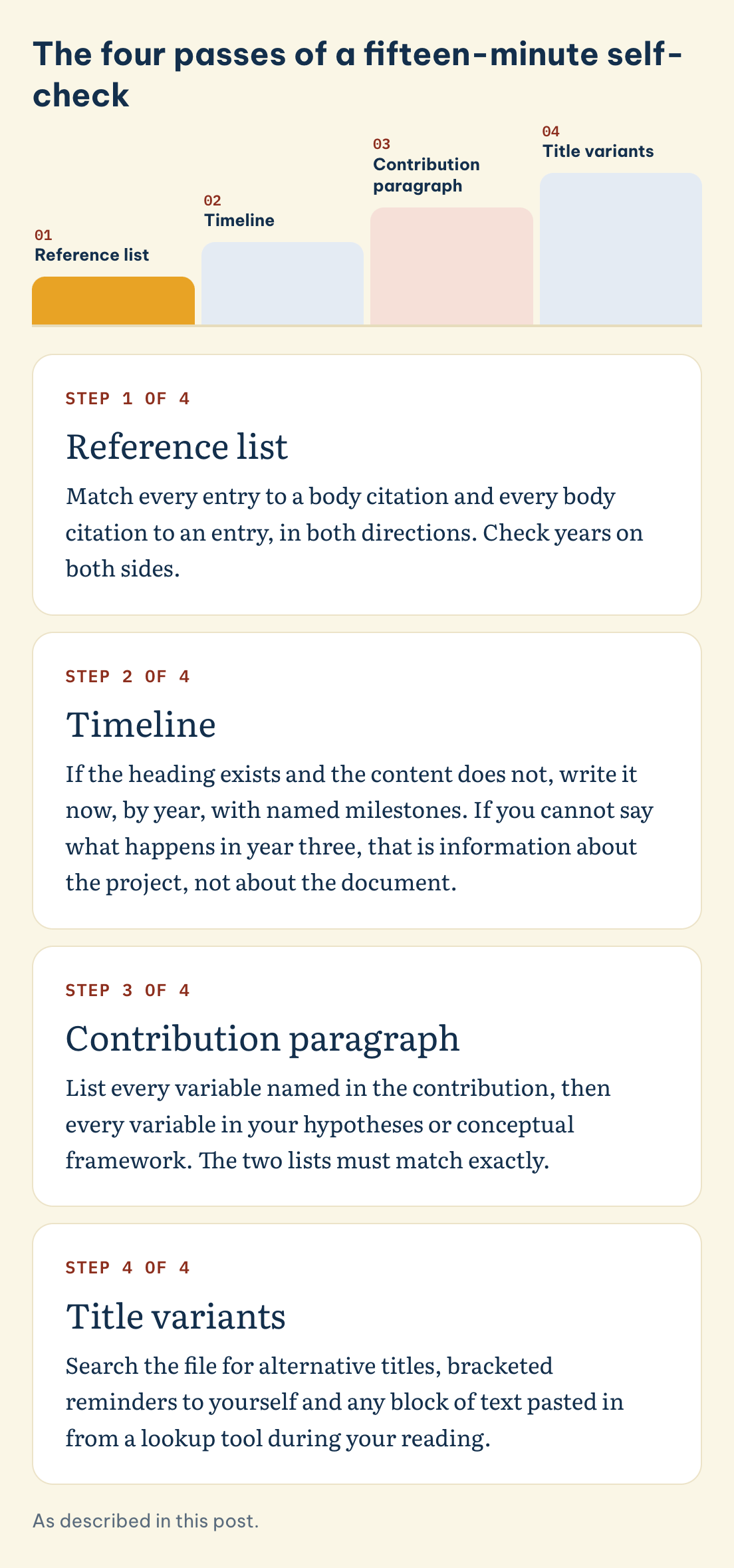
The four passes of a fifteen-minute self-check
Tap a pass to read it as the post puts it, in the order the post gives them.
Step 1 of 4
Reference list
Match every entry to a body citation and every body citation to an entry, in both directions. Check years on both sides.
Step 2 of 4
Timeline
If the heading exists and the content does not, write it now, by year, with named milestones. If you cannot say what happens in year three, that is information about the project, not about the document.
Step 3 of 4
Contribution paragraph
List every variable named in the contribution, then every variable in your hypotheses or conceptual framework. The two lists must match exactly.
Step 4 of 4
Title variants
Search the file for alternative titles, bracketed reminders to yourself and any block of text pasted in from a lookup tool during your reading.
Save this figure
- Reference list, both directions. Match every entry to a body citation and every body citation to an entry. Check years on both sides. A related cleanup step is separating research notes from the submission draft, which is where most of these faults enter the file.
- Timeline. If the heading exists and the content does not, write it now, by year, with named milestones. If you cannot say what happens in year three, that is information about the project, not about the document.
- Contribution paragraph against the hypotheses. List every variable named in the contribution. List every variable in your hypotheses or conceptual framework, the throughline Ravitch and Riggan (2017) describe as needing to stay identical from the first page to the last. The two lists must match exactly. Any name appearing in one and not the other is a fossil of an older draft.
- Title variants and stray notes. Search the file for alternative titles, bracketed reminders to yourself and any block of text pasted in from a lookup tool during your reading. Those belong in your private notes, not in a document you submit.
Run in order, the four passes rarely take more than 15 minutes combined, and three of the four take minutes and need no expertise. That is exactly why leaving them is so expensive: they are the errors a reader is most confident about, because there is no interpretation involved in spotting them.
◆ Question 7 / 7 · The usual numbers
What do the numbers around a proposal usually look like?
Direct answer: Enough to sanity-check your own draft against, not enough to copy blindly, since every department sets its own limits.
Word counts vary by institution, but most UK doctoral proposals run 1,500 to 3,000 words excluding the reference list, and a timeline is expected to name what happens in each of the 3 to 4 years of a typical PhD rather than only year one. Citation style usually follows either APA 7th or a Harvard variant the department sets, and a reference list at this stage typically holds 20 to 40 sources, weighted toward work published in the last 10 years but anchored by a handful of foundational texts the field still cites decades on. A gap of more than 5 years since the newest source in your literature review is one of the fastest ways to signal that the reading stopped early. Several UK bodies publish overlapping guidance on what a strong proposal looks like, including the Quality Assurance Agency for Higher Education and the UK Council for Graduate Education, and when independent sources converge on the same checklist, treating it as optional is a bad bet.
Frequently asked questions
Should I fix these before or after I contact a professor?
Before, if the file is going to be attached to the email. The threshold for making contact is lower than applicants think, and the PhD application guide explains where that threshold sits, but whatever you attach should be internally consistent, with citations following APA 7th (or the department's stated alternative) and every source checked once more through Google Scholar. A developing draft is fine. A draft that contradicts itself is not.
My supervisor said the proposal was fine. Do these still matter?
A supervisor reading for intellectual merit and a panel reading against a rubric such as the one Augusta University publishes, or the framework Vitae maintains for UK doctoral researchers, are doing different jobs. Feedback that the idea is sound is not feedback that the document is clean, and the two are usually given by different people at different moments.
Is a mismatch between conclusion and hypotheses really that damaging?
It is the most damaging of the four, because it is the only one a reader can interpret as a problem with your conceptual framework (Ravitch & Riggan, 2017) rather than your admin, the same weighting reflected in rubrics such as Augusta University's. The good news is that it is also fully fixable by you in about 2 to 3 hours, once you know to look for it.
How long should the timeline actually be?
Long enough to name the milestones for each of the 3 to 4 years of a typical PhD and say what each year produces. A short paragraph plus a chart is normal in a proposal of around 2,000 words. The panel is checking that the plan is achievable, not admiring the formatting.
How common are these four mistakes in practice?
In MAAS advisory casework, the model mismatch and the empty timeline together account for roughly 60% of first-pass feedback, though the sample is small and this is a working impression rather than a formal audit, the same caveat that applies to the coherence effect described earlier (University of Leeds, n.d.; Augusta University, n.d.).
What does MAAS draft, and what do I do?
Your expert drafts the proposal from your own account of your research, argues against it point by point, and checks citations against APA 7th and against the American Psychological Association's own manual (American Psychological Association, 2020), and the same applies to the statement of purpose and the approach letters. You review, edit and approve every document, you submit the application yourself, and you are the candidate in the interview. That boundary is described in full on the PhD Application Strategy and Execution service page.
How quickly can I be matched with a mentor in my field?
Within 48 hours when our network already covers that field. If it does not, MAAS opens a dedicated recruitment round for your case, which usually takes about 2 weeks.
How do I check that my literature review is not already out of date?
Search the same author names and the same core terms again through Google Scholar and the Web of Science Core Collection a week or two before submission, not only at the start of your reading. A search of the British Library's EThOS database of UK doctoral theses is also worth 10 minutes, since it shows whether a closely related project has already been completed in the last 3 to 5 years. For non-UK applicants, the equivalent check runs through ProQuest Dissertations and Theses Global, and the same 3 to 5 year window applies: if a closely related study surfaces there, your framing needs to explain how your project differs rather than ignore the overlap.
Related MAAS guides
- How do you write a PhD research proposal? for the structure of each section
- Which stage is your PhD proposal template written for? for telling an admission outline apart from a detailed proposal before you fill a downloaded form
- PhD application guide for admissions systems, contact order and the shortlist
- PhD Application Strategy and Execution for what an engagement covers, usually starting within 48 hours once your field is confirmed
References
American Psychological Association. (2020). Publication manual of the American Psychological Association (7th ed.). https://doi.org/10.1037/0000165-000
Creswell, J. W., & Creswell, J. D. (2018). Research design: Qualitative, quantitative, and mixed methods approaches (5th ed.). SAGE Publications.
Ravitch, S. M., & Riggan, M. (2017). Reason & rigor: How conceptual frameworks guide research (2nd ed.). SAGE Publications.
Augusta University. (n.d.). Evaluation rubric: Research proposal. Retrieved August 17, 2026, from https://www.augusta.edu/gradschool/documents/2018-research-proposal-rubric.pdf
Quality Assurance Agency for Higher Education. (2024). The frameworks for higher education qualifications of UK degree-awarding bodies (2nd ed.). https://www.qaa.ac.uk/docs/qaa/quality-code/the-frameworks-for-higher-education-qualifications-of-uk-degree-awarding-bodies-2024.pdf
University of Leeds. (n.d.). Research proposals. Retrieved August 17, 2026, from https://www.leeds.ac.uk/research-applying/doc/research-proposals
A free 20-minute consultation with a MAAS adviser, to talk through your proposal and the four-pass self-check before anyone else reads it.
Book Free Discovery ▸