

Same study 01
32
proposals submitted to a school research committee at a South African university in 1 academic year.
◆ PhD Admissions
Last updated: 2026-08-28
Category: admissions
Direct answer: Sort every paragraph by who it was written for. Notes are written for you and may be shorthand, unsourced or provisional, while the submission is written for a reader who does not yet trust you. The two look identical on screen, so mark the note lines while drafting rather than hunting them at the end.
Last checked: 28 August 2026.
A proposal file that arrives for review is often not one document. In one MAAS case the attachment held 4 layers at once: loose notes on the topic, the actual proposal, 3 alternative titles for the same project, and a long block pasted from a reference tool with its licence line still attached. Nothing marked where one layer stopped and the next began, and the applicant had read the file many times without noticing, which is the ordinary condition of a draft rather than a lapse of care. MAAS reviews proposals inside its PhD application service; for the wider sequence of proposal, shortlist and outreach, start at the PhD application resource hub.
A related division runs between documents rather than inside one. Where the application also asks for a statement, the two files carry different arguments, and genre research on 35 successful statements found that the research step filled 8 of 9 Electrical Engineering files but 0 of 14 Business Administration ones (Samraj & Monk, 2008). Our guide to the statement of purpose and the motivation letter sets out which claims belong in which.
Before drafting, it helps to read what your target department has actually accepted, and our guide to where to read Vietnamese doctoral theses covers where those are published and why the obvious search misses them.
◆ Section 1 / 8 · Why is a proposal draft
Direct answer: Because 2 kinds of writing are produced in the same file. Notes are private working text, allowed to be shorthand, unattributed and undecided. The submission is public argument, where every sentence is read as a claim you are prepared to defend. Both are typed in the same font.
A note may say "check this later", carry an unverified number, or hold a passage copied in so you could think against it, and each is a legitimate working move. The submission has no such permission, because a panel reads every sentence as something you are asserting, so when both live in one file the reader applies the strict standard to all of it. That is a meaning-level distinction rather than a surface one, and Mazgutova and McCray (2023) note that less-skilled writers concentrate their revising on surface features such as spelling and punctuation while more-skilled writers also revise organisation and meaning.
The layering happens because a proposal is written across weeks in one window. The MAAS checklist weights one symptom most heavily, where the model in the conclusion no longer matches the model in the hypotheses because an earlier version was never cleared out. All 4 recurring faults MAAS records were found in that case inside 15 minutes of reading, and 3 of the 4 are cleanup faults rather than thinking faults, and a cleanup fault is cheap to fix and expensive to leave, since a panel reading a mismatch cannot tell whether you changed your mind or never held a settled position.
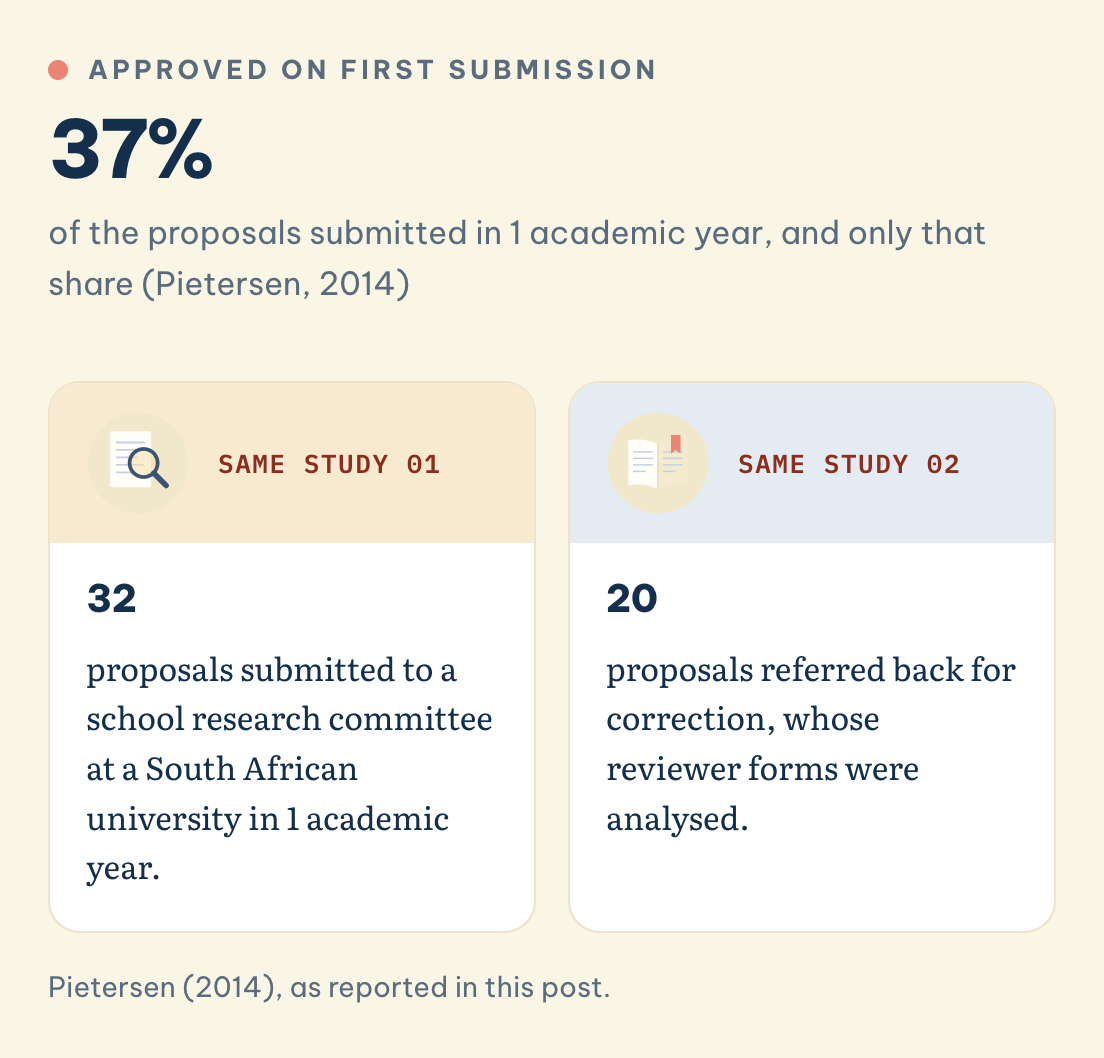
There is committee evidence that these faults decide outcomes. Writing in the Mediterranean Journal of Social Sciences, Pietersen (2014) analysed reviewer forms for 20 research proposals referred back for correction by a school research committee at a South African university, drawn from 32 submitted in 1 academic year, of which only 37% were approved on first submission. The 7 themes she extracted include lack of logical continuity, superficiality and technicalities, and 2 of the reviewer comments quoted under those themes describe exactly the layered draft: "Information in different sections are repetitive" and "Sources not listed or listed sources not used in text" (Pietersen, 2014).
◆ Section 2 / 8 · What should you remove
Direct answer: Remove text that does not help establish the problem, the gap, the question, the method, the contribution or your capacity to do it. That means generic field background, motivation restated in every section, citation lists that never touch your question, and any passage still carrying another document's formatting.
Six categories cover most of what comes out: textbook background the panel knows, motivation repeated after the introduction, citations that name authors without connecting them to your question, author-by-author summary not yet turned into synthesis, claims you cannot defend such as novel or the first, and any block that arrived from elsewhere and still looks like it.
Ask each paragraph one question rather than applying a rule about length: does it establish the problem, the gap, the research question, the method, the contribution, or your capacity to carry it out? A paragraph that does none of those is a note, and one that does any weakly is usually 2 sentences of substance wrapped in 6. Cutting to a word count instead is the surface-level move Mazgutova and McCray (2023) associate with less-skilled revising, since it can be done without reading for meaning at all.
Two layers are worth a separate pass because a search can find them. A panel reading 3 phrasings of the project reads 3 different projects, so keep one title and move the rest to your notes. And any block pasted from a reference tool arrives with its own formatting, its own citation style and sometimes a licence line, which makes it findable; it is a personal research note and belongs in your notes file.
◆ Section 3 / 8 · Which faults do review
Direct answer: Committee forms record structural and housekeeping faults far more often than bad ideas. Reviewing 20 referred proposals, Pietersen (2014) grouped the comments into 7 themes: logical continuity, superficiality, justification of choices, subjectivity, confusion about proposal sections, foundational methodological knowledge, and technicalities.
approved on first submission
37%
of the proposals submitted in 1 academic year, and only that share (Pietersen, 2014)
proposals submitted to a school research committee at a South African university in 1 academic year.
proposals referred back for correction, whose reviewer forms were analysed.
Three of those 7 themes describe a file that was never sorted. Under logical continuity, reviewers wrote that nothing in the background led to the problem statement, that the aim did not flow from the problem statement, and that information in different sections was repetitive (Pietersen, 2014). Under confusion about sections, the recorded complaint was that "The Introduction reads like a literature review" (Pietersen, 2014). Under technicalities, reviewers flagged poor editing, wordiness and unscientific language.
A mixed file leaves exactly those marks. A note pasted under the wrong heading turns an introduction into a literature review; an unresolved earlier version makes 2 sections repeat each other; a passage written for yourself reads as unscientific language to a committee. With only 37% of first submissions approved in that year, the cleanup pass is not cosmetic (Pietersen, 2014).
◆ Section 4 / 8 · Why can you not see your own
Direct answer: Familiarity changes how you read. Daneman and Stainton reported that students proofreading their own essays detected about 20% fewer errors than students reading a familiar essay by someone else, and that the gap closed once 2 weeks had passed, as cited in Burgoyne et al. (2023).
Your eyes stop reading the page and start reading your memory of it. In a 1993 study, Daneman and Stainton had participants proofread essays they had just written and essays by others, and found self-generated text proofread worst, with about 20% fewer errors detected than on a familiar essay by another writer; 2 weeks later, accuracy on their own essays had recovered to roughly the level of a familiar essay by someone else, which points to overfamiliarity rather than carelessness (as cited in Burgoyne et al., 2023). They described the state as being "intimately acquainted with [its] semantic and syntactic features" (Daneman and Stainton, 1993, p. 306, as cited in Burgoyne et al., 2023).
The self-generation finding is contested, and the honest version matters more than a tidy one. Writing in Psychological Research, Burgoyne et al. (2023) ran 2 eye-tracking experiments to test it. In Experiment 1, with 64 undergraduates at Michigan State University, the effect ran the other way: the self-generated group detected 5.31% more errors, a difference that did not reach significance, t(61) = 1.92, p = .059. Experiment 2 induced overfamiliarity deliberately and produced only a weak, non-significant effect, so the direction of the self-generation effect is unsettled.
What survived both experiments is more useful than the disputed effect. Burgoyne et al. (2023) found that participants who spent longer proofreading and made more fixations detected more errors, r = .35, p = .005 for time spent, while reading comprehension, working memory capacity and processing speed did not predict performance. Attention paid, rather than ability held, separated the readers who found things from those who did not (Burgoyne et al., 2023). A draft skimmed on the night of the deadline is read under exactly the wrong condition, whichever way the self-generation effect points.
The error that hides best is the kind a stray note produces. In Experiment 1, Burgoyne et al. (2023) found misspellings caught 87.30% of the time and wrong-word errors that still spell a real word caught 84.92%, while function-word errors were caught 84.13% against 89.09% for content words, t(62) = 2.67, p = .010. A note left in a proposal is the extreme case, because it is made of real words, correctly spelled, in grammatical sentences. There is no visual signal to catch, so detection has to move off the eye and onto a search function.
A second problem stacks on the first. Hargis et al. (2017) asked adults to predict what percentage of planted errors they would catch, then measured what they caught: predictions averaged 64.60% against actual performance of 53.43%, and both age groups were overconfident. So the reader most likely to declare the file clean is you, immediately after finishing, on a judgement that is systematically too generous.
◆ Section 5 / 8 · How do you mark notes while
Direct answer: Give every provisional line a mark a machine can find, applied at the moment you write it. A bracketed token such as [NOTE] or [CHECK] can be searched, counted and confirmed to be at zero before you export. Your judgement at the end cannot be audited that way.
Mark at the point of writing, because that is the only moment you still know the status of a sentence. Tag the unverified number when you type it and the pasted passage when you paste it. Three weeks later tagged and untagged sentences look the same, and the detection rates in Burgoyne et al. (2023) say your reading will not recover the difference reliably, since even planted misspellings were missed 12.70% of the time.
MAAS applies the same logic to its review pass. The 4 recurring faults are read in a fixed order rather than noticed in passing: the model mismatch between hypotheses and conclusion, the empty Timeline heading, in-text citations absent from the reference list with years that disagree between the two, and a source base drawn from the last 1 or 2 years of lower-tier journals with no leading journal behind the theoretical frame. A fixed order stops attention settling only on the interesting one.
Use one token rather than a colour or an italic, because highlighting is lost when a file is converted and the eye skips it once the file is familiar. A searchable token gives a countable check: search for it, and the count must read zero before you export. That turns vigilance into arithmetic, which is what the calibration gap in Hargis et al. (2017) argues for: their participants marked 4 error types per passage, from misspellings of 1 to 2 syllable words to verb agreement errors, in text pitched at a reading level of about 15.2, and still overestimated their catch rate by roughly 11 percentage points.
Do not expect a short course to install the habit for you. Writing in Frontiers in Communication, Mazgutova and McCray (2023) tracked 39 undergraduate and postgraduate students with keystroke-logging software at the start and end of a 1-month intensive English for Academic Purposes programme, analysed with Bayesian hypothesis testing, and found moderate evidence against any change in revision behaviour across the month. Separating notes from submission text is a meaning-level task, which is the level a 1-month course did not move.
One caution belongs here. Writing in the International Journal of Doctoral Studies, Doh Nubia and Simmonds (2021) interviewed 19 participants at 3 South African universities, 11 supervisors and 8 doctoral students, and found that treating the proposal as technical compliance narrows what the phase can teach. Cleaning the file is necessary and it is not the work: the argument still has to be worth reading once the notes are gone.
◆ Section 6 / 8 · What should you keep no
Direct answer: Keep the logical chain intact: problem, gap, research question, approach, expected contribution, and the evidence that you can actually do it. Everything else is negotiable. A proposal that loses one link in that chain reads as unfocused however clean the prose around it becomes.
The chain is what a panel reconstructs as it reads, so if the gap is stated but the question does not follow from it, or the method is described but never tied back to the question, the reader stops. Lack of logical continuity is the first of Pietersen's (2014) 7 themes for exactly this reason. Cutting is safe as long as each remaining section still hands the reader to the next one. The usual casualty of an aggressive cut is the feasibility evidence, which feels like housekeeping beside the intellectual sections and is the part that answers whether a project designed to run 3 or 4 years can be finished at all.
One more thing survives every cut, which is a Timeline or Work Plan section with content in it. In the MAAS checklist an empty Timeline heading is a fault in its own right, alongside in-text citations missing from the reference list and years that disagree between the two. Pietersen (2014) records the same class of fault under technicalities, where reviewers flagged references not listed alphabetically and sources cited in the text but absent from the list.
◆ Section 7 / 8 · How long should you leave
Direct answer: Leave enough time that the file stops feeling familiar. In the study Burgoyne et al. (2023) revisit, accuracy on a writer's own text recovered after 2 weeks. Where a deadline forbids 2 weeks, change the reading conditions instead of trusting a fresh look.
All 5 sources used in drafting were opened and read on 28 August 2026, and 2 further candidates were dropped because the publisher pages returned bot blocks rather than text. Two weeks is the interval reported in the original finding, and the version of this advice with a number attached (as cited in Burgoyne et al., 2023). Applying it means finishing the substantive work well before the submission date, which is a scheduling decision made weeks earlier rather than an editing decision made at the end.
When the calendar will not allow 2 weeks, break the familiarity another way. Read the sections in reverse order so the argument cannot carry you, or read only the topic sentence of each paragraph and check the chain still holds. Have someone read it who has never seen it, since a reader without your memory of the draft reads the page rather than an expectation of it. And give it longer than feels necessary, because the one durable predictor in Burgoyne et al. (2023) was minutes spent, r = .35, p = .005.
Changing the medium has measured support. In a follow-up study, Hargis et al. (2017) gave 31 younger adults, mean age 20.74, the same task on a screen rather than on paper, and those working on paper detected errors more accurately, F(1, 60) = 4.91, p = .03. Calibration did not differ between the 2 conditions, F(1, 60) = 0.21, p = .65, so the screen readers were no less confident despite catching less. Printing the proposal for the final read is a cheap change that does not depend on your judgement improving.
◆ Section 8 / 8 · Where MAAS stops
MAAS reviews the proposal against the 4-fault checklist above and marks the layers, telling you which paragraphs are doing work and which are notes wearing the same font. The expert drafts the replacement sections from your own account of your work, and you edit and approve them, because the proposal is submitted under your name and defended by you at interview. MAAS does not submit for you, and no academic letter goes out until you approve it. Where a proposal needs a subject specialist, MAAS matches one within 48 hours if the network already holds someone suitable, and opens a recruitment round of roughly 2 weeks if it does not.
Burgoyne, A. P., Saba-Sadiya, S., Harris, L. J., Becker, M. W., Brascamp, J. W., & Hambrick, D. Z. (2023). Revisiting the self-generation effect in proofreading. Psychological Research, 87(3), 890–905. https://englelab.gatech.edu/articles/2022/Burgoyne%20et%20al.%20(2022)%20Revisiting%20the%20self-generation%20effect%20in%20proofreading.pdf
Doh Nubia, W., & Simmonds, S. (2021). Dismantling common perceptions of research proposals through South African doctoral students' and supervisors' experiences. International Journal of Doctoral Studies, 16, 737–756. https://ijds.org/Volume16/IJDSv16p737-756Nubia7600.pdf
Hargis, M. B., Yue, C. L., Kerr, T., Ikeda, K., Murayama, K., & Castel, A. D. (2017). Metacognition and proofreading: The roles of aging, motivation, and interest. Aging, Neuropsychology, and Cognition, 24(2), 216–226. https://centaur.reading.ac.uk/65627/1/Proofreading%20ANC%202016%20in%20press.pdf
Mazgutova, D., & McCray, G. (2023). An exploratory analysis of revision behavior development of L2 writers on an intensive English for academic purposes program using Bayesian methods. Frontiers in Communication, 7, 934583. https://eprints.whiterose.ac.uk/id/eprint/196148/1/fcomm-07-934583.pdf
Samraj, B., & Monk, L. (2008). The statement of purpose in graduate program applications: Genre structure and disciplinary variation. English for Specific Purposes, 27(2), 193-211. https://doi.org/10.1016/j.esp.2007.07.001
Pietersen, C. (2014). Content issues in students' research proposals. Mediterranean Journal of Social Sciences, 5(20), 1533–1540. https://www.richtmann.org/journal/index.php/mjss/article/download/3889/3806/15248
A free 20-minute consultation is a conversation about your situation and your proposal.
Book a free consultation ▸