
◆ Research Methods
Where can you read Vietnamese doctoral theses in full?
Category: research-methods
Last updated: 2026-09-03

Search this question in Vietnamese and the first page fills with document-sharing sites. The answer that regulation actually provides is duller and more reliable: your target institution is required to publish this material, and so is every other institution that trains doctoral candidates.
Direct answer: Article 33 of Circular 53/2026/TT-BGDĐT requires training institutions to publish, on their own websites, information including lecturers, supervisors, theses and related academic material (Bộ Giáo dục và Đào tạo, 2026). Article 23 separately requires the time, place and summary of each defence to be published in advance.
That changes where to look first, and it changes what you are entitled to expect when the page is missing.
◆ Part 1 / 6 · Start with the institution
Start with the institution, not with a search engine
Direct answer: Article 33 of Circular 53/2026/TT-BGDĐT places the duty on the institution, and Article 32 requires each one to issue its own detailed regulation. The department awarding the degrees you want to read is therefore the primary source, and its list is tied to a legal obligation rather than a commercial motive.
Article 32 is what turns the national framework into a local rule, and Article 33 also requires institutions to update thesis and degree data onto the national higher education database, and makes the institution responsible for the accuracy and currency of what it publishes (Bộ Giáo dục và Đào tạo, 2026). Those two clauses matter when a departmental page is thin: incompleteness is a compliance gap you can point at, not simply bad luck.
Article 23 adds a window most candidates never use. Because the defence schedule and thesis summary must be published before the defence takes place, you can read summaries of work that has not yet been examined, in your own department, in the months before you write your own proposal.
◆ Part 2 / 6 · The national collection
The national collection, and the reason people think it is dead
Direct answer: The National Library of Vietnam runs a full-text doctoral thesis database. Checked on 3 September 2026, its front page states that the collection holds 20,395 theses totalling 312,817 pages. The reason many people conclude it is offline is technical rather than editorial.
Checked on 3 September 2026, the service answers on the insecure protocol only. A request to the secure address returned nothing at all, while the same host on the older protocol returned the catalogue and its 20,395 records normally. Modern browsers default to the secure address, so a reader who types the domain often sees a failure and assumes the resource no longer exists.
Two practical consequences follow. First, if a colleague tells you the national thesis database is gone, test it before believing them. Second, cite what you find there by title, author, year and defending institution rather than by link, because a link on the insecure protocol is not one you should be asking readers to follow.
◆ Part 3 / 6 · What reading prior theses is
What reading prior theses is actually for
Direct answer: Reading 3 or 4 theses defended in your target department shows the shape of argument that department accepts, including how much literature review it expects, whether chapters are built around studies or around themes, and how findings are presented. No template supplies that (Urdă-Cîmpean et al., 2016).
The format question is not hypothetical under current regulation. Article 21 of Circular 53/2026/TT-BGDĐT allows a thesis to be built as a monograph or on the basis of the candidate's publications, and leaves the choice to the institution's rules. Reading what your department has actually accepted tells you which of those it treats as normal, which our guide to how long a PhD thesis should be works through in more detail.
Repositories also make theses analysable in ways that individual copies do not. Urdă-Cîmpean et al. (2016) built their comparison of 75 traditional and publication-based medical theses, defended between 2003 and 2015, entirely from one university's open thesis repository, which is the kind of study that becomes possible only once the deposits are public.
◆ Part 4 / 6 · How theses get found
How theses get found, and why metadata decides it
Direct answer: Discovery runs mostly through general search engines rather than through library front doors. In the London School of Economics case study, most users reached the thesis repository from outside the university, and Google was the dominant source of that traffic (Bennett & Flanagan, 2016).
The authors put the figure plainly: "the entry point for around 80% of users remained constant, with Google dominant in directing traffic" (Bennett & Flanagan, 2016, p. 113).
The same study gives a sense of scale and appetite. By May 2015 the London School of Economics project had loaded 2,000 digitised theses, and usage settled at an average of 15 downloads per item per month (Bennett & Flanagan, 2016). Of the authors contacted about digitisation, only 14 opted out and five take-down requests were received, which is a small fraction of a collection that size.
Metadata is what makes the difference between a deposited thesis and a findable one. Rasuli et al. (2024) analysed 22,276 doctoral dissertations in one institutional repository and found downloads averaging 651.35 with a median of 403, page views averaging 971.72 with a median of 702, and a moderate positive correlation between the number of completed metadata fields and both visibility and downloads. Longer abstracts correlated with higher engagement; title length did not.
Read that from the searcher's side and it becomes a search tactic. Theses are found through their abstracts and subject fields rather than their titles (Rasuli et al., 2024), so search abstract text, and do not conclude that nothing exists because a title-based search returned nothing.
◆ Part 5 / 6 · A workable search order
A workable search order
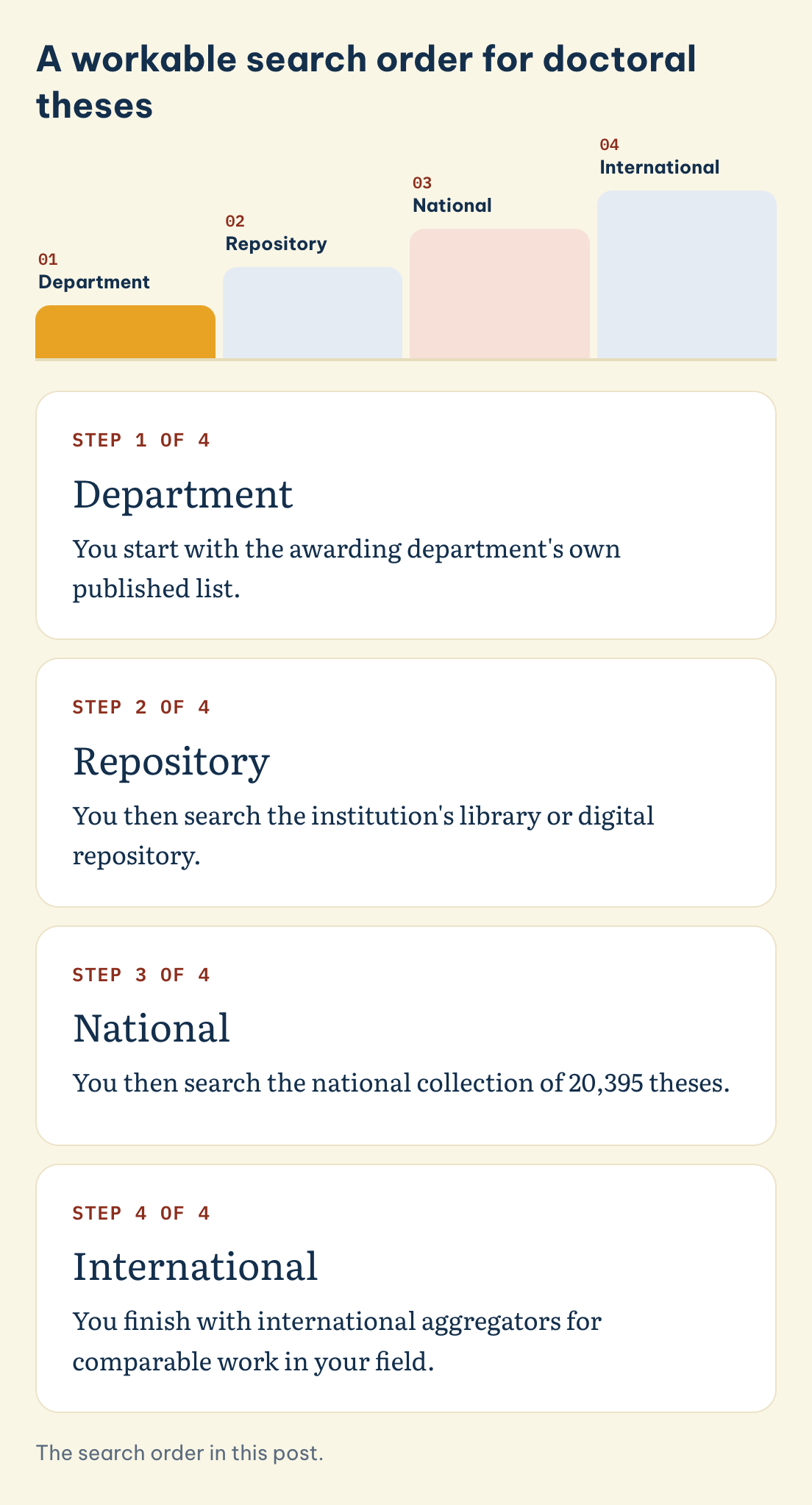
Direct answer: Work outward from the narrowest and most authoritative source. Start with the awarding department's own published list, then the institution's library or digital repository, then the national collection of 20,395 theses, then international aggregators for comparable work in your field.
A workable search order for doctoral theses
Tap a step to see where to look next, working outward from the narrowest source.
Step 1 of 4
Department
You start with the awarding department's own published list.
Step 2 of 4
Repository
You then search the institution's library or digital repository.
Step 3 of 4
National
You then search the national collection of 20,395 theses.
Step 4 of 4
International
You finish with international aggregators for comparable work in your field.
Save this figure
Two habits save time at every step. Search on the concepts that would appear in an abstract rather than on a phrase you expect in a title, for the reason the metadata evidence gives. And record, for every thesis you read, which institution awarded it and in which year, because thesis conventions are institutional and dated. A thesis defended in 2015 was written under the regulation that Circular 08/2017/TT-BGDĐT later replaced, which is two rulebooks before the one in force today.
Do not build a proposal on documents from sharing sites whose provenance you cannot establish. If you cannot say which institution accepted a document and when, you cannot use it as evidence of what any committee expects.
◆ Part 6 / 6 · Where MAAS fits
Where MAAS fits
Reading in your field is preparation; turning that reading into an accepted publication is the constraint that governs the rest of the doctorate, and it is what MAAS Publishing Advisory works on, with you as sole author and sole submitter. MAAS does not write or submit for you and cannot promise acceptance. The stage that follows is set out in our guide to the timeline from submission to the award, and the wider sequence in the PhD application guide.
Frequently asked questions
Is my university obliged to publish theses?
Article 33 of Circular 53/2026/TT-BGDĐT requires training institutions to publish information on their websites including lecturers, supervisors, theses and related academic information, and to update thesis and degree data to the national database.
Can I read a thesis before it is defended?
Article 23 requires the time and place of the defence and the thesis summary to be published in advance, so summaries are available before examination even when the full text is not.
Is the National Library thesis database still working?
Checked on 3 September 2026, yes. Its catalogue reports 20,395 theses and 312,817 pages. It responds on the insecure protocol only, which is why secure-by-default browsers often show a failure.
How many theses should I read before writing my proposal?
There is no rule. Three or four from your target department, read for structure rather than content, will tell you more about expectations than any general guide.
Can I cite a thesis I found on a document-sharing site?
Only if you can establish the awarding institution and year from the document itself. If you cannot, treat it as unverified and find the deposited copy instead.
References
Bennett, L., & Flanagan, D. (2016). Measuring the impact of digitized theses: A case study from the London School of Economics. Insights, 29(2), 111-119. https://doi.org/10.1629/uksg.300
Rasuli, B., Boock, M., Schöpfel, J., & Van Wyk, B. (2024). The role of metadata quality in the discoverability of electronic theses and dissertations [Conference paper]. ETD 2024. https://etd2024.unza.zm/proceedings/full-papers/papers/docs-paper-etd24-23.pdf
Urdă-Cîmpean, A. E., Bolboacă, S. D., Achimaş-Cadariu, A., & Drugan, T. (2016). Knowledge production in two types of medical PhD routes: What's to gain? Publications, 4(2), Article 14. https://res.mdpi.com/publications/publications-04-00014/article_deploy/publications-04-00014.pdf
Bộ Giáo dục và Đào tạo. (2026). Thông tư số 53/2026/TT-BGDĐT ban hành Quy chế tuyển sinh và đào tạo sau đại học (Công báo số 447). Công báo Chính phủ. https://congbao.chinhphu.vn/van-ban/thong-tu-so-53-2026-tt-bgddt-470098/67203.htm
A free 20-minute consultation is a conversation about your situation.
Book a free consultation ▸