
◆ Dissertation
PhD thesis word count in Vietnam: how long should it be?
Category: thesis-dissertation
Last updated: 2026-09-03

There is no national PhD thesis word count or page count. Neither Circular 53/2026/TT-BGDĐT nor the circular it replaced states one, and the figures circulating online, whether 150 pages or 300, come from individual institutions or from nowhere at all. Ask an AI assistant and it will hand you a table of page ranges by discipline with no document behind any row.
Direct answer: Article 21 of Circular 53/2026/TT-BGDĐT gives the institution the power to specify the structure, format and academic requirements of the thesis, in line with the programme standard for the field. The regulation sets no minimum or maximum length. The number that binds you is your own institution's, and it exists in writing.
A more useful question than how long is how the thesis is built, because the same circular now recognises two constructions that differ in almost everything except length.
◆ Part 1 / 6 · Where the missing number
Where the missing number actually lives
Direct answer: Article 21 delegates structure and form to the training institution, and Article 32 requires each institution to issue its own detailed regulation. So the binding page or word limit sits in a document published by your university, not in the national circular, and Article 33 obliges the institution to publish that regulation on its website.
That chain matters more than it looks. Article 32 is what turns a national framework into a local rule, and Article 33 is what makes that local rule readable by you. If a colleague tells you the limit is 200 pages, they are quoting a university, possibly not yours, and possibly not this year (Bộ Giáo dục và Đào tạo, 2026). The regulation your programme operates under is a published document you are entitled to read, and reading it takes less time than arguing about page counts.
◆ Part 2 / 6 · Monograph or thesis by
Monograph or thesis by publication
Direct answer: Article 21 allows the thesis to be built as a monograph or on the basis of the candidate's own published work, according to the institution's rules and the field's programme standard. These are two different objects: one argument developed across chapters, or a set of published studies bound by connecting material.
The publication route is not a shortcut through the writing. It reorders it. Under the monograph route the writing happens once, for one audience, at the end. Under the publication route the writing happens repeatedly, for journal reviewers, throughout the programme, and the thesis becomes the frame that makes the separate studies read as one project.
Which route is available to you is not your choice alone. Article 21 conditions it on the institution's rules, so the first question is whether your programme permits the format at all. Universities abroad use the same name for two different routes, one for work published before registration and one for papers written during the programme, and the two routes of a PhD by publication in the UK sets out how their regulations keep them apart.
◆ Part 3 / 6 · Does the format change
Does the format change the length?
Direct answer: The evidence says no. Comparing 75 medical doctoral theses defended at United Kingdom institutions between 2003 and 2015, Urdă-Cîmpean et al. (2016) found no statistically significant length difference between traditional and publication-based theses, whether measured in pages or in declared word counts.
Traditional and publication-based theses: similar length, more studies inside
Each row compares the two formats in 75 medical doctoral theses defended in the United Kingdom between 2003 and 2015.
Measure
By format
Pages, excluding references and appendices
Traditional 219, publication-based 196 (p = 0.299)
Pages, counting everything
Traditional 274, publication-based 250 (p = 0.563)
Declared word count
Traditional 67,897, publication-based 58,969 (p = 0.071)
Studies per thesis, on average
Traditional 2.67, publication-based 4.44 (p < 0.001)
Thesis-related articles, on average
Traditional 0.95, publication-based 1.75 (p = 0.017)
Save this figure
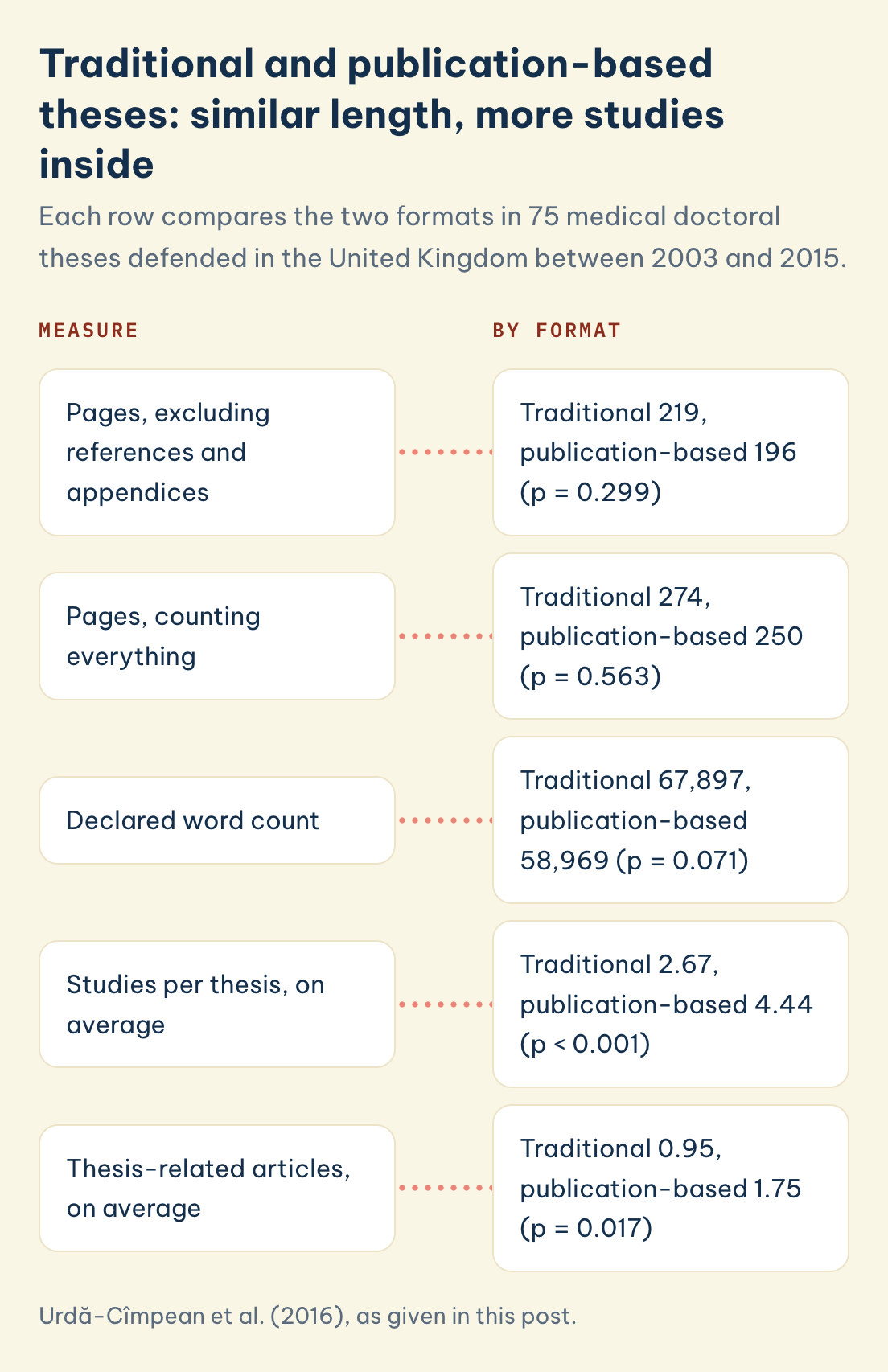
The numbers are worth seeing. Across that 2003 to 2015 sample of 75 theses, and excluding references and appendices, traditional theses averaged 219 pages and publication-based theses 196, a difference that did not reach significance at p = 0.299. Counting everything, the figures were 274 and 250 pages, at p = 0.563. Declared word counts came to 67,897 and 58,969, at p = 0.071.
The authors state the finding plainly: "We concluded that the theses originating from the TT group are similar in length compared to those from the PBT group" (Urdă-Cîmpean et al., 2016, p. 7).
Look at the variation rather than the averages. The standard deviation on that 219-page mean was 63.54 pages. Within one faculty at one university, under one set of regulations, theses of the same type differed from one another by around a third of their own length. A national page target would have to be wide enough to be useless.
Where the two formats did diverge was in content density. Publication-based theses contained significantly more studies, 4.44 against 2.67 on average, at p < 0.001, and more thesis-related articles, 1.75 against 0.95, at p = 0.017. Same length, more studies inside it.
◆ Part 4 / 6 · What the length is
What the length is downstream of
Direct answer: Length follows from the publication requirement rather than the other way round. Article 21 requires the candidate's published output to be accepted before the thesis can be assessed at departmental level, so the number of completed studies is already fixed by the time anyone starts counting pages.
Under Article 21, qualifying output means work indexed in Web of Science or Scopus with the candidate as first or corresponding author, or a chapter with a reputable international publisher, or an article in a domestic journal on the national Category I list of the Ministry of Science and Technology, or a granted patent or utility solution. The required quantity is set by the programme standard for the field rather than by the circular.
Churchill et al. (2021) supply the relevant counterweight to the fear that this makes everything slower. Across 1,143 doctoral graduates at an Australian university between 2000 and 2020, with time-to-degree data for 664, those who published four or more articles recorded the shortest median time to degree, 3.76 full-time-equivalent years.
The failure mode is the reverse of what candidates expect. Ahmad et al. (2025), interviewing doctoral candidates in Pakistan, documented theses that were finished and assessed, with examiner reports returned, while the examination department declined to schedule the viva because the mandatory article had not appeared. Nobody in those cases was short of pages.
◆ Part 5 / 6 · A practical way to decide
A practical way to decide
Direct answer: Take the limit from your own institution's regulation, take the number of studies from the publication requirement in your programme standard, then let the page count fall out of those two inputs. Do not start from a target length, because no document anywhere in the system is asking you for one.
Three checks cover most cases. Read your institution's own regulation, which Article 33 requires it to publish, and note whether the stated limit counts references and appendices, since the difference in the Urdă-Cîmpean data was around 55 pages. Confirm which construction your programme allows. Then count what you already have accepted or published, because that number, not your word processor, is what determines when the thesis is ready to submit.
◆ Part 6 / 6 · Where MAAS fits
Where MAAS fits
The binding constraint here is the accepted publication, and that is what MAAS Publishing Advisory works on: fitting a study to a journal within scope, restructuring the manuscript, and preparing reviewer responses, with you as sole author and sole submitter. MAAS does not write or submit for you and cannot promise acceptance, which rests with the journal's editors. The stage that follows is described in our guide to the timeline from submission to the award, and the wider sequence in the PhD application guide.
Frequently asked questions
Is there a minimum page count for a Vietnamese doctoral thesis?
Not nationally. Article 21 of Circular 53/2026/TT-BGDĐT assigns structure, format and academic requirements to the training institution, in line with the programme standard for the field.
Do references and appendices count towards the limit?
That depends on your institution's wording, and the gap is material: in the Urdă-Cîmpean data, including references and appendices added roughly 55 pages to the average thesis.
Can I submit a thesis made of my published papers?
Article 21 permits a thesis built on the basis of the candidate's publications, subject to the institution's rules and the field's programme standard. Confirm with your graduate office before planning around it.
Will a publication-based thesis be shorter?
On the available evidence, no. Urdă-Cîmpean et al. (2016) found no significant length difference; what differed was the number of studies contained in the thesis.
How many publications do I need?
Article 21 defers the quantity to the programme standard for your field, so the answer is specific to your discipline and your institution rather than national.
References
Ahmad, F., Waheed, S. A., & Gilani, N. (2025). Navigating the complex intersection of doctoral degree requirements: Results from a qualitative analysis. Bulletin of Education and Research, 47(1), 11-35. https://pu.edu.pk/images/journal/ier/PDF-FILES/2_47_1_25.pdf
Churchill, M. P., Lindsay, D., Mendez, D. H., Crowe, M., Emtage, N., & Jones, R. (2021). Does publishing during the doctorate influence completion time? A quantitative study of doctoral candidates in Australia. International Journal of Doctoral Studies, 16, 689-713. https://ijds.org/Volume16/IJDSv16p689-713Churchill7432.pdf
Urdă-Cîmpean, A. E., Bolboacă, S. D., Achimaş-Cadariu, A., & Drugan, T. (2016). Knowledge production in two types of medical PhD routes: What's to gain? Publications, 4(2), Article 14. https://res.mdpi.com/publications/publications-04-00014/article_deploy/publications-04-00014.pdf
Bộ Giáo dục và Đào tạo. (2026). Thông tư số 53/2026/TT-BGDĐT ban hành Quy chế tuyển sinh và đào tạo sau đại học (Công báo số 447). Công báo Chính phủ. https://congbao.chinhphu.vn/van-ban/thong-tu-so-53-2026-tt-bgddt-470098/67203.htm
A free 20-minute consultation is a conversation about your situation and where your publications stand.
Book a free consultation ▸