
◆ PhD Admissions
PhD by publication in the UK: which of the two routes is yours?
Category: admissions
Last updated: 2026-09-30

Search for "PhD by publication UK" and most of what comes back describes a route for people who already hold a body of published research and want it examined as a doctorate. For many applicants reading those pages from abroad, that route is closed before a single paper is counted, because British regulations filter it by years of standing and by a tie to the university. The route an overseas applicant can usually take has the same name in conversation and a different name in the regulations.
Direct answer: "PhD by publication" names two routes. The retrospective route examines work published before you register, and the University of Edinburgh admits only its own graduates of five years' standing or staff of three years. The prospective route is a thesis format inside an ordinary PhD, where papers are written during the programme and need not yet be published.
Asked on 30 September 2026, ChatGPT in guest mode and Perplexity both separated the two routes, and both said the retrospective one is often restricted to staff or alumni. Neither said what the restriction means for someone applying from outside the United Kingdom, or that at some universities, such as Edinburgh, papers accepted before the programme starts cannot go into an ordinary thesis. The regulations below answer both points.
◆ Section 1 / 9 · Retrospective or prospective
How is a retrospective PhD by publication different from a thesis by publication?
Direct answer: The difference is when the research was done. The retrospective route examines work published before you register, with a short registration and a written commentary. The prospective route admits you to a normal PhD, and your papers come out of the research you do during a standard registration of several years.
The Quality Assurance Agency for Higher Education (QAA) describes both forms in its national statement on doctorates. The QAA (2020, p. 7) notes that awarding bodies "may award this qualification infrequently" and "may also differentiate between retrospective publication (published before registration) and concurrent/prospective publications (published within the period of registration)". For the retrospective form, the candidate may not need to register formally at all, or may register for a shorter period, and may already be a graduate or staff member of the provider. The prospective form, the QAA (2020, p. 8) adds, "is now offered by some providers, particularly in science and engineering subjects".
The University of Portsmouth (2025) states the contrast inside one institution. Its PhD by Publication is for established researchers whose outputs were published before registration, and registration lasts one year part-time with submission between 6 and 12 months. Its compilation-style thesis, by contrast, requires the candidate to produce outputs during the 3 to 6 years of a standard PhD registration. Same university, same word "publication", two different degrees of access.
◆ Section 2 / 9 · Who is eligible
Who is eligible for a PhD by publication in the UK?
Direct answer: For the retrospective route, eligibility is set by years and by your tie to the university, not by how many papers you hold. Cambridge requires six years' standing and a Cambridge degree, Edinburgh requires its own graduates or staff, and Portsmouth accepts a good honours or master's degree from any recognised university, held five years.
The University of Cambridge (n.d.) offers the PhD under Special Regulations only to graduates of the University. A candidate must be of not less than six years' standing from admission to a first Cambridge degree, or of six years' standing from a first degree elsewhere and admitted to the Cambridge Master of Arts under Statute B II 2 or to a Cambridge degree by incorporation. Graduates already approved for a Cambridge PhD cannot apply. For most applicants from abroad, that means the route does not exist.
The University of Edinburgh (2025) sets out its PhD by Research Publications in regulations 52 to 55 of the 2025/26 postgraduate regulations. Applicants must be Edinburgh graduates of at least five years' standing, or staff of the University or an associated institution of at least three years' standing. They must have been active postgraduate researchers for at least five years, and they may not submit material published more than ten years before registration.
Portsmouth is the open case. The University of Portsmouth (n.d.) accepts a first or higher degree from a UK institution or a recognised non-UK equivalent, held for at least five years, and says that from October 2026 every PhD by publication will be completed by distance learning. Its guidance, University of Portsmouth (2025), specifies a first or upper second-class honours degree or a master's degree, from the UK or a recognised non-UK equivalent. Applicants who already hold a doctoral qualification are not eligible.
◆ Section 3 / 9 · How many publications
How many publications do you need for a PhD by publication?
Direct answer: Some regulations name a floor and others refuse to. Edinburgh asks for at least six refereed papers or one or two books. Manchester's journal format thesis names three to five papers as typical but no upper limit. Macquarie reports that most theses by publication contain between 2 and 8 papers.
The University of Edinburgh (2025) is the most specific of the rules read here: at least six refereed journal articles or research papers, or one or two books or creative works, already in the public domain, with the whole submission capped at 100,000 words. The University of Cambridge, Student Registry (2025) sets no count and instead asks for work of the same standard as a thesis embodying three years of research, adding for reference that a Cambridge PhD thesis runs up to 55,000 to 80,000 words.
On the prospective side, The University of Manchester (2026) says in section 13.5 of its thesis policy that the number of publications is "not prescribed", that three to five papers or equivalent results chapters is typical, and that there is no upper limit. Macquarie University (2020) gives a wider range for its own theses, between 2 and 8 papers in combinations of sole and co-authored work. The University of Portsmouth (2025) says the number will vary by candidate and discipline, and its faculty appendices differ: Science and Health usually expects 6 to 8 papers, while Technology sets a minimum of 3. The count follows the discipline, and the useful question to ask a department is what a successful thesis in your field looked like.
◆ Section 4 / 9 · Papers from before the PhD
Can published papers from before the PhD go into a thesis by publication?
Direct answer: Usually only a limited share, and at some universities none. Edinburgh bars material accepted for publication before the programme starts from an ordinary thesis. Manchester requires a significant proportion of the work to follow registration. Macquarie requires at least half of the research behind each included paper to be done during enrolment.
The University of Edinburgh, Academic Quality and Standards (n.d.) states in regulation 32.2 that a student cannot include in a thesis material accepted for publication before the start of their programme, unless registered for the PhD by Research Publications. At Edinburgh, papers accepted before the programme starts therefore belong only to the retrospective route, and an ordinary thesis cannot include them.
The University of Manchester (2026) sets a looser rule in section 13.3, requiring that "a significant proportion of the researched materials should be derived from original research undertaken after the date the PGR initially registered". Macquarie University (2020) sets the line at "at least half of the research" done during enrolment for each included paper. An applicant with two papers from a master's degree should read these clauses before planning to reuse them as chapters, and the question of how an admissions panel reads those same papers is covered in what to do when a PhD programme asks for published papers.
◆ Section 5 / 9 · Must papers be published
Do the papers in a thesis by publication have to be published already?
Direct answer: Not at every university. At Manchester a journal format chapter can be a draft that no journal has seen yet, and the University of British Columbia accepts manuscripts that are ready for submission. Manchester adds that already published chapters do not by themselves secure a recommendation to award the degree.
The University of Manchester (n.d.) states in its guiding principles for journal format theses that "Papers within the journal format do not have to be already published or even submitted for publication." Chapters can be drafts not yet ready for a journal, and they may change later after peer review. The University of British Columbia, Faculty of Graduate and Postdoctoral Studies (n.d.) lists "a series of published or publication-ready manuscripts with synthesis" among the accepted structures of a doctoral dissertation.
The reverse also holds. The University of Manchester (2026) states in section 13.12 that containing published or accepted material "does not guarantee" a recommendation for the award, because the examiners judge the thesis as a whole. Each paper passed a journal's reviewers, but the doctoral question is whether the papers together make one coherent contribution, which is why every format requires a linking introduction and conclusion.
◆ Section 6 / 9 · Commentary and viva
How long is the commentary, and is there a viva?
Direct answer: In the retrospective route the commentary is a separate document: 1,000 to 5,000 words at Cambridge, 5,000 to 10,000 at Portsmouth, 10,000 to 25,000 at Edinburgh. An oral examination follows, at Cambridge after an initial assessment. Prospective linking chapters sit inside the thesis, capped at 90,000 words at Manchester.
Manchester, prospective route
90,000 words
normal maximum of main text for a journal format thesis
Length of the written commentary in the retrospective PhD by publication
Each bar spans the range of words that one university asks for in the retrospective route.
Save this figure
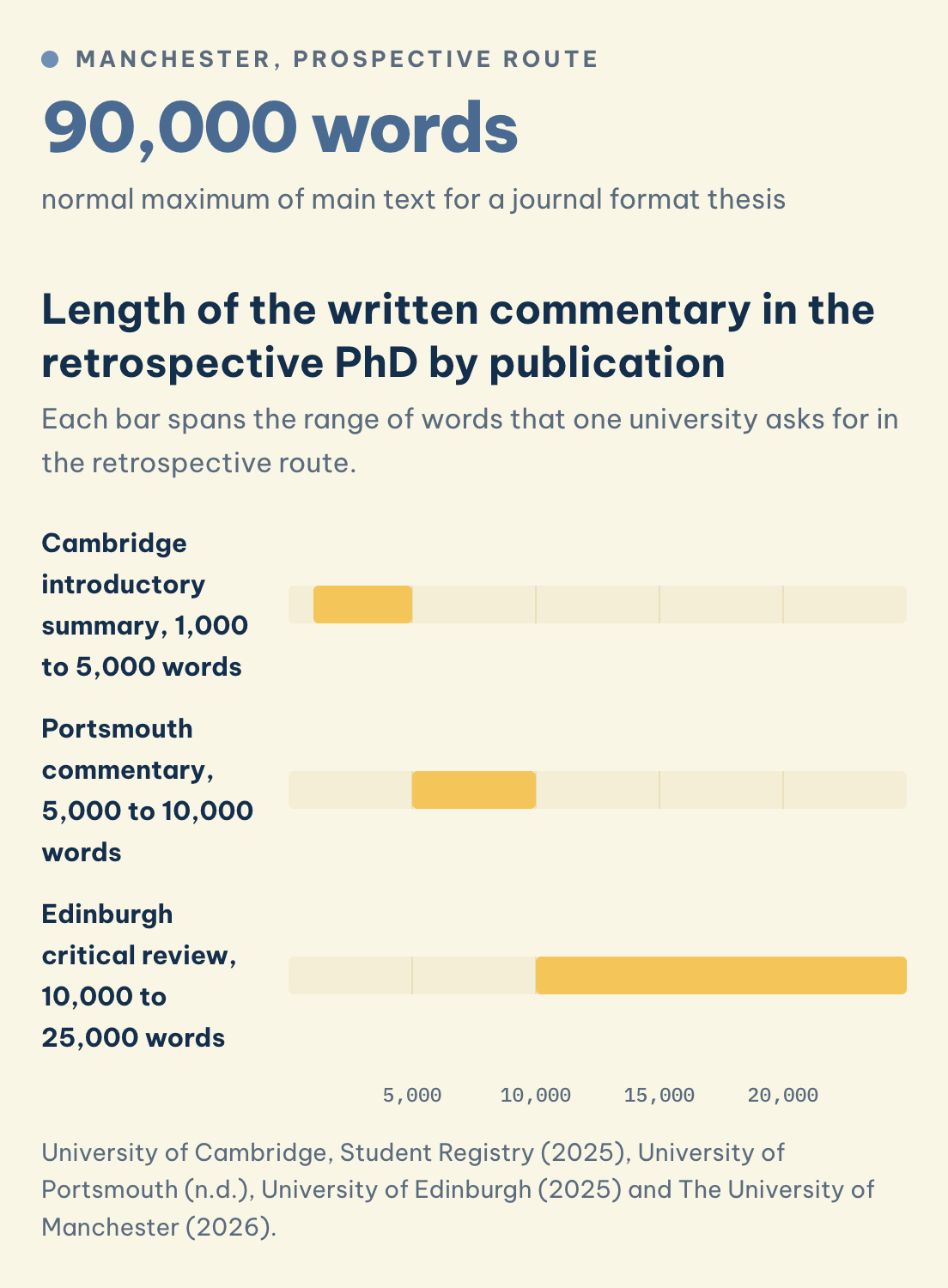
The University of Cambridge, Student Registry (2025) asks for an introductory summary of 1,000 to 5,000 words covering the rationale, the extent to which the works form a consistent body of research and their original contribution, and the candidate must also satisfy the examiners at an oral examination. The University of Portsmouth (n.d.) asks for a commentary of 5,000 to 10,000 words and a viva voce. The University of Edinburgh (2025) requires a critical review of at least 10,000 and not more than 25,000 words, which must also state what the candidate contributed to jointly authored work.
For the prospective route, The University of Manchester (2026) expects a journal format thesis to include a rationale for the format, a review of previous research, a critical account of the methods and a synthesis at the end, and sets a normal maximum of 90,000 words of main text. The QAA (2020, p. 8) describes the same final step for both routes: examination of the materials and the commentary, followed by an oral examination.
◆ Section 7 / 9 · Co-authored papers
Can co-authored papers count?
Direct answer: Yes, if you can show your own share. Edinburgh requires sole authorship or a major contribution to every multi-author work. Manchester asks the introduction to justify the candidate's and co-authors' contributions in full. UBC requires a preface stating the student's part in the question, design, research, analysis and writing.
The University of Edinburgh (2025) states that students must either be the sole author of the portfolio or demonstrate in the critical review "that they have made a major contribution" to all multi-author work. The University of Portsmouth (2025) asks for a statement of the extent of the candidate's contribution to each listed work at the application stage, and adds a language rule that matters for researchers from Vietnam: all parts of the submission must be in English, and English translations of works published in other languages are not permitted.
The University of British Columbia, Faculty of Graduate and Postdoctoral Studies (n.d.) requires a preface covering identification of the research questions, design, performance, analysis and writing, with the approximate proportion done by the student where the work was collaborative. For a paper where you are the third of five authors, the practical test is whether you could defend every section of it in the viva.
◆ Section 8 / 9 · Australia and Canada
Is a PhD by publication the same in Australia and Canada?
Direct answer: The name travels but the dominant route does not. In a cross-country study of humanities and social science theses, Paltridge and Starfield found the UK examples mostly retrospective, the US and Canadian examples prospective, and Australia mostly prospective. A search for the Australian term usually leads to a thesis format for enrolled students.
Paltridge and Starfield (2023) analysed 100 doctoral theses by publication in the humanities and social sciences from the United States, the United Kingdom, Canada and Australia, and interviewed students and supervisors. Paltridge and Starfield (2023, p. 863) conclude that "In the UK, by contrast, retrospective PhDs, the PhD by published work, largely dominate", while in the United States all the examples were prospective and Canada, in education, was similar. The sample is limited to those disciplines, so the pattern is a tendency rather than a rule.
For Australia, Paltridge and Starfield (2023) summarise a 2013 survey of 34 universities in which 9 offered a retrospective PhD by prior publication, 23 a prospective PhD by publication, and 5 a hybrid allowing papers published before candidature, so some universities offered more than one form. The survey is more than a decade old, so treat the counts as a snapshot of that year. Macquarie University (2020) is an example of the prospective rule in practice. An applicant who searches "PhD by publication Australia" is therefore usually reading about a thesis format for enrolled students, while the same search for the United Kingdom returns mostly the route for established researchers.
◆ Section 9 / 9 · Which route a university means
Checking which route a university means
Three clauses in a university's regulations tell you which route you are reading about: the eligibility clause (years of standing, staff or graduate status), the submission window (months after registration, or the end of a full doctoral programme), and the rule on work published before registration. The PhD application guide shows where the thesis format decision sits in the wider sequence, and Vietnam's own rules for a thesis built on publications are covered in how long a PhD thesis should be in Vietnam.
MAAS supports this step through PhD application strategy. Your expert drafts the application documents from your own account of your work, you review, edit and approve each one, and you submit the application yourself. The expert also helps you read the regulations of each university on your list and challenges the research plan behind a thesis by publication. MAAS experts do not write or publish papers for you and do not submit your application. Approach letters go out only after you have read and approved each one, sent by MAAS from an academic mailbox opened in your name and handed over to you when the engagement ends. Where our network already includes a suitable expert we introduce them within 48 hours, and where it does not we open a dedicated recruitment round, which usually takes about two weeks.
Frequently asked questions
Is a PhD by publication in the UK a single route?
No. The label covers two separate arrangements: one examines papers published before you register, and the other is a way of packaging the thesis during a normal PhD (Quality Assurance Agency for Higher Education, 2020).
Can an applicant from abroad take the retrospective route?
It depends on the university. Cambridge opens the route only to its own graduates and Edinburgh only to its own alumni or staff, while Portsmouth accepts a good honours or master's degree held five years from any recognised university.
Can papers published before the PhD go into the thesis?
Usually only a limited share, and at some universities none. At Edinburgh, material accepted for publication before the programme starts cannot go into an ordinary thesis, and Macquarie requires at least half of the research behind each paper to be done during enrolment.
Do the papers in a thesis by publication have to be published already?
Not at every university. A journal format chapter at Manchester may still be only a draft, while UBC accepts manuscripts that are merely ready to submit.
Can co-authored papers count?
Yes, provided your own share is clear. For multi-author work, Edinburgh asks you either to be the sole author or to demonstrate a major contribution.
References
Macquarie University. (2020). HDR thesis by publication (Schedule 1, HDR Thesis Preparation, Submission and Examination Policy). https://policies.mq.edu.au/download.php?associated=&id=248&version=1
Paltridge, B., & Starfield, S. (2023). The PhD by publication in the humanities and social sciences: A cross country analysis. Journal of Further and Higher Education, 47(7), 863–874. https://doi.org/10.1080/0309877X.2023.2190450
Quality Assurance Agency for Higher Education. (2020). Characteristics statement: Doctoral degree. https://www.qaa.ac.uk/docs/qaa/quality-code/doctoral-degree-characteristics-statement-2020.pdf
The University of Manchester. (2026). Presentation of theses policy. https://documents.manchester.ac.uk/display.aspx?DocID=7420
The University of Manchester. (n.d.). Journal format theses: Guiding principles. Retrieved September 30, 2026, from https://documents.manchester.ac.uk/display.aspx?DocID=15216
University of British Columbia, Faculty of Graduate and Postdoctoral Studies. (n.d.). Doctoral dissertation. Retrieved September 30, 2026, from https://www.grad.ubc.ca/s/doctoral-dissertation
University of Cambridge. (n.d.). PhD under Special Regulations. Cambridge Students. Retrieved September 30, 2026, from https://www.cambridgestudents.cam.ac.uk/your-course/higher-degrees/phd-under-special-regulations
University of Cambridge, Student Registry. (2025). Guide for applicants: PhD degree under Special Regulations [PDF]. https://www.cambridgestudents.cam.ac.uk/files/phd_spreg_guide_for_applicants.pdf
University of Edinburgh. (2025). Postgraduate degree programme regulations 2025/26 [PDF]. https://governance-strategic-planning.ed.ac.uk/sites/default/files/2025-04/No.7/2025%3A%20Postgraduate%20Degree%20Programme%20Regulations_0.pdf
University of Edinburgh, Academic Quality and Standards. (n.d.). Section C: Thesis regulations. Postgraduate research assessment regulations. Retrieved September 30, 2026, from https://registryservices.ed.ac.uk/academic-services/policies-regulations/regulations/assessment-regulations/postgraduate-research/section-c
University of Portsmouth. (2025). PhD by Publication guidance (Version 1.2) [PDF]. https://guidelines.docstore.port.ac.uk/A1207350.pdf
University of Portsmouth. (n.d.). PhD by publication. Retrieved September 30, 2026, from https://www.port.ac.uk/study/postgraduate-research/research-degrees/phd-by-publication
A free 20-minute consultation is a conversation about your situation and which PhD by publication route a university means.
Book a free consultation ▸