
◆ PhD in Vietnam
How long from PhD thesis submission to the award in Vietnam?
Category: thesis-dissertation
Last updated: 2026-09-03
Ask two AI assistants this question in September 2026 and both will tell you there is no fixed deadline between submission and defence, and both will cite a regulation that has been replaced. The current rules do set ceilings, in months, for every stage. They are published, they are enforceable, and almost nobody is quoting them yet.
Direct answer: Under Circular 53/2026/TT-BGDĐT, every stage after submission carries a stated ceiling: independent review within 6 months, plus 3 more for a second round; the defence within 3 months of the thesis passing review; the board valid for 3 months; the degree issued within 6 months of completion. Which rules apply depends on when you enrolled.
The reason this question feels unanswerable is structural. Article 3 counts your training period only up to the moment you submit the thesis, so everything that follows sits outside the three-to-four-year clock you were given at admission.
◆ Question 1 / 5 · The stages
What are the stages between submission and the award?
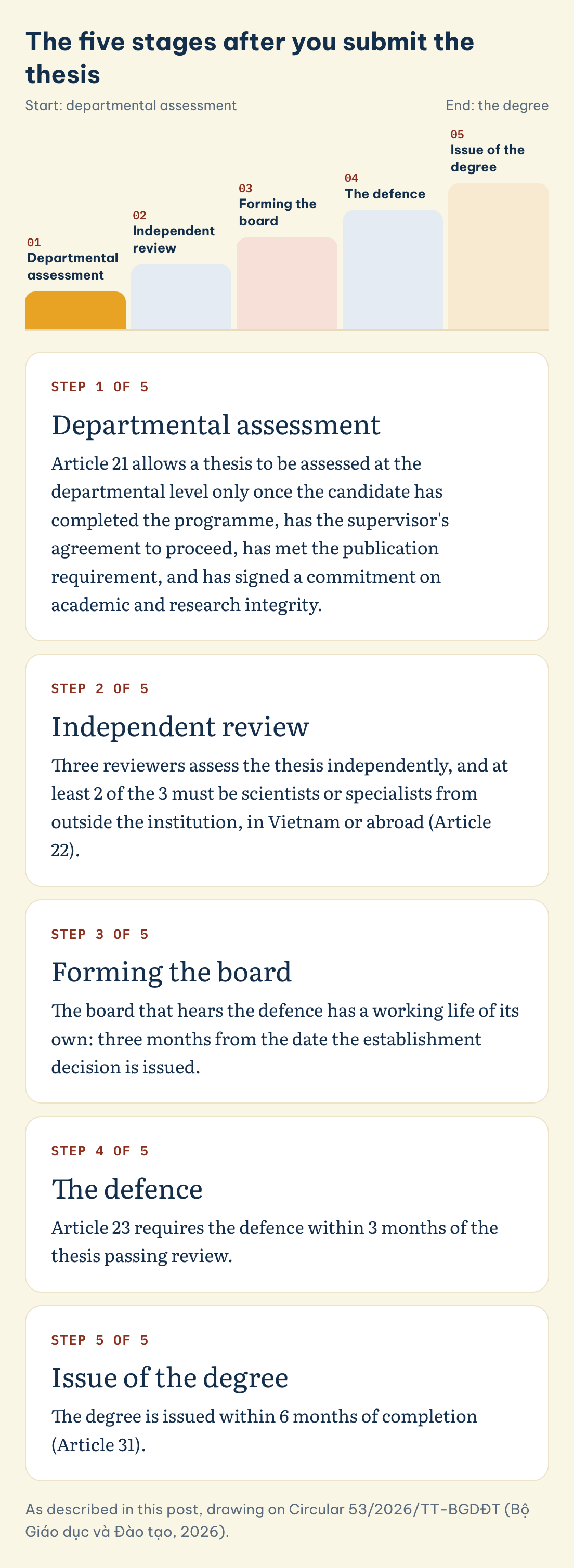
Direct answer: There are five stages in sequence: departmental assessment, independent review by 3 reviewers, formation of the board, the defence, then issue of the degree. Each has its own trigger condition, so a delay in one pushes every later stage. Circular 53/2026/TT-BGDĐT sets a ceiling for each.
The five stages after you submit the thesis
Tap a stage to see what the post says about it.
Step 1 of 5
Departmental assessment
Article 21 allows a thesis to be assessed at the departmental level only once the candidate has completed the programme, has the supervisor's agreement to proceed, has met the publication requirement, and has signed a commitment on academic and research integrity.
Step 2 of 5
Independent review
Three reviewers assess the thesis independently, and at least 2 of the 3 must be scientists or specialists from outside the institution, in Vietnam or abroad (Article 22).
Step 3 of 5
Forming the board
The board that hears the defence has a working life of its own: three months from the date the establishment decision is issued.
Step 4 of 5
The defence
Article 23 requires the defence within 3 months of the thesis passing review.
Step 5 of 5
Issue of the degree
The degree is issued within 6 months of completion (Article 31).
Save this figure
The regulation now in force is Circular 53/2026/TT-BGDĐT, issued by the Ministry of Education and Training on 30 June 2026 and published in Official Gazette No. 447 on 28 July 2026 (Bộ Giáo dục và Đào tạo, 2026). It replaces Circular 18/2021/TT-BGDĐT (Bộ Giáo dục và Đào tạo, 2021), which governed doctoral admissions and training for the previous five years.
The first stage is not a formality. Article 21 allows a thesis to be assessed at the departmental level only once the candidate has completed the programme, has the supervisor's agreement to proceed, has met the publication requirement, and has signed a commitment on academic and research integrity. Article 21 also frames that assessment as an academic seminar whose purpose is to help the candidate finish the thesis, rather than a pass-or-fail gate.
◆ Question 2 / 5 · Draft to defence
How long from submitting the draft to the defence?
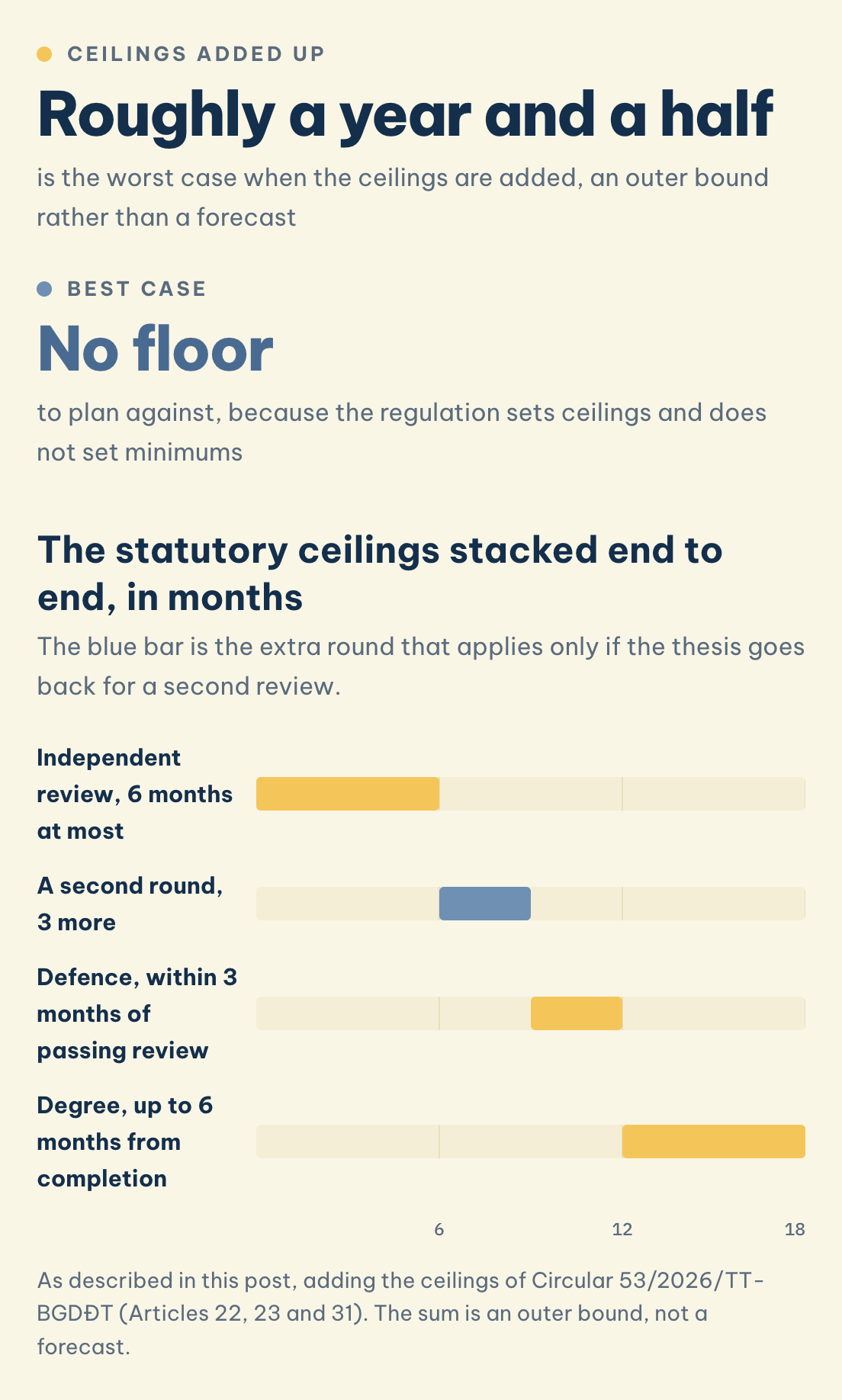
Direct answer: Article 22 gives the institution 6 months at most to complete independent review, counted from the date you submit the draft your department has approved. A second round of independent review extends that ceiling by 3 months. Article 23 then requires the defence within 3 months of the thesis passing review.
Ceilings added up
Roughly a year and a half
is the worst case when the ceilings are added, an outer bound rather than a forecast
Best case
No floor
to plan against, because the regulation sets ceilings and does not set minimums
The statutory ceilings stacked end to end, in months
The blue bar is the extra round that applies only if the thesis goes back for a second review.
Save this figure
Three reviewers assess the thesis independently, and at least 2 of the 3 must be scientists or specialists from outside the institution, in Vietnam or abroad (Article 22). Web of Science or Scopus publication within the past 5 years is part of the standard those reviewers must themselves meet, since Article 22 holds them to the supervisor criteria in Article 17. The board that hears the defence has a working life of its own: three months from the date the establishment decision is issued, and if the defence has not taken place by then, the institution must form a new board.
Adding the ceilings gives an outer bound rather than a forecast. Six months of review, three more if the thesis goes back for a second opinion, three months to schedule the defence, and up to six months from completion to the certificate under Article 31. A candidate planning around the worst case is planning around roughly a year and a half; a candidate planning around the best case has no published floor to plan against, because the regulation sets ceilings and does not set minimums.
What arrives at that first stage is a thesis whose shape the institution defines rather than the national regulation, a point our guide to how long a PhD thesis should be works through.
◆ Question 3 / 5 · What lengthens it
What lengthens the timeline?
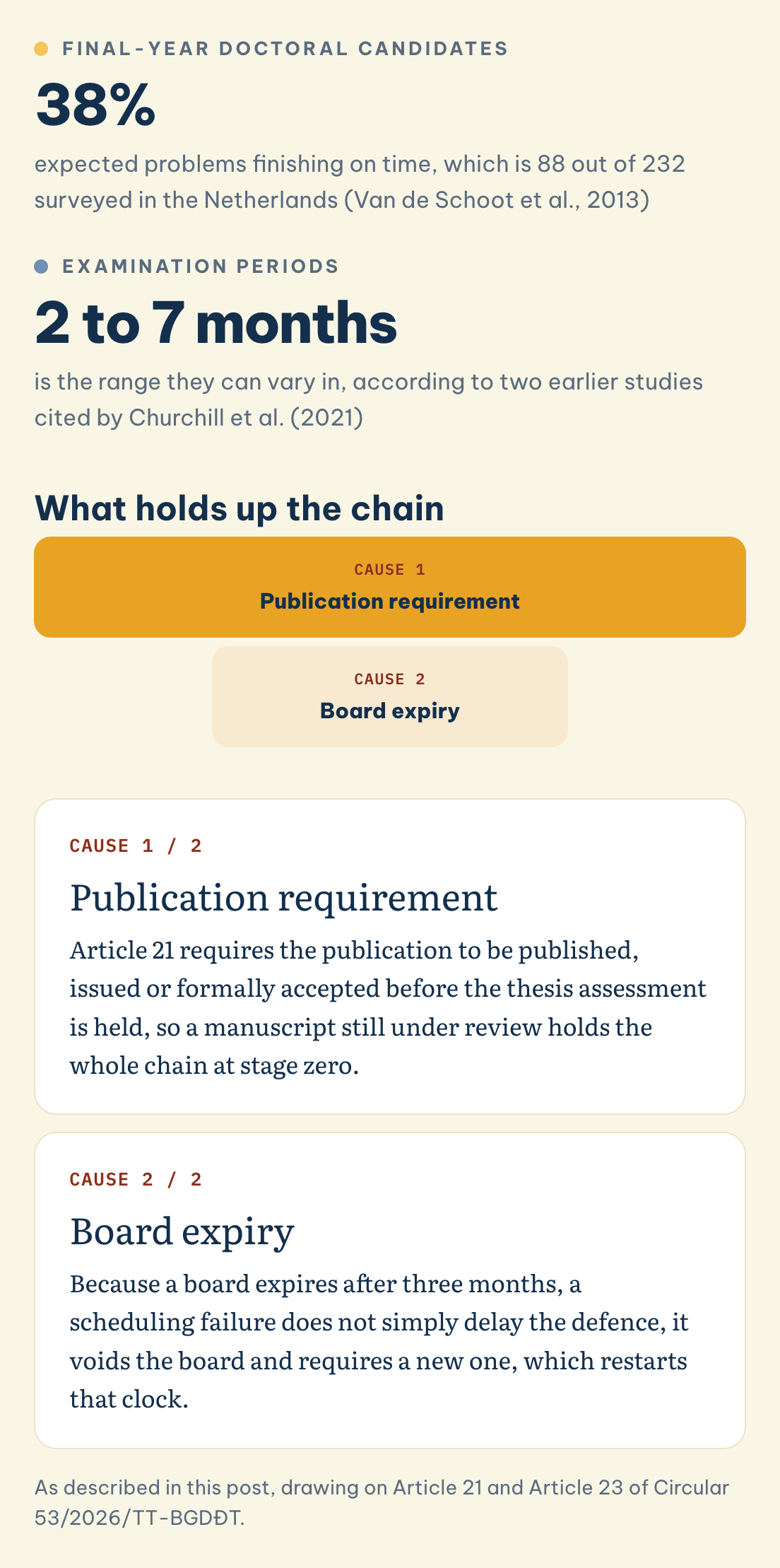
Direct answer: The publication requirement is the most common cause, and it bites before any ceiling starts. Article 21 requires the publication to be published, issued or formally accepted before the thesis assessment is held, so a manuscript still under review holds the whole chain at stage zero (Ahmad et al., 2025).
Final-year doctoral candidates
38%
expected problems finishing on time, which is 88 out of 232 surveyed in the Netherlands (Van de Schoot et al., 2013)
Examination periods
2 to 7 months
is the range they can vary in, according to two earlier studies cited by Churchill et al. (2021)
What holds up the chain
Tap a cause to see how it delays the timeline.
Cause 1 / 2
Publication requirement
Article 21 requires the publication to be published, issued or formally accepted before the thesis assessment is held, so a manuscript still under review holds the whole chain at stage zero.
Cause 2 / 2
Board expiry
Because a board expires after three months, a scheduling failure does not simply delay the defence, it voids the board and requires a new one, which restarts that clock.
Save this figure
The qualifying evidence is specific. The candidate must be first or corresponding author of work indexed in Web of Science or Scopus, or a chapter with a reputable international publisher, or an article in a domestic journal on the national Category I list maintained by the Ministry of Science and Technology. A granted patent or a utility solution also qualifies, and the arts and sports have their own route. How many items are required is not in the regulation at all; Article 21 defers that to the programme standard for each field.
That design has a practical consequence worth stating plainly. Peer review at an indexed journal is measured in months and is not under your control or your institution's, while every stage after submission is measured in months and is under your institution's control. The part of the timeline you can influence is the part that happens earliest.
Two findings from the research literature are worth holding alongside that. Churchill et al. (2021) analysed 1,143 doctoral graduates from a single Australian university across the years 2000 to 2020, with time-to-degree data available for 664 of them, and found that publishing during candidature did not lengthen completion: graduates who produced four or more articles recorded the shortest median time-to-degree at 3.76 full-time-equivalent years. The common assumption that publishing and finishing pull against each other did not hold in that dataset.
The second finding is about the measurement itself. The authors excluded examination periods from their time-to-degree figure, writing that "Thesis examination periods are excluded because they are outside of the influence of the candidate or the institution" (Churchill et al., 2021, p. 697). They add, citing two earlier studies, that those periods can vary significantly, in a range of 2 to 7 months. Vietnamese regulation draws the same line in Article 3 and for the same reason, which is why the months after submission are so rarely quoted anywhere: the standard metric in both the research and the regulation simply stops at the door.
Delay itself is ordinary rather than exceptional. Van de Schoot et al. (2013), surveying doctoral candidates in the Netherlands, found that of those in their final year, 88 out of 232, or 38 per cent, expected problems finishing on time.
A publication-gated defence produces a specific and documented failure mode. In a qualitative study of doctoral candidates in Pakistan, where the Higher Education Commission requires at least two papers in a recognised journal, Ahmad et al. (2025) recorded candidates whose theses had been assessed and whose examiner reports had been received, but whose viva the examination department would not schedule because the required article had not yet appeared. The thesis was finished; the file was not. Preparing for the examination itself is covered in viva voce, written for ESL students.
A second cause is the board itself. Because a board expires after three months, a scheduling failure does not simply delay the defence; it voids the board and requires a new one, which restarts that clock.
◆ Question 4 / 5 · Planning
How should you plan the schedule?
Direct answer: Work backwards from the publication, not from the defence. Establish which of the 2 circulars applies to you, confirm the publication count your programme standard requires, then treat journal review as the fixed block and fit the rest around it. Publishing during candidature is not what makes candidates late (Churchill et al., 2021).
Which circular applies to which candidate
Each row sets a point about the old circular against the new one.
Circular 18/2021/TT-BGDĐT
Circular 53/2026/TT-BGDĐT
Institutions may continue to train, examine and award under it for candidates admitted under an announcement issued before the new circular took effect and enrolled before 1 January 2027.
Candidates in intakes announced from 1 January 2027 fall under it.
It governed doctoral admissions and training for the previous five years, and the new circular replaces it.
It is the regulation now in force, issued on 30 June 2026 and published in Official Gazette No. 447 on 28 July 2026.
Parts of it stay in force for everyone, including the supervisor standards and certain pre-assessment requirements until the Ministry issues the doctoral programme standard for the relevant field, and the foreign language certificates listed in its old appendices until 31 December 2027.
Ask your graduate office to confirm in writing which regulation applies to you.
Save this figure
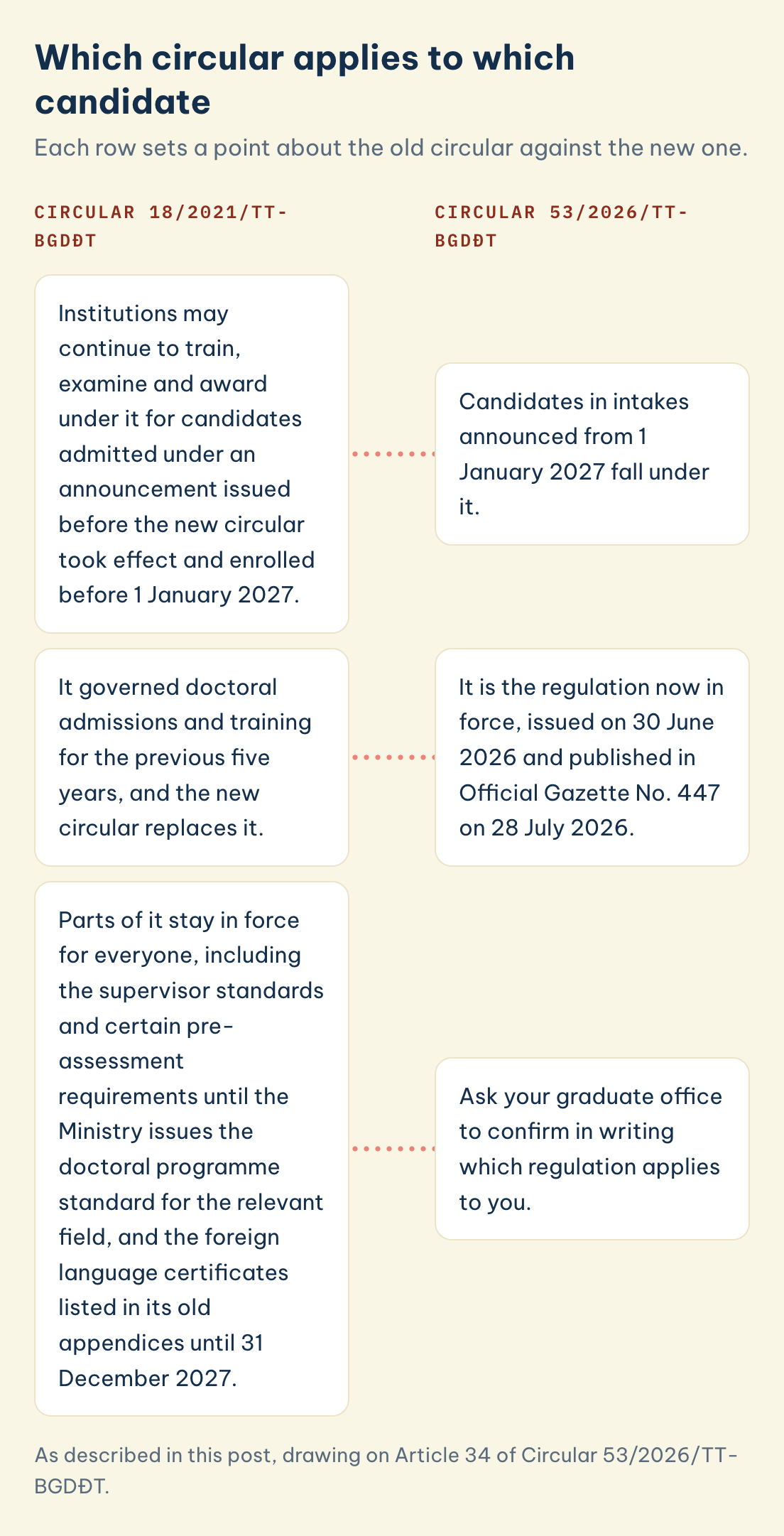
Establishing which regulation applies is the first step because two are running in parallel. Article 34 lets institutions continue to train, examine and award under Circular 18/2021 for candidates admitted under an announcement issued before the new circular took effect and enrolled before 1 January 2027. Candidates in intakes announced from 1 January 2027 fall under Circular 53/2026. Article 34 also keeps parts of the old circular alive for everyone: the supervisor standards and certain pre-assessment requirements stay in force until the Ministry issues the doctoral programme standard for the relevant field, and foreign language certificates listed in the old appendices remain usable until 31 December 2027.
Two further dates belong in the same calendar. Article 17 requires the supervisor to propose your thesis topic for the rector's approval within 18 months of your admission decision, the first hard checkpoint in the degree. Article 3 sets the standard duration at 3 years to 4 years, requires a minimum of two-thirds of it, and caps total training at 2.5 times the standard duration, measured to the day you submit the thesis.
◆ Question 5 / 5 · What can be shortened
Which stages can actually be shortened?
Direct answer: None of the post-submission ceilings can be shortened by the candidate, because they are obligations placed on the institution rather than allowances made to you. What can be moved earlier is the publication, the topic approval, and the departmental assessment.
It follows that the honest answer to "how do I speed this up" is that the levers sit in the first half of the degree, not the second. A candidate who submits with the publication already accepted enters a chain of institutional deadlines. A candidate who submits while waiting on a journal decision is not in that chain yet, and no ceiling in the regulation protects them.
One stage does reward attention rather than speed. Article 23 requires the time and place of the defence, together with the thesis summary, to be published on the institution's website. That obligation exists for scrutiny, and it also means the defences in your own department are readable in advance, which is the cheapest available preparation.
Where MAAS fits
The stage that decides this timeline is the indexed publication, and that is what MAAS Publishing Advisory works on: screening a study against Q1 and Q2 scope, restructuring the manuscript into the form a journal expects, and preparing responses to reviewers. You remain the sole author and the sole submitter, MAAS does not write or submit on your behalf, and no adviser can promise acceptance, because that decision belongs to the journal's editors. The wider sequence this sits inside is set out in our PhD application guide.
Matching to an adviser runs on two tracks. Where the network already holds someone in your field, matching is usually complete within 48 hours. Where it does not, MAAS opens a dedicated recruitment round for your case, which normally takes around two weeks.
Frequently asked questions
Does the three-to-four-year duration include the defence?
No. Article 3 of Circular 53/2026/TT-BGDĐT counts doctoral training from the effective date of the admission decision to the day you submit the thesis for independent review. The review, the defence and the award all fall after that clock has stopped, which is also how Churchill et al. (2021) measured time-to-degree.
Can the institution take longer than six months for independent review?
The regulation gives 6 months, extendable by 3 more only where a second round of independent review is required under Article 22. These are stated as institutional obligations.
What happens if the board expires before my defence?
Article 23 requires the institution to establish a new board. The old board's three-month term is not extended.
Does an accepted-but-unpublished article count?
Article 21 accepts work that has been published, issued, or accepted by the competent body before the thesis assessment is held. Your institution decides how acceptance is evidenced, so ask before you rely on it.
Which regulation applies to me?
If you were admitted under an announcement issued before Circular 53/2026/TT-BGDĐT took effect and enrolled before 1 January 2027, your institution may continue under Circular 18/2021/TT-BGDĐT. Intakes announced from 1 January 2027 fall under the new circular. Foreign language certificates listed in the old appendices remain usable until 31 December 2027. Ask your graduate office to confirm in writing.
References
Ahmad, F., Waheed, S. A., & Gilani, N. (2025). Navigating the complex intersection of doctoral degree requirements: Results from a qualitative analysis. Bulletin of Education and Research, 47(1), 11-35. https://pu.edu.pk/images/journal/ier/PDF-FILES/2_47_1_25.pdf
Churchill, M. P., Lindsay, D., Mendez, D. H., Crowe, M., Emtage, N., & Jones, R. (2021). Does publishing during the doctorate influence completion time? A quantitative study of doctoral candidates in Australia. International Journal of Doctoral Studies, 16, 689-713. https://ijds.org/Volume16/IJDSv16p689-713Churchill7432.pdf
Van de Schoot, R., Yerkes, M. A., Mouw, J. M., & Sonneveld, H. (2013). What took them so long? Explaining PhD delays among doctoral candidates. PLOS ONE, 8(7), Article e68839. https://doi.org/10.1371/journal.pone.0068839
Bộ Giáo dục và Đào tạo. (2021). Thông tư số 18/2021/TT-BGDĐT ban hành Quy chế tuyển sinh và đào tạo trình độ tiến sĩ. Công báo Chính phủ. https://congbao.chinhphu.vn/van-ban/thong-tu-so-18-2021-tt-bgddt-33987.htm
Bộ Giáo dục và Đào tạo. (2026). Thông tư số 53/2026/TT-BGDĐT ban hành Quy chế tuyển sinh và đào tạo sau đại học (Công báo số 447). Công báo Chính phủ. https://congbao.chinhphu.vn/van-ban/thong-tu-so-53-2026-tt-bgddt-470098/67203.htm
A free 20-minute consultation with a MAAS adviser, to talk through where your publication sits in this timeline.
Book Free Discovery ▸