
◆ PhD application
Do you need the GMAT or GRE for a PhD?
Sometimes, and where it is required the requirement is usually absolute. What surprises applicants is not that answer but its shape. At doctoral level an admissions test behaves asymmetrically: not having a required score can end an application outright, while having an excellent one buys you far less than the effort suggests. The test is a gate you can fail, not a contest you can win.
That asymmetry decides something practical, which is what to do first when you have neither a finished proposal nor a test score and cannot build both at once. This guide sets out why the test matters differently here than it does on a taught master's application, and what the sequencing decision actually rests on.

◆ Question 1 / 6 · Why it differs
Why does the same test mean something different at doctoral level?
Direct answer: Because two different bodies use it for two different purposes. On a taught master's application the score is a live differentiator that the admitting programme weighs and that often affects scholarship decisions. On a doctoral application, by contrast, the score is usually an eligibility condition set centrally, checked before your file reaches the people who decide.
Those people are then assessing something the test does not measure.
The two tests are owned by different bodies, and that matters because their policies do not transfer. The GRE General Test is owned and administered by Educational Testing Service (ETS), while the GMAT and its current GMAT Focus Edition are owned and administered by the Graduate Management Admission Council (GMAC). The GRE reports Verbal Reasoning and Quantitative Reasoning on a 130 to 170 scale each, with Analytical Writing scored from 0 to 6, and the GMAT Focus Edition, which GMAC launched in 2023, reports a total score on a 205 to 805 scale, a different range from the older 200 to 800 GMAT scale it replaced. Reporting windows, retake rules and fee schedules are set separately by each organisation, so a rule you read about one test should never be assumed to hold for the other.
The documents a programme insists on tell you where its attention sits. One business school's own guidelines say it plainly: "Applications received without a research proposal will not be considered" (University of Edinburgh Business School, n.d.), and a personal statement does not satisfy that requirement either. The proposal is the thing without which nothing proceeds, and it is the thing a supervisor reads.
That a test score functions as a checked condition rather than a scored criterion is a working rule drawn from MAAS advisory casework, not a published finding, so verify it against the wording your own targets use. Where a programme says the score must simply be met, treat it as a condition. Where a programme says the score is considered alongside other evidence, treat it as scored, and weight your effort accordingly.
This condition-versus-scored distinction is why "I got a strong score, will that carry me" is the wrong hope, and why "I have no score at all" is a genuinely different problem. One is a number that has already done its job. The other is a door that may not open.
◆ Question 2 / 6 · The asymmetry
What does that asymmetry cost in practice?
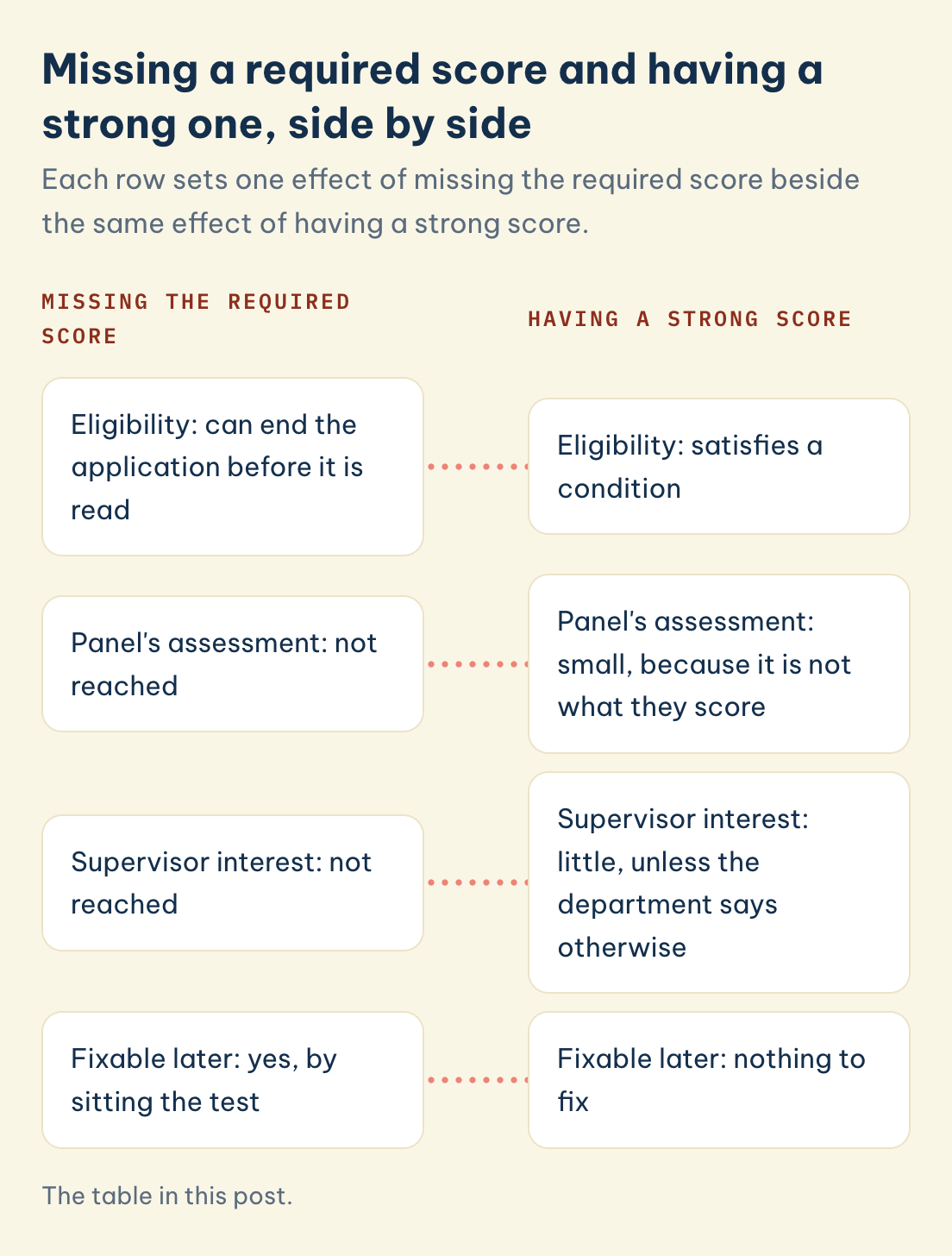
Direct answer: That asymmetry means effort spent on the test has a ceiling and effort spent on the proposal does not. Past the threshold a programme states, additional points change very little in the assessment that follows. A proposal, by contrast, is scored, discussed, and is the thing a supervisor decides on.
Missing a required score and having a strong one, side by side
Each row sets one effect of missing the required score beside the same effect of having a strong score.
Missing the required score
Having a strong score
Eligibility: can end the application before it is read
Eligibility: satisfies a condition
Panel's assessment: not reached
Panel's assessment: small, because it is not what they score
Supervisor interest: not reached
Supervisor interest: little, unless the department says otherwise
Fixable later: yes, by sitting the test
Fixable later: nothing to fix
Save this figure
| Missing the required score | Having a strong score | |
|---|---|---|
| Effect on eligibility | Can end the application before it is read | Satisfies a condition |
| Effect on the panel's assessment | Not reached | Small, because it is not what they score |
| Effect on supervisor interest | Not reached | Little, unless the department says otherwise |
| Can it be fixed later | Yes, by sitting the test | Nothing to fix |
Read the table as a resource-allocation problem rather than a comment on the test. Doctoral admission is decided on evidence of research capability, and doctoral qualifications are defined by the creation and interpretation of new knowledge, through original research of a quality to satisfy peer review and extend the forefront of the discipline, per the QAA (Quality Assurance Agency for Higher Education, 2024). That is the standard the file is being read against, and a quantitative reasoning score speaks to it only distantly.
The predictive-validity literature backs this up. Kuncel, Hezlett, and Ones (2001), publishing in Psychological Bulletin, ran a meta-analysis of GRE scores against graduate outcomes and found the test predicts some outcomes, such as first-year grades, more strongly than others, such as degree completion, which is exactly the kind of narrow, partial signal a screening threshold is built to use, not one strong enough to carry an admission decision on its own.
◆ Question 3 / 6 · What comes first
If I can only do one thing this term, which comes first?
Direct answer: The proposal, in most cases, because of one fact about test scores that applicants rarely factor in. Scores keep. Application cycles do not.
The GRE states this plainly: scores are reportable for 5 years following your test date (Educational Testing Service, n.d.). That is how long the test provider will still send the score; how long a given programme will accept it is a separate rule that can be shorter, so check the window each of your targets publishes. A cycle you miss because your proposal was not ready is simply gone, and with it whatever supervisor capacity existed in that department this year.
So the two tasks are not symmetric in time either. Preparing for the test is work whose product has a long shelf life. Preparing the proposal is work that expires against a deadline and, more importantly, is the thing that determines whether anyone wants to supervise you at all. Splitting 4 months evenly between the two usually produces a mediocre version of each.
Two conditions flip this advice, and both are worth checking before you follow it:
- The deadline for your target programmes falls this cycle and they require the score. Then the test is not a parallel task, it is a precondition, and there is nothing to sequence.
- A scholarship you are targeting weighs the score. Funding processes sometimes treat test performance more seriously than the admissions decision does, and that is a separate calculation from admission.
Check the reporting window with the provider for whichever test your programmes require, since the rules differ between tests and are occasionally revised.
◆ Question 4 / 6 · Check each programme
How do I find out whether my programmes actually require it?
Direct answer: On each programme's own admissions page, one programme at a time, and never by generalising from a country or a ranking band. Requirements are set at programme level and they change between intakes.
This one-programme-at-a-time check is not a counsel of perfection, it is the observed reality of the sector. Even inside a single business school, published requirements can differ substantially between programmes housed in the same faculty, to the point where one route asks for a proposal of 1,000 to 1,500 words and another asks for 3,000 to 5,000 (University of Edinburgh Business School, n.d.). If the proposal specification varies that much within one building, treating a test requirement as uniform across a country is not a shortcut, it is a guess.
Three things are worth recording for each target while you check: whether the test is required, whether a waiver route exists and on what basis, and whether the deadline for the score is the same as the deadline for the application. That third one catches people out, because a score has to arrive and be processed, not merely be sat.
◆ Question 5 / 6 · Waivers
Is a waiver good news?
Direct answer: A waiver is neutral, and it is worth understanding what it changes rather than treating it as a lucky escape. A programme that removes a test still has to distinguish between applicants, so the weight moves onto what remains, which is your proposal, your writing sample and your referees.
There is a second-order effect that applicants rarely consider. If the score is gone, a panel has one less independent signal about you, so the signals that remain are read more closely. That is fine if your proposal is strong. It is not fine if you were quietly relying on the score to compensate for a research direction you have not yet sharpened.
Some funding processes also continue to consider test performance even where the admitting programme does not require it. A waiver that helps your application may therefore be irrelevant, or occasionally unhelpful, to a scholarship you are also chasing. These are two decisions, made by two groups of people, on two timelines.
The funder layer is worth naming because it is easy to overlook. In the UK, bodies such as UK Research and Innovation (UKRI) and the Engineering and Physical Sciences Research Council (EPSRC) set their own eligibility rules that sit alongside, not inside, a university's admissions requirements. In the United States, a National Science Foundation (NSF) Graduate Research Fellowship follows its own separate review criteria, distinct again from a National Institutes of Health (NIH) training grant or a Fulbright Program award administered by the Institute of International Education (IIE). Comparable funders exist elsewhere too: the Australian Research Council (ARC) and Canada's Natural Sciences and Engineering Research Council (NSERC), alongside its Social Sciences and Humanities Research Council (SSHRC) counterpart, both publish separate eligibility pages that a proposal has to satisfy independently of the admitting university. Either way, the test question has to be checked twice: once for the programme, once for the funder.
◆ Question 6 / 6 · No score, no proposal
Where does this leave someone with no score and no proposal?
Direct answer: With a sequencing decision that should be made against your specific shortlist rather than in general, and usually with the proposal first.
In MAAS engagements this is a Stage 1 question rather than a Stage 2 one, because everything downstream inherits the answer. The shortlist is built by checking each department's published requirements item by item against your profile, and where a department's rules are genuinely ambiguous MAAS writes to ask. Once that table exists, the test question stops being abstract: you can see how many of your realistic targets require a score, when those scores are due, and whether dropping the test this term costs you a cycle or costs you nothing. Your expert drafts the proposal from your own account of your research and argues against that direction, while you review, edit and approve every document and submit the application yourself. The PhD Application Strategy and Execution page sets out the scope, and the PhD application guide explains how the shortlist and outreach sequence are built.
Frequently asked questions
I have a mid-range score. Should I retake it?
If it clears the stated threshold at your targets, retaking is usually the lowest-yield use of the time available, because the extra points land on a criterion the panel is not scoring. If it falls below a stated threshold, that is a different question with a clear answer.
Does a strong score compensate for a weaker degree classification?
Sometimes at the eligibility stage, where some programmes publish exactly this kind of alternative route. Rarely at the assessment stage, because the two are being read by different people for different purposes. Check whether your specific targets publish such a route rather than assuming one exists.
Do subject-specific tests work the same way?
Treat any test requirement the same way structurally: find out whether it is required, who checks it, and whether it is scored or merely verified. The asymmetry described here comes from that structure, not from the name of the test.
My score expires before I would start. Is that a problem?
It can be, and this is why the reporting window matters at application time rather than at enrolment. Check the date the programme requires the score to be reportable by, not the date you plan to arrive.
Can MAAS guarantee that a waiver will be granted?
No. Waivers are decided by the institution on its own criteria, and nobody outside it controls that. What can be done is establishing accurately whether a route exists for your profile before you spend a term preparing for a test you may not need.
How long before someone can look at my shortlist with me?
Within 48 hours when our network already covers that field. If it does not, MAAS opens a dedicated recruitment round for your case, which usually takes about 2 weeks.
Related MAAS guides
- Is there a PhD programme with lower entry requirements? for how published minimums differ from fit
- What does a reader notice in your PhD proposal first? for the self-check before you send anything
- Can you just email the professor yourself? for what outreach actually costs
- PhD application guide for admissions systems and contact order
- PhD Application Strategy and Execution for what an engagement covers
References
Educational Testing Service. (n.d.). Getting your GRE General Test scores. Retrieved August 17, 2026, from https://www.ets.org/gre/test-takers/general-test/scores/get-scores.html
Kuncel, N. R., Hezlett, S. A., & Ones, D. S. (2001). A comprehensive meta-analysis of the predictive validity of the Graduate Record Examinations: Implications for graduate student selection and performance. Psychological Bulletin, 127(1), 162–181. https://doi.org/10.1037/0033-2909.127.1.162
Quality Assurance Agency for Higher Education. (2024). The frameworks for higher education qualifications of UK degree-awarding bodies (2nd ed.). https://www.qaa.ac.uk/docs/qaa/quality-code/the-frameworks-for-higher-education-qualifications-of-uk-degree-awarding-bodies-2024.pdf
University of Edinburgh Business School. (n.d.). PhD research proposal guidelines. Retrieved August 17, 2026, from https://www.business-school.ed.ac.uk/phd/research-proposal-guidelines
A free 20-minute consultation with a MAAS adviser, to look at your shortlist of programmes together and work out the order in which to do things.
Book Free Discovery ▸