
◆ PhD application
How long should a PhD writing sample be, and what is it judged on?
Category: admissions
Last updated: 2026-10-01

Most advice about the writing sample starts from a page count, and the page count is the one number that cannot be compared from one department to the next. The same graduate school can ask for 25 pages in one field, 5,000 to 10,000 words in another and 9,000 words in a third, and a department in the United Kingdom can cap written work at 2,000 words. What carries across all of them is the question the committee is trying to answer, which is whether you can build an argument and defend it.
Direct answer: Committees read a writing sample for how you build an argument, not for its topic. The limits compared here range from 2,000 words at York to 50 pages at Stanford Sociology, and the unit changes between programmes, so read each department's page. Pick the paper with the tightest reasoning and cut to the cap without losing analysis.
Asked on 1 October 2026, Perplexity and ChatGPT in guest mode both gave the same core advice: show a clear question, original argument and careful use of evidence, and treat a stated limit as a ceiling. Perplexity added that humanities samples often run 15 to 25 double-spaced pages. Neither named the cases that make a page count misleading, such as a cap given in single-spaced pages or in words, or a department that does not want a sample on your proposed topic at all. The official pages below do.
◆ Question 1 / 6 · What committees look for
What does a PhD admissions committee look for in a writing sample?
Direct answer: Committees look for evidence of how you think on the page: a question, a claim, evidence used analytically and a structure the reader can follow. Stanford's Department of Religious Studies names it plainly, asking for "the capacity to think your way through a problem and frame an argument". Topic and polish matter less than that.
The Department of Religious Studies at Stanford University (n.d.) asks for recent work of 15 to 25 double-spaced pages that shows "a clear writing style" and the ability to reason through a problem, and lists "evidence of intellectual gift in the writing sample" among the four primary considerations in selection. The University of York (n.d.-a) says written work is assessed for "analytical and critical thinking skills", for "your ability to construct and defend an argument" and for your powers of expression. The Department of Sociology at Stanford University (n.d.) asks for "original work giving evidence of writing ability and the capacity for research, analysis, and original thought at the graduate level".
Three departments with different cultures, one test. The Goldman School of Public Policy at the University of California, Berkeley (n.d.) puts the negative version: it strongly prefers a sample that "goes beyond just a literature review or summary of existing research", because the sample exists to make it evident that the student can undertake policy research. A paper that summarises well and claims nothing fails that test however well written it is.
Reviewers also read small signals. In a study of ten highly selective doctoral programmes that included 86 interviews and 22 hours of committee observation (Posselt, 2015), Posselt (2016, p. 156) writes that "reviewers may read meanings and value judgments into each of these", and the appeal of a writing sample's introduction is one of the details named in that passage, one that can tip a borderline case between admission and rejection. The introduction of your sample is therefore not a warm-up. It is the place where the committee decides whether the argument is worth following.
◆ Question 2 / 6 · How long it should be
How long should a PhD writing sample be?
Direct answer: There is no standard length. The pages compared here range from 2,000 words to 50 pages, and the unit varies even inside one university: Princeton asks for 25 pages in Politics, 5,000 to 10,000 words in Philosophy and a 9,000-word maximum in Religion. The only reliable rule is to read your own department's page.
| Programme | What the official page asks for | Unit |
|---|---|---|
| Stanford, Sociology | up to 50 pages; a short, effectively written sample is preferable | pages |
| Princeton, Politics, Sociology, Economics | 25 pages maximum, bibliography and title page not counted | pages |
| Princeton, History | 25 to 30 pages, including bibliography | pages |
| Princeton, Philosophy | 5,000 to 10,000 words | words |
| Princeton, Religion | 9,000 words maximum, relevant to the proposed subfield | words |
| Berkeley, Goldman School of Public Policy | under 30 double-spaced pages, solo-authored original research | double-spaced pages |
| Stanford, Religious Studies | 15 to 25 pages, double-spaced, with a preface paragraph | double-spaced pages |
| UC Santa Cruz, Anthropology | no more than 20 pages | single-spaced pages |
| UC San Diego, Literature | 25 pages, a single substantive work preferred | pages |
| Cambridge, Literature, Culture and Thought | about 5,000 to 10,000 words, single-authored | words |
| York, PhD in History | no more than 2,000 words | words |
| York, PhD in Philosophy | one essay of 3,000 words | words |
Official pages read on 1 October 2026. Limits change by admissions year, so check the current cycle.
The University of Cambridge (n.d.) asks Literature, Culture and Thought applicants for a single-authored sample of about 5,000 to 10,000 words with references not counted, while the University of York (n.d.-b) allows no more than 2,000 words of written work for a PhD in History, excluding notes and bibliography.
Two things in the table are easy to miss. The first is the unit: Princeton Graduate School (n.d.) states that its page limit does not include the bibliography or title page unless a department says otherwise, while its History and History of Science programmes count the bibliography inside 25 to 30 pages. The second is spacing. The University of California, Santa Cruz (n.d.) asks for no more than 20 single-spaced pages, which on a common rule of thumb of about 250 words per double-spaced page is nearer 40 double-spaced pages, so the same number of pages can mean twice the text. On the same rule of thumb, and if Stanford's 50 pages are double-spaced (the department accepts either spacing), the spread between York's 2,000 words and Stanford Sociology's 50 pages is roughly six-fold. Treat the conversion as an approximation and keep to the unit each department uses.
◆ Question 3 / 6 · Choosing the paper
How do I choose which paper to submit as a writing sample?
Direct answer: Choose the paper in which your reasoning is easiest to follow, not the one you are proudest of or the one closest to your proposed topic. The test is whether a committee that read only this paper would understand how you build a case. Single-authored, original work beats a long review of the literature.
Three official pages point the same way. Berkeley's Goldman School requires a solo-authored original research paper, and Cornell's ILR School (n.d.) advises against co-authored work unless you provide excerpts that you wrote entirely yourself. Stanford Sociology accepts an honours or master's thesis, a published paper or a co-written paper, and a short sample is preferred to a long one when the quality is equal. Read together, these pages ask for the same thing: a piece in which your own contribution can be seen.
ChatGPT framed the same test as a question: if a committee read only this paper, would it understand how you think as a researcher? That question is worth asking about each candidate, and it usually eliminates two kinds of paper. One is the broad survey that never commits to a claim. The other is the technical report whose reasoning sits in tables the reader has to rebuild.
◆ Question 4 / 6 · Trimming to fit
How do I trim a longer paper to fit the page limit?
Direct answer: Cut what repeats, compress background and shorten the literature section, and protect the thesis, the evidence and the reasoning that links them. Do not delete the last pages because they are last. If your best paper is a thesis chapter, an excerpt with a short note on where it sits in the larger argument is allowed by some programmes.
ChatGPT's answer on this point was specific and sound: preserve the question, context, central claim, evidence and implications, cut repetition first, and rewrite transitions after cutting so that the paper does not read as amputated. It also warned against the common mistake of keeping exposition while cutting analysis, because for a PhD application the reasoning is what the committee most needs to see.
Some departments tell you how to handle length. Stanford Sociology invites applicants who submit more than the usual length to indicate which pages the committee should review. Stanford Religious Studies asks for a preface paragraph that explains why you chose the paper and why the topic matters for the study of religion, written for faculty outside your subfield, and for an excerpt from a longer work it asks for a cover sheet explaining the larger project. UC San Diego (n.d.) accepts a single substantive work of 25 pages or more, excluding the bibliography, and also accepts multiple shorter samples that add up to the same length. Where a department publishes no such rule, ask it before you cut, because an excerpt that is welcome in one department can look like an incomplete paper in another.
◆ Question 5 / 6 · Matching your topic
Does the writing sample have to match my proposed research topic?
Direct answer: It depends on the department, and the departments disagree. Princeton Religion wants a sample relevant to the proposed subfield, Stanford Religious Studies says related if possible, and Cornell's ILR School says it does not necessarily need to be on the topic of your application field. Read the line that applies to your programme.
Three official positions on matching your topic
Tap a department to read what its page says, as the post reports it. The departments disagree, so read the line that applies to your programme.
Item 1 of 3
Princeton, Religion
The 9,000-word sample must be relevant to the proposed academic subfield.
Item 2 of 3
UC San Diego
It prefers a work related to the field you name in your statement of purpose, but accepts samples that are only tangentially related.
Item 3 of 3
Cornell, ILR School
The sample should help the committee understand your writing, analytical or communication abilities, and it does not necessarily need to be on the same topic as the field you apply to.
Save this figure
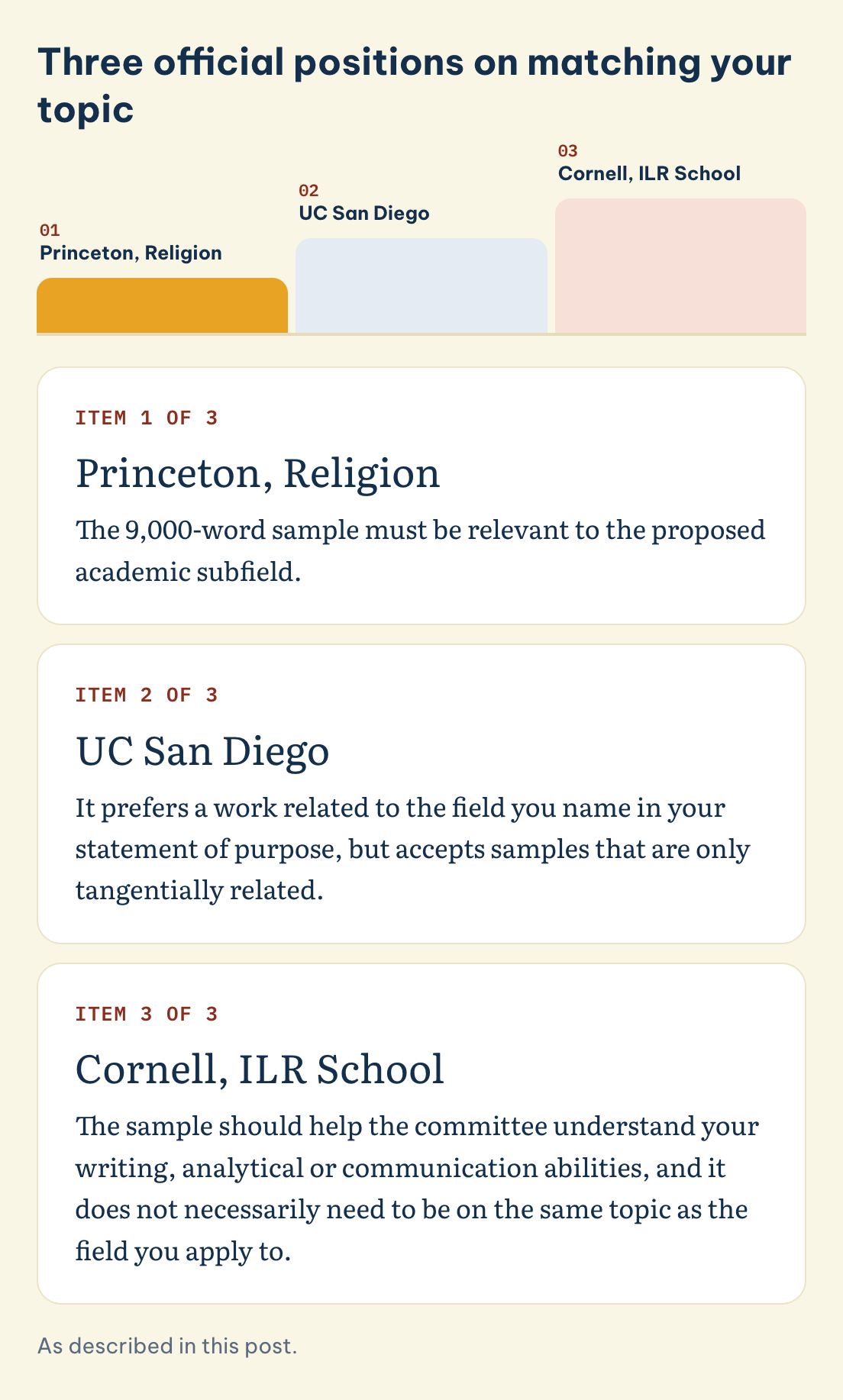
Cornell's ILR School (n.d.) says the sample should help the committee understand your writing, analytical or communication abilities and "does not necessarily need to be on the same topic" as the field you apply to. UC San Diego (n.d.) goes in a middle direction: it prefers a work related to the field you name in your statement of purpose but accepts samples that are only tangentially related. Princeton (n.d.) states for Religion that the 9,000-word sample must be relevant to the proposed academic subfield.
When the rule is silent, the argument-first reading above gives a usable default. A sample on a nearby topic with a tight argument shows the committee more than a sample on your exact topic that summarises. A related topic is a bonus, not a condition, unless the department writes the condition down.
◆ Question 6 / 6 · Writing it in Vietnamese
Can a writing sample be written in Vietnamese?
Direct answer: Usually not as it stands. Princeton's Graduate School says samples should be written in English unless a programme states otherwise, and Stanford Sociology requires an English translation of any paper originally written in another language. Check whether the department says who may produce the translation.
Princeton Graduate School (n.d.) notes that a few programmes ask for another language, such as a preference for French in French and Italian or a requirement of Spanish or Portuguese in Spanish and Portuguese. For a Vietnamese applicant, the safe plan is to start from the language the department asks for and to check, before any translation is made, whether the programme says anything about who translates. Stanford's sociology page requires translation but, in the text read for this article, does not say who must do it.
Where MAAS fits
The sample has to be your own work, written in your own words, because the committee is reading it as evidence of how you think. MAAS EdTech does not write or edit a writing sample for you. What a mentor can do is read your draft and tell you where the argument is thin, which of two candidate papers reasons more clearly, or whether a cut removed analysis rather than repetition, and then you decide and revise. The wider process of preparing an application is laid out in the PhD application guide, and the one-to-one version of the planning work is the PhD application strategy service.
References
Cornell University, ILR School. (n.d.). Program and admissions requirements. Retrieved October 1, 2026, from https://www.ilr.cornell.edu/programs/graduate-degree-programs/doctoral-program/doctoral-program-and-admissions-information
Goldman School of Public Policy, University of California, Berkeley. (n.d.). Applying for the PhD. Retrieved October 1, 2026, from https://gspp.berkeley.edu/programs/doctoral-program-phd/applying-for-the-phd
Posselt, J. R. (2015). Disciplinary logics in doctoral admissions: Understanding patterns of faculty evaluation. The Journal of Higher Education, 86(6), 807–833. https://doi.org/10.1080/00221546.2015.11777385
Posselt, J. R. (2016). Inside graduate admissions: Merit, diversity, and faculty gatekeeping. Harvard University Press. https://www.hup.harvard.edu/books/9780674915640
Princeton University, Graduate School. (n.d.). Writing sample. Retrieved October 1, 2026, from https://gradschool.princeton.edu/admission-onboarding/prepare/writing-sample
Stanford University, Department of Religious Studies. (n.d.). Admissions. Retrieved October 1, 2026, from https://religiousstudies.stanford.edu/graduate/admissions
Stanford University, Department of Sociology. (n.d.). Applying for the PhD. Retrieved October 1, 2026, from https://sociology.stanford.edu/doctoral/phd-program/applying-phd
University of California, Santa Cruz, Graduate Admissions. (n.d.). Anthropology (Ph.D.). Retrieved October 1, 2026, from https://graduateadmissions.ucsc.edu/graduate-programs/anthropology-phd/
University of California San Diego, Department of Literature. (n.d.). Application guide. Retrieved October 1, 2026, from https://literature.ucsd.edu/grad-phd/admissions/application-guidelines.html
University of Cambridge, Postgraduate Admissions. (n.d.). PhD in Literature, Culture and Thought: Apply. Retrieved October 1, 2026, from https://www.postgraduate.study.cam.ac.uk/courses/directory/mmmmpdlct/apply
University of York. (n.d.-a). Written work: Postgraduate research. Retrieved October 1, 2026, from https://www.york.ac.uk/study/postgraduate-research/apply/documents/written-work/
University of York. (n.d.-b). PhD in History. Retrieved October 1, 2026, from https://www.york.ac.uk/history/study/postgraduate-research/phd-history/
A free 20-minute consultation with a MAAS adviser, to talk through which paper to submit and how to cut it.
Book Free Discovery ▸