
◆ Admissions
How do IELTS Speaking topics work in Part 2 and Part 3?
IELTS Speaking topics change shape across the three parts of the test. Part 1 stays on familiar subjects such as home, family, work, studies and interests, Part 2 hands you a task card with one topic, and Part 3 takes that same topic into a more general and abstract discussion (IELTS, n.d.-a). This guide explains how the topic travels from the card into the discussion, and how to prepare for topics you cannot predict.
◆ Question 1 / 6 · How are IELTS Speaking
How are IELTS Speaking topics organised across the three parts?
Direct answer: The Speaking test lasts 11 to 14 minutes in three parts. Part 1 runs 4 to 5 minutes on familiar topics, Part 2 lasts 3 to 4 minutes including one minute of preparation, and Part 3 runs 4 to 5 minutes on issues linked to the Part 2 topic, according to the official IELTS (n.d.-a) format page.
The whole test takes 11 to 14 minutes, and the official description of it is short, so each line matters for preparation. IELTS (n.d.-a) says that in Part 1 "the examiner asks you general questions on some familiar topics, such as home, family, work, studies or interests." In Part 2 "the examiner gives you a task card which asks you to talk about a particular topic." In Part 3 "you and the examiner discuss issues related to the topic in Part 2 in a more general and abstract way." Read together, those sentences show that the test has one personal block and one linked pair. Part 1 can jump between several unrelated subjects, while Parts 2 and 3 share a single theme that moves from your own story to society in general.
| Part | Length | What the topic looks like | Preparation time |
|---|---|---|---|
| Part 1 | 4 to 5 minutes | Several familiar topics about you | None |
| Part 2 | 3 to 4 minutes | One topic on a task card | One minute, with pencil and paper |
| Part 3 | 4 to 5 minutes | Wider issues linked to the Part 2 topic | None |
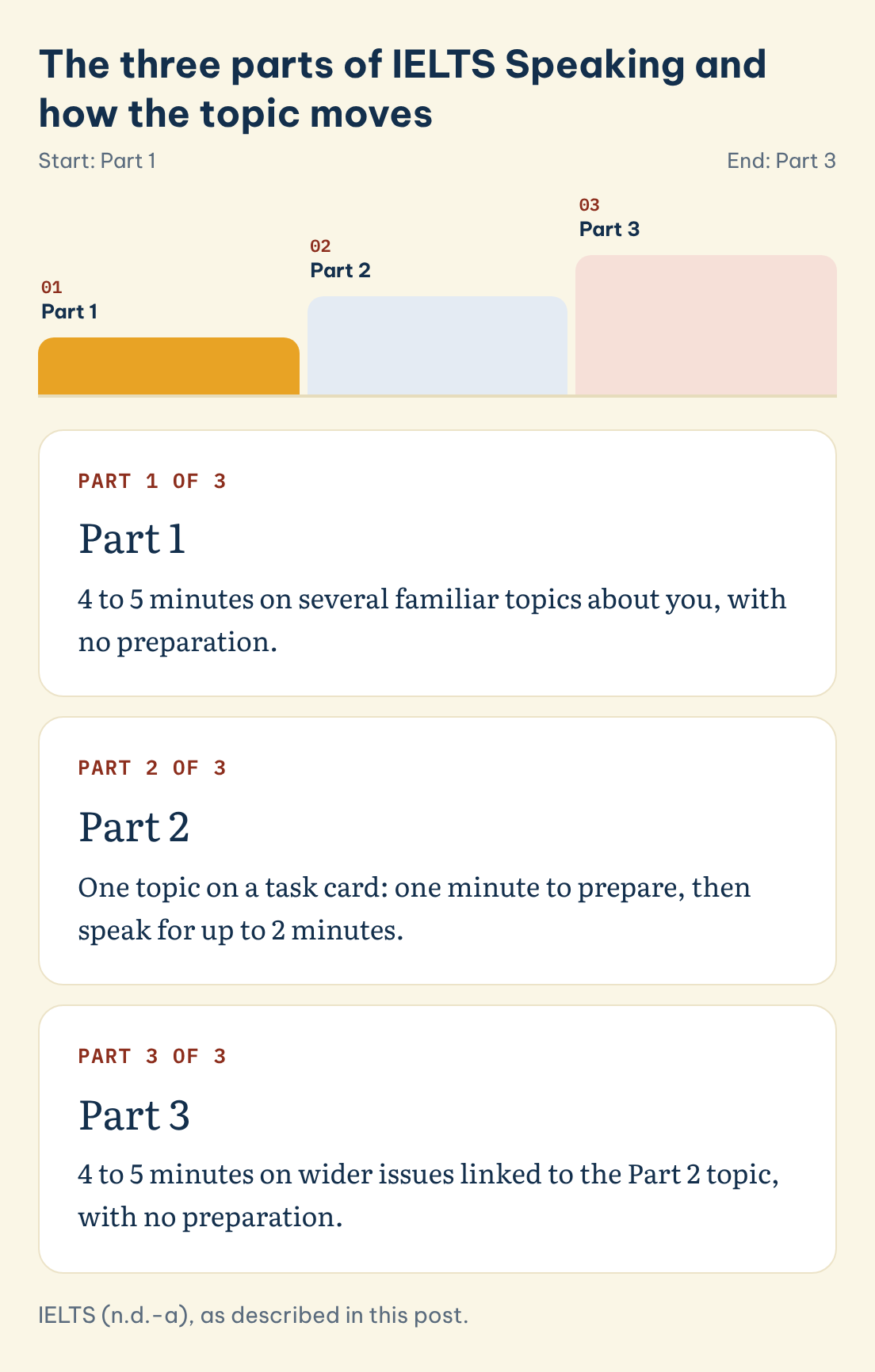
The three parts of IELTS Speaking and how the topic moves
Tap a part to see what the topic looks like.
Part 1 of 3
Part 1
4 to 5 minutes on several familiar topics about you, with no preparation.
Part 2 of 3
Part 2
One topic on a task card: one minute to prepare, then speak for up to 2 minutes.
Part 3 of 3
Part 3
4 to 5 minutes on wider issues linked to the Part 2 topic, with no preparation.
Save this figure
The same four criteria apply to every part: fluency and coherence, lexical resource, grammatical range and accuracy, and pronunciation (IELTS, n.d.-a). A topic is therefore a vehicle for showing those four things, and not a test of what you know about the subject itself.
◆ Question 2 / 6 · What do IELTS Speaking
What do IELTS Speaking topics in Part 2 look like?
Direct answer: Part 2 gives you a task card with one topic, with points to cover listed underneath. IELTS (2023) gives examples such as a book, a leader or a family member. You get one minute to prepare and then speak for up to 2 minutes before the examiner stops you, as the IELTS (n.d.-a) format page sets out.
IELTS (n.d.-a) is specific about the mechanics: "You have one minute to prepare your talk, and the examiner will give you a pencil and paper to make notes." IDP IELTS (2021) advises using that minute for notes on "the three bullet points and on the final question," and reassures candidates that "You are not tested on what you write, so don't worry about spelling." A useful habit is to write one or two words per bullet, not sentences, because a sentence takes too long to write and tempts you to read it aloud.
The 2-minute limit also changes how you should judge a talk. IDP IELTS (2021) reminds candidates that "the examiner will interrupt you at the 2-minute mark," and says that if you have not finished, "you have already shown the examiner that you can speak at length." Running out of time with points still to cover is therefore safer than running out of ideas after 50 seconds. Plan more content than you think you need, and let the examiner close the talk for you.
◆ Question 3 / 6 · How does Part 3 build
How does Part 3 build on the Part 2 topic?
Direct answer: Part 3 keeps the Part 2 theme but moves from your experience to general issues. IELTS (2023) says examiners look for the capacity "to speak about related issues in much greater depth, provide analysis, and justify their opinions," with no preparation time and occasional interruptions.
The shift is easiest to see with one theme. If your Part 2 card asks you to describe a teacher who helped you, Part 3 is unlikely to ask about that teacher again. It is more likely to ask why some teachers motivate students better than others, or how technology changes the role of teachers. IELTS (2023) describes the aim as sharing "more about your general view as opposed to a personal experience," and warns that you should "expect to be interrupted by the examiner from time to time during this part of the test."
The same article suggests a four-step pattern for each Part 3 answer: give a direct answer, explain with reasons, provide an example, and add an alternative or a consequence (IELTS, 2023). That pattern fits the band descriptors, because long answers produced without noticeable effort are what separate band 7 from band 6. At band 7 for fluency and coherence, a candidate is "Able to keep going and readily produce long turns without noticeable effort" (IELTS, n.d.-b, p. 1), whereas at band 6 the descriptor reads "Able to keep going and demonstrates a willingness to produce long turns" (IELTS, n.d.-b, p. 2).
◆ Question 4 / 6 · Should you learn IELTS
Should you learn IELTS Speaking topics with answers or a 100-topic PDF?
Direct answer: Topic lists and sample answers are useful for vocabulary and structure, but not as scripts to memorise. IDP IELTS (2021) suggests a memorised opening phrase if it helps calm nerves, and the band descriptors reward language used flexibly across topics rather than recited text (IELTS, n.d.-b).
Lists titled "100 topics with answers" or "topics 2026" appear high in search results, which suggests many candidates hope to predict the card. The official format page does not list current Part 2 cards, so any "2026" list is a collection made by a third party, and no list can promise that your card will be on it. A safer way to use such a list is to group its prompts by theme and practise talking about each theme from several angles.
Memorising a full answer also carries a scoring cost. The lexical resource descriptor at band 7 speaks of a "Resource flexibly used to discuss a variety of topics" (IELTS, n.d.-b, p. 1), and a rehearsed paragraph tends to fit the card only partly, which makes the speech sound detached from the question. The only memorised language IDP IELTS (2021) mentions is a short opener such as "Today, I would like to describe ... to you." The rest of the talk should come from the notes you made in the one minute of preparation.
◆ Question 5 / 6 · How can you practise topics
How can you practise topics you cannot predict?
Direct answer: Practise by theme and under test timing. Pick a theme, give yourself one minute of notes, speak for 2 minutes, then answer three general questions on the same theme without preparation. Wilson (2021) describes impromptu speaking tasks as "a great way for students to improve confidence and build fluency in speaking."
A theme-based plan covers far more cards than a list of model answers. The table below groups common prompt types into themes you can rehearse; it is a practice grouping by MAAS, not an official list of test cards.
| Theme | Part 2 style prompt | Part 3 style question |
|---|---|---|
| People | Describe a person who helped you | Why do some people become good mentors? |
| Places | Describe a place you like to visit | How does tourism change a town? |
| Objects | Describe something you own that is useful | Do people buy too many things today? |
| Events | Describe a celebration you enjoyed | Are traditional festivals still important? |
| Learning | Describe a skill you learned recently | Should schools teach practical skills? |
| Technology | Describe an app you use often | How has technology changed communication? |
Record each attempt and listen back for long pauses, repeated words and points you skipped. Wilson (2021) also recommends starting with shorter speaking times for learners at lower levels so that confidence can build, which is a sensible way to work up to the full 2 minutes. Because the four criteria are the same in every part (IELTS, n.d.-a), one recorded practice session trains your Part 1, Part 2 and Part 3 skills together.
Research on the test also suggests where theme practice should stop. Nakatsuhara et al. (2023) compared the speaking functions students use in online university classes with those elicited by the video-call version of the IELTS Speaking Test, and found that some functions appear rarely in both settings. They observe that "The elicitation of some of these functions, such as staging, summarising, persuading, seems task-dependent" (Nakatsuhara et al., 2023, p. 52). For test preparation, that points to the functions the task does ask for in Part 3: giving an opinion, explaining a reason and supporting it with an example. Seminar skills such as summarising a group discussion still matter for your degree, but they belong in your study plan rather than in a list of Speaking topics.
◆ Question 6 / 6 · How can MAAS help you
How can MAAS help you prepare for IELTS Speaking?
Direct answer: A MAAS tutor can run timed Part 2 and Part 3 practice with you, give feedback against the four public criteria, and help you build vocabulary by theme. The sessions are tutoring: you do the speaking, and MAAS does not set a target band.
MAAS one-to-one tutoring works in live sessions with a tutor; ask during the free consultation whether a tutor for IELTS Speaking practice is available for your timeline. For IELTS Speaking, that usually means mock long turns with a timer, a follow-up discussion in the Part 3 style, and notes on which descriptor lines your answers already meet. If you are preparing IELTS for a doctoral application, our guide to why a PhD offer hinges on your lowest IELTS band explains how universities read the Speaking score next to the other three skills.
Frequently asked questions
How many topics are there in the IELTS Speaking test?
Part 1 covers several familiar topics, while Parts 2 and 3 share one topic from the task card, according to IELTS (n.d.-a). The official pages do not publish a fixed bank of current cards.
How long do I speak in IELTS Speaking Part 2?
You speak for up to 2 minutes after one minute of preparation, and the whole part lasts 3 to 4 minutes, as IELTS (n.d.-a) states.
Can I write notes in Part 2?
Yes. IELTS (n.d.-a) says the examiner gives you a pencil and paper, and IDP IELTS (2021) adds that your notes are not marked.
Is Part 3 about the same topic as Part 2?
Yes, but at a more general and abstract level. IELTS (2023) describes the aim as sharing your general view rather than a personal experience.
Should I memorise IELTS Speaking answers?
Use sample answers for ideas and vocabulary, not as scripts. IDP IELTS (2021) mentions a memorised opening phrase as a way to calm nerves, while the band descriptors reward language used flexibly (IELTS, n.d.-b).
What happens if the examiner stops me before I finish Part 2?
Nothing bad. IDP IELTS (2021) says that by then you have already shown you can speak at length.
References
IDP IELTS. (2021, May 13). IELTS Speaking: How to perform at your best in the part 2 long turn. https://ielts.idp.com/prepare/article-ielts-speaking-test-long-turn-part-2
IELTS. (n.d.-a). IELTS Academic: Speaking test format. Retrieved October 22, 2026, from https://ielts.org/take-a-test/test-types/ielts-academic-test/ielts-academic-format-speaking
IELTS. (n.d.-b). IELTS Speaking band descriptors [PDF]. Retrieved October 22, 2026, from https://ielts.org/cdn/ielts-downloadable-assets/ielts-guidance-and-support/ielts-guides/ielts-speaking-band-descriptors.pdf
IELTS. (2023, February 1). Three parts of IELTS Speaking, and what to look out for. https://ielts.org/news-and-insights/three-parts-of-ielts-speaking-and-what-to-look-out-for
Nakatsuhara, F., May, L., & Khabbazbashi, N. (2023). Exploring the speaking construct in academic settings in a digital age (IELTS Research Reports Online Series No. 4/23). British Council, Cambridge Assessment English and IDP: IELTS Australia. https://ielts.org/cdn/Research/exploring-speaking-construct-in-academic-settings-in-digital-age-nakatsuhara-et-al-2023.pdf
Wilson, M. (2021, May 21). Using impromptu speaking tasks to prepare learners for IELTS Speaking. IELTS. https://ielts.org/news-and-insights/using-impromptu-speaking-tasks-to-prepare-learners-for-ielts-speaking
Not sure how this guide applies to your own case? Talk it through with MAAS in a free 20-minute consultation.
Book a free consultation ▸