
◆ PhD Admissions
Is an English-taught master's enough to skip IELTS for a PhD?
Category: admissions
Last updated: 2026-09-24

Two graduate schools of the same university, Leiden University, answer this question in opposite ways. The Graduate School of Social and Behavioural Sciences waives the English test for anyone holding "an English-speaking master's degree from a foreign university". The Graduate School of Humanities accepts a degree only from a fixed list of countries or from a Dutch research university, and adds that "only these documents are accepted". A Vietnamese master's taught in English passes the first school's rule and fails the second's.
Direct answer: Sometimes. Whether an English-taught master's replaces IELTS depends on which of three proof rules the page you are reading applies: a list of countries, the language of your programme, or a document from your university confirming that language. A Vietnamese degree never meets the first rule, and often meets the second only on paper.
Asked the same question on 24 September 2026, Perplexity answered "usually, not necessarily" and advised requesting a medium-of-instruction letter. That advice holds at some doctoral schools and is useless at others, and the difference is worth knowing before you book or skip a test date.
◆ Section 1 / 7 · IELTS in the Netherlands
Is IELTS required for a PhD in the Netherlands if your master's was taught in English?
Direct answer: Not at every Dutch university, but the waiver is a rule of the graduate school, not of the country. Delft University of Technology (n.d.) exempts English-taught master's degrees "in principle", Leiden's social sciences school exempts foreign English-taught master's, and Leiden's humanities school exempts only degrees from nine named countries or a Dutch university.
Delft University of Technology (n.d.) states the widest version of the rule. Native speakers are exempt, and so, "in principle", are non-native applicants "who have obtained an English-taught Master's degree", with no condition on where that degree was earned. The same page keeps a reserve power: if the selection committee doubts your English, you "may also be asked to do a placement test", which "can only be taken at TU Delft and not online". The exemption therefore removes the certificate, not the scrutiny.
Leiden University (n.d.-b), at its Graduate School of Social and Behavioural Sciences, reaches the same result in plainer terms. The test obligation "does not hold" for holders of a Dutch master's degree, a bachelor's or master's degree from an English-speaking country, or "an English-speaking master's degree from a foreign university". Everyone else shows an IELTS of 7.0 or a TOEFL internet-based score of 100, taken within the last two years.
Leiden University (n.d.-a), at its Graduate School of Humanities, draws the line elsewhere. Exemption requires secondary or higher education completed in the USA, the UK, Ireland, New Zealand, Australia, Canada (except French-taught programmes), Singapore, South Africa or Malta, an International Baccalaureate diploma taught in English, or an English-taught MA from a Dutch research university. The requirement it waives is also steeper: IELTS 7.0 overall with 7.0 in each of the four components.
◆ Section 2 / 7 · Two schools, opposite answers
Why do two schools at one university give opposite answers?
Direct answer: Because each graduate school writes its own proof rule, and the rules measure different things. One asks where your degree came from, another asks what language it was taught in. A Vietnamese English-taught master's is judged on its country under the first rule and on its programme under the second, so it can pass one and fail the other.
The country-list rule treats location as the evidence. It assumes that a degree earned in Australia or Singapore was lived in English, inside and outside the classroom, and it declines to assess programmes one by one. The programme-language rule treats the curriculum as the evidence and accepts that an English-taught master's in Hanoi or Ho Chi Minh City can do the same work. Neither rule is careless; they simply answer different questions about the same applicant.
Research on English-medium instruction explains why a cautious school might prefer the country list. A systematic review of 83 studies of English-medium instruction in higher education concluded that "the research evidence to date is insufficient to assert that EMI benefits language learning" (Macaro et al., 2018, p. 36). In Vietnam specifically, Vu and Burns (2014) reported from a two-year project on a new English-medium undergraduate programme that lecturers were challenged by their own language abilities and by students' language competence. Sahan et al. (2025), drawing on questionnaires from 1,377 students and 231 teachers across 17 universities in Thailand and Vietnam, found that the first language is used in these classrooms, sparingly, as a teaching tool. An admissions office cannot see how much of your programme was delivered in English, so a label alone may not persuade it.
◆ Section 3 / 7 · German universities and letters
Do German universities accept a medium-of-instruction letter for a PhD?
Direct answer: Some require it, some accept a transcript instead, and some ignore it entirely. Frankfurt School asks graduates of non-English-speaking countries for proof from their university, the ZEF doctoral programme in Bonn accepts a transcript stating English as the medium, and BTU Cottbus-Senftenberg exempts only degrees from countries with English as an official language.
Frankfurt School of Finance & Management (n.d.) sets its bar at TOEFL iBT 100 or IELTS 7.0, and allows a waiver for applicants whose degree was "taught exclusively in English". Its condition for everyone outside the English-speaking world is explicit: "you have to submit proof from your university that the medium of instruction was English". Here the letter Perplexity recommended is not optional advice but the only route to the waiver.
Center for Development Research (n.d.), for its Bonn International Graduate School for Development Research, asks for IELTS band 6 or TOEFL internet-based 80, and lets applicants who completed university education in English submit proof instead, "e.g. the transcript of records stating that the medium of instruction for your degree was English". The same page tells applicants holding a degree from China, India or Vietnam to upload documents from the Akademische Prüfstelle (APS), which is a separate certification step from the language question.
Brandenburg University of Technology Cottbus-Senftenberg (n.d.) runs the country-list rule. A PhD applicant may skip the certificate after a degree completed in English in a country where English is an official language, or in Germany. The list comes from uni-assist, dated March 2019, and includes Singapore, India, the Philippines and Hong Kong. Vietnam is not on it, so no letter from a Vietnamese university can open this door.
◆ Section 4 / 7 · How the check works
How do universities check that a master's was really taught in English?
Direct answer: Usually by reading the wording on your degree documents, not the language they are printed in. The strictest rules want the medium of instruction stated on the diploma, the official transcript or the diploma supplement, and some state outright that a separate letter from your university is not enough.
The University of Twente (n.d.) gives the clearest example, although its rule governs bachelor's and master's admission rather than doctoral admission. It requires the language of instruction to appear on the degree certificate, the official final transcript or the diploma supplement, warns that a transcript issued in English "is not the same" as English being stated as the language of instruction, and says a statement or proficiency letter from the university "is not sufficient". The same logic appears in the ZEF wording above, which names the transcript rather than a letter.
For a Vietnamese graduate, that turns into a check you can run tonight. Open your diploma, your official transcript and any diploma supplement, and look for a sentence that names English as the language of instruction for the whole programme. A transcript printed in English, or a programme title containing the word "international", does not say that. If the sentence is missing, find out from your university which office can issue it and on what document, because a doctoral school that accepts letters may still specify the form of that letter.
◆ Section 5 / 7 · IELTS scores asked
What IELTS score do Dutch and German PhD programmes ask for?
Direct answer: Between band 6 and band 7 overall on the pages checked for this article, often with a floor for each section. ZEF asks for 6, Delft for 7.0 with 6.5 in each section, Frankfurt School for 7.0, and Leiden's humanities school for 7.0 in every one of the four components.
Delft section floor
6.5
at least, in each section, on top of 7.0 overall
IELTS scores on the Dutch and German doctoral pages checked
Each bar shows the IELTS band that one page asks for.
Save this figure
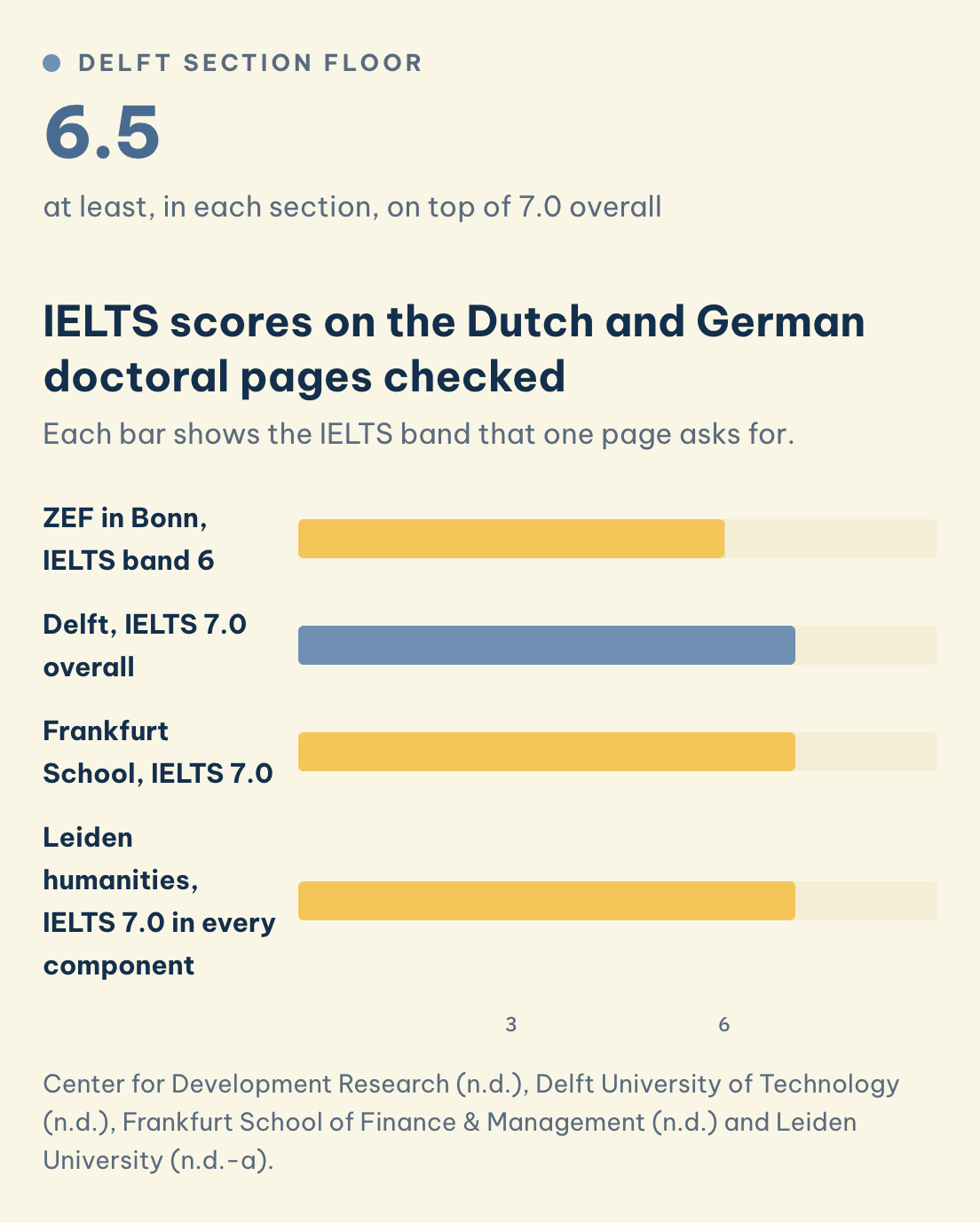
Delft University of Technology (n.d.) accepts IELTS Academic at 7.0 overall with at least 6.5 per section, and lists TOEFL iBT at an overall band of 5 with 4.5 per section for tests taken from 21 January 2026, or 100 overall with 22 per section for older tests. Leiden University (n.d.-a) sets IELTS 7.0 in every component and TOEFL internet-based 100, and refuses IELTS General Training, IELTS Academic Online and TOEFL home editions except when test centres are closed. Test scores at both Leiden schools expire after two years.
The spread matters more than any single number. A Vietnamese applicant with IELTS 6.5 overall qualifies at ZEF and falls short at Delft, Leiden and Frankfurt School, while an applicant with 7.0 overall and a 6.0 in writing clears Frankfurt School's published overall score and still fails Delft's and Leiden's section floors. Why a section floor can sink an application that clears the overall score is covered in our guide to IELTS band scores per skill.
◆ Section 6 / 7 · Dutch or German needed
Do you need Dutch or German for a PhD taught in English?
Direct answer: For admission, usually not, but check which language your dissertation will be written in. Leiden's humanities school ties its language requirement to the dissertation language, asking for Dutch at CEFR level C1 from international candidates who will write in Dutch, and waiving it for a degree taught in that same language.
Leiden University (n.d.-a) makes the logic explicit. The requirement is "for the language in which you will write your dissertation", so a candidate writing in English needs English, a candidate writing in Dutch needs Dutch at C1, and a candidate writing in another language needs that language at C1. The exemption follows the same logic: a foreign university-level diploma, comparable to a Dutch MA, "where the programme was taught in the language that is the same as the dissertation will be written in".
None of the German doctoral pages checked for this article asks for German at admission. That is a narrower claim than it sounds, because enrolment, contracts and daily life follow their own rules, and this article only read the admission pages.
◆ Section 7 / 7 · Before you book the test
What to check before you book, or skip, the test
Read the language section of the exact graduate school you are applying to, not the university's general admissions page. Identify which rule it uses: a country list, programme language, or a document requirement. If it is a country list and Vietnam is absent, book the test. If it accepts English-taught degrees, check whether your diploma or transcript states English as the medium of instruction, and ask whether a letter is accepted if it does not. If a placement test is reserved, as at Delft, treat the waiver as provisional.
If you are still choosing between countries, the PhD application resource hub sets out how the admission routes differ before language proof enters the picture. When the shortlist is settled and the next task is a proposal that a supervisor will read in English, MAAS works with you through PhD application strategy: your expert drafts the proposal from your own account of your research, you review, edit and approve it and attend the interviews, and the expert challenges the research design, the timeline and the fit with each school's rules. Where MAAS's network already includes a suitable expert, MAAS introduces them within 48 hours, and where it does not, MAAS opens a dedicated search, which usually takes about two weeks.
References
Brandenburg University of Technology Cottbus-Senftenberg. (n.d.). Possible exemptions of an English proficiency certificate for applicants to Ph.D. programmes. Retrieved September 24, 2026, from https://www-docs.b-tu.de/zulassung/public/universitaere/English_Language_exemptions_PhD.pdf
Center for Development Research. (n.d.). Frequently asked questions. Bonn International Graduate School for Development Research. Retrieved September 24, 2026, from https://www.zef.de/doctoralprogram/application/frequently-asked-questions
Delft University of Technology. (n.d.). PhD admission. Retrieved September 24, 2026, from https://www.tudelft.nl/en/education/programmes/phd/phd-admission
Frankfurt School of Finance & Management. (n.d.). Doctoral programme: Application checklist. Retrieved September 24, 2026, from https://www.frankfurt-school.de/cms/dam/degree-programmes/doctoral/PhD-Admissions-Checklist.pdf
Leiden University. (n.d.-a). Application procedure. Graduate School of Humanities. Retrieved September 24, 2026, from https://www.universiteitleiden.nl/en/humanities/graduate-school/admission-to-the-graduate-school/application-procedure
Leiden University. (n.d.-b). Proficiency in English. Graduate School of Social and Behavioural Sciences. Retrieved September 24, 2026, from https://www.universiteitleiden.nl/en/social-behavioural-sciences/graduate-school-of-social-and-behavioural-sciences/prospective-phd-candidates/proficiency-in-english
Macaro, E., Curle, S., Pun, J., An, J., & Dearden, J. (2018). A systematic review of English medium instruction in higher education. Language Teaching, 51(1), 36-76. https://doi.org/10.1017/S0261444817000350
Sahan, K., Galloway, N., & McKinley, J. (2025). 'English-only' English medium instruction: Mixed views in Thai and Vietnamese higher education. Language Teaching Research, 29(2), 657-676. https://doi.org/10.1177/13621688211072632
University of Twente. (n.d.). English exemption. Student Services. Retrieved September 24, 2026, from https://www.utwente.nl/en/education/student-services/english-exemption/
Vu, N. T. T., & Burns, A. (2014). English as a medium of instruction: Challenges for Vietnamese tertiary lecturers. Journal of Asia TEFL, 11(3), 1-31.
A free 20-minute consultation is a conversation about your situation and whether to book or skip the English test.
Book a free consultation ▸