
◆ Admissions
What TOEFL iBT score do you need for university admission in 2026?
Since 21 January 2026, the TOEFL iBT test reports every section and the overall result on a 1 to 6 band scale instead of the familiar 0 to 120 total. Universities in the UK and Australia are rewriting their entry tables at different speeds, so the score you need now depends on which scale your chosen university reads.
Direct answer: The UK and Australian university pages checked here ask for an overall band of 4 to 5 on the 1 to 6 scale, usually with a section minimum. ETS maps a band of 4 to CEFR B2 and a band of 5 to C1. Check each university's table, because some still accept only the old 0 to 120 scale.
◆ Question 1 / 8 · What is in the test
What does TOEFL iBT mean, and what is in the test now?
Direct answer: TOEFL iBT is the internet-based Test of English as a Foreign Language, run by ETS. Since January 2026 it has four sections in a fixed order (Reading, Listening, Writing and Speaking) and ETS asks candidates to allow about two hours, with some sections adapting to how well you answer.
ETS lists 50 Reading items in about 30 minutes, 47 Listening items in about 29 minutes, 12 Writing items in about 23 minutes and 11 Speaking items in about 8 minutes, and asks candidates to allow roughly two hours for the whole session (ETS, n.d.-a). The task names tell you what changed. Reading now includes "Complete the Words" and "Read in Daily Life" alongside the academic passage, Writing adds "Build a Sentence" and "Write an Email" next to the academic discussion post, and Speaking is a "Listen and Repeat" task followed by a simulated interview. ETS's 2026 score-scale report describes the test as multistage, so the difficulty of later questions depends on earlier answers (Papageorgiou et al., 2026). For a student preparing from older materials, this matters more than any score table. A practice book printed before 2026 will not include the new task types listed above, so check the edition date before you rely on it.
◆ Question 2 / 8 · How scoring works
How is the TOEFL iBT score calculated on the 1 to 6 scale?
Direct answer: Each of the four sections gets a band from 1 to 6 in half-band steps. The overall score is the average of the four bands, rounded to the nearest half band, so an average of 5.25 becomes 5.5 while 5.125 becomes 5. The old total was a sum of four sections out of 30.
ETS gives the rounding rule with worked examples (an average of 5.25 rounds up to 5.5, and 5.125 rounds down to 5) (ETS, n.d.-a, n.d.-b). Its score guidance page adds that, for a two-year transition after January 2026, score reports also carry a comparable 0 to 120 total "representing the midpoint of the corresponding total range" (ETS, n.d.-b). The reason for the change is consistency with the Common European Framework of Reference (CEFR). On the old scale, the lowest B2 section score differed by skill: 18 for Reading, 17 for Listening and Writing, and 20 for Speaking. On the new scale, a 4 means B2 in every section (Papageorgiou et al., 2026). ETS also argues that admissions rarely need fine ranking: "the primary use of TOEFL iBT test scores is to inform 'yes/no' types of decisions about admission of international students to a degree program" (Papageorgiou et al., 2026, p. 4). A university sets one threshold, and you either meet it or you do not.
| Band (1 to 6) | CEFR level | Old total (0 to 120) |
|---|---|---|
| 6 | C2 | 114+ |
| 5.5 | C1 | 107+ |
| 5 | C1 | 95+ |
| 4.5 | B2 | 86+ |
| 4 | B2 | 72+ |
| 3.5 | B1 | 58+ |
Source: ETS (n.d.-b); Papageorgiou et al. (2026), Tables 6 and 7.
◆ Question 3 / 8 · University requirements
What score do UK and Australian universities actually ask for?
Direct answer: Published thresholds mostly sit between an overall 4 and 5, with section floors of 3.5 to 4.5. The detail varies by university and course, and one large Australian university does not accept the 1 to 6 scale at all, so read the admissions page of each university on your list.
Three published tables show the spread. The University of Stirling asks for 4 overall with no band below 4 where it would ask for IELTS 6.0, 4.5 overall for IELTS 6.5, and 5 overall for IELTS 7.0 (University of Stirling, n.d.). Queen Mary University of London sorts courses into five English bands, from 3.5 overall with 3.5 in each section up to 5 overall with 4.5 in each section, and does not accept MyBest scores (Queen Mary University of London, n.d.). RMIT University in Melbourne takes the opposite position: tests taken on or after 21 January 2026 must be the TOEFL iBT Australia test, results "reported on a 1–6 score scale are not accepted", and at-home tests are refused for international students (RMIT University, n.d.). If your list mixes UK and Australian universities, one TOEFL sitting may not cover all of them.
| University | Typical requirement on the 1 to 6 scale | Home Edition |
|---|---|---|
| University of Stirling (UK) | 4 to 5 overall, no band below 4 | Accepted |
| Queen Mary University of London (UK) | 3.5 to 5 overall, section floors 3.5 to 4.5 | Accepted |
| RMIT University (Australia) | 1 to 6 scale not accepted; TOEFL iBT Australia only | Not accepted |
Source: university admissions pages, read 22 October 2026.
◆ Question 4 / 8 · TOEFL vs IELTS
Is TOEFL iBT easier than IELTS, and which one is better?
Direct answer: Neither test is easier in a way that holds for every student. On the ETS concordance table, IELTS 6.5 sits next to a TOEFL overall of 4.5 and IELTS 7.0 next to 5. Choose by which test your universities accept and which task style suits you.
IELTS and TOEFL iBT, overall
ETS concordance between IELTS bands and the TOEFL 1 to 6 overall score.
IELTS Academic
TOEFL iBT overall (1 to 6)
6.0
4
6.5
4.5
7.0
5
Save this figure
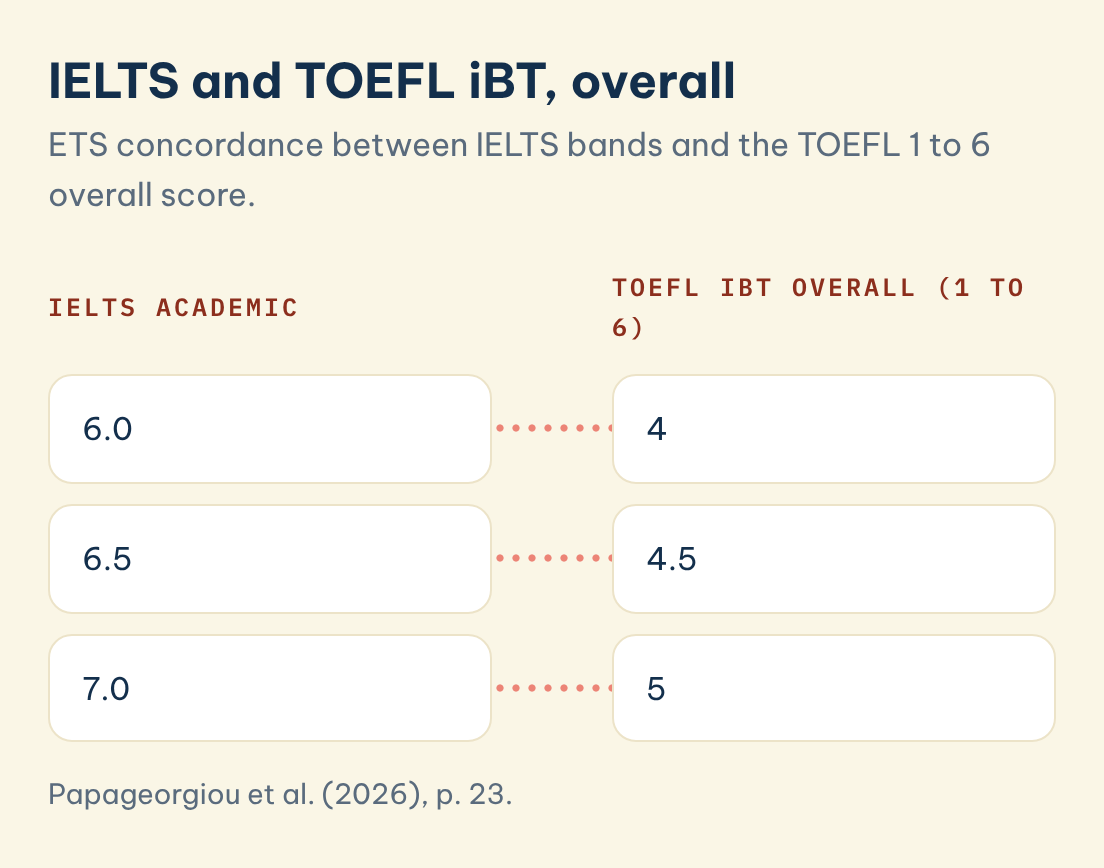
The concordance table in the ETS score-scale report pairs IELTS 6.0 with a TOEFL overall of 4, 6.5 with 4.5, and 7.0 with 5 (Papageorgiou et al., 2026, p. 24). The report explains that overall comparisons were rounded up to the next half band "to minimize false positive classifications", which means the TOEFL figure is set slightly on the cautious side. Section by section the match is uneven: for IELTS 6.5, the Reading equivalent is 4 while the Listening and Writing equivalents are 4.5. A student whose IELTS profile is strong in Reading but weak in Writing should expect a similar shape on TOEFL, not an automatic improvement. The practical choice usually comes down to two things. First, acceptance: RMIT, for example, accepts IELTS Academic but restricts TOEFL. Second, format: TOEFL Speaking is spoken to a computer, while IELTS Speaking is a face-to-face interview with an examiner.
◆ Question 5 / 8 · iBT vs ITP
What is the difference between TOEFL iBT and TOEFL ITP?
Direct answer: TOEFL iBT is the test you book yourself and send to universities. TOEFL ITP is an institutional test that a school or programme runs for its own students, and ETS says its scores are for that institution's internal use. Do not book ITP if you need a score for a university application elsewhere.
ETS describes TOEFL ITP as a test administered "by your institution using your own facilities, staff and resources", with scores that "are not shared with other institutions" (ETS, n.d.-c). Because ITP scores stay inside the institution that runs the test, an ITP result is not a substitute for an iBT report in a university application. Students in Vietnam sometimes meet ITP through a partner university or an in-country English programme. That score can help you track progress, but an overseas admissions office will still ask for an iBT result sent directly from ETS.
◆ Question 6 / 8 · Home Edition
Can you take TOEFL iBT Home Edition for university admission?
Direct answer: Sometimes. ETS offers the same test at home on your own computer with a live human proctor, and many UK universities treat the Home Edition like a test-centre sitting. Some Australian universities refuse all at-home tests, so confirm before you book a home session.
ETS states that the TOEFL iBT is offered at an authorised test centre or as the Home Edition, "monitored by a live human proctor" (ETS, n.d.-a). Stirling lists TOEFL iBT "test centre or Home Edition" under one requirement, and Queen Mary accepts both versions on the 1 to 6 scale (University of Stirling, n.d.; Queen Mary University of London, n.d.). RMIT does not accept results from at-home or online tests for international students (RMIT University, n.d.). Stirling also notes that TOEFL is not on the UK government's list of Secure English Language Tests (SELT), and applicants from Bangladesh, Iran, Iraq, Nepal, Pakistan and Sri Lanka must present a SELT to meet its English requirements, so TOEFL does not work for them there. If you are unsure, email the admissions office with the exact test name and date before paying the fee.
◆ Question 7 / 8 · Score validity
How long is a TOEFL iBT score valid for admission?
Direct answer: ETS sends TOEFL iBT scores for two years from the test date, and several universities count that window to your course start date rather than your application date. A test taken too early can expire before enrolment, so plan the test date backwards from the term you intend to start.
ETS states that scores are valid for two years from the test date and that it will not report scores after that (ETS, n.d.-b). Queen Mary asks that the test was taken "no more than 2 years from the start date of your course", and RMIT applies the same two-year window to its course start date (Queen Mary University of London, n.d.; RMIT University, n.d.). The two-year transition in score reporting runs alongside this. Until early 2028, your report shows both the 1 to 6 bands and a comparable 0 to 120 total, so you can meet either form of requirement from a single report (ETS, n.d.-b). After that, older-style requirements should disappear from most admissions pages. Note also that MyBest scores, which combine your best sections from different test dates, are accepted by some universities and refused by others, as the Queen Mary and Aberdeen pages show (Queen Mary University of London, n.d.; University of Aberdeen, n.d.).
◆ Question 8 / 8 · How to prepare
How can you prepare for the 2026 TOEFL iBT format?
Direct answer: Start from the university requirement, not from the test. Write down the overall band and each section floor you need, take an official practice test in the 2026 format, and spend most of your preparation on the section with the largest gap.
A gap analysis is more useful than a target number alone. Suppose a Queen Mary course needs 4.5 overall with 4 in each section, and your practice result is Reading 5, Listening 5, Writing 4 and Speaking 3.5. Your average already rounds to 4.5, but the Speaking floor fails the requirement on its own. Speaking is also where ETS reports the lowest mean among 2024 test takers, 3.96 on the banded scale against 4.59 for Reading and 4.77 for Listening (Papageorgiou et al., 2026). Students whose schooling stressed reading and grammar often show the same pattern, with stronger receptive skills than spoken fluency under time pressure. Short daily speaking practice with a recording and feedback on clarity tends to move that band more than another week of reading drills. Students who want structured help can work with a one-to-one university subject tutor on the academic English they will need after admission, alongside their own TOEFL practice.
Frequently asked questions
Is TOEFL iBT easier than IELTS?
Neither test is easier for everyone. ETS's concordance places IELTS 6.5 next to a TOEFL overall of 4.5, and the two tests differ mainly in format: TOEFL is fully computer-based, while IELTS Speaking is a live interview.
What is a good TOEFL iBT score in 2026?
On the UK pages checked here, requirements run from an overall 3.5 to 5, with section floors between 3.5 and 4.5 depending on the course. A band of 5 or above maps to CEFR C1.
Do universities still accept the 0 to 120 TOEFL score?
Yes, for tests taken before 21 January 2026 and within the validity window. Newer reports show a comparable 0 to 120 total for two years, but some universities, such as RMIT, set their own rules.
What is the TOEFL iBT full form?
It stands for Test of English as a Foreign Language, internet-based test. ETS develops and administers it.
Can I use a TOEFL ITP score to apply abroad?
Generally no. ITP scores are for the institution that ran the test, and ETS says ITP should not replace the TOEFL iBT.
Is the TOEFL iBT Home Edition accepted in Australia?
It depends on the university. RMIT refuses at-home tests for international students, so check each admissions page before booking.
Related guides
- Can you skip the English test with an English-taught master's degree?: when a waiver replaces a test score
- What IELTS band per skill do PhD programmes ask for?: section minimums for research degrees
- One-to-one university subject tutoring: guided practice in academic English for your course
References
- ETS. (n.d.-a). TOEFL iBT test content: A breakdown of test sections. Retrieved October 22, 2026, from https://www.ets.org/toefl/test-takers/ibt/about/content.html
- ETS. (n.d.-b). TOEFL iBT score breakdown: What your scores mean. Retrieved October 22, 2026, from https://www.ets.org/toefl/test-takers/ibt/scores/understand-scores.html
- ETS. (n.d.-c). Administration: The TOEFL ITP assessment series. Retrieved October 22, 2026, from https://www.ets.org/toefl/itp/administration.html
- Papageorgiou, S., Li, S., Gu, L., & Barton, K. (2026). A banded score scale for the TOEFL iBT test: Rationale, development, and score linking. ETS. https://www.ets.org/pdfs/toefl/score-scale-update-2026.pdf
- Queen Mary University of London. (n.d.). Accepted English language tests and qualifications. Retrieved October 22, 2026, from https://www.qmul.ac.uk/international-students/englishlanguagerequirements/accepted-english-language-tests-and-qualifications/
- RMIT University. (n.d.). English language proficiency tests for international students. Retrieved October 22, 2026, from https://www.rmit.edu.au/study-with-us/international-students/apply-to-rmit-international-students/entry-requirements/english-requirements/english-language-proficiency-tests
- University of Aberdeen. (n.d.). Undergraduate degrees: English requirements. Retrieved October 22, 2026, from https://www.abdn.ac.uk/study/international/english/undergraduate-english-requirements/
- University of Stirling. (n.d.). English language requirements. Retrieved October 22, 2026, from https://www.stir.ac.uk/international/international-students/english-language-requirements/
This article is part of the MAAS Journal series for international students. MAAS is an academic support partner: experts guide students through each stage of their own work, and we do not complete assessed work on a student's behalf.
Not sure how this guide applies to your own case? Talk it through with MAAS in a free 20-minute consultation.
Book a free consultation ▸