
◆ Admissions
What do cum laude, magna cum laude and summa cum laude mean?
Direct answer: The three Latin honours are cum laude ("with distinction"), magna cum laude ("with great distinction") and summa cum laude ("with highest distinction"), in rising order. Each university sets its own cutoff, either as a fixed GPA or as a share of the graduating class. "Magna sum laude" is a common misspelling of magna or summa cum laude.
◆ Question 1 / 6 · What the honours mean
What does magna sum laude mean, and which of the three is highest?
Direct answer: Searchers often type "magna sum laude", but the phrase is a blend of two real honours, magna cum laude and summa cum laude. Summa is the highest of the three, magna sits in the middle and cum laude is the entry tier. Latin honours mainly belong to the US degree system.
Merriam-Webster glosses cum laude as "with distinction", magna cum laude as "with great distinction : with great honors" and summa cum laude as "with highest distinction", and dates all three to 1851 (Merriam-Webster, n.d.). So the answer to "who is higher, magna or summa?" is summa, and the answer to "is magna cum laude the highest?" is no: it is the second of three. A common source of confusion is that the middle word changes. Cum laude means "with praise", magna adds the idea of "great" and summa means "highest", so the pattern is the same phrase with a stronger adjective. Because the honours are a US label, a UK or Australian admissions officer will not read "magna" the way a US registrar does. They will look at the grade behind the label, which is why the rest of this guide concerns how the cutoffs are set.
◆ Question 2 / 6 · 3.9 or 4.0 GPA
Is a 3.9 GPA magna or summa, and what about a 4.0?
Direct answer: It depends on the university. At Cal State San Marcos a 3.9 is summa cum laude, while at Vanderbilt the same figure falls just below the cum laude line. Across the three fixed or percentile cutoffs compared below, a 4.0 reaches the top tier, though percentile systems cap how many students get it.
Summa cum laude cutoff by university
Published summa lines differ by school and by rule.
University
Summa cum laude cutoff (GPA)
William & Mary
3.80
Cal State San Marcos
3.900
Vanderbilt (Arts and Science, 2026-27)
3.990
Save this figure
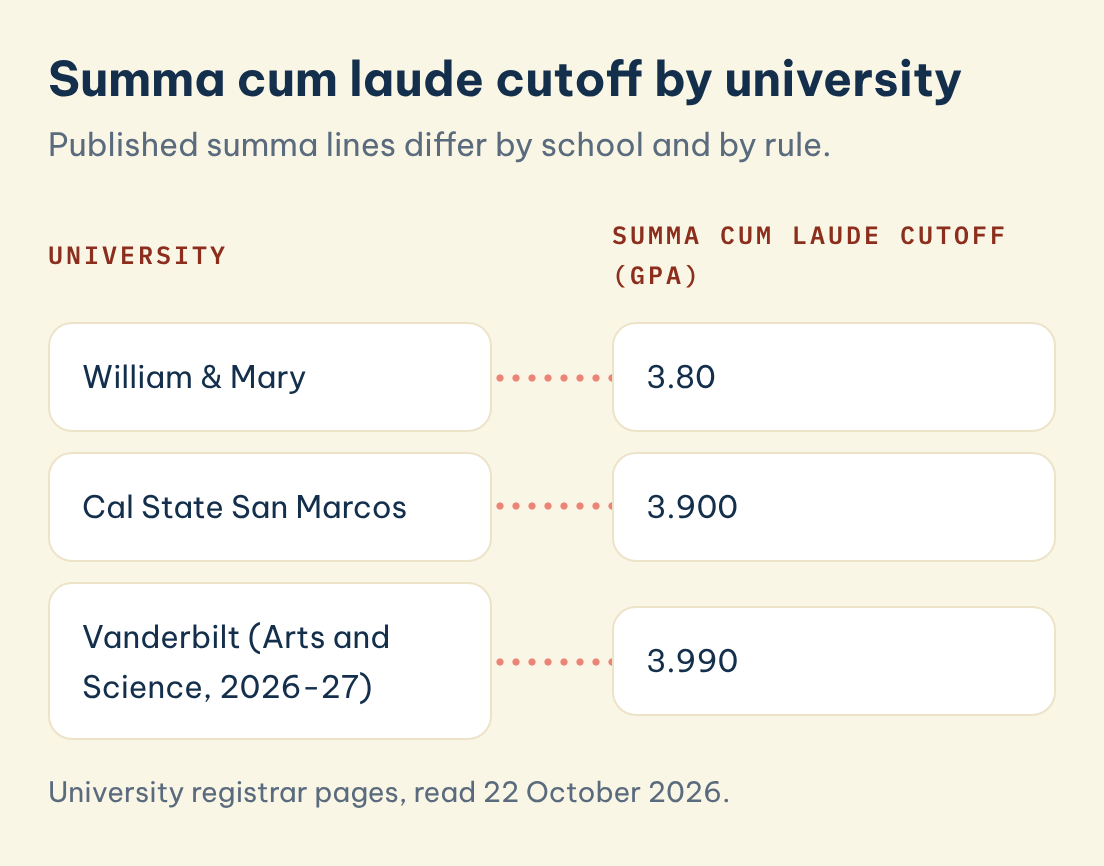
Two kinds of rule produce this spread. Fixed-GPA schools publish bands that any student can read in advance. Cal State San Marcos lists "Cum Laude 3.500 - 3.699, Magna Cum Laude 3.700 - 3.899, Summa Cum Laude 3.900 - 4.000" (California State University San Marcos, n.d.). William & Mary is also fixed but lower: the GPA "required for a degree cum laude is 3.50, for a degree magna cum laude 3.65" and 3.80 for summa (William & Mary Registrar, n.d.). Percentile schools work the other way. Vanderbilt awards summa to students whose GPA "equals or exceeds that of the top 5 percent of the previous three years' graduating seniors", magna to the next 8 percent and cum laude to the next 12 percent, which for Arts and Science in 2026-27 means 3.990, 3.961 and 3.908 (Vanderbilt University Registrar, n.d.). A student with a 3.9 who looks like a summa at one school may not reach any tier at another.
| University | Rule | What the published page says |
|---|---|---|
| Cal State San Marcos | Fixed GPA | Summa 3.900 to 4.000; magna 3.700 to 3.899; cum laude 3.500 to 3.699 |
| William & Mary | Fixed GPA | Summa 3.80; magna 3.65; cum laude 3.50 |
| Vanderbilt (Arts and Science, 2026-27) | Percentile of previous three years | Summa 3.990; magna 3.961; cum laude 3.908 |
Source: university registrar and advising pages, read 22 October 2026.
◆ Question 3 / 6 · Why cutoffs differ
Why do the cutoffs differ so much from one university to the next?
Direct answer: Latin honours were never standardised nationally, so each institution decides what "distinction" means. Some set a number, some set a share of graduating students, and some combine both with extra conditions. Rising grades push fixed bands towards the top of the scale, which is one reason many selective schools moved to percentages.
Vanderbilt's rule, quoted above, is a good example of the percentile approach. Why would a school prefer a share to a number? Because grades have been rising for decades. In a long study of American grading, Rojstaczer and Healy found that "A is the most common grade at 125 of the 135 schools for which we have data on recent (2006-2009) grades" (Rojstaczer & Healy, 2012). They also warned that at selective schools GPAs "are now so saturated at the high end that they have little use as a motivator of students and as an evaluation tool for graduate and professional schools and employers" (Rojstaczer & Healy, 2012, p. 1). A fixed 3.9 can then describe a large group, while a percentile keeps the honour scarce by design. The data in that study end in 2009, so it explains the trend and says nothing about any single school's current cutoff.
◆ Question 4 / 6 · UK, Australia and beyond
How do cum laude and magna cum laude compare with a UK First or an Australian H1?
Direct answer: The three honours do not convert one for one. A UK first-class degree starts at about 70%, Australian honours is a separate classed year based on a weighted average mark, and the Dutch use of cum laude is set by each faculty. Read each as a local label, and quote the number behind it.
In the UK, Prospects lists first-class honours as "70% and above", upper second as "60% to 70%" and lower second as "50% to 60%", and adds that "percentage thresholds may vary slightly between universities" (Prospects, n.d.). Australia works differently, because honours is usually an extra year. RMIT's procedure gives Honours First Class (H1) for a weighted average mark of 80 or more, H2A for 70 to 79 and H2B for 60 to 69 (RMIT University, n.d.). In the Netherlands the University of Groningen's law faculty awards cum laude for an average of 8.0 or higher with a thesis of 8.0 or higher, and summa cum laude from 9.0 (University of Groningen Faculty of Law, n.d.). The Dutch rule is faculty-specific, so a Dutch "cum laude" says little without the faculty rules.
| System | Top label | Basis on the published page |
|---|---|---|
| US bachelor's | Summa cum laude | University rule: fixed GPA or share of class |
| UK bachelor's | First-class honours | About 70% and above |
| Australia, honours year | H1 | Weighted average mark of 80 or more at RMIT |
| Netherlands, law master's at Groningen | Summa cum laude | Average and thesis both 9.0 or higher |
Source: Prospects, RMIT and University of Groningen pages, read 22 October 2026.
◆ Question 5 / 6 · Does summa matter
Does summa cum laude matter for a UK or Australian master's application?
Direct answer: A Latin honour helps most as supporting evidence, not as a conversion. Admissions teams in the UK and Australia read the GPA and the transcript, then compare them with their own entry rules. The Latin label can add context, but it does not replace the grade or tell them where you ranked.
UK entry tables we checked list GPA thresholds for US degrees rather than Latin honours. The published sources checked here do not say how heavily any UK or Australian office weighs a summa, and it would be a guess to claim they do. A sensible approach is to treat the honour as one more line of evidence. State your GPA on its scale, name the honour, and explain the rule behind it in a sentence, such as "top 5% of the graduating class" or "GPA of 3.90 or above". Then let the transcript carry the rest. If your degree has no Latin honours, do not try to translate it into one: give the classification you hold, such as a UK 2:1 or an Australian H2A.
◆ Question 6 / 6 · How to present it
How should you present Latin honours in a statement of purpose or scholarship form?
Direct answer: Give the honour, the rule that earned it and the evidence next to it, in one line, and then move on to what you did. The panel reads many applications, so a label with its rule is more persuasive than a label alone, and it avoids any appearance of exaggeration.
A short template keeps this accurate. Write the degree, the honour and the basis: "BA in Economics, magna cum laude (the 8% of the class after summa, at the university's published cutoff)". If your school uses a fixed GPA, put the number. If it uses a share, put the share, because a reader abroad cannot guess either. Keep the statement of purpose for what the honour does not show, such as the dissertation question you chose, the method you learned or the research you want to continue. Our guide to UCAS personal statement questions shows how admissions teams frame such questions, and if you are also preparing an English test, the TOEFL iBT guide for university admission lists current university requirements. For applicants who want a second reader on a draft, our study abroad SOP consulting service pairs you with an adviser who comments on your draft, while you write the statement yourself. It is an advisory service with no admission outcome attached.
Frequently asked questions
Is a 3.9 GPA magna or summa cum laude?
The answer changes with the school: Cal State San Marcos and William & Mary would place a 3.9 in the summa band, whereas Vanderbilt (Arts and Science, 2026-27) puts its cum laude line at 3.908.
Is a 4.0 GPA magna or summa cum laude?
At the three schools with published cutoffs checked here, a 4.0 reaches the summa tier. Percentile schools such as Vanderbilt set the line from the previous three graduating years, so a 4.0 does not decide it on its own.
Who is higher, magna cum laude or summa cum laude?
Summa cum laude is higher. Merriam-Webster glosses magna as "with great distinction" and summa as "with highest distinction".
Is magna cum laude the highest honour?
No. Magna cum laude is the middle of the three Latin honours, between cum laude and summa cum laude.
Does summa cum laude matter after graduation?
Evidence on its weight is thin in the sources checked here. Rojstaczer and Healy (2012) warn that very high GPAs lose value as a signal, so state your honour together with the rule that earned it.
What does "magna sum laude" mean?
"Magna sum laude" is a misspelling that blends magna cum laude and summa cum laude. Both phrases are real, and they mean "with great distinction" and "with highest distinction".
Related guides
- UCAS personal statement questions: how admissions teams frame what they ask applicants
- What TOEFL iBT score do you need for university admission in 2026?: English test requirements alongside your grades
- Study abroad SOP consulting: adviser feedback on your own statement draft
References
- California State University San Marcos. (n.d.). Graduation honors. Retrieved October 22, 2026, from https://www.csusm.edu/enroll/graduation/honors.html
- Merriam-Webster. (n.d.). Cum laude; Magna cum laude; Summa cum laude. In Merriam-Webster.com dictionary. Retrieved October 22, 2026, from https://www.merriam-webster.com/dictionary/magna%20cum%20laude
- Prospects. (n.d.). Understanding university grades in the UK. Retrieved October 22, 2026, from https://www.prospects.ac.uk/applying-for-university/university-life/understanding-university-grades-in-the-uk
- RMIT University. (n.d.). Program and course qualifying for an award and grade point average procedure. Retrieved October 22, 2026, from https://policies.rmit.edu.au/download.php?id=240&version=1
- Rojstaczer, S., & Healy, C. (2012). Where A is ordinary: The evolution of American college and university grading, 1940-2009. Teachers College Record, 114(7), 1-23. https://doi.org/10.1177/016146811211400707
- University of Groningen Faculty of Law. (n.d.). The Dutch system. Retrieved October 22, 2026, from https://www.rug.nl/rechten/studiegids/master/english-taught-llm/general-information/dutch-system
- Vanderbilt University Registrar. (n.d.). Latin honors. Retrieved October 22, 2026, from https://registrar.vanderbilt.edu/academic-records/latin-honors.php
- William & Mary Registrar. (n.d.). Undergraduate honors. Retrieved October 22, 2026, from https://www.wm.edu/offices/registrar/degree-progress/graduation/ughonors/
This article is part of the MAAS Journal series for international students. MAAS is an academic support partner: experts guide students through each stage of their own work, and we do not complete assessed work on a student's behalf.
Not sure how this guide applies to your own case? Talk it through with MAAS in a free 20-minute consultation.
Book a free consultation ▸