
◆ Study Abroad
What do you need for a UK Student visa in 2026?
Direct answer: You need an unconditional offer from a licensed student sponsor, shown by a CAS number, enough money for one year of fees and up to nine months of living costs, English at CEFR B2 for degree study, and a passport. Vietnamese applicants also need a TB certificate. The visa fee is £558, plus the healthcare surcharge.
This checklist was written on 22 October 2026 from the Student visa pages on gov.uk and the Home Office caseworker guidance published on 9 October 2026. It is aimed at Vietnamese students heading to a UK university, but the core requirements apply to every nationality. Rules and amounts change, so check each figure on gov.uk on the day you apply.

◆ Question 1 / 9 · Requirements
What are the requirements for a UK student visa?
Direct answer: GOV.UK (n.d.-a) lists four core requirements: a place on a course with a licensed student sponsor, enough money to support yourself and pay for the course, the ability to speak, read, write and understand English, and parental consent for applicants under 18.
The place on a course is proven by a reference number. GOV.UK (n.d.-a) explains that once a licensed provider has offered you an unconditional place, it sends you a Confirmation of Acceptance for Studies (CAS), and you need that CAS before you can apply. The same page adds that you must apply within 6 months of receiving it, and that a full-time course at degree level or above (RQF level 6, 7 or 8) qualifies.
The table below turns the requirements into a document checklist. The "who needs it" column matters, because several items only apply in particular cases.
| Item | Who needs it | Where it comes from |
|---|---|---|
| Current passport | Everyone | Your own document |
| CAS reference number | Everyone | Your university, after an unconditional offer |
| Proof of money for fees and living costs | Most applicants, including Vietnamese nationals | Bank statements, or a loan or sponsor letter |
| Proof of English | Most applicants | Your university's assessment or an approved test |
| TB test certificate | Residents of listed countries, including Vietnam | An approved clinic |
| ATAS certificate | Some sensitive subjects at RQF level 7 or above | Applied for online before the visa |
| Parental consent and birth certificate | Applicants under 18 | Parents or legal guardians |
| Sponsor's written consent | Anyone sponsored for fees and living costs in the last 12 months | The sponsoring body |
GOV.UK (n.d.-a) states that you may need more documents depending on your circumstances, so read the full list in the guidance before you book an appointment. The ATAS line deserves attention for postgraduate science and engineering students, because it is easy to discover late.
◆ Question 2 / 9 · Is it hard?
Is it hard to get a UK student visa?
Direct answer: A UK Student visa is more predictable when the paperwork is complete, but the Home Office also judges whether you are a genuine student. A caseworker who doubts this must normally interview you before refusing, and refusals usually trace back to money evidence, missing documents or a weak explanation of your study plans.
The Home Office (2026, p. 18) states the test plainly: "the caseworker must be satisfied on the balance of probability that the applicant is a genuine student." The same guidance lists the factors caseworkers weigh, including your immigration history, the time since you last studied, whether the course represents academic progression, and "the credibility of the applicant’s rationale for, knowledge of, and research into the proposed course of study and the sponsoring institution" (Home Office, 2026, p. 19).
In general terms, the guidance asks whether a course choice holds together: progression from earlier study is one listed factor, and a long gap since your last studies is another that caseworkers consider. The Home Office (2026) also allows caseworkers to use your English ability as one factor in that assessment, provided they justify it in writing.
Timing is the other half of the answer. GOV.UK (n.d.-a) says you will usually get a decision within 3 weeks when applying from outside the UK, and that the earliest you can apply is 6 months before the course starts. Applying early gives you room to fix a document if something is queried.
◆ Question 3 / 9 · Money to show
How much money do you need to show?
Direct answer: You must show the unpaid part of one academic year of fees, as stated on your CAS, plus living costs of £1,529 a month in London or £1,171 a month elsewhere, for up to 9 months. The money must sit in your account for 28 consecutive days.
According to GOV.UK (n.d.-a), the 28-day period must end within 31 days of the date you apply. Its own example is that an application submitted on 1 January needs funds held for the 28 days ending on 1 December. London means the City of London and the 32 London boroughs, so a university in Greater London but outside those boroughs needs checking.
| Location of study | Monthly amount | Maximum months | Living-cost total |
|---|---|---|---|
| London | £1,529 | 9 | £13,761 |
| Outside London | £1,171 | 9 | £10,539 |
These totals are the monthly figures multiplied by nine, as listed on GOV.UK (n.d.-a) in October 2026. They are on top of the tuition shown on your CAS. A deposit paid to your university for its own accommodation can reduce the amount, up to the London monthly figure, because the Home Office (2026) lets caseworkers offset it, up to the London monthly figure, when it appears on the CAS and the accommodation is provided by the university.
Vietnamese applicants should plan to submit this evidence. GOV.UK (n.d.-a) publishes a "differential evidence requirement" list of countries whose nationals do not need to prove funds at the application stage, and Vietnam is not on it. If you have been in the UK on a valid visa for at least 12 months, the money requirement does not apply.
◆ Question 4 / 9 · English and IELTS
Can you study in the UK without IELTS?
Direct answer: Often, yes. For degree-level study, GOV.UK (n.d.-a) says your university can assess your English itself, as long as the level is equivalent to CEFR B2. A degree taught in English can also count, once an assessment confirms it.
GOV.UK (n.d.-a) lists four ways to prove English: a UK school qualification such as a GCSE or A level, a degree from a UK institution, a degree taught in English by an institution outside the UK, or a Secure English Language Test (SELT) from an approved provider. Degree-level courses require B2, and courses below degree level require B1.
Two points matter for Vietnamese applicants. First, a bachelor's taught in English at a Vietnamese campus does not count automatically: GOV.UK (n.d.-a) says you need an assessment confirming it is equivalent to a UK bachelor's degree and taught in English, and the Home Office (2026) records that the assessment body Ecctis has been renamed the Qualification and Language Service (QLS). Second, the university decides which tests it accepts for its own assessment, so "no IELTS" really means "no IELTS if your university agrees". Check the admissions page of your course rather than relying on a general list.
◆ Question 5 / 9 · Cost
How much does a UK Student visa cost?
Direct answer: The application fee is £558, and the immigration health surcharge is £776 for each year of the visa. A three-year visa therefore carries a surcharge of £2,328, paid upfront in one sum with the application, on top of the visa fee.
What a three-year UK Student visa costs upfront
Tap each item to see the figure and where it comes from.
Visa fee
£558 to apply from outside the UK (GOV.UK, n.d.-a).
Health surcharge
£776 per year, so £2,328 for a three-year visa, paid with the application (GOV.UK, n.d.-b).
Living funds, London
£1,529 a month for up to 9 months, £13,761 in total, held for 28 days (GOV.UK, n.d.-a).
Living funds, elsewhere
£1,171 a month for up to 9 months, £10,539 in total, held for 28 days (GOV.UK, n.d.-a).
Save this figure
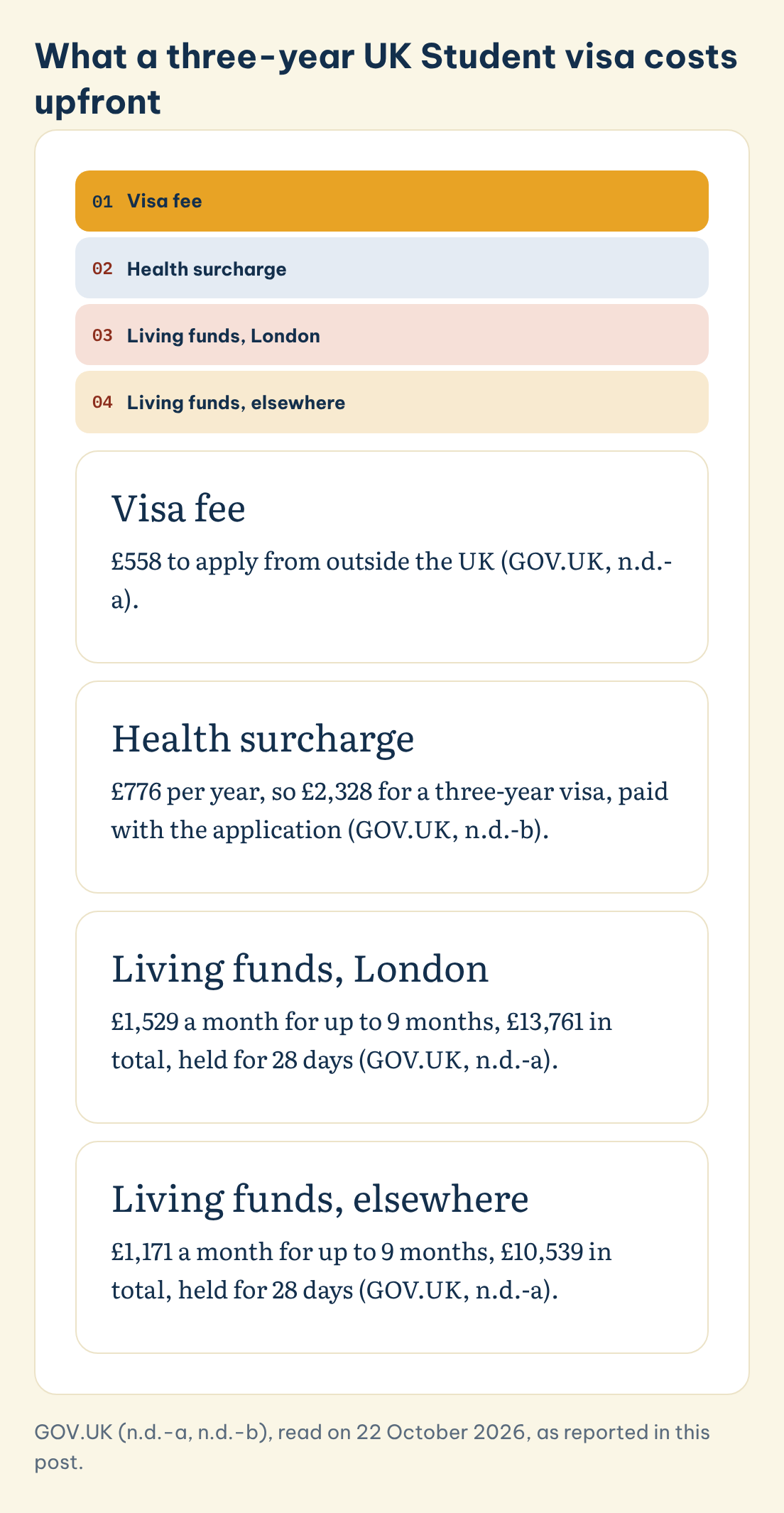
GOV.UK (n.d.-b) sets the surcharge at £776 per year for students and their dependants, with its own example of £1,552 for a 2-year visa, so a three-year course means a surcharge of £2,328. The surcharge gives you access to the NHS from the date your visa starts, though GOV.UK (n.d.-b) notes that prescriptions, dental treatment and eye tests can still cost money.
Add the TB test to the budget if you live in Vietnam. GOV.UK (n.d.-c) says you need one if you are coming for 6 months or more and have lived in a listed country for 6 months or more, and Vietnam appears on the list (GOV.UK, n.d.-d). The certificate is valid for 6 months from the date of the x-ray, so book it close to your application date.
◆ Question 6 / 9 · 2026 changes
What are the new rules for UK Student visas in 2026?
Direct answer: Three changes stand out: the Graduate visa shortens to 18 months for applications from 1 January 2027, a "visa brake" refuses applications from four nationalities since March 2026, and the living-cost requirement rises from 30 November 2026, as set out below.
GOV.UK (n.d.-a) says the Graduate visa lasts 2 years if you apply on or before 31 December 2026 and 18 months if you apply on or after 1 January 2027, with 3 years for a PhD. Students who graduate in 2027 should plan their job search around the shorter window.
The Home Office (2026, p. 15) states that Afghanistan, Cameroon, Myanmar and Sudan "will be subject to a visa brake from 00:01 GMT 26 March 2026", meaning out-of-country applications from their nationals are refused. Vietnam was not on that list as of October 2026.
The guidance also notes "the increase to the maintenance requirement from 30 November 2026" (Home Office, 2026, p. 8). The new monthly amounts were not shown on the gov.uk Student visa page when this checklist was written, so treat the figures in the money section as the minimum and check gov.uk again if you apply after 30 November 2026.
◆ Question 7 / 9 · Work and family
Can you work and bring family on a Student visa?
Direct answer: Degree-level students at a university can normally take paid work for up to 20 hours a week during term and full-time during official vacations. Bringing a partner or children is now restricted mainly to students on PhD and research degrees.
The Home Office (2026) sets the 20-hour limit for full-time degree-level study at a higher education provider with a track record of compliance, and 10 hours for study below degree level. You cannot be self-employed or work as a professional sportsperson or coach (GOV.UK, n.d.-a).
On family, GOV.UK (n.d.-a) says that for postgraduate courses starting on or after 1 January 2024, dependants are allowed only if the course is a PhD or other doctorate, or a research-based higher degree, unless you are a government-sponsored student on a course longer than 6 months. A taught master's student therefore applies alone in most cases.
◆ Question 8 / 9 · Applying online
How do you apply for a UK Student visa online?
Direct answer: You apply online on gov.uk, prove your identity either through the UK Immigration: ID Check app or at a visa application centre, and receive an eVisa rather than a physical card if you are approved. You can save the form and finish it later.
The sequence below follows GOV.UK (n.d.-a).
- Accept an unconditional offer and receive your CAS from the university.
- Gather the documents in the checklist above, starting the 28-day bank period early.
- Book the TB test, if it applies to you.
- Complete the online form up to 6 months before the course starts, pay the £558 fee and the surcharge.
- Verify your identity through the app or at a visa application centre.
- Wait for a decision, usually within 3 weeks from outside the UK.
- Create a UKVI account to access your eVisa, then travel no earlier than the start date on your visa.
GOV.UK (n.d.-a) adds that for a course longer than 6 months you can arrive up to 1 month before it begins. If your university place came late, for example through Clearing as an international student, build these steps into your timeline from the first day.
◆ Question 9 / 9 · Study plan
Where does a study plan fit in?
Direct answer: The visa itself has no personal statement, but your university application and any credibility interview both test whether your course choice makes sense. A clear, honest account of why this course and this university is the part you prepare yourself.
MAAS does not handle visa applications or give immigration advice; that belongs to the university, UKVI or a regulated adviser. What MAAS offers is study abroad and SOP consulting, where a MAAS expert works with you on the statement of purpose and on explaining your academic progression in your own words. If you are still choosing a course, our guide to a UK master's research proposal shows how progression is argued on paper.
Frequently asked questions
How early can I apply for a UK Student visa?
From outside the UK, up to 6 months before your course starts, and within 6 months of receiving your CAS (GOV.UK, n.d.-a).
Do Vietnamese students need to show bank statements?
Yes. Vietnam is not on the differential evidence list, so plan to show fees and living costs held for 28 consecutive days (GOV.UK, n.d.-a).
Is IELTS required for a UK Student visa?
Not always. For degree-level study your university can assess your English at CEFR B2 equivalent, and an English-taught degree can count after an assessment (GOV.UK, n.d.-a).
How long does a decision take?
Usually within 3 weeks from outside the UK and 8 weeks from inside, and you may be able to pay for a faster decision (GOV.UK, n.d.-a).
Can I work while studying?
At degree level with a university, up to 20 hours a week in term time and full-time in vacations (Home Office, 2026).
Can my partner come with me on a master's?
Usually not, unless the master's is research-based or you are government-sponsored on a course longer than 6 months (GOV.UK, n.d.-a).
References
GOV.UK. (n.d.-a). Student visa. UK Visas and Immigration. Retrieved October 22, 2026, from https://www.gov.uk/student-visa
GOV.UK. (n.d.-b). Pay for UK healthcare as part of your immigration application: How much you have to pay. Retrieved October 22, 2026, from https://www.gov.uk/healthcare-immigration-application/how-much-pay
GOV.UK. (n.d.-c). Tuberculosis tests for visa applicants. Retrieved October 22, 2026, from https://www.gov.uk/tb-test-visa
GOV.UK. (n.d.-d). Tuberculosis tests for visa applicants: Countries where you need a TB test to enter the UK. Retrieved October 22, 2026, from https://www.gov.uk/tb-test-visa/countries-where-you-need-a-tb-test-to-enter-the-uk
Home Office. (2026). Student and Child Student (Version 15.0) [Caseworker guidance]. https://assets.publishing.service.gov.uk/media/6ad09e010f7b53973e0266f3/Student_and_Child_Student.pdf
Not sure how this guide applies to your own case? Talk it through with MAAS in a free 20-minute consultation.
Book a free consultation ▸