
◆ Dissertation
What does a research proposal example look like for a UK master's?
A UK taught master's proposal is a short plan, usually no more than about 3,000 words, that states one question, the sources behind it, the method and a timetable. The worked example below is invented by MAAS for illustration, with notes on why each section is written the way it is, so you can copy the structure but not the topic.
◆ Question 1 / 7 · What does a UK master's
What does a UK master's proposal actually have to do?
Direct answer: A proposal shows that your study is worth doing and that you can finish it. Sudheesh et al. (2016) say it must show how the work fits what is known, specify the question, and establish significance. Marking criteria differ by university, so your module guide decides the details.
The most useful single sentence on this comes from a medical research guide, which describes the job in terms that transfer to any discipline: "A proposal needs to show how your work fits into what is already known about the topic and what new paradigm will it add to the literature, while specifying the question that the research will answer, establishing its significance, and the implications of the answer." (Sudheesh et al., 2016, p. 631). The same authors list eight headings: introduction, review of literature, aims and objectives, research design and methods, ethical considerations, budget, appendices and citations (Sudheesh et al., 2016, p. 632). Budget makes sense in a clinical trial and rarely appears in a taught master's proposal, which is a reminder to treat any generic template as a starting point.
At master's level the audience is usually one supervisor or a module marker. They are asking a practical question: can this student carry out this study in the time left? A good proposal answers that early and keeps answering it to the last page.
◆ Question 2 / 7 · How long is a master's
How long is a master's proposal, and how much is it worth?
Direct answer: Lengths vary widely, from 800 words up to about 3,000 words in the guides read for this post, and the marks vary too. Some proposals carry 15% of a module, while others are unmarked. The module guide for your own course is the only figure that counts.
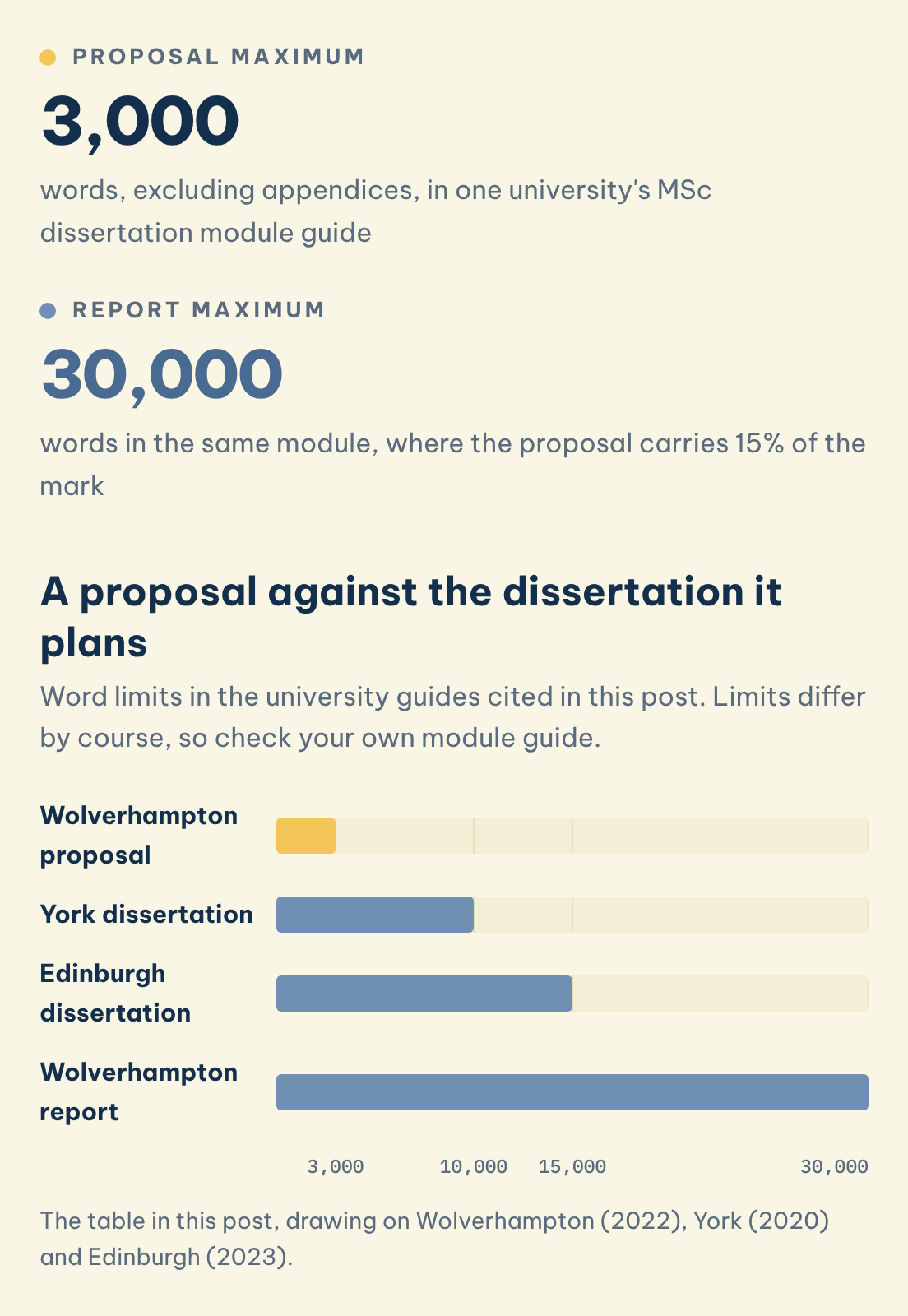
University of Westminster (2023) notes that proposal word counts "can vary from anywhere between 800 to 3,000 words at undergraduate, postgraduate and doctoral levels." Faculty of Science and Engineering, University of Wolverhampton (2022) sets a maximum of 3,000 words excluding appendices for its dissertation module and weights the proposal at 15% of the module mark, with the project report carrying 85% and a ceiling of 30,000 words. Department of Health Sciences, University of York (2020) takes a different approach: the proposal is a structured form with word limits for each section, ahead of a dissertation of up to 10,000 words. The table sets these side by side.
| Source | Level | Length rule | Weight or status |
|---|---|---|---|
| Wolverhampton (2022) | MSc dissertation module | Maximum 3,000 words, excluding appendices | 15% of module mark |
| Worcester (n.d.) | Master's by Research template | About 2,100 words across sections | Application template |
| York (2020) | Master's, health research | Form with word limit per section | Formative, not marked |
| Westminster (2023) | General guide | 800 to 3,000 words | Varies by level |
| Edinburgh (2023) | MSc, social and political science | Dissertation (not proposal) limit, 15,000 words | A 5 mark penalty for going over |
Worcester's template is for a Master's by Research, a research degree, so read its limits as a guide rather than a taught MSc rule. The Worcester figure is a MAAS sum of the suggested section limits in its template, which run from 10 to 15 words for the title up to 500 words each for the overview, literature and methodology (University of Worcester, n.d.). Edinburgh's penalty applies to the final dissertation, not the proposal, but it shows why a proposal should teach you to plan to a word limit (School of Social and Political Science, University of Edinburgh, 2023).
Proposal maximum
3,000
words, excluding appendices, in one university's MSc dissertation module guide
Report maximum
30,000
words in the same module, where the proposal carries 15% of the mark
A proposal against the dissertation it plans
Word limits in the university guides cited in this post. Limits differ by course, so check your own module guide.
Save this figure
◆ Question 3 / 7 · How do the title, aim
How do the title, aim and research question look in an example?
Direct answer: The title names the topic and setting, the aim is one sentence, and the research question is narrow enough for one method to answer. The example below is fictional. University of Wolverhampton guidance asks for a single clear aim and five or six measurable objectives.
The illustrative proposal is written for an imagined MSc programme in a UK business school. Everything in it, including the school, the numbers and the findings it hopes for, is invented to show the shape of the document. Read the quoted text as the student's draft and the notes after it as a supervisor's comments.
Working title: How international master's students use written feedback on draft coursework: a case study in one UK business school
Aim: To explore how international master's students decide what to do with written feedback on a draft assignment.
Research question: How do international master's students at one UK business school interpret and act on written feedback on draft coursework?
Objectives: (1) Identify the kinds of feedback students receive on drafts. (2) Describe how students say they interpret each kind. (3) Compare what students report doing with what the revised drafts show. (4) Summarise implications for how feedback is written.
Notice what the title does: it names the group, the setting and the focus in 18 words, which is above the 10 to 15 words the research-degree template of University of Worcester (n.d.) suggests, so a real student would trim it to "Using written feedback on draft coursework: international master's students in one UK business school" (14 words). University of Westminster (2023) says an aim echoes the research question but uses an infinitive, which is exactly the relationship between the two lines above. Faculty of Science and Engineering, University of Wolverhampton (2022) asks for "a set of five or six measurable objectives"; the four here would need a fifth and sixth for that module.
◆ Question 4 / 7 · How do the literature
How do the literature and method sections look in an example?
Direct answer: The literature section is a short, argued positioning of your question, not a full review. The method section names who, how many, how collected and how analysed, matched to the question. Worcester's research-degree template suggests 500 words for each at proposal stage.
University of Worcester (n.d.) describes its literature section as a place where "a full literature review is not required at this stage", and gives 500 words as the suggested maximum. Sudheesh et al. (2016, p. 632) advise that it is "preferable to summarise each article in a paragraph, highlighting the details pertinent to the topic of interest." Here is how the illustrative student might handle both sections.
Positioning (extract): Studies of feedback tend to ask what teachers write; far fewer ask what students do next. This proposal starts from the second question. The review will cover three strands: how feedback is classified, how students from different educational systems read it, and how drafts change after feedback. The gap is a small one: little work compares what students say they do with what their revised drafts show.
Method (extract): A single-site case study. Twelve volunteer students will each be interviewed once for about 40 minutes, and with consent their draft, feedback and revision will be collected. Interviews will be transcribed and coded thematically; the revisions will be coded for the type of change made. The two sets of codes will then be compared.
The notes a supervisor would add are specific. The positioning names its strands in advance, which shows the reading is organised. The gap is claimed modestly, which suits a master's study and is safer than claiming novelty. In the method, "twelve" and "40 minutes" are the details a marker can check against the timetable, and Sudheesh et al. (2016, p. 631) note that a proposal must show "the writer has thought about the time needed to conduct each stage of the research." If a method seems to need more time than you have, say so and shrink the sample.
◆ Question 5 / 7 · How do the ethics, timeline
How do the ethics, timeline and reading list look in an example?
Direct answer: Ethics states consent, anonymity and approval status in about 150 words. The timeline works backwards from your submission date. Wolverhampton asks for an indicative reading list of at least 20 references, while Hochschule für Technik und Wirtschaft Berlin considers five to ten sources enough, so check your own brief.
Ethics (extract): Participation is voluntary and written consent will be taken before each interview. Names will be replaced by codes, and drafts and feedback will be stored on the university's secure drive. Approval will be sought from the school ethics committee before any data are collected.
Timeline (extract): Weeks 1 to 3: ethics application and reading. Weeks 4 to 5: recruit and pilot. Weeks 6 to 9: interviews and document collection. Weeks 10 to 12: coding and comparison. A two-week buffer is held before the submission date.
University of Worcester (n.d.) suggests 150 words for ethics and 200 for the project plan, whose purpose it gives as to "consider whether your proposed study is feasible within the time available for the MRes research project." Notice that the example puts ethics approval before data collection and leaves a buffer. Hochschule für Technik und Wirtschaft Berlin (2022) goes further and tells students to build "proofreading and another time buffer of at least ten days" into the timetable, a German university's rule, but a sensible habit anywhere.
On sources, requirements differ by a factor of four. Faculty of Science and Engineering, University of Wolverhampton (2022) asks for an indicative reading list of "not less than twenty (20) references", while Hochschule für Technik und Wirtschaft Berlin (2022) says "five to ten scientific sources should be sufficient." Neither is the right number in general. Use the number your own module guide gives, and make every listed source one you have actually opened.
◆ Question 6 / 7 · What are the common mistakes
What are the common mistakes in a master's proposal?
Direct answer: The common faults are a topic instead of a question, a review that only summarises, jargon, no real timetable, and going over the word limit. The guides read for this post name most of these. Your marker will apply the criteria in your module guide, not a general list.
Several of these have been written down by universities themselves. University of Manchester's School of Social Sciences warns that "Poorly specified, jargon-filled or rambling proposals will not convince us that you have a clear idea of what you want to do" (School of Social Sciences, University of Manchester, n.d.). That guidance is for research-degree applicants, not taught master's students, so treat it as an analogy; the same page adds that proposals relying on "descriptive, AI-produced text are unlikely to be successful." Sudheesh et al. (2016, p. 631) ask for the aim to be stated "in simple language that describes the research in a way that non-specialists can comprehend, without use of jargons."
A second group of faults is about scale. Edinburgh's handbook sets a 15,000 word limit for 60-credit taught dissertations and a 5 mark penalty above it (School of Social and Political Science, University of Edinburgh, 2023), and York caps its dissertation at 10,000 words (Department of Health Sciences, University of York, 2020). A proposal that cannot be carried out within limits like these has not yet been thought through. The fix is usually to narrow the question, not to write more.
◆ Question 7 / 7 · Where can a MAAS expert help
Where can a MAAS expert help with your own proposal?
Direct answer: MAAS works as a tutor and advisor. A MAAS expert reads your plan at Outline, Draft and Final stages and gives feedback on structure and feasibility, while you write the proposal and make every decision about it. Nothing here promises a mark.
If you want a second reader before you submit, the MAAS research proposal support service pairs you with an expert in your field. The expert comments on whether the question is narrow enough, whether the method fits the question and whether the timetable survives an ethics queue. You do the writing, and the proposal you hand in is yours. For a general walkthrough, the guide to how to write a research proposal covers the undergraduate version step by step. If your proposal is the first stage of a dissertation, read how to write a dissertation proposal as well. The first conversation is free.
Frequently asked questions
Can I copy this example proposal?
No. The topic is invented by MAAS for illustration. Copy the structure, then write your own question, sources and plan, and follow your module guide.
How long should my proposal be?
Check your module guide. The guides read for this post range from 800 to 3,000 words, and Wolverhampton sets a maximum of 3,000 words excluding appendices (Faculty of Science and Engineering, University of Wolverhampton, 2022).
How many references do I need?
It depends on your course. Wolverhampton asks for at least 20 in an indicative reading list, while Hochschule für Technik und Wirtschaft Berlin says five to ten sources should be sufficient (Hochschule für Technik und Wirtschaft Berlin, 2022).
Does the proposal count towards my mark?
Sometimes. At Wolverhampton it is 15% of the module mark, and at York it is formative and not marked (Faculty of Science and Engineering, University of Wolverhampton, 2022; Department of Health Sciences, University of York, 2020).
Do I need ethics approval before I start collecting data?
Plan for it. Most universities expect approval before data collection, so put it early in your timeline and state its status in the proposal.
Is a PhD proposal guide useful for a master's student?
Only as an analogy. PhD guides, such as Manchester's 1,500 word limit including references, describe research-degree applications and are not taught master's rules (School of Social Sciences, University of Manchester, n.d.).
References
Department of Health Sciences, University of York. (2020). Assessment guideline: Dissertation (HEA00184M) [Assessment guideline]. https://www.york.ac.uk/media/healthsciences/documents/student-intranet/guidelines/postgraduate/pgdisspgtMPH_HR_MHR.pdf
Faculty of Science and Engineering, University of Wolverhampton. (2022). Dissertation module guide 2022/2023 [Module guide]. https://www.wlv.ac.uk/media/departments/faculty-of-science-and-engineering/engineering-landing-page-images/IO-7-Dissertation-Module-Guide.pdf
Hochschule für Technik und Wirtschaft Berlin. (2022). Guidelines for the preparation of a Master's Thesis proposal. https://mide.htw-berlin.de/files/Stg/MIDE/ExposeGuidelines_Nov2022.pdf
School of Social and Political Science, University of Edinburgh. (2023). Taught MSc student dissertation handbook 2023-24. https://www.sps.ed.ac.uk/sites/default/files/assets/doc/PGT%20Dissertation/MSc%20Dissertation%20Handbook%202023-24.pdf
School of Social Sciences, University of Manchester. (n.d.). Writing your proposal. https://socialsciences.manchester.ac.uk/study/postgraduate-research/how-to-apply/writing-your-proposal/
Sudheesh, K., Duggappa, D. R., & Nethra, S. S. (2016). How to write a research proposal? Indian Journal of Anaesthesia, 60(9), 631-634. https://doi.org/10.4103/0019-5049.190617
University of Westminster. (2023). Dissertations 1: Getting started: Writing a proposal [Library guide]. https://libguides.westminster.ac.uk/starting-your-dissertation/writing-a-proposal
University of Worcester. (n.d.). Applicant research proposal: Masters by Research in Education [Application template]. https://www.worcester.ac.uk/documents/Preparing-your-research-outline-for-MRes.pdf
Tools & resources
- University of Westminster Library: writing a proposal (University of Westminster)
Not sure how this guide applies to your own case? Talk it through with MAAS in a free 20-minute consultation.
Book a free consultation ▸