
◆ PhD Admissions
What should a CV for a PhD application include and omit?
Category: admissions
Last updated: 2026-10-06

Asked this question on 6 October 2026, Perplexity cited eight advice sites and not one university page, while ChatGPT cited nothing and quietly assumed a UK application. Both gave a tidy list of sections. Neither answer mentioned a fact that decides how much the file matters: at Oxford, most courses do not accept a CV file and read form fields instead.
Direct answer: A CV for a PhD application is a short record of the research you have already done, ordered by how closely it relates to the project you propose. Oxford asks for one or two pages where a CV is required, covering qualifications, any publications and other relevant experience (University of Oxford, n.d.-a).
This guide uses the published instructions of universities and their careers services, because they come from the institutions that read applications. It does not repeat the commercial templates that dominate search results.
◆ Question 1 / 7 · Does a university want a CV
Does the university even want a CV file?
Direct answer: Often it does not. Oxford states that most of its courses do not require an uploaded CV, and a CV uploaded where none is required "will be removed" from the application. Those courses collect the same material in form sections, so the form is the CV (University of Oxford, n.d.-a).
Oxford's graduate application form captures eight CV-type sections: professional qualifications and training courses, employment experience, research experience, publications and pre-prints, presentations, posters and performances, prizes and awards, skills and interests, and other information. Oxford warns that information cannot be added to the form after you submit, and that skipping a form question expecting the CV to cover it fails, because the CV will have been deleted (University of Oxford, n.d.-a).
The University of British Columbia lists a CV or résumé among the components that appear only "depending on the discipline", next to GRE or GMAT scores, creative portfolios and writing samples (University of British Columbia, Graduate and Postdoctoral Studies, 2025). The practical consequence is simple. Read the programme page first, and where the form already asks for the same material, treat the CV as a second copy.
◆ Question 2 / 7 · What to include
What should a CV for a PhD application include?
Direct answer: Education, research experience, publications and presentations, funding and awards, and only the other experience that bears on the research. The same Oxford page suggests headings of Education, Funding and awards, Publications, Academic or research experience, Other relevant experience and Public engagement (University of Oxford, n.d.-a).
The same Oxford page says the CV should support your research proposal and personal statement, and that it matters less than those documents. The University of British Columbia's list of what committees look for gives research experience, "doing and presenting original work", for research-focused programmes, and adds peer-reviewed publications and presentations for applicants moving from a master's to a PhD (University of British Columbia, Graduate and Postdoctoral Studies, 2025). The Haskayne School of Business at the University of Calgary puts the test in a checklist line: "My CV reflects academic preparation and research experience" (Haskayne School of Business, n.d.).
MAAS editorial view, not a published rule: give each research entry one line on the question, one on what you personally did and one on the method or output. Imperial College London's tip sheet for postdoc and fellowship CVs assumes an employer scans a CV for at most 30 seconds, so each entry should show ability without making the reader open a paper (Joy, n.d.).
Your CV should also match the programme you are applying to. For the document that does most of the persuading, see How do you write a PhD research proposal? and What is the difference between a statement of purpose and a motivation letter?
◆ Question 3 / 7 · What committees ignore
What do admissions committees ignore on a CV?
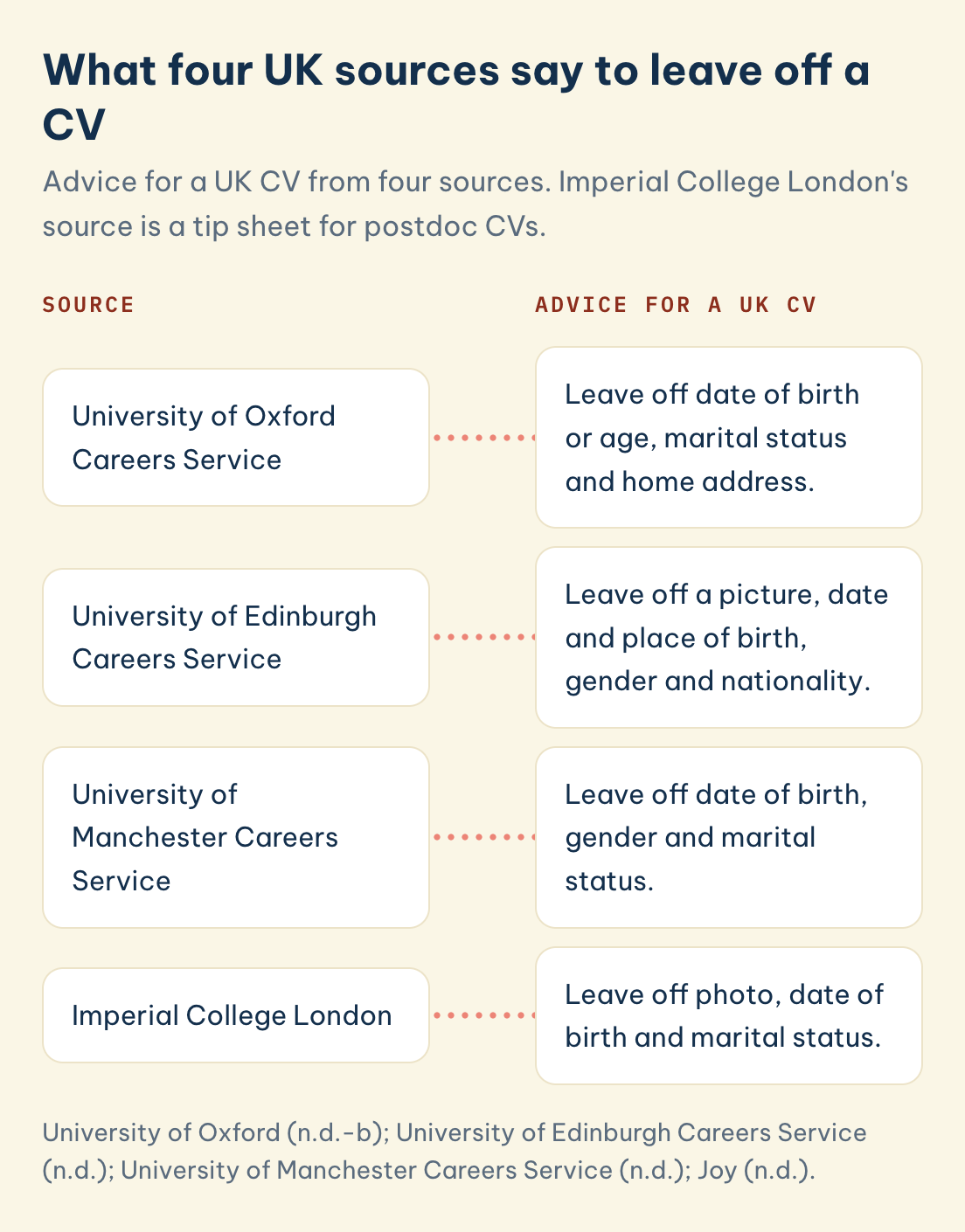
Direct answer: Personal details that carry no research information. Four UK university guides each call a date of birth unnecessary on a CV, and they variously add a photograph, marital status, gender and nationality. Imperial College London adds a caution to check local conventions when applying to other countries (Joy, n.d.).
What four UK sources say to leave off a CV
Advice for a UK CV from four sources. Imperial College London's source is a tip sheet for postdoc CVs.
Source
Advice for a UK CV
University of Oxford Careers Service
Leave off date of birth or age, marital status and home address.
University of Edinburgh Careers Service
Leave off a picture, date and place of birth, gender and nationality.
University of Manchester Careers Service
Leave off date of birth, gender and marital status.
Imperial College London
Leave off photo, date of birth and marital status.
Save this figure
| Source | Advice for a UK CV | Also said |
|---|---|---|
| University of Oxford Careers Service | No date of birth or age, marital status, home address | Nationality only to show right to work |
| University of Edinburgh Careers Service | No picture, date or place of birth, gender, nationality | Add links if appropriate |
| University of Manchester Careers Service | No date of birth, gender, marital status | Photograph "not usual practice" |
| Imperial College London | No photo, date of birth, marital status | "Check local conventions" abroad |
Sources: University of Oxford (n.d.-b); University of Edinburgh Careers Service (n.d.); University of Manchester Careers Service (n.d.); Joy (n.d.). These pages address UK CVs and, in Imperial's case, a postdoc tip sheet, so treat them as the norm for UK applications, not a law for every country.
The jobs.ac.uk advice column agrees for the UK: avoid a photograph, date of birth, nationality and marital status (Lewis, n.d.). Oxford Careers also says an academic CV should include non-academic work or extracurricular activity only if it is "very relevant", and then should state the transferable skills involved (University of Oxford, n.d.-b). That advice is written for job applications, so read it as a general principle.
Do not read this as a list of items a committee secretly penalises. It is a list of items four UK guides consider unnecessary, which means they take space from lines that do earn a reading.
◆ Question 4 / 7 · CV length
How long should a CV for a PhD application be?
Direct answer: One or two pages is the only page range Oxford states for applicants, and it applies to courses that require a CV file. The same Oxford page adds that there is no specific page limit and that "a page is often enough, especially at master's level" (University of Oxford, n.d.-a).
Other sources give different numbers for different audiences. Oxford's Careers Service says an academic CV has no page limit but should stay concise and relevant (University of Oxford, n.d.-b). Imperial College London sets a maximum of two to three pages for postdoc and fellowship applications (Joy, n.d.). That ceiling is for researchers further along, so MAAS reads it as an upper bound for applicants, and the call text of the programme overrides all of these.
The sources even disagree on small points. Oxford Careers says to include supervisors' names with your degrees, while Imperial says there is no need to give them (University of Oxford, n.d.-b; Joy, n.d.). When guidance conflicts, follow the instruction of the programme you are applying to.
◆ Question 5 / 7 · Papers under review
How do you list papers under review, or have none?
Direct answer: List a paper only if you have submitted it, and mark its status where the date would go: "under review" or "submitted" for work awaiting a decision, and "forthcoming" (humanities, social sciences) or "accepted" (STEM) once accepted. UCLA Graduate Career Services also says to state the status truthfully (UCLA Career Center, 2025).
UCLA's CV guide for doctoral students on the academic job market says not to include any article you have not yet submitted. It says to put the status in place of the publication date, to keep your name in its published position in multi-author entries, and to check your field's standard for the labels (UCLA Career Center, 2025). The guide is written for the academic job market, so treat the extension to an application CV as the MAAS view that the same labels work there.
If you have no publications, the University of British Columbia's list of what committees look for also includes research experience and presentations, which MAAS reads as what to lean on (University of British Columbia, Graduate and Postdoctoral Studies, 2025). Do not pad the section with unsubmitted drafts. A short, accurate list does less harm than a long one that cannot survive a question at interview. For that stage, see What methodology questions come up in a PhD interview?
◆ Question 6 / 7 · Résumé to PhD CV
How do you turn a work résumé into a PhD CV?
Direct answer: Reorder it around research. An Oxford alumna writing on that page notes that applicants used to professional CVs find it hard to decide what is relevant, and the Careers Service advice is to keep non-academic work only where it is very relevant and to name the transferable skill (University of Oxford, n.d.-a; University of Oxford, n.d.-b).
In practice this means moving education and any research, dissertation or analysis work to the top and shortening job descriptions to the lines that show method, data, writing or independent project work. MAAS would put the reason for a career change in the statement rather than the CV. The University of British Columbia tells career-changers not to let committees guess and to say why they are switching and how they prepared (University of British Columbia, Graduate and Postdoctoral Studies, 2025). For a job application rather than a PhD one, see our guide to a cover letter for a job application.
◆ Question 7 / 7 · Applicants from Vietnam
What should an applicant from Vietnam check before sending a CV?
Direct answer: Check four things in writing: whether the programme wants a file or form fields, the page limit in the call text, the country convention on personal details, and that every line is something you can discuss at interview. The UK guides above describe UK practice, and Imperial College London advises checking local conventions elsewhere (Joy, n.d.).
If the template you have been using includes a photograph, date of birth or marital status, the UK careers services above advise leaving them off for a UK application. For other countries, ask the programme or read its admissions page rather than assuming one rule. If you want an expert to draft it with you, MAAS adviser support drafts the academic CV from your own account of your work, and you read, edit and approve it before you submit the application yourself. See PhD Application Strategy and Execution for what that covers, and Can you cold email a professor yourself? for the next step.
Frequently asked questions
How long should a CV for a PhD application be?
For applicants, the one written figure is Oxford's one or two pages where a CV is required. The same page adds there is no fixed limit and one page is often enough at master's level. Imperial College London gives two to three pages for postdoc and fellowship CVs (University of Oxford, n.d.-a; Joy, n.d.).
What should a PhD CV include?
It should cover education, research experience, publications, presentations, awards and any other experience tied to the research. Oxford proposes six headings, running from Education to Public engagement (University of Oxford, n.d.-a).
What do admissions committees ignore?
According to UK university guides, a date of birth is not needed, and depending on the source neither are a photograph, marital status, gender or nationality. None describes a committee penalty, only that the space is better spent (University of Edinburgh Careers Service, n.d.; Joy, n.d.).
How do I format papers under review?
List only submitted work and put "under review" or "submitted" where the date would go. UCLA Graduate Career Services says accepted work is "forthcoming" in humanities and social sciences or "accepted" in STEM, and to state the status truthfully (UCLA Career Center, 2025).
Do I need a separate CV file at all?
Not always. Oxford says most courses do not require an uploaded CV and removes one that is uploaded where not required, so check the course page (University of Oxford, n.d.-a).
Related MAAS guides
- How do you write a PhD research proposal?
- What is the difference between a statement of purpose and a motivation letter?
- What methodology questions come up in a PhD interview?
- Can you cold email a professor yourself?
- PhD application resources
- PhD Application Strategy and Execution
- Should you use a PhD personal statement example?: what an example can and cannot show
References
Haskayne School of Business. (n.d.). PhD in management application guide [PDF]. University of Calgary. Retrieved October 6, 2026, from https://haskayne.ucalgary.ca/sites/default/files/teams/9/PhD-application-guide.pdf
Joy, S. (n.d.). Academic CVs [Tip sheet]. Imperial College London. Retrieved October 6, 2026, from https://www.imperial.ac.uk/media/imperial-college/administration-and-support-services/staff-development/public/postdocs/tipsheets/Academic-CVs-v2019.pdf
Lewis, N. (n.d.). 10 things not to do on your CV. jobs.ac.uk Career Advice. Retrieved October 6, 2026, from https://career-advice.jobs.ac.uk/cv-and-cover-letter-advice/10-things-not-to-do-on-your-cv/
UCLA Career Center. (2025). Graduate Career Services PhD CV book. University of California, Los Angeles. Retrieved October 6, 2026, from https://cdn.uconnectlabs.com/wp-content/uploads/sites/230/2025/07/GCS-CV-Book_2025_FINAL.pdf
University of British Columbia, Graduate and Postdoctoral Studies. (2025). Application guide [PDF]. Retrieved October 6, 2026, from https://static.grad.ubc.ca/ebook/ApplicationAdvice_2025-lores.pdf
University of Edinburgh Careers Service. (n.d.). Building your CV. Retrieved October 6, 2026, from https://careers.ed.ac.uk/cvs-and-applications/building-your-cv
University of Manchester Careers Service. (n.d.). Step 1: Creating your CV. Retrieved October 6, 2026, from https://www.careers.manchester.ac.uk/applicationsinterviews/cv/step1creatingyourcv/
University of Oxford. (n.d.-a). CV/résumé. Graduate admissions application guide. Retrieved October 6, 2026, from https://www.ox.ac.uk/admissions/graduate/application-guide/supporting-documents/cv-resume
University of Oxford. (n.d.-b). CVs. Careers Service. Retrieved October 6, 2026, from https://www.ox.ac.uk/careers/careers-guidance/job-search-and-applications/writing-applications/cvs
Tools & resources
- Oxford graduate admissions guidance on CVs: https://www.ox.ac.uk/admissions/graduate/application-guide/supporting-documents/cv-resume
- Imperial College London academic CV tip sheet (PDF): https://www.imperial.ac.uk/media/imperial-college/administration-and-support-services/staff-development/public/postdocs/tipsheets/Academic-CVs-v2019.pdf
A free 20-minute consultation is a conversation about your situation and the programmes you are applying to.
Book a free consultation ▸