
◆ Admissions
How do you find a summer internship as an international student?
Start about six months before the summer you want, check what your visa allows in vacations, and ask each employer about right to work before you apply. This guide is for university students in the UK and Australia who want a summer internship, and it sets out the calendar, the visa rules for breaks, and the questions about pay and sponsorship.
Direct answer: Prospects advises applying at least six months ahead, so September to December for the following summer, and earlier for large employers. UK Student visa holders on a full-time degree may work full time outside term-time, and most Australian student visas allow unlimited hours in course breaks. Always confirm right to work with each employer.
◆ Question 1 / 8 · Internship types
What are summer internships for college students, and how do they differ from spring weeks?
Direct answer: A summer internship is a work placement that fills the summer break, typically two or three months, while a spring week lasts about a week in the Easter holidays. Spring weeks suit first and second years who are still choosing a career path, and they often lead into summer applications.
Prospects describes the two formats side by side. Summer internships "tend to last the length of your summer break - typically for two or three months", while spring week programmes "typically last a week during the Easter holidays" (Smith, 2025). The same page says spring weeks can be ideal for first or second-year undergraduates who are uncertain about their future career path (Smith, 2025). That gives international students a sensible ladder: use a short spring programme to test a sector, then apply for a longer summer role in the next cycle. The phrase "college students" in many searches is American usage. In the UK and Australia the same people are simply university students, and the advice in this guide applies to undergraduates and to postgraduates on a full-time course.
This guide is about university students. The search "summer internships 2026 for 16 year olds" points to school-age work experience schemes, which follow different rules and are outside the scope here.
◆ Question 2 / 8 · When to apply
When should you apply for summer internships in the UK?
Direct answer: Aim to apply roughly half a year ahead, which means the autumn before the summer you want. Large employers recruit earliest, smaller ones may keep applications open into the new year, and a late start leaves you with fewer open roles.
For a summer internship, Prospects says to "apply between September and December of the previous year" and adds that "the bigger the organisation, the earlier you'll need to apply as competition for internships at large, well-known companies is fierce" (Smith, 2025). The page also notes that many organisations set internship deadlines between January and March, with others operating rolling deadlines (Smith, 2025). In practice, a student who reads this in late October still has time for the autumn window, while a student who waits until May will mostly meet closed applications. Treat the dates below as typical, not fixed, and check each employer's own page, because firms differ.
| Step | Typical timing | What to do |
|---|---|---|
| Spring week (first or second year) | Applications open earlier than summer roles, programme in the Easter holidays | Test a sector and meet recruiters |
| Summer internship applications | September to December of the previous year | Apply early to large employers |
| Later deadlines | January to March, or rolling | Apply to smaller firms and second choices |
| Online tests and interviews | After you apply, during screening | Practise online tests in advance |
| Internship | Two to three months over the summer | Check hours against your visa |
Source: Smith (2025), Prospects.
Online tests deserve early attention. Prospects says psychometric tests are "often used during the preliminary screening stage, or as part of an assessment centre", and that most are taken online (Prospects, 2026). If your first language is not English, extra practice with timed reading and numerical items before the application window opens is more useful than polishing a long list of applications.
◆ Question 3 / 8 · UK visa hours
Can you do summer internships in the UK as an international student?
Direct answer: Yes, if the internship fits your Student visa conditions. The Immigration Rules allow full-time degree students at compliant providers to work up to 20 hours a week in term-time and full time outside term-time. Whether you may take a particular role still depends on your own visa and course.
The rule sits in the Appendix Student section of the Immigration Rules, which allows "20 hours per week during term-time (full-time employment permitted outside of term-time)" for a student on a full-time degree-level course sponsored by a higher education provider with a track record of compliance (Home Office, 2026). The condition matters in two ways. First, the full-time allowance applies outside term-time, so check your university's term dates, because the summer break for a taught master's may differ from an undergraduate calendar. Second, the rule describes a student on a compliant provider's degree-level course, so confirm your category on your visa record and with your international student team. The University of Manchester Careers Service gives a practical example of the employer's side of this: an undergraduate whose vacation internship starts and finishes while the Student visa is valid can answer "yes" to a right-to-work question, because the visa permits legal work for that period (University of Manchester Careers Service, n.d.). Interns who plan to stay after graduation should read our guide to the UK Graduate visa for the next step.
◆ Question 4 / 8 · Right to work
Summer internships in the UK for international students: how do you check right to work and sponsorship?
Direct answer: The right-to-work box on an application is about whether the firm must sponsor you. For a vacation placement that begins and finishes inside your Student visa, an undergraduate can usually tick yes. Ask the recruiter which documents they want to see, and do it early.
The University of Manchester Careers Service explains that "this question is asked by employers because they may have to sponsor a visa for a new employee" (University of Manchester Careers Service, n.d.). That sentence explains why some international applicants are rejected at the first screen: a tick box reads "no" when the real situation is "yes, for the duration of the placement". A short, calm note in the application or to the recruiter, stating your visa type, that your course is full time, and the start and end dates of the internship, avoids this. If a firm lists "no sponsorship" in its advert, read what it means. It may refer to a permanent job after graduation, not to a placement within your Student visa. When the wording is unclear, ask the careers service at your university to confirm the position with the employer's HR team.
◆ Question 5 / 8 · London, law, engineering
What do summer internships in London, Cambridge, law and engineering involve?
Direct answer: Location and sector change the calendar more than the visa rules. Large employers, including law and engineering firms, may run their own schemes with early deadlines, so check each employer. Read each employer's page for dates, because published timing varies.
The searches for London, Cambridge, law and engineering show what students want to know: where the roles are and how sector changes the process. The checked sources do not publish a firm-by-firm calendar, so treat any list of exact dates on the web with care and rely on the employer's own page. What the verified guidance does say is general. The bigger the organisation, the earlier you need to apply (Smith, 2025), and spring weeks give first and second years a way into a sector (Smith, 2025). For a law or engineering student, that suggests building a short list of employers in your chosen city in October, putting their opening dates in a calendar, and keeping a second list of smaller employers whose deadlines run into the new year. If you are a first-year student, apply for a spring week first and a summer role in the following cycle.
◆ Question 6 / 8 · Australia
How does summer work differ in Australia?
Direct answer: In Australia, a student visa normally limits work to 48 hours a fortnight during teaching periods but sets no hour limit in breaks, and that cap returned on 1 July 2023. Confirm your own visa conditions and how any course placement is treated.
Student visa work hours in course breaks
UK and Australia, as published in the sources cited in this guide.
Country
Hours outside term-time or in breaks
UK (full-time degree)
Full-time work permitted
Australia (most student visas)
Unlimited hours
Save this figure
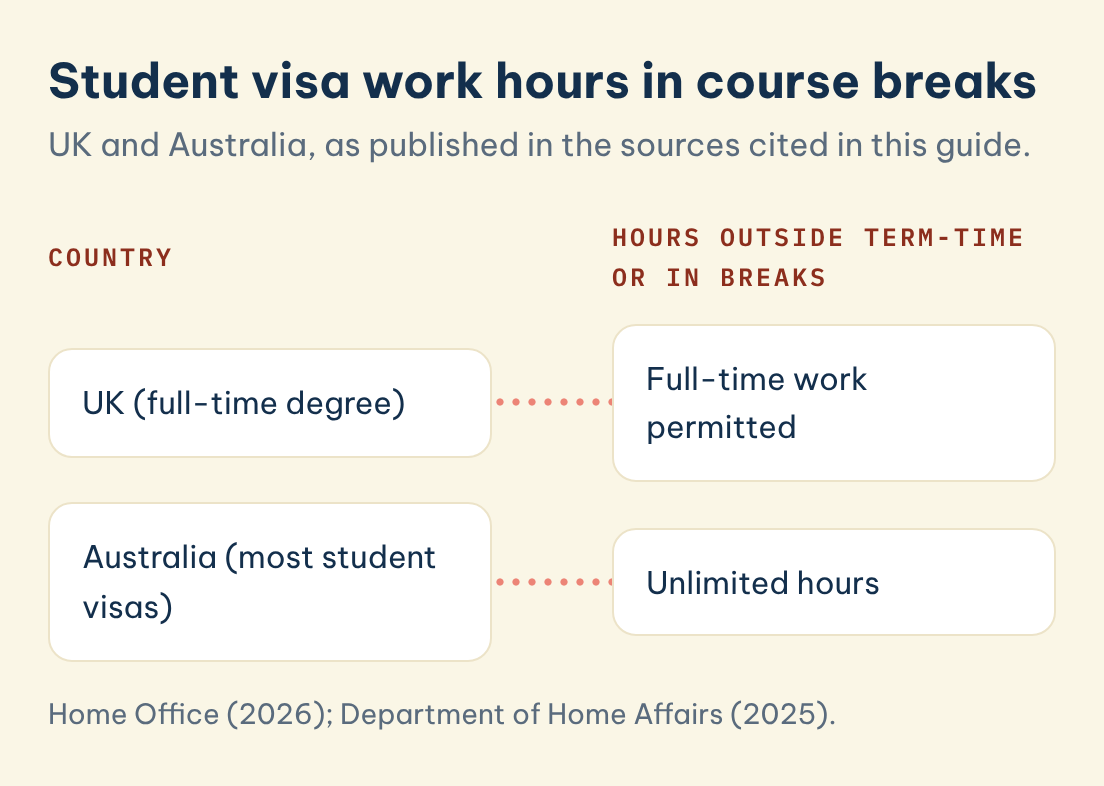
A Department of Home Affairs document released under Freedom of Information states that student visas allow most students "to work for up to 48 hours per fortnight while their course is in session and for unlimited hours during course breaks" (Department of Home Affairs, 2025, p. 1). UNSW confirms that "from 1 July 2023, work restrictions for Student Visa holders have been reintroduced and capped at the increased rate of 48 hours per fortnight" (University of New South Wales, n.d.). The Australian summer break falls around December to February, so many students find that the long break at the end of the year gives the best chance of full-time work. UNSW also notes that compulsory work-integrated learning activities are treated differently from ordinary work, so ask your university's international office before assuming a placement counts towards your hours. Research on this group is thin, and an Australian study states that "limited research exists on international students' workplace experience specifically" (Barton et al., 2022, p. 778), which is a reason to ask your university for local advice and not rely on forum posts.
| Country | Term-time | Course breaks | Source |
|---|---|---|---|
| UK (full-time degree, compliant provider) | Up to 20 hours a week | Full-time work permitted | Home Office (2026) |
| Australia (most student visas) | Up to 48 hours a fortnight | Unlimited hours | Department of Home Affairs (2025) |
Source: Home Office (2026); Department of Home Affairs (2025). Individual visa conditions can differ.
◆ Question 7 / 8 · Pay
Are summer internships paid, and what about unpaid roles in the UK?
Direct answer: In the UK, an intern who counts as a worker is normally due the National Minimum Wage, and an intern promised a contract of future work is a worker. Students on a required internship of under one year as part of a UK course are an exception.
GOV.UK states that "if an intern is classed as a worker, then they're normally due the National Minimum Wage" and that "an intern is classed as a worker and is due the National Minimum Wage if they're promised a contract of future work" (GOV.UK, n.d.). The same page lists students required to do an internship of under a year as part of a UK-based further or higher education course among those not entitled (GOV.UK, n.d.). So the label "unpaid" in an advert does not settle the matter. Check current rates on the GOV.UK minimum wage page before you accept an offer. Ask your university whether unpaid or voluntary work counts towards your hours. If an offer is unpaid, ask the careers service whether the role meets the legal test before you commit.
◆ Question 8 / 8 · Tutoring support
How can tutoring support your internship applications?
Direct answer: MAAS is an academic support partner, not a recruiter, and does not place students in internships or give immigration advice. A tutor can help you build the academic English and subject confidence that online tests and interviews rely on, while you do the applying yourself.
Students who struggle with timed English tests or with explaining their coursework in an interview can work with a one-to-one university subject tutor on the underlying skills. The tutor guides practice; you write your own applications and answer for yourself. The service does not set grade targets or promise outcomes, and decisions about hiring belong to employers. If you are also preparing language tests for study, our guide to TOEFL iBT scores for university admission explains the current format.
Frequently asked questions
When do summer internship applications open in the UK?
Prospects advises applying between September and December of the previous year for a summer internship, and earlier for large organisations. Many deadlines fall between January and March, and some employers recruit on a rolling basis.
Can international students do a summer internship in the UK?
Yes, within the conditions of the Student visa. A full-time degree student at a compliant provider may work full time outside term-time under the Immigration Rules. Confirm your own conditions with your university.
Is a summer internship in Australia limited to 48 hours a fortnight?
Not in course breaks. Most student visas allow up to 48 hours a fortnight while the course is in session and unlimited hours during breaks, but check your visa conditions.
Do I have to say I need sponsorship on an application?
Employers ask about right to work because they may have to sponsor. For a vacation internship that starts and ends while your Student visa is valid, an undergraduate can answer yes. Explain your dates if the form is unclear.
Are unpaid summer internships legal in the UK?
An intern classed as a worker is normally due the National Minimum Wage, and a promise of future work makes an intern a worker. Students on a required course internship of under one year are exempt.
What is the difference between a spring week and a summer internship?
A spring week lasts about a week in the Easter holidays and suits first and second years exploring options. A summer internship typically lasts two or three months.
Related guides
- The UK Graduate visa explained: what happens after your final summer
- What TOEFL iBT score do you need for university admission in 2026?: English test requirements
- UCAS deadlines: the undergraduate application timeline
- One-to-one university subject tutoring: guided practice for your course
References
- Barton, G., Hartwig, K., Hu, Y., Kavanagh, M., & Watson, M. (2022). Investigating the benefits and challenges of workplace volunteering experiences for international students' employability literacies. Journal of International Students, 12(3), 777-793. https://doi.org/10.32674/jis.v12i3.3493
- Department of Home Affairs. (2025). Information regarding student visa work limitations (FOI request FA 25/06/01036) [Document released under the Freedom of Information Act]. Australian Government. https://www.homeaffairs.gov.au/foi/files/2025/fa-250601036-document-released.PDF
- GOV.UK. (n.d.). Employment rights and pay for interns. UK Government. Retrieved October 23, 2026, from https://www.gov.uk/employment-rights-for-interns
- Home Office. (2026). Immigration Rules: Appendix Student [Guidance]. GOV.UK. https://www.gov.uk/guidance/immigration-rules/immigration-rules-appendix-student
- Prospects. (2026). Psychometric tests. Prospects.ac.uk. https://www.prospects.ac.uk/careers-advice/interview-tips/psychometric-tests/
- Smith, J. (2025). Internships: where to find them, what you'll be paid and how to apply. Prospects. https://www.prospects.ac.uk/jobs-and-work-experience/work-experience-and-internships/internships
- University of Manchester Careers Service. (n.d.). Do I have the right to work in the UK? The University of Manchester. Retrieved October 23, 2026, from https://www.careers.manchester.ac.uk/applicationsinterviews/faqs/right-to-work/
- University of New South Wales. (n.d.). Visa requirements & rights. UNSW Current Students. Retrieved October 23, 2026, from https://www.student.unsw.edu.au/visa/work
This article is part of the MAAS Journal series for international students. MAAS is an academic support partner: experts guide students through each stage of their own work, and we do not complete assessed work on a student's behalf.
Not sure how this guide applies to your own case? Talk it through with MAAS in a free 20-minute consultation.
Book a free consultation ▸