
◆ Student Success
How do international students get a UK graduate scheme?
Direct answer: Apply in the autumn of your final year, often a year before the start date, to schemes that state they sponsor visas. Expect online tests, a video interview and an assessment centre. The Graduate visa lets you join most schemes without sponsorship at first, but a long-term stay usually needs a Skilled Worker visa.
A UK graduate scheme is a structured training programme for new graduates, and international students can win places if they plan around two clocks: the recruitment calendar and the visa calendar. This guide was written on 23 October 2026 from Prospects, the National Careers Service, UCAS, two university careers services and the relevant gov.uk pages. It explains what a scheme is, when the 2027 cycle runs, how selection works, which sectors recruit, and how the Graduate and Skilled Worker visas fit in. Visa rules change, so check each figure on gov.uk on the day you act.

◆ Question 1 / 8 · What a scheme is
What is a graduate scheme in the UK?
Direct answer: A graduate scheme is a paid, full-time training programme run by an employer for recent graduates. Prospects (Higginbotham, 2026) says it usually lasts between one and three years, and UCAS (n.d.) adds that most last two years and lead to a permanent role at the same company.
Higginbotham (2026) describes a scheme as "a structured training programme run by an employer to develop graduates' professional knowledge and skills", offered in streams such as finance, human resources, IT, law, management, marketing and retail. The National Careers Service (n.d.) gives a wider range of 1 to 4 years and says a scheme offers hands-on experience of different areas of a company. Warwick Careers (University of Warwick, n.d.) explains that the time is usually split into rotations, which means working in different teams, and possibly different locations, on projects within the company. UCAS (n.d.) contrasts this with an ordinary graduate job, where you are a working employee from day one, the structure is looser, and you can apply at any time of year. For an international student, the practical difference matters: UCAS (n.d.) notes that employer sponsorship for a work visa is more likely with graduate schemes, though it is never guaranteed.
| Feature | Graduate scheme | Graduate job |
|---|---|---|
| Length | Fixed, usually 1 to 3 years (Prospects) | Open-ended |
| Structure | Rotations and formal training | Single role from day one |
| When you apply | Set annual window, mostly autumn | Any time of year |
| Selection | Tests, video interview, assessment centre | Often CV, cover letter and interview |
| Visa sponsorship | More likely, never guaranteed (UCAS) | Depends on the employer |
◆ Question 2 / 8 · 2027 timeline
When do 2027 graduate schemes open and close?
Direct answer: Most 2027 schemes open between September and December 2026 and start between July and October 2027. Prospects (Higginbotham, 2026) says many employers keep accepting applications until the end of the year or early January, but some close early once places are filled.
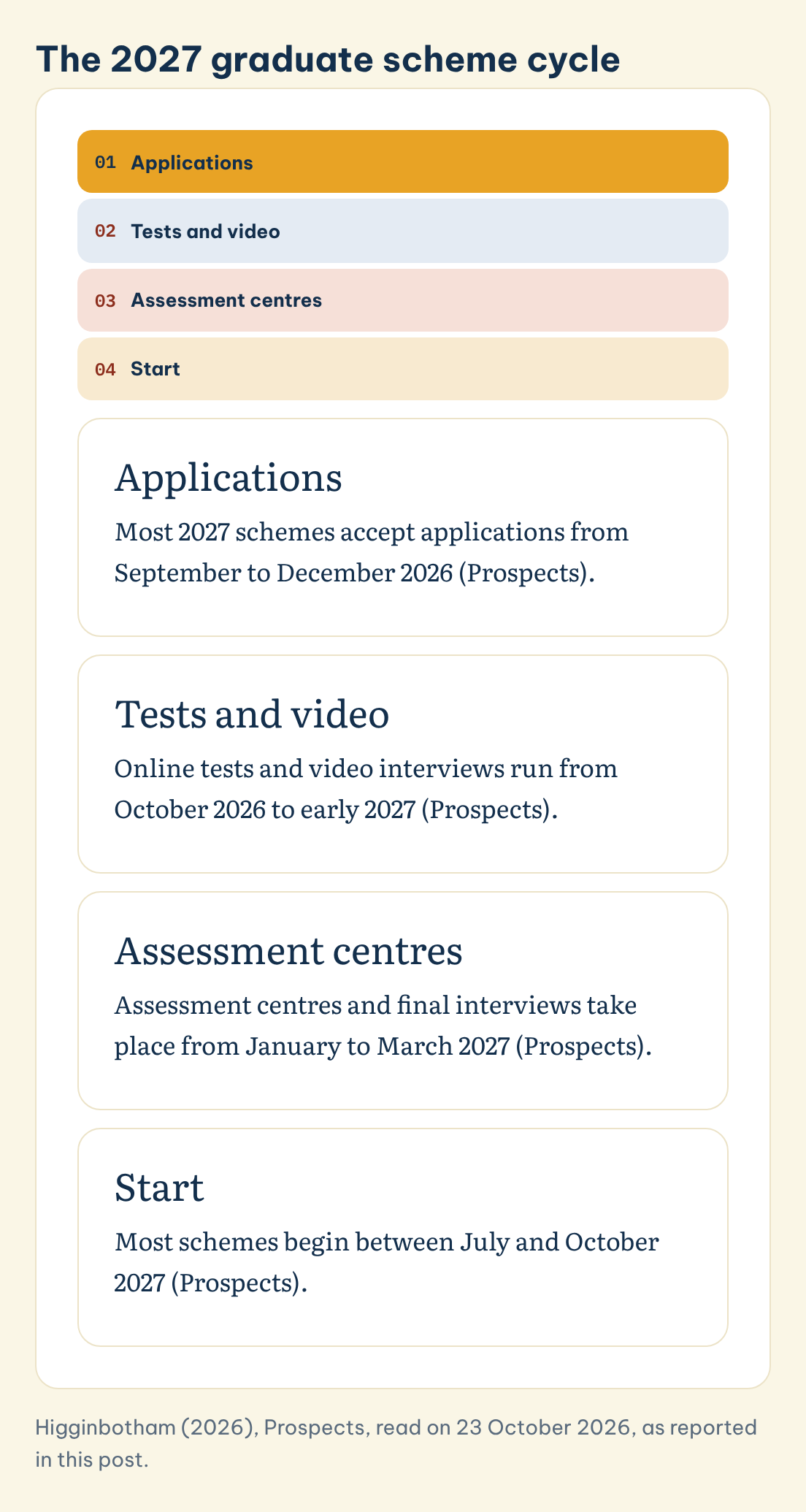
The 2027 graduate scheme cycle
Tap each stage to see when it happens and where the date comes from.
Applications
Most 2027 schemes accept applications from September to December 2026 (Prospects).
Tests and video
Online tests and video interviews run from October 2026 to early 2027 (Prospects).
Assessment centres
Assessment centres and final interviews take place from January to March 2027 (Prospects).
Start
Most schemes begin between July and October 2027 (Prospects).
Save this figure
Higginbotham (2026) gives the Civil Service Fast Stream 2027 as one example, opening in October 2026, while Tesco starts accepting applications in September. The University of Bristol Careers Service (2026) adds that by around February most graduate schemes have closed, so a student who starts looking in the spring of their final year has already missed most of the cycle. The table below combines the two calendars.
| Period | What happens | Source |
|---|---|---|
| July to September 2026 | Many applications open; research employers and sponsorship | Bristol Careers Service |
| September to December 2026 | Most 2027 schemes accept applications | Prospects |
| October 2026 to early 2027 | Online tests and video interviews | Prospects |
| January to March 2027 | Assessment centres and final interviews | Prospects |
| By around February 2027 | Most schemes have closed | Bristol Careers Service |
| July to October 2027 | Most schemes begin | Prospects |
The timing hits one-year master's students hardest. Warwick Careers (University of Warwick, n.d.) says that a master's student needs to start thinking of applying as soon as the course begins, because schemes start a year after they are advertised. If you arrive in September, the autumn deadlines fall in your first term, at the same time as your first assignments.
◆ Question 3 / 8 · Selection
How does the graduate scheme selection process work?
Direct answer: You apply on the employer's own careers site, then move through online psychometric tests, a telephone or video interview, an assessment centre with group exercises or a presentation, and a final interview. The National Careers Service (n.d.) lists each of these stages.
The National Careers Service (n.d.) adds e-tray exercises, which are timed inbox tasks, and a presentation on a topic chosen by the employer. Warwick Careers (University of Warwick, n.d.) notes that the application questions often test soft skills, so before you start an application, review what you have done in communication, problem solving and team working. Interview technique, such as answering competency questions, deserves its own preparation; this guide stays with the scheme itself.
Two practical points apply to international applicants. First, Higginbotham (2026) advises checking each employer's eligibility rules for international students before applying, so if your overseas qualifications do not obviously fit an application form, ask the graduate recruitment team before you submit. Second, University of Bristol Careers Service (2026) warns that you typically cannot apply more than once for the same scheme within the same year, so a rushed application can cost you a whole cycle.
◆ Question 4 / 8 · Degree needed
What degree classification do you need?
Direct answer: Many schemes ask for at least a 2:1, which is an upper second-class honours degree. The National Careers Service (n.d.) says some accept a 2:2 if you show potential and have a good CV, and some schemes do not require a degree related to the role.
Warwick Careers (University of Warwick, n.d.) says that for the vast majority of graduate schemes, recruiters do not specify degree disciplines, so a History graduate can apply for a marketing scheme and an engineer for finance. What employers look for instead is a good degree, work experience and a clear explanation of your motivation. Higginbotham (2026) advises checking four things in the entry requirements: the minimum classification, any required subject, any professional or language skills, and eligibility for international students and sponsorship.
Offers made during the final year are often conditional on your result. Higginbotham (2026) says to check whether an offer depends on achieving a particular classification, which means your final-year grades still decide whether the place becomes real. A careful plan for your dissertation and last modules protects the job offer as much as the degree.
◆ Question 5 / 8 · Sectors
Which sectors run graduate schemes?
Direct answer: UCAS (n.d.) lists professional services, accounting, engineering, finance, law, technology, and government and public services as the industries where schemes are most common. Prospects (Higginbotham, 2026) adds marketing, human resources and retail streams that run inside large employers across many industries.
The searches that sit next to "graduate schemes" on Google show what students look for: business, law, marketing, media and criminology. These map onto the sectors above in different ways. Higginbotham (2026) lists marketing and law among the streams that large employers run, so business and marketing searches usually lead to streams inside big companies. For law and for public sector routes that criminology graduates may consider, recruitment can follow its own timeline and rules, so read the employer's own page. Higginbotham (2026) tells applicants to check any nationality, residency or security-clearance requirements for each programme, and this check matters most in government work.
◆ Question 6 / 8 · Location
Are graduate schemes only in London?
Direct answer: No. Warwick Careers (University of Warwick, n.d.) says schemes are located throughout the UK, and that flexibility is expected, so you may be asked to relocate during rotations. London has many employers, but regional offices of the same large firms also run their own schemes across the country.
Higginbotham (2026) gives Scottish Power as one example, with programmes starting in mid-September, and the NHS Graduate Management Training Scheme as a national programme with no age limit. Before you accept, check where each rotation takes place, because moving city mid-scheme affects rent, travel and, for some students, a partner's plans. Our guide to living costs for international students in Australia and London gives a starting point for comparing a London salary with London rent.
◆ Question 7 / 8 · Visa sponsorship
Do you need visa sponsorship for a graduate scheme?
Direct answer: Not at first if you hold a Graduate visa, which lets you work in most jobs without a sponsor. But schemes run longer than the Graduate visa, which is 2 years if you apply by 31 December 2026, 18 months from 1 January 2027, or 3 years with a PhD (GOV.UK, n.d.-a).
GOV.UK (n.d.-a) says the Graduate visa cannot be extended, but you may be able to switch to a Skilled Worker visa. That is why sponsorship matters even when you start on a Graduate visa: a two- or three-year scheme can outlast your permission to stay. The government has explained the shorter route directly: "we will reduce the ability for Graduates to remain in the UK after their studies to a period of 18 months" (HM Government, 2025, p. 39). See our full guide to the UK Graduate visa for eligibility and costs.
The Skilled Worker visa has a salary floor, but graduates get a lower one. GOV.UK (n.d.-b) says you can be paid 70% of your job's standard going rate if your salary will be at least £33,400 per year and you are in the UK on a Student or Graduate visa, or were in the last 2 years. Your total stay on these terms cannot be more than 4 years, including any time already spent on a Graduate visa (GOV.UK, n.d.-b).
| Visa | What it allows | Key limit |
|---|---|---|
| Graduate visa | Work in most jobs without a sponsor | 2 years if applying by 31 Dec 2026, 18 months from 1 Jan 2027; 3 years for PhD holders |
| Skilled Worker (new entrant rate) | Sponsored work at 70% of the going rate | Salary at least £33,400; 4 years in total |
University of Bristol Careers Service (2026) suggests confirming sponsorship with the employer's HR team when an advert does not say, and Higginbotham (2026) advises checking whether you have the right to work for the whole length of the programme.
◆ Question 8 / 8 · Preparing
How can you prepare while you are still studying?
Direct answer: Start the employer research in your first term, keep a record of every application, and use your university careers service for application checks and mock interviews. The National Careers Service (n.d.) recommends asking a careers adviser to check an application before you submit it.
University of Bristol Careers Service (2026) suggests working through the year in stages: researching employers between July and September, attending careers fairs and preparing for interviews between October and January, and expecting assessment centres from mid-December to May. Warwick Careers (University of Warwick, n.d.) adds that the quality of an application beats the quantity, so a shortlist of well-researched schemes is a better use of a busy final year than dozens of rushed forms.
The hardest part for many international students is that the cycle overlaps with coursework and exams. If deadlines in specific modules are squeezing your preparation time, MAAS offers 1-on-1 university subject tutoring, where a MAAS expert helps you understand difficult course content so you keep up with the module; the work you submit stays your own.
Frequently asked questions
Can international students apply for UK graduate schemes?
Yes. Many schemes are open to international students, but each employer decides whether to sponsor a visa, so check every programme (Higginbotham, 2026).
When should I apply for a 2027 graduate scheme?
Between September and December 2026 for most schemes, and as early as possible because some close once places are full (Higginbotham, 2026).
Can I apply during a one-year master's?
Yes, but start as soon as the course begins, because schemes start a year after they are advertised (University of Warwick, n.d.).
Do I need a 2:1?
Often, but not always: a lower second can still be considered by some employers when the rest of the application is strong (National Careers Service, n.d.).
Can I join a scheme on a Graduate visa?
Yes, you can work in most jobs on it, but it cannot be extended, so a longer scheme usually means switching to a Skilled Worker visa (GOV.UK, n.d.-a).
What salary does a sponsored graduate need?
At least £33,400 a year and 70% of the going rate for the job, for recent Student or Graduate visa holders (GOV.UK, n.d.-b).
References
GOV.UK. (n.d.-a). Graduate visa. Retrieved October 23, 2026, from https://www.gov.uk/graduate-visa
GOV.UK. (n.d.-b). Skilled Worker visa: When you can be paid less. Retrieved October 23, 2026, from https://www.gov.uk/skilled-worker-visa/when-you-can-be-paid-less
Higginbotham, D. (2026, September 14). Graduate schemes 2027. Prospects. https://www.prospects.ac.uk/careers-advice/getting-a-job/graduate-schemes/
HM Government. (2025). Restoring control over the immigration system (CP 1326). Home Office. https://assets.publishing.service.gov.uk/media/6821aec3f16c0654b19060ac/restoring-control-over-the-immigration-system-white-paper.pdf
National Careers Service. (n.d.). Graduate schemes: Getting a place. Retrieved October 23, 2026, from https://nationalcareers.service.gov.uk/careers-advice/how-to-find-graduate-schemes/
UCAS. (n.d.). Graduate schemes and entry-level jobs. Retrieved October 23, 2026, from https://www.ucas.com/international/international-students/after-graduation/graduate-schemes-and-entry-level-jobs
University of Bristol Careers Service. (2026, August 21). Get a UK job: A timeline for international students. University of Bristol. https://universityofbristolcareers.blogs.bristol.ac.uk/2026/08/21/get-a-uk-job-a-timeline-for-international-students/
University of Warwick. (n.d.). What are graduate schemes? Warwick Careers Blog. Retrieved October 23, 2026, from https://warwick.ac.uk/services/careers/blog/what_are_graduate_schemes/
Not sure how this guide applies to your own case? Talk it through with MAAS in a free 20-minute consultation.
Book a free consultation ▸