
◆ Careers
What competency-based interview questions do graduate recruiters ask?
Direct answer: Graduate recruiters ask questions that start "Tell me about a time when..." or "Give an example of...", each one aimed at a single skill such as teamwork, leadership, problem solving or resilience. Your answer is scored against criteria the panel fixed in advance, so it needs a real example and a visible result.
This guide was written on 23 October 2026 for international students applying to UK and Australian graduate schemes. It is built from university careers and HR guidance, Prospects, and the UK Civil Service Success Profiles, not from recruitment agency lists. It covers what the questions look like, how they are marked, and how to build a bank of examples before the interview.

◆ Question 1 / 7 · What it is
What is a competency-based interview?
Direct answer: A competency-based interview is a structured interview in which every question targets one skill the job needs, and every candidate is compared against the same pre-set criteria. Prospects (Swain, 2025a) notes that these interviews are also called structured, behavioural or situational interviews.
The idea underneath is simple. The LSE Human Resources guide for its own hiring managers puts it this way: "Competency-based selection methods are based on the assumption that past behaviour is the best predictor for future behaviour. It is not enough for a candidate to just say what they can offer; they need to provide evidence" (LSE Human Resources, 2019, p. 4). That sentence explains most of what follows. A claim such as "I am a strong communicator" earns nothing, while a short account of a real event in which you communicated well earns marks.
Swain (2025a) contrasts this with an unstructured interview, where the panel asks open questions such as "why did you apply for the job?" to form an overall impression. In a competency interview the panel holds a list of questions, writes down what you say, and marks it. Prospects adds that large graduate recruiters particularly favour the format, and often use it inside an assessment centre.
◆ Question 2 / 7 · Common competencies
Which competencies do graduate recruiters test most often?
Direct answer: The same ten or so skills recur across graduate schemes: adaptability, commercial awareness, communication, conflict resolution, decision-making, leadership, organisation, problem solving, resilience and teamwork. The job description for each role tells you which of these a particular employer weights most heavily, so read it first.
Swain (2025a) lists adaptability, commercial awareness, communication, conflict resolution, decisiveness, independence, flexibility, leadership, problem solving, organisation, resilience and teamwork as the competencies employers regularly seek. The Prospects page on assessment centres gives an overlapping list that adds analytical thinking, creativity, negotiation, persuasion, planning and time management (Swain, 2025b).
The table below groups the common competencies with a typical question and what a panel is usually listening for. The questions are adapted from the Prospects list and the LSE guide; the third column is a summary of the published criteria, not a mark scheme from any one employer.
| Competency | Typical question | What the panel listens for |
|---|---|---|
| Teamwork | Give an example of a time you handled conflict in a team. | Your own contribution, not "we" |
| Leadership | Describe a situation in which you led a team. | How you set direction and involved others |
| Problem solving | Give an example of a problem you solved in a creative way. | How you analysed the problem before acting |
| Decision-making | Tell me about a big decision you made recently. How did you go about it? | The options you weighed and the evidence used |
| Resilience | How do you cope in adversity? Give an example. | What you did next, and what you learned |
| Communication | Tell me about a time your communication skills improved a situation. | Adapting the message to the audience |
| Adaptability | Describe a time you were asked to do something you had never attempted. | How quickly you learned and adjusted |
| Integrity | Tell me about a time you showed integrity and professionalism. | A concrete choice, not a statement of values |
What are the top competency-based interview questions?
Direct answer: No official top-ten list exists, but eight questions appear again and again on university and Prospects lists. Prepare a real example for each one, drawn from study, work or volunteering, and you will have material that adapts to most graduate interviews.
The eight below are taken word for word, or nearly so, from Swain (2025a) and the LSE guide (LSE Human Resources, 2019).
- Describe a situation in which you led a team.
- Give an example of a time you handled conflict in the workplace.
- Tell me about a big decision you have made recently. How did you go about it?
- What has been your biggest achievement to date?
- Tell me about a time when your communication skills improved a situation.
- Give me an example of a challenge you faced and tell me how you overcame it.
- Give an example of a situation where you solved a problem in a creative way.
- Tell me about a time that you made a decision and then changed your mind.
Notice that question 8 rewards you for admitting a change of mind. Several of these questions are designed to test self-awareness, so an example in which nothing went wrong is often weaker than one in which you corrected course.
◆ Question 4 / 7 · How answers are marked
How are competency answers marked?
Direct answer: Each answer is scored against criteria written before the interview, usually on a numbered scale, and the panel compares scores across candidates. Swain (2025a) says your answers "will be compared against pre-determined criteria and marked accordingly", which is why vague or hypothetical answers score low.
How a structured competency interview is usually balanced
Tap each part to see the figure and where it comes from.
Competency questions
Around 70% of questions in LSE's recommended format (LSE Human Resources, 2019, p. 5).
Technical questions
The remaining 30%, on skills specific to the role (LSE Human Resources, 2019, p. 5).
Questions per interview
Typically three to six in a 45 to 60 minute interview (Swain, 2025a).
Examples to prepare
Five to eight examples you can adapt (Swain, 2025a).
Save this figure
Employers do not publish their scoring sheets, but the published guidance shows what they reward. Swain (2025a) names four common mistakes: rambling, giving hypothetical answers such as "I would usually...", describing a task without showing the result, and hiding your own contribution behind the team's. Each of these leaves the assessor with nothing to write in the evidence box.
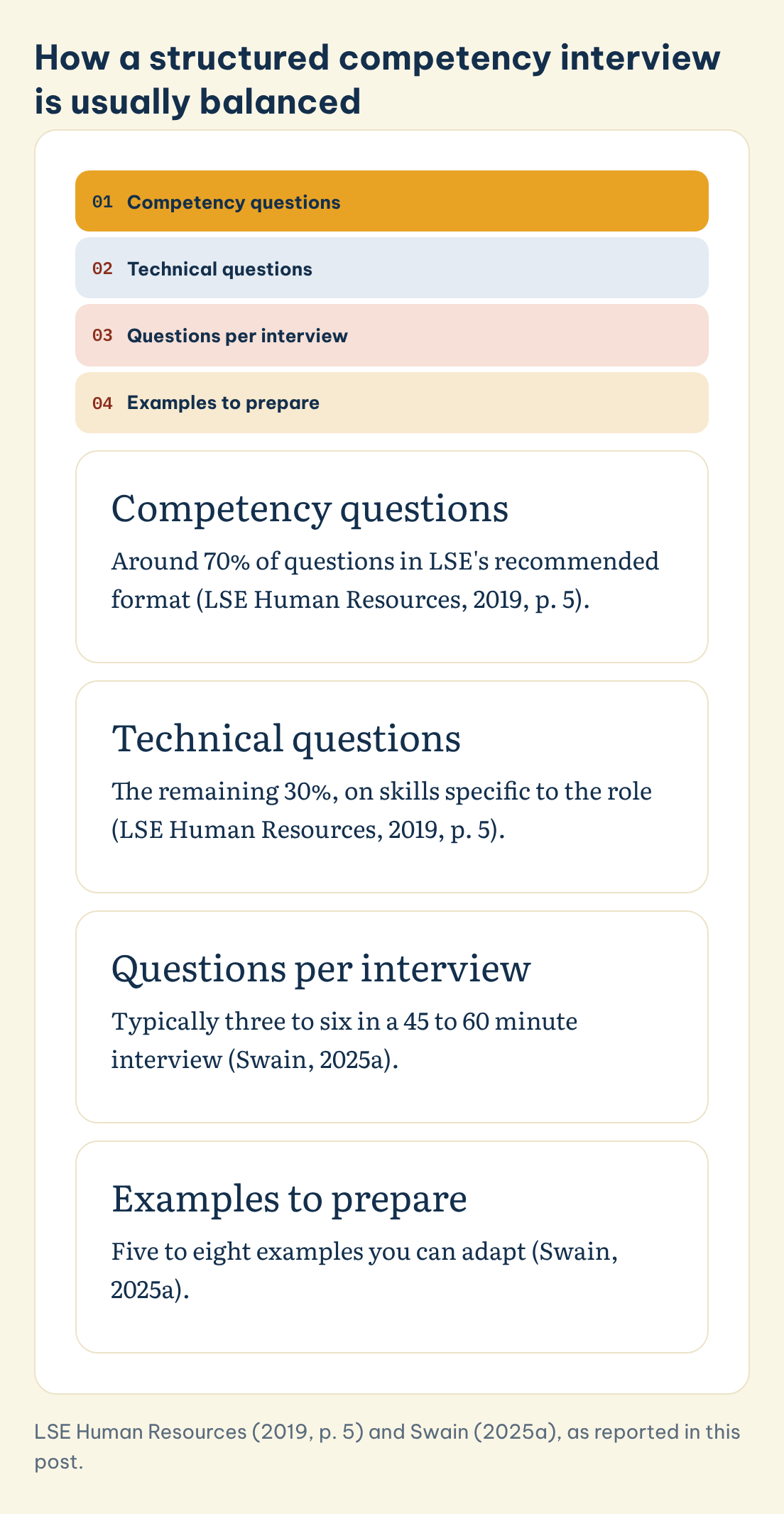
The LSE guide also shows the balance a panel plans for. It recommends that competency questions "could make up for around 70% of your interview questions with the remaining 30% covering the technical skills specific to the role" (LSE Human Resources, 2019, p. 5). That figure is guidance for LSE's own professional staff, not a rule for every employer, but it signals that competency questions usually form most of a structured interview.
On length, Swain (2025a) says a standard interview of around 45 to 60 minutes typically includes between three and six competency questions, and suggests having five to eight examples ready that you can adapt.
◆ Question 5 / 7 · Civil Service
How do UK Civil Service competency questions differ?
Direct answer: The UK Civil Service no longer uses the word "competency". It recruits through Success Profiles, and the behaviour element lists nine Civil Service Behaviours. Each job advert names the few behaviours that role will test, and the examples expected change with the grade.
The Cabinet Office (2025b) defines the nine behaviours as seeing the big picture, changing and improving, making effective decisions, leadership, communicating and influencing, working together, developing self and others, managing a quality service, and delivering at pace. It says you "will not be asked to demonstrate all Civil Service Behaviours for one role", so the job description is the first thing to read.
Three details matter for students. First, the Cabinet Office (2025b) says your examples can come from work, work experience, volunteering or a hobby, so a university society or a group project counts. Second, behaviours are assessed in several ways, including the application form, interviews, assessment centres and situational judgement tests. Third, the guidance itself suggests the STAR method and adds that "there is no expectation that you need to demonstrate every part of each example to be successful" (Cabinet Office, 2025b). Success Profiles also include strengths, ability, experience and technical elements, and not every element applies to every role (Cabinet Office, 2025a).
◆ Question 6 / 7 · Building answers
How should you build answers before the interview?
Direct answer: Read the job description, list the competencies it names, and match each one to a real experience from study, work or volunteering. Write each example down once, with your actions and the result, then practise saying it aloud rather than reciting it.
Swain (2025a) recommends drawing on "a variety of experiences from your studies, previous employment or any work experience", and warns against embellishing, because "any lies or invented examples can be easily checked". The same page allows one strong example to serve more than one question, as long as you shift the emphasis to the competency being asked about and do not lean on that example for the whole interview.
For international students, the richest examples often come from coursework rather than jobs. A group assignment with a member who stopped contributing, a dissertation whose data collection fell through, or a presentation you redesigned for a non-specialist audience can each answer a teamwork, resilience or communication question. The key is to describe what you did and what changed, with a number if one exists. Swain (2025a) suggests a structure called STARR, which adds a final reflection on what you learned.
◆ Question 7 / 7 · PDF guides
Where can you find competency questions as a PDF?
Direct answer: The most reliable free PDFs come from universities and public bodies rather than recruitment sites. The LSE guide to competency-based interviews is one example, and the Civil Service behaviour examples on gov.uk can be printed or saved as a document.
LSE Human Resources (2019) publishes a 19-page guide that includes a behaviour framework by staff band and sample questions. Because it was written for hiring managers, it shows the interview from the panel's side, which is useful when you are trying to guess what a question is really testing. Your own university careers service is the other place to look, since many publish question lists and offer mock interviews.
If you want to rehearse explaining a piece of coursework clearly before an interview, a one-to-one session with a MAAS subject tutor can help you talk through the academic side of your example; the experience and the answer stay your own. If you are applying for doctoral posts rather than graduate jobs, see questions to ask at a PhD interview, and for post-study work rights in the UK, our guide to the UK Graduate Route visa.
Frequently asked questions
How many competency questions are asked in an interview?
Prospects says a standard interview of about 45 to 60 minutes typically includes three to six competency questions (Swain, 2025a).
Can I use the same example for two questions?
Yes, if the example shows both competencies and you change the emphasis for each question, but avoid using one example for the whole interview (Swain, 2025a).
Can I use university examples instead of work experience?
Yes. The Civil Service accepts examples from work experience, volunteering or a hobby, and Prospects suggests drawing on your studies as well (Cabinet Office, 2025b; Swain, 2025a).
What is the difference between competency and strengths questions?
Competency questions ask for evidence of what you have done. Strengths questions, such as those in the Civil Service Success Profiles, ask what you do regularly, do well and are motivated by (Cabinet Office, 2025a).
Are hypothetical answers acceptable?
Usually not for a competency question. Prospects lists answers beginning "I would usually..." as a common mistake, because the panel wants what actually happened (Swain, 2025a).
Do I need to cover every behaviour in a Civil Service interview?
No. Recruiting managers choose a selection of behaviours for each role, and the job advert names them (Cabinet Office, 2025b).
References
Cabinet Office. (2025a). Success Profiles. GOV.UK. Retrieved October 23, 2026, from https://www.gov.uk/government/publications/success-profiles
Cabinet Office. (2025b). Success Profiles: Civil Service behaviours. GOV.UK. Retrieved October 23, 2026, from https://www.gov.uk/government/publications/success-profiles/success-profiles-civil-service-behaviours
LSE Human Resources. (2019). A guide to competency based interviews [Recruitment toolkit]. London School of Economics and Political Science. https://info.lse.ac.uk/staff/divisions/Human-Resources/Assets/Documents/Recruitment-Toolkit/Interview-and-Assessment/4.2-A-Guide-to-Competency-Based-Interviews.pdf
Swain, R. (2025a). Competency-based interviews. Prospects. Retrieved October 23, 2026, from https://www.prospects.ac.uk/careers-advice/interview-tips/competency-based-interviews
Swain, R. (2025b). Assessment centres. Prospects. Retrieved October 23, 2026, from https://www.prospects.ac.uk/careers-advice/interview-tips/assessment-centres
Not sure how this guide applies to your own case? Talk it through with MAAS in a free 20-minute consultation.
Book a free consultation ▸