
◆ Student Success
How do students build a weekly time management system?
A student week fills up with classes, shifts and deadlines long before it fills up with study. This guide shows a Sunday or Monday routine that takes under half an hour, built from published university planners and one large meta-analysis, and explains what the research does and does not say about grades.
Last updated: 2026-10-23
Category: student-success

◆ Question 1 / 8 · What are time management
What are time management skills for students?
Direct answer: Time management skills are three linked habits: structuring your time with a schedule, protecting it with boundaries, and adapting it when plans change. Aeon et al. (2021) pooled 158 studies and describe exactly these three aspects, which is why a good weekly system has a plan, a defended block of rest and a review.
The meta-analysis spells out its own definition: "Time management measures typically capture three aspects of time management: structuring, protecting, and adapting time to changing conditions" (p. 4). The same page explains that structuring means mapping activities to time "using a schedule, a planner, or other devices that represent time in a systematic way", and that protecting means setting "boundaries around their time to repel intruders" (Aeon et al., 2021, p. 4). Everything below applies those three words to a student week. Lists published under "5" or "7 essential time management skills" vary, and a common set is planning, prioritising, scheduling, monitoring progress and adjusting. Whether a list has 5 items or 7, each one fits inside the structure, protect and adapt loop, so you do not need to memorise a list to use the system.
◆ Question 2 / 8 · What does the evidence say
What does the evidence say about time management and grades?
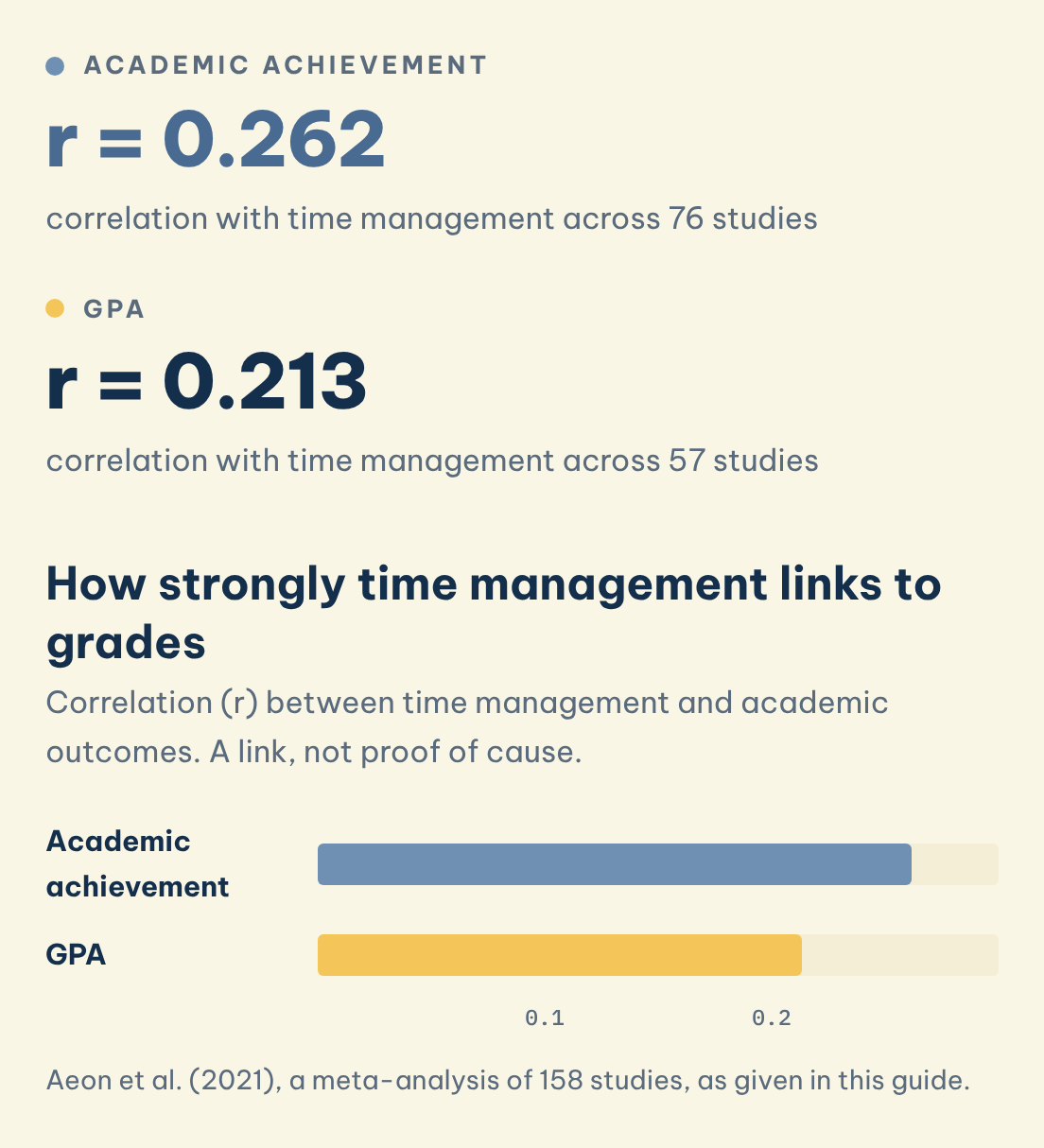
Direct answer: The evidence supports a real but modest link. Aeon et al. (2021) pooled 76 studies and found a correlation of r = 0.262 between time management and academic achievement, and r = 0.213 for GPA specifically. Correlation does not prove that planning causes better grades, so treat the system as support, not a guarantee.
Academic achievement
r = 0.262
correlation with time management across 76 studies
GPA
r = 0.213
correlation with time management across 57 studies
How strongly time management links to grades
Correlation (r) between time management and academic outcomes. A link, not proof of cause.
Save this figure
Two older studies add context. Britton and Tesser (1991) examined time-management practices among college students and their grades. Claessens et al. (2007) reviewed 32 empirical studies from 1982 to 2004 and found that time management relates to perceived control of time, better health and lower stress, while its link with work and academic performance was not clear. Wolters and Brady (2021) later framed student time management as part of self-regulated learning, meaning that planning is one visible piece of a wider habit of monitoring and adjusting your own study.
| What was measured | Result in Aeon et al. (2021) |
|---|---|
| Academic achievement (76 studies) | r = 0.262 |
| GPA (57 studies) | r = 0.213 |
| Standardized tests (7 studies) | r = 0.011, no clear link |
| Stress, all settings (17 studies) | r = -0.286 |
The honest reading is stated on p. 9: "time management is more likely to get people a good performance review at work than a strong GPA in school" (Aeon et al., 2021, p. 9). Across studies, time management is linked at least as strongly to lower stress as to marks, and Claessens et al. (2007) add a link to perceived control of time, which is a good reason to build a light system you will actually keep rather than an elaborate one you abandon by week three.
◆ Question 3 / 8 · How much study time does
How much study time does a full-time week actually contain?
Direct answer: Credit rules give a starting estimate. The Quality Assurance Agency for Higher Education (2021) says one credit typically represents 10 notional hours of learning, so a 120-credit year is about 1,200 hours. Spread over 30 teaching weeks, as an illustration, that is roughly 40 hours a week of classes plus independent study.
The Quality Assurance Agency for Higher Education (2021) describes notional learning hours as the time a learner is expected to spend, on average, to reach the learning outcomes, and says this may include "time spent in class, directed learning, independent study and assessment". The framework applies to England. The arithmetic here is an illustration, not a rule from the source: 120 credits × 10 hours = 1,200 hours, and 1,200 divided by a 30-week teaching year is 40 hours, or about 33 hours if the year is 36 weeks. Your university sets the real number of weeks, so check your handbook before you rely on either figure.
The point of the calculation is not precision. If your timetable shows 12 hours of classes and your credits imply something near full-time work, the difference is independent study that nobody schedules for you. A weekly system exists to give that unscheduled time a place on the page before the week fills it with other things.
◆ Question 4 / 8 · What is the weekly review
What is the weekly review that holds the system together?
Direct answer: A weekly review is a fixed 20 to 30 minute session, on Sunday evening or Monday morning, in which you list the week's fixed commitments, rank deadlines, choose the few study tasks that matter and write them into specific slots. It works only if you do it every week, so keep it short.
Run the review in 6 steps, in this order, with a target of 20 to 30 minutes in total:
- Map the fixed commitments. Write in classes, work shifts, travel and anything with a time you cannot move. This is the "structuring" step from Aeon et al. (2021).
- List what is due and what it is worth. Take every assessment from your term plan with its due date and weighting, and rank them by date first, weight second.
- Work backwards. For the nearest large item, decide what must be finished this week for the deadline to stay safe.
- Choose 3 to 5 study tasks. Name each one in a verb phrase ("draft the methods paragraph"), not a topic ("methodology").
- Place them in the gaps. Write each task into a specific slot beside your fixed commitments.
- Protect one block of rest. Mark an evening or half day as closed to study, which is the "protecting" step.
The sixth step is the one students skip, and it is the one that guards against the overload the research links to stress.
◆ Question 5 / 8 · How do you rank assessments
How do you rank assessments and plan backwards from deadlines?
Direct answer: Use a term planner. Southern Cross University (2023) tells students to write each unit's due dates, word or time limits and weighting in one grid, then "work backwards from the due dates to plot start dates for each task". Your weekly plan then draws its tasks from that grid.
The weekly review is the short-range layer; the term planner is the long-range layer that feeds it. Southern Cross University (2023) recommends completing the planner at the start of term and lists three things to record for every assessment: the due date and time, the word or time limit, and the weighting. It then asks you to consider the tasks required and how long they will take, and to work backwards to a start date for each. If you are writing a longer project, the same logic is laid out in how to plan a dissertation timeline, and for a single piece of coursework the sequence in how to do a university assignment shows where each stage fits.
Ranking is where students most often go wrong. A 10 per cent quiz due Tuesday and a 40 per cent report due in three weeks compete for the same Monday. Rank by due date first so nothing becomes urgent by surprise, then use weighting to decide where extra time goes when two tasks clash. Federation University Australia (n.d.) publishes a blank weekly planner with a box for "Preparing for Assignments", a reminder that assessment preparation deserves its own slot in the week rather than whatever time is left over.
◆ Question 6 / 8 · How do you track actual
How do you track actual hours and adjust the plan?
Direct answer: Write down how long each task really took, compare it with your estimate at the next review, and adjust. This is the "adapting" step in Aeon et al. (2021). Two or three weeks of real numbers give you a personal correction factor that no generic guide can supply.
Estimates are usually the weak point of a student plan. A paragraph you expected to take 30 minutes takes an hour and a half, and the whole afternoon slips. The fix is not a better guess but a record: next to each task in your planner, add one number after you finish it, the minutes it took. At the Monday review, look at the gap between planned and actual, and scale your next week's estimates up by that gap. If your reading tasks consistently take twice what you planned, plan them at twice the length and drop a task rather than squeezing it in.
Adapting also covers the week that falls apart because of illness, a shift change or a bad day. Move the unfinished tasks to the next review rather than stacking them on top of new ones, and decide consciously which one drops. Wolters and Brady (2021) link time management to the forethought, performance and post-performance phases of self-regulated learning, and checking and revising a plan sits in those later phases, which is a useful reminder that a missed plan is information, not failure. A plan you revise each Monday stays accurate; a plan you keep defending from week one becomes fiction by week four.
◆ Question 7 / 8 · Which sample week shows
Which sample week shows the whole system?
Direct answer: A sample week has one 25-minute review on Sunday, three to five named study tasks placed beside fixed classes, one tracked-hours note per task, one protected evening and a short Friday check. The table below is an example layout, not a prescription, so change the slots to match your timetable.
| Day | What happens | Purpose |
|---|---|---|
| Sunday evening | 25-minute weekly review: map commitments, rank deadlines, choose tasks | Structure |
| Monday to Thursday | One or two named study tasks per day, minutes logged after each | Structure and tracking |
| Wednesday evening | Closed to study | Protect |
| Friday afternoon | Five-minute check: what moved, what drops, what carries over | Adapt |
| Saturday | Catch-up slot only if needed, otherwise free | Protect |
The same layout answers the question of what to write when a CV or interview asks for examples of time management skills. A concrete example is easier to defend than a claim: "I planned each week from a term planner, logged my actual hours and adjusted the following week's estimates" says more than "I am well organised". If you are preparing a reflective essay on the topic, the weekly review, the tracked hours and the revised plan are three pieces of evidence you can describe. A first-year student arriving in a new country faces extra variables, which the first-year checklist for studying in Australia walks through.
◆ Question 8 / 8 · When you want help building
When you want help building the plan with an expert
A MAAS tutor can sit with you in a 1-on-1 session, look at your term planner and timetable, and help you build the first few weekly reviews, so that you leave with a plan you understand and can maintain. The tutor guides the planning and explains how to rank and estimate; the studying and the assignments stay your own work, and sessions do not set grade targets.
If planning with an expert would help you start, explore 1-on-1 university subject tutoring at MAAS.
Frequently asked questions
What are time management skills?
They are the everyday habits of scheduling, guarding and revising your hours. The meta-analysis by Aeon et al. (2021), which covered 158 studies and 53,957 participants, groups them as structuring, protecting and adapting, and each maps onto a step of the weekly review above.
What are the 5 essential time management skills?
Published lists vary, so there is no single official five. A practical set is planning, prioritising, scheduling, monitoring and adjusting. Each fits inside the structure, protect and adapt loop in Aeon et al. (2021), and the weekly review in this guide exercises all five in one short session.
Does good time management raise your grades?
It is linked to them, but modestly. Aeon et al. (2021) found r = 0.262 with academic achievement and r = 0.213 with GPA, and note that these are correlations. Claessens et al. (2007) found clearer links to perceived control of time and lower stress than to performance.
How long should a weekly review take?
Twenty to thirty minutes is enough once the habit is in place. The first one may take longer if you also fill in a term planner as Southern Cross University (2023) suggests. The value comes from doing it every week, not from making any single review thorough.
How many hours a week should a full-time student study?
Credit rules give an estimate. One credit typically represents 10 notional hours of learning (Quality Assurance Agency for Higher Education, 2021), so 120 credits is about 1,200 hours a year, or roughly 40 hours a week over an assumed 30 teaching weeks. Check your own university's handbook for the real figure.
How do I describe time management skills on a CV?
Describe a specific system and a result rather than a trait. For example, state that you planned each week from a term planner, logged actual hours per task and revised your estimates, then name one deadline you met this way. Concrete evidence is easier to defend at interview than a general claim.
References
Aeon, B., Faber, A., & Panaccio, A. (2021). Does time management work? A meta-analysis. PLOS ONE, 16(1), Article e0245066. https://doi.org/10.1371/journal.pone.0245066
Britton, B. K., & Tesser, A. (1991). Effects of time-management practices on college grades. Journal of Educational Psychology, 83(3), 405–410. https://doi.org/10.1037/0022-0663.83.3.405
Claessens, B. J. C., van Eerde, W., Rutte, C. G., & Roe, R. A. (2007). A review of the time management literature. Personnel Review, 36(2), 255–276. https://doi.org/10.1108/00483480710726136
Federation University Australia. (n.d.). Weekly planner: Plan your study week [Helpsheet]. https://www.federation.edu.au/siteassets/files/students/study-skills/weekly_planner_helpsheet.pdf
Quality Assurance Agency for Higher Education. (2021). Higher education credit framework for England: Advice on academic credit arrangements (2nd ed.). https://www.qaa.ac.uk/docs/qaa/quality-code/higher-education-credit-framework-for-england.pdf
Southern Cross University. (2023). Term planner: Assessments [Quick guide]. Student Learning Zone. https://www.scu.edu.au/media/scu-dep/current-students/learning-zone/quick-guides/Term-Planner---Assessments.pdf
Wolters, C. A., & Brady, A. C. (2021). College students' time management: A self-regulated learning perspective. Educational Psychology Review, 33(4), 1319–1351. https://doi.org/10.1007/s10648-020-09519-z
Not sure how this guide applies to your own case? Talk it through with MAAS in a free 20-minute consultation.
Book a free consultation ▸