
◆ Admissions
What should you sort out in your first year to study in Australia?
Direct answer: Before you fly, hold a subclass 500 student visa, buy Overseas Student Health Cover (OSHC), and prove your English. In your first weeks, tell your provider your address within seven days, apply for a tax file number, and learn the 48-hour fortnightly work limit. In semester one, keep your course progress satisfactory.
◆ Question 1 / 8 · Before you arrive
What do you need before you arrive to study in Australia?
Direct answer: You need a subclass 500 student visa, health cover bought before arrival, and proof of English, such as a passport from an exempt country or an approved test result. Visa application charges change over time, so confirm the current charge before you budget.
Study Australia (n.d.-a) lists the conditions of the student visa, among them keeping OSHC "for the required period, unless an exemption applies" and giving your provider your residential address "within seven days of arriving". The same page tells applicants to confirm the current visa application charge, because charges change. The Department of Health, Disability and Ageing (2026) is blunt about timing: you must buy OSHC before you arrive and keep it for the whole time you study in Australia. Most first-year problems start from skipping one of these three items, so treat them as a short pre-departure list rather than paperwork to sort out later. The table below puts the first-year items in order, with the source that sets each one.
| Stage | What to do | Who sets the rule |
|---|---|---|
| Before arrival | Hold a subclass 500 visa and buy OSHC | Home Affairs and the Department of Health |
| Before arrival | Prove English with a passport or an approved test | Department of Home Affairs (via Study Australia) |
| First week | Give your provider your address within 7 days | Visa condition 8533 |
| First weeks | Apply for a TFN before you start work | Australian Taxation Office |
| Every fortnight | Work no more than 48 hours while classes run | Visa condition 8105 |
| Every semester | Keep course progress and attendance satisfactory | National Code, Standard 8 |
Source: Study Australia (n.d.-a); Department of Health, Disability and Ageing (2026); Commonwealth of Australia (1994).
◆ Question 2 / 8 · English proof
Do you need IELTS to study in Australia, and what changes if you apply from the UK?
Direct answer: Not always. You must show English proficiency, but a valid passport from the United Kingdom, United States, Canada, New Zealand or Ireland can serve as proof. Otherwise you need a certificate from an approved test, and at-home or online versions of those tests are not accepted by Home Affairs.
Study Australia (n.d.-b) says that to prove your English level you must provide either proof that you are a citizen of, and hold a valid passport issued by, one of those five countries, or a certificate from one of its approved tests. British National (Overseas) passports are not accepted for the passport route. The approved list includes IELTS Academic, IELTS General Training, PTE Academic, TOEFL iBT, Cambridge C1 Advanced, CELPIP General, LANGUAGECERT Academic, the Michigan English Test and OET. The page also warns that the Department of Home Affairs does not accept scores from "at-home" or "online" tests. A UK applicant with a British passport can therefore skip the test for the visa, although the university may ask for a score of its own for admission. If you are unsure which exam suits you, read how PTE Academic compares with IELTS or what the new TOEFL iBT bands mean for admission, then check the minimum score on the Home Affairs page for your course level.
◆ Question 3 / 8 · Money
Is $10,000 or $20,000 enough to move to Australia as a student?
Direct answer: The honest answer is that no single figure applies to everyone. The financial capacity you must show is set by the Department of Home Affairs and changes with your family size, so check its page rather than a blog or agency number. The visa application charge changes, so confirm it.
Search results for this question are full of round numbers, and that is the problem with them. Study Australia (n.d.-a) tells applicants to confirm the current visa application charge because charges change, so look it up rather than trusting an old figure. Everything else depends on your course, your city and who travels with you. OSHC is a legal condition and must be paid before arrival (Department of Health, Disability and Ageing, 2026). Tuition varies by university and level, so the only usable figure is the one on your offer letter. Work income cannot be counted on in month one, because Study Australia (n.d.-a) says you cannot work before your course starts unless you hold another visa that allows it. Add up the visa fee, the first year of OSHC, tuition, flights and a deposit for housing, then compare the total with the capacity figure Home Affairs publishes for your situation. If your total sits close to the line, plan for more, not less.
◆ Question 4 / 8 · Visa conditions
Which student visa conditions matter most in your first weeks?
Direct answer: Four conditions do most of the damage when missed: 8202, 8501, 8533 and 8105. They cover full-time enrolment, health insurance, telling your provider your address within seven days, and the fortnightly work cap. Read them once in the regulation itself, because summaries often drop the detail.
The Migration Regulations (Commonwealth of Australia, 1994, sch 8) set each condition in plain terms. Condition 8202 requires the holder to be "enrolled in a full - time registered course". Condition 8501 says the holder "must maintain adequate arrangements for health insurance while the holder is in Australia". Condition 8533 requires a student who was outside Australia at grant to tell the education provider their residential address within 7 days of arriving, and to report any change of address within 7 days of the change. Condition 8105 limits work, and subclause 2A applies the 48-hour figure to subclass 500 holders in place of 40. Students often treat address updates as a courtesy to the university, yet a missed update is a breach of a visa condition. Move house in week six, and you have a seven-day clock again. Put the address deadline in your phone calendar on the day you land, and check the change rule every time you sign a new lease.
◆ Question 5 / 8 · Work and rights
How many hours can you work, and what are your rights at work?
Direct answer: While classes are running, the cap is 48 working hours in each fortnight, and scheduled breaks carry no cap. Count fortnights from a Monday. Employers owe you the same legal protections they owe local staff, so ask about pay slips, rates and trial shifts whenever something looks wrong.
Student visa limits in your first year
Work hours and the address deadline for subclass 500 holders.
Situation
Limit or deadline
Course in session
48 hours per fortnight
Scheduled course break
No limit
Arrival or change of address
Tell your provider within 7 days
Save this figure
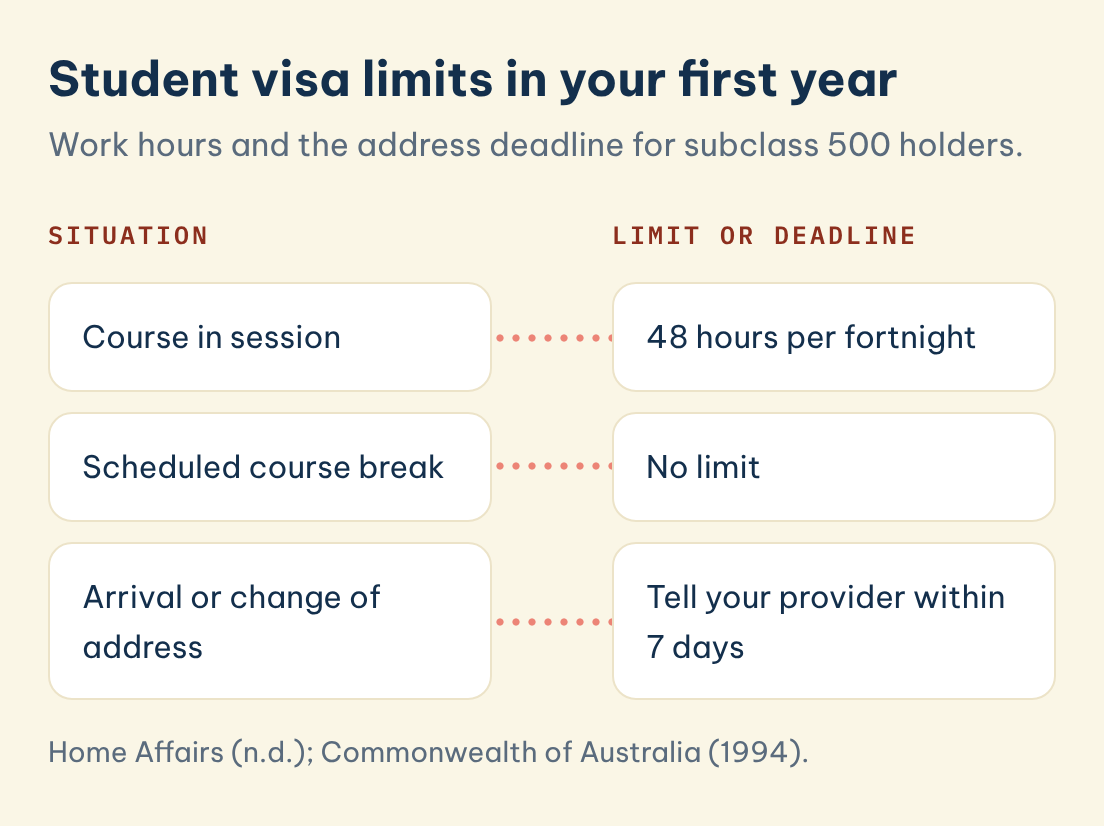
Home Affairs (n.d.) states that from 1 July 2023 student visa holders can work no more than 48 hours a fortnight while studying, defines a fortnight as "a period of 14 days starting on a Monday", and says the limit equals about three days per week. Students who start a masters degree by research or a doctoral degree can work more than 48 hours a fortnight. The Fair Work Ombudsman (2026) adds that you keep the same entitlements and protections under the Fair Work Act as other employees regardless of your visa, and that you cannot be penalised or have your visa cancelled for asking about pay. It lists not being given a pay slip, which you should receive within one day of payment, and unpaid work trials longer than needed to show the skills required, as things that are not acceptable. A shift that pays cash with no slip, or a trial that runs for several unpaid days, is worth questioning early. The Australian Taxation Office also notes that a tax file number is free to apply for, so sort out your TFN early using the ATO link under Tools & resources.
◆ Question 6 / 8 · Provider support
What support should your provider give you in the first weeks?
Direct answer: Registered providers must offer reasonable support at no extra cost, name at least one staff member as the official contact for overseas students, and give you information on, or access to, an orientation program. Services can include English and academic support, counselling, housing advice and financial help.
The Department of Education (n.d.) factsheet on Standard 6 of the National Code states that providers "must offer reasonable support to overseas students to enable them to achieve expected learning outcomes" and that "there must be no additional cost to the overseas student for this support." The factsheet says services may include English and academic support, tutoring, study skills centres, counselling and mental health support, career services, housing and tenancy services, financial support and health and disability services. Go to orientation week with a short list of questions rather than waiting to see what is covered. Ask who the designated contact is, where the academic skills service sits, and how to book counselling. Students from systems that expect self-study often wait until a grade arrives before asking for help, but a provider's duty to support you starts at enrolment, so use it early. A study abroad SOP consulting session can also help you frame questions about course choice and next steps with an adviser.
◆ Question 7 / 8 · First semester
How do you stay on track in the first semester?
Direct answer: Keep attendance and course progress satisfactory, because providers must monitor both under Standard 8 of the National Code. Build contact with other students early too, by joining one club or study group in the first few weeks, since a pandemic-era study of first-year students found domestic students lonelier than international ones.
Standard 8 of the National Code requires providers to monitor an overseas student's course progress and attendance, and Home Affairs (n.d.) tells visa holders they must still ensure satisfactory progress and attendance and maintain their enrolment while working. Social connection is part of that picture. Dingle et al. (2022) studied 1,239 first-year students at a metropolitan Australian university, 30.4% of them international, and reported: "Contrary to expectation, domestic students were lonelier than international students across all cohorts" (Dingle et al., 2022, p. 146). The sample is general first-year students during the pandemic years, so do not read it as proof about international students alone, yet it supports a simple habit. Join one club or study group in weeks one to three, because belonging is easier to build before assignments start piling up.
◆ Question 8 / 8 · Scholarships
Can you study in Australia for free, or win a 100% scholarship?
Direct answer: Sometimes, but rarely and only through specific schemes. Australia Awards Scholarships cover full tuition fees and OSHC for eligible students from developing countries, mainly in the Indo-Pacific. Universities also offer merit scholarships, and the UK has the Northcote Postgraduate Scholarship. Rounds open periodically, so check dates.
The Department of Foreign Affairs and Trade describes Australia Awards Scholarships as full-time undergraduate or postgraduate study at participating universities and TAFE institutions for people from developing countries, particularly in the Indo-Pacific. Benefits include full tuition fees and OSHC for the duration of the award. Rounds open periodically and a past round may already be closed, so check the DFAT dates page rather than relying on an old calendar. Study Australia's scholarship page adds that Australian providers regularly offer scholarships to qualifying international students on academic merit, and that the Northcote Postgraduate Scholarship is aimed at UK students taking a higher degree at an Australian university for up to three years. A 100 per cent scholarship is the rare outcome, so plan your budget on the assumption that you will pay at least part of your costs.
Frequently asked questions
Do I need IELTS to study in Australia?
Not always. Passport holders from the UK, US, Canada, New Zealand and Ireland can use their passport as proof, except British National (Overseas) passports. Everyone else needs an approved test, and at-home tests are not accepted by Home Affairs.
Is $20,000 enough to move to Australia?
No single figure fits everyone. The visa application charge changes so confirm it, OSHC must be paid before arrival, and the financial capacity you must show is set by Home Affairs. Check its page for your situation.
How many hours can an international student work in Australia?
Up to 48 hours per fortnight while your course is in session, and unlimited hours during scheduled breaks. A fortnight is 14 days starting on a Monday, and research masters and doctoral students can work more.
Do I need a tax file number to work as a student?
You should get one when you start work, otherwise you pay more tax. It is free to apply; see the ATO link under Tools & resources.
Can I study in Australia for free?
Rarely. Australia Awards Scholarships cover full tuition and OSHC for eligible students from developing countries, but rounds open periodically. Most students rely on merit scholarships, savings or family support for at least part of the cost.
What happens if I move house in my first year?
You must tell your education provider the new address within 7 days of the change. This is part of visa condition 8533, so a missed update is a breach rather than a courtesy.
Related guides
- How do you apply for a PhD in Australia as an international student?: supervisors, funding and the research-degree route
- Is PTE Academic easier than IELTS?: choosing an approved English test
- What TOEFL iBT score do you need for university admission?: the new 1 to 6 band scale
- Study abroad SOP consulting: expert guidance on your study abroad plan and statement
References
- Commonwealth of Australia. (1994). Migration Regulations 1994 (Cth), sch 8. https://www.austlii.edu.au/cgi-bin/viewdoc/au/legis/cth/consol_reg/mr1994227/sch8.html
- Department of Education. (n.d.). Standard 6: Student support services [Factsheet]. Australian Government. Retrieved October 22, 2026, from https://www.education.gov.au/download/11458/standard-6-overseas-student-support-services/29920/document/pdf
- Department of Health, Disability and Ageing. (2026). Overseas Student Health Cover (OSHC) fact sheet. Australian Government. https://www.health.gov.au/sites/default/files/2026-08/overseas-student-health-cover-oshc-fact-sheet_1.pdf
- Department of Home Affairs. (n.d.). Work restrictions for student visa holders. Australian Government. Retrieved October 22, 2026, from https://immi.homeaffairs.gov.au/visas/getting-a-visa/visa-listing/student-500/temporary-relaxation-of-working-hours-for-student-visa-holders
- Dingle, G. A., Han, R., & Carlyle, M. (2022). Loneliness, belonging, and mental health in Australian university students pre- and post-COVID-19. Behaviour Change, 39, 146-156. https://doi.org/10.1017/bec.2022.6
- Fair Work Ombudsman. (2026, January 16). International students fact sheet. Australian Government. https://www.fairwork.gov.au/tools-and-resources/fact-sheets/rights-and-obligations/international-students
- Study Australia. (n.d.-a). Student visa (subclass 500). Australian Government. Retrieved October 22, 2026, from https://www.studyaustralia.gov.au/en/plan-your-move/your-guide-to-visas/student-visa-subclass-500
- Study Australia. (n.d.-b). Language testing organisations. Australian Government. Retrieved October 22, 2026, from https://www.studyaustralia.gov.au/en/plan-your-move/language-testing-organisations
Tools & resources
- Australian Taxation Office: TFN application for temporary visitors
- Study Australia: scholarships
- DFAT: Australia Awards Scholarships
- ASQA: overseas student attendance and Standard 8
This article is part of the MAAS Journal series for international students. MAAS is an academic support partner: experts guide students through each stage of their own work, and we do not complete assessed work on a student's behalf.
Not sure how this guide applies to your own case? Talk it through with MAAS in a free 20-minute consultation.
Book a free consultation ▸