
◆ PhD Admissions
How do you apply for a PhD in Australia as an international student?
Last updated: 2026-10-20
Category: admissions

Applying for a PhD in Australia means finding a supervisor first, then funding, then a student visa, and each step follows its own rules. Most questions that international applicants type into a search engine are really questions about the order of those steps. The sequence matters because at some universities, such as UNSW Sydney, an application without supervisor contact or an Expression of Interest is not reviewed, a scholarship round has a closing date, and a visa officer asks separate questions from the admissions office. This guide takes the questions people search for and answers each one from the published pages of universities and government departments.
Direct answer: Contact a potential supervisor, meet the university's entry requirement, apply through its research degree portal, and compete for a Research Training Program scholarship, which can cover tuition and a stipend. Then apply for a student visa that proves you are a genuine student with enough funds. Check every rule on the university's own page.
◆ Question 1 / 7 · Entry requirements
What are the entry requirements for a PhD in Australia as an international student?
Direct answer: Entry rules are set by each university and faculty, not nationally. UNSW Sydney, for example, asks for a UNSW Honours bachelor's degree at first or upper second class, or a UNSW Master by Research, or an equivalent that its Faculty Higher Degree Committee determines, which is how international applicants are assessed (UNSW Sydney, n.d.-a).
The Australian Qualifications Framework Council (2013) describes what the degree is for: "Research is the defining characteristic of all Doctoral Degree qualifications" (p. 63). The same document says that the research doctorate, typically called a Doctor of Philosophy, makes "a significant and original contribution to knowledge" (p. 63), and it gives the volume of learning as typically 3 to 4 years (Australian Qualifications Framework Council, 2013, p. 64). The framework is from 2013, so treat it as the description of the degree rather than a current admissions rule.
English requirements are a separate matter. UNSW Sydney (n.d.-b) says that applicants must meet its English requirements before applying. The score and the test accepted differ by university, so read the English page of the university you are targeting rather than relying on a figure quoted in a forum.
◆ Question 2 / 7 · Without a master's
Can you do a PhD without a master's degree in Australia?
Direct answer: Sometimes. The UNSW minimum entry lists an Honours bachelor's degree as an alternative to a Master by Research, so a master's degree is not always required (UNSW Sydney, n.d.-a). Other universities write their own rules, and the faculty decides what counts as equivalent.
What matters in the UNSW wording is that the research content of your previous degree is tested, not the number of degrees. A UNSW Master by Research with a substantial research component qualifies, and so does a UNSW bachelor's degree with first or upper second class Honours, while any other qualification is an equivalent as determined by the Faculty Higher Degree Committee (UNSW Sydney, n.d.-a). An applicant with a degree from elsewhere should therefore ask the faculty what research evidence it accepts.
If your own degree path is unclear, the question of which prior degree a doctoral programme reads is set out in which degree to study before a PhD. Check the programme page for the exact wording before you spend time on a proposal.
◆ Question 3 / 7 · How to apply
How do you apply for a PhD in Australia?
Direct answer: Start with the supervisor, because at UNSW Sydney most Faculties expect contact before you apply and an application with neither contact nor an Expression of Interest is not reviewed. Then prepare the research description, which that university caps at 3000 words, and an English result.
The route at one university gives a useful template, though you should check the process of your own. UNSW Sydney (n.d.-b) says that the Faculties of Arts, Design and Architecture, Business, and Law and Justice use an Expression of Interest, and that a pre-admission interview follows once a supervisor is found. The research description in the application is limited to no more than 3000 words (UNSW Sydney, n.d.-c). The order is therefore to read the supervisor's recent work, write a short message that shows how your question fits it, wait for a reply, and only then prepare the full application.
| Step | What the source says | Source |
|---|---|---|
| 1. Contact a supervisor | Most Faculties require it before applying | UNSW Sydney (n.d.-b) |
| 2. Expression of Interest | Used by Arts, Design and Architecture, Business, Law and Justice | UNSW Sydney (n.d.-b) |
| 3. Pre-admission interview | Follows once a supervisor is found | UNSW Sydney (n.d.-b) |
| 4. Research description | No more than 3000 words | UNSW Sydney (n.d.-c) |
| 5. English requirement | Met before applying | UNSW Sydney (n.d.-b) |
MAAS advisors help applicants plan this sequence: you read the supervisors' work, our experts challenge the fit between your question and theirs, and you review every document and submit the application yourself. The scope of that work is described under PhD supervisor search and application strategy.
◆ Question 4 / 7 · How hard it is
How hard is it to get into a PhD program in Australia?
Direct answer: The sources used here publish no overall acceptance rate, so no honest single figure exists. What they do show is a series of gates: a qualifying degree, a supervisor who agrees to take you, a funding decision and a visa decision, and a file that fails any one of them does not proceed.
At UNSW Sydney the supervisor is the first gate, because UNSW Sydney (n.d.-c) states that applications without supervisor contact or an Expression of Interest "will not be reviewed". That rule means a strong transcript cannot compensate for a missing conversation. Funding is the second gate. Scholarship rounds have closing dates set by each university, and an applicant who is admitted but not funded faces the cost question covered below.
Difficulty also depends on field and on the supervisor's current capacity, neither of which a national statistic describes. If you want to compare the pressure of entry with the pressure of finishing, our guide to how long a PhD takes is a useful companion.
◆ Question 5 / 7 · Funding
Is a PhD in Australia fully funded for international students?
Direct answer: Not automatically. The Australian Government Department of Education (2026) says that Research Training Program applications go through the university, and the program can cover a tuition fee offset, a living stipend and allowances. Whether you receive it is a competitive decision by each university.
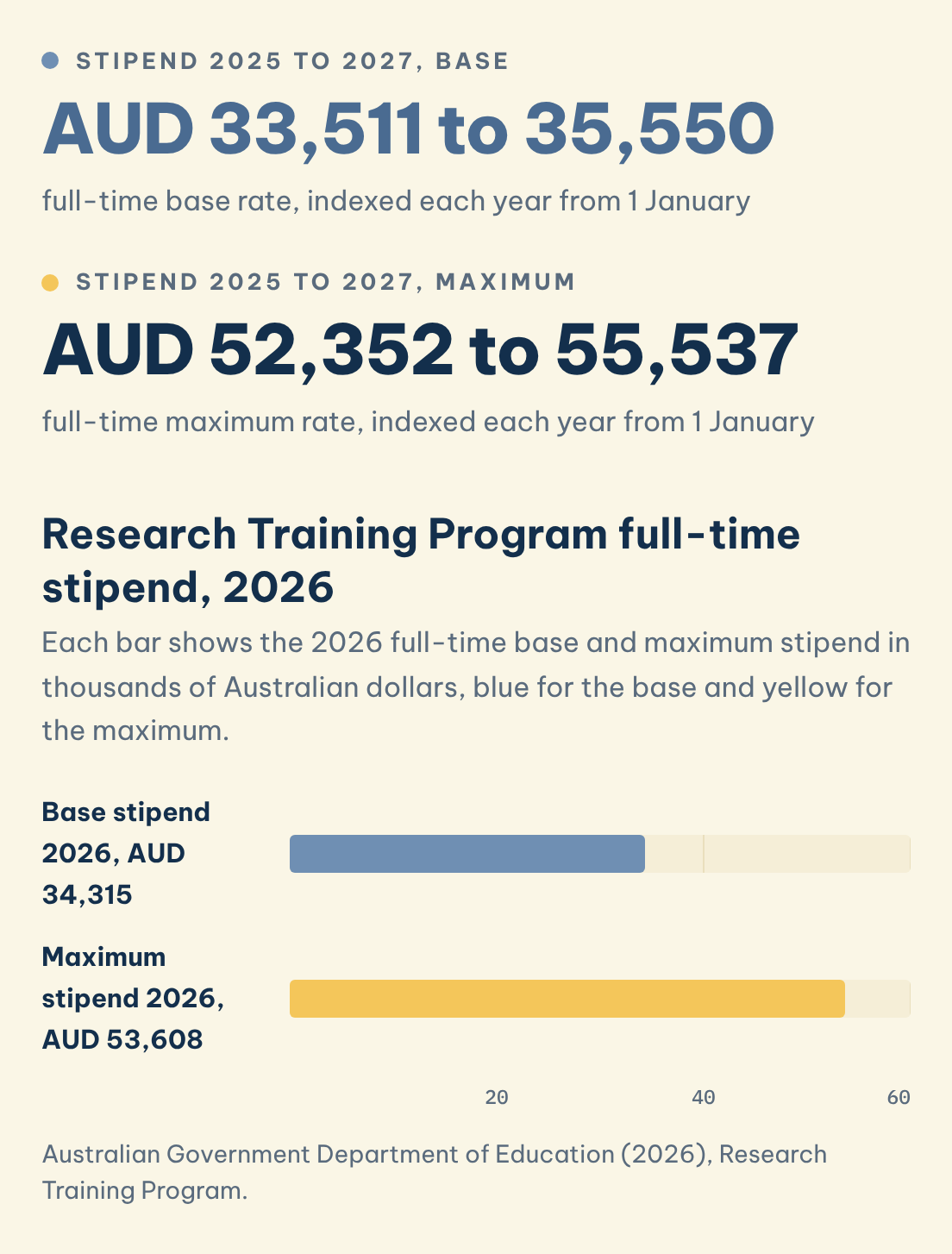
The stipend rate is published and indexed. The Australian Government Department of Education (2026) lists a full-time base and maximum for each year, and the rates are indexed each year from 1 January.
| Year | Base stipend (AUD) | Maximum stipend (AUD) |
|---|---|---|
| 2025 | 33,511 | 52,352 |
| 2026 | 34,315 | 53,608 |
| 2027 | 35,550 | 55,537 |
Stipend 2025 to 2027, base
AUD 33,511 to 35,550
full-time base rate, indexed each year from 1 January
Stipend 2025 to 2027, maximum
AUD 52,352 to 55,537
full-time maximum rate, indexed each year from 1 January
Research Training Program full-time stipend, 2026
Each bar shows the 2026 full-time base and maximum stipend in thousands of Australian dollars, blue for the base and yellow for the maximum.
Save this figure
Each university sets its own scholarship rounds, closing dates and extras, so read the scholarship page of the university you are targeting.
◆ Question 6 / 7 · Cost
How much does a PhD cost in Australia for international students?
Direct answer: The sources here give no tuition figure, because it differs by university and field, so check the university's fee page. What they do show is what a visa application must cover: travel, 12 months of living costs and tuition, plus health cover, unless a scholarship covers part of it.
The Department of Home Affairs (n.d.-b) document checklist says that Overseas Student Health Cover is required from at least one week before the course starts and for the duration of your stay, and that financial capacity covers travel, 12 months of living costs and tuition. A scholarship that pays a fee offset and a stipend changes the amount you must show. A self-funded applicant has a larger burden. UNSW Sydney (n.d.-c) asks self-funded applicants for bank statements from the last 6 months showing funds available for a minimum of 3 years for a PhD, or 4 years for Engineering applicants.
The visa also has a purpose test. The Department of Home Affairs (n.d.-a) says that an applicant must "be a genuine applicant for entry and stay as a student" and must be able to demonstrate an understanding that "studying in Australia is the primary reason for applying for a student visa."
◆ Question 7 / 7 · Permanent residence
Can a PhD student apply for permanent residence in Australia?
Direct answer: A PhD does not give permanent residence. Study Australia (n.d.) describes the Temporary Graduate visa (subclass 485), whose Post-Higher Education Work stream lets you stay usually between 2 and 3 years, depending on your qualification. It is temporary, and permanent residence is a separate application.
The distinction matters for planning, because a graduate visa is a period of work rights, not a status that converts on its own. Study Australia (n.d.) states the stay length as usually between 2 and 3 years, depending on your qualification. Permanent residence has its own eligibility rules, and they change, so check the Department of Home Affairs before making any decision that depends on it. This guide gives no migration advice beyond that pointer.
If you are still choosing between a PhD and other routes, the full pathway is set out in our PhD application guide.
Frequently asked questions
Can I apply for a PhD in Australia without a master's degree?
Sometimes. At UNSW Sydney the minimum entry accepts a UNSW Honours bachelor's degree with first or upper second class Honours or a UNSW Master by Research, and the Faculty Higher Degree Committee decides on equivalents, which is the route international applicants are assessed through. Check your target university's page.
Is a PhD in Australia fully funded for international students?
Not automatically. Research Training Program scholarships can cover a tuition fee offset and a living stipend, but each university decides who receives one, so apply for a scholarship alongside your admission application.
How much is the Research Training Program stipend?
In 2026 the full-time base is AUD 34,315 and the maximum is AUD 53,608. The rates are indexed each year from 1 January.
Do I need to contact a supervisor before I apply?
At UNSW Sydney, most Faculties require it, and applications without supervisor contact or an Expression of Interest will not be reviewed. Other universities may differ, so read the process page.
How long does a PhD in Australia take?
The Australian Qualifications Framework Council (2013) gives the volume of learning as typically 3 to 4 years. Your university's regulations set the exact registration period.
Can a PhD student apply for permanent residence?
A PhD does not give permanent residence automatically. The Temporary Graduate visa (subclass 485) is a temporary stay, and permanent residence is a separate application, so check Home Affairs.
Related MAAS guides
References
Australian Government Department of Education. (2026). Research Training Program. https://www.education.gov.au/research-block-grants/research-training-program
Australian Qualifications Framework Council. (2013). Australian Qualifications Framework (2nd ed.). https://www.wa.gov.au/system/files/2025-08/aqf-2nd-edition-january-2013.pdf
Department of Home Affairs. (n.d.-a). Genuine Student requirement. https://immi.homeaffairs.gov.au/visas/getting-a-visa/visa-listing/student-500/genuine-student-requirement
Department of Home Affairs. (n.d.-b). Document checklist tool. https://immi.homeaffairs.gov.au/visas/web-evidentiary-tool
Study Australia. (n.d.). Temporary Graduate visa (subclass 485). https://www.studyaustralia.gov.au/en/plan-your-move/your-guide-to-visas/temporary-graduate-visa-subclass-485.html
UNSW Sydney. (n.d.-a). Doctor of Philosophy (PhD). https://www.unsw.edu.au/research/hdr/phd
UNSW Sydney. (n.d.-b). HDR application process. https://www.unsw.edu.au/research/hdr/application
UNSW Sydney. (n.d.-c). Document submission guidelines. https://www.unsw.edu.au/content/dam/pdfs/research/higher-degree-research/document-submission-guidelines-v16.pdf
Not sure how this guide applies to your own case? Talk it through with MAAS in a free 20-minute consultation.
Book a free consultation ▸