
◆ Student Success
How do VCE SACs, exams and scaling shape your study score?
Direct answer: Your VCE study score comes from school-assessed coursework, set tasks and an external exam. Scores are standardised, ranked and placed on a scale with a mean of 30. The ATAR is a separate rank, built by VTAC from scaled study scores, so pick subjects you can do well in.
◆ Question 1 / 7 · What VCE means
What does VCE mean and what do you need to complete it?
Direct answer: VCE is the Victorian Certificate of Education, the senior school certificate in Victoria. Completing it takes 16 or more satisfactory units, with English-group units and further Units 3 and 4 sequences on top. A study score needs two or more graded assessments.
Searches for "VCE" also bring up the medical meaning, but this guide is about the school certificate. The Victorian Curriculum and Assessment Authority (VCAA) sets the completion rule (VCAA, n.d.-c): an S, meaning satisfactory, for a minimum of 16 units. Those must include at least three units from the English group, with a Units 3 and 4 sequence among them, plus at least three other Units 3 and 4 sequences. A study score is a separate matter. To receive one you need two or more graded assessments in the study and an S for both Units 3 and 4 in the same year (VCAA, n.d.-a). The ATAR adds its own condition: VTAC (2026) requires study scores in at least four permissible Units 3 and 4 studies, including one from the English group. Keep the order of events in mind as you read on. First you complete the certificate, then you earn study scores, and only then does VTAC turn those scores into a rank.
◆ Question 2 / 7 · SACs and SATs
How do SACs and SATs count towards your study score?
Direct answer: SACs are school-assessed coursework tasks in Units 3 and 4, and SATs are practical tasks set by the VCAA. The VCAA combines your school's scores into one total, which is then statistically moderated against exam results. Weightings differ by study, so check each study design instead of trusting a single figure.
The VCAA (n.d.-b) describes SACs as "a set of tasks that assess each student's level of achievement" in Units 3 and 4, while school-assessed tasks are "set by the VCAA to assess specific sets of practical skills and knowledge". The VCAA combines your school's scores into one total for each student, and that total is "statistically moderated against the examination scores in the study" (VCAA, n.d.-b). Externally assessed tasks are marked by assessors the VCAA appoints. In a few studies the General Achievement Test is also used for moderation, yet the VCAA (n.d.-a) states that "the examination scores remain the primary reference for adjusting school-based scores". In plain terms, a strong SAC result helps, but your school's marks are adjusted against how the whole group performs in the exam. The table below sets the pieces side by side.
| Piece | Who sets or marks it | Role in your result |
|---|---|---|
| SACs | School, Units 3 and 4 | Coursework tasks, combined into one school total |
| SATs | Set by the VCAA | Practical skills and knowledge tasks |
| Exams | Marked by VCAA-appointed assessors | Primary reference for moderating school scores |
| GAT | Used in a few studies only | Supports moderation |
Source: VCAA (n.d.-a); VCAA (n.d.-b).
◆ Question 3 / 7 · Study score
How is a VCE study score calculated?
Direct answer: Each graded assessment is standardised against the state results and weighted by its contribution. Totals are then ranked and placed on a fixed scale centred on 30, with a spread of 7 and hard limits at 0 and 50. Most study scores land between 23 and 37.
The study score scale
How the VCAA places study scores on a fixed scale.
Feature
Value
Mean
30
Standard deviation
7
Cut-offs
0 and 50
Most study scores
23 to 37
Save this figure
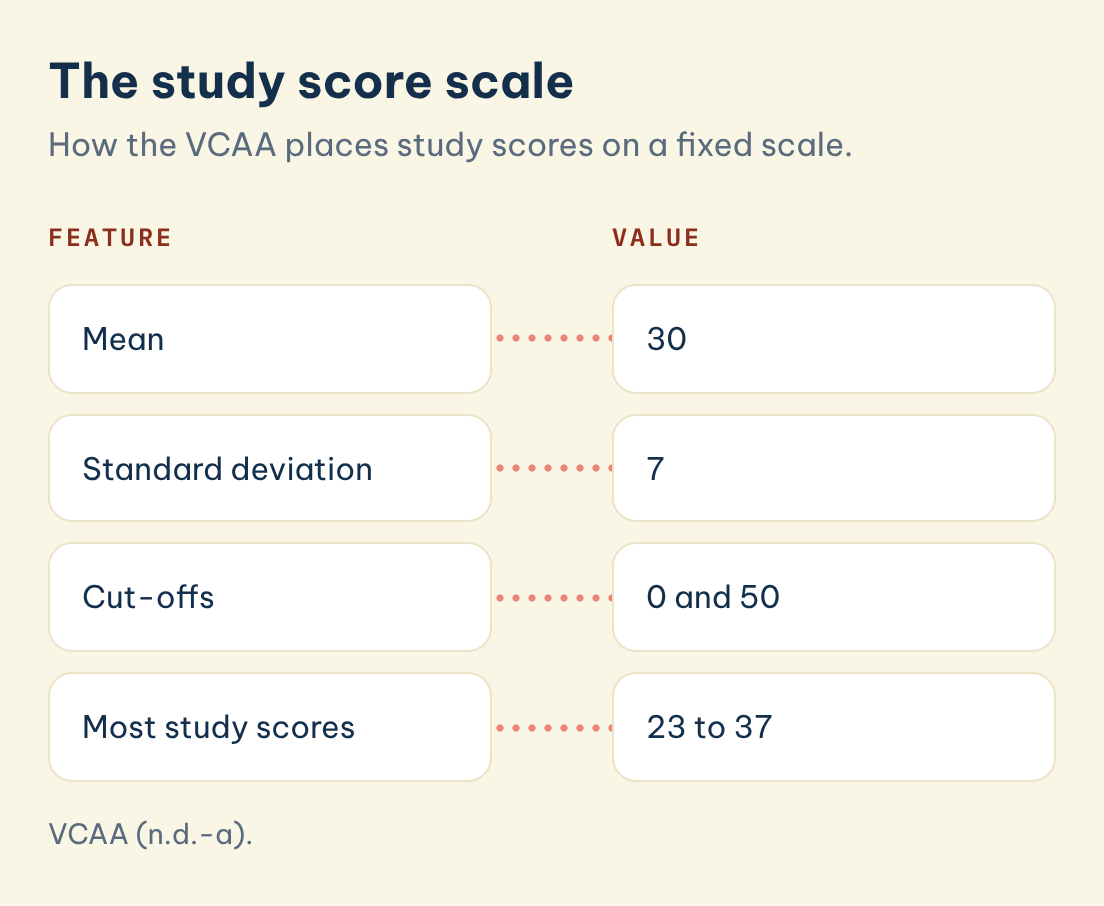
The VCAA (n.d.-a) explains the steps in order. Every graded assessment is standardised: your final score minus the state mean, divided by the state standard deviation. The result is then weighted by how much that assessment contributes to the study. Weighted totals are ranked, and the normalised ranks are "converted to a scale with a mean of 30 and standard deviation of 7, truncated at zero and 50". The VCAA adds that most study scores sit between 23 and 37. Two things follow from this. A study score describes where you stand compared with other students in that study, so it is not a percentage of marks earned. And because the scale is fixed, a score near 30 tells you that you are around the middle of those taking the study. Use the figure below to keep the numbers in view while you plan your year.
◆ Question 4 / 7 · VTAC scaling
How does VTAC scaling work, and should you pick subjects for it?
Direct answer: VTAC scales study scores to reflect the different levels of competition in each study, adjusting some up and some down. Its own advice is to choose studies you like or are good at. Picking a subject only because it may be scaled up would be a mistake.
The Victorian Tertiary Admissions Centre (VTAC) says in its scaling guide that scaling "ensures that students are neither advantaged nor disadvantaged based on the studies they choose" (VTAC, 2026). Study scores are scaled to consider the different levels of competition in different studies, with higher competition adjusted upwards and lower competition downwards. The ATAR aggregate is then built from your scaled scores: one of English, English Language, Literature or EAL, plus your next best three scaled scores, plus 10% of your fifth and sixth permissible scores (VTAC, n.d.). Students often hunt for a subject that scales well, and VTAC (2026) answers this directly: "Choosing a study that you are not very good at, or engaged in, simply because it may be scaled up would be a mistake." It also says students should freely choose studies they like or are good at without worrying about their ATAR. A study you understand will produce stronger SAC and exam results, which feed everything above.
◆ Question 5 / 7 · A 70 ATAR
How hard is a 70 ATAR in VCE?
Direct answer: The ATAR is not a score out of 100. VTAC (n.d.) calls it a rank, running from 0 to 99.95, that shows your relative performance against your age group. How hard a 70 is therefore depends on how you compare with others, not on a fixed mark.
Searchers ask this question often, and the first step is to drop the idea of a pass mark. VTAC (n.d.) states plainly that "the ATAR is not a score out of 100 – it is a rank". It is a percentile rank showing relative performance against your age group, on a range from 0 to 99.95. So a target of 70 describes a position, and no number of correct answers guarantees it. What you can control is the input: strong results in studies you are good at, a sound English result because that study anchors the aggregate, and steady work on SACs through the year. Because the aggregate uses scaled study scores, your ATAR depends on the results of the whole group in each study as well as your own. If you want to compare how other systems report achievement, this guide to Australian GPA and grade bands shows a different style of grading.
◆ Question 6 / 7 · VM and IB
VCE vs VM, and IB vs VCE: which should you choose?
Direct answer: VCE VM, the Vocational Major, has different completion requirements from the standard VCE. VM subjects do not receive a study score, so VM does not lead to an ATAR. Some IB students receive a notional ATAR, so choose between IB and VCE by fit.
The VCAA (n.d.-d) says the Vocational Major also needs at least 16 units and at least four Unit 3–4 sequences, but the required units differ: VM Literacy or English, Numeracy or Maths, Work Related Skills, Personal Development Skills and VET credits at Certificate II or above, equal to 180 nominal hours. VTAC (2026) notes that VCE VM subjects do not receive a study score and are not eligible to be used in the ATAR. Ask your school about the pathway that fits your goals. On IB, VTAC (2026) explains that some IB students receive a notional ATAR, which is treated the same as a normal ATAR for course selection. The honest advice is to choose between IB and VCE by the style of learning that suits you, and to check entry requirements for the courses you want. Treat any ranking of one program above the other with caution, since the answer depends on the course and the university you are aiming at.
◆ Question 7 / 7 · Studying
How should you study for SACs and exams?
Direct answer: Test yourself and spread practice over days instead of rereading. Dunlosky (2013) reports that practice testing and distributed practice were rated the most effective strategies in his review. Rereading is easy but weaker, so switch to questions, past tasks and self-explanation.
Dunlosky (2013, p. 13) reports that he and his colleagues rated practice testing and distributed practice as the most effective strategies among those reviewed. On rereading, he writes that "rereading may be relatively easy for students to do, but they should be encouraged to use other strategies (such as practice testing, distributed practice, or self-explanation) when they revisit their text and notes" (Dunlosky, 2013, p. 20). For a SAC that means closing your notes and writing out an answer from memory, then checking it. For the exam it means spacing topics across weeks, so you return to each one several times. Because school scores are moderated against exam results, steady exam-style practice helps both. Our guide on how to revise for final exams effectively turns these ideas into a weekly routine. Students who later go on to university can also book a 1:1 tutoring session where an expert guides how you approach your university coursework, and you do the work yourself.
Frequently asked questions
What does VCE mean?
It stands for the Victorian Certificate of Education, the senior school certificate in Victoria. Searches also show a medical meaning, which this guide does not cover.
Do SACs or exams matter more?
Both count, but the VCAA says exam scores remain the primary reference for adjusting school-based scores. Weightings differ by study, so check your study design.
What is a good study score?
The scale has a mean of 30 and a standard deviation of 7, and most study scores fall between 23 and 37. A study score shows your position against other students in that study.
Is the ATAR a mark out of 100?
No. VTAC calls it a rank from 0 to 99.95 that compares you with your age group. It is built from scaled study scores.
Should I choose subjects because they scale up?
VTAC says choosing a study you are not good at, or engaged in, just because it may be scaled up would be a mistake. Choose studies you like or do well in.
Does VCE VM give you an ATAR?
No. VTAC (2026) notes that VCE VM subjects do not receive a study score and are not eligible to be used in the ATAR. Ask your school about your pathway.
Related guides
- How do you revise for exams effectively, final exams included?: retrieval practice and spacing
- How do Australian GPA and grade bands work?: reading grades in the Australian system
- What should you sort out in your first year to study in Australia?: visas, work limits and support
- University subject tutoring, 1:1: expert guidance on your university coursework
References
- Dunlosky, J. (2013). Strengthening the student toolbox: Study strategies to boost learning. American Educator, 37(3), 12-21. https://files.eric.ed.gov/fulltext/EJ1021069.pdf
- Victorian Curriculum and Assessment Authority. (n.d.-a). Score aggregation. VCE Administrative Handbook. Retrieved October 23, 2026, from https://vcaa.vic.edu.au/administration/vce-administrative-handbook/score-aggregation
- Victorian Curriculum and Assessment Authority. (n.d.-b). Scored assessment. VCE Administrative Handbook. Retrieved October 23, 2026, from https://vcaa.vic.edu.au/administration/vce-administrative-handbook/scored-assessment
- Victorian Curriculum and Assessment Authority. (n.d.-c). English requirement for satisfactory completion of the VCE. Retrieved October 23, 2026, from https://vcaa.vic.edu.au/curriculum/vce-curriculum/vce-study-designs/english-requirement-satisfactory-completion-vce
- Victorian Curriculum and Assessment Authority. (n.d.-d). VCE frequently asked questions: Current students. Retrieved October 23, 2026, from https://vcaa.vic.edu.au/curriculum/vce-curriculum/vce-frequently-asked-quesions/current-students
- Victorian Tertiary Admissions Centre. (n.d.). ATAR. Retrieved October 23, 2026, from https://vtac.edu.au/atar
- Victorian Tertiary Admissions Centre. (2026). VTAC ATAR and scaling guide 2026. https://www.vtac.edu.au/guides/atar-scaling-guide-2026.html
Tools & resources
This article is part of the MAAS Journal series for students. MAAS is an academic support partner: experts guide students through each stage of their own work, and we do not complete assessed work on a student's behalf.
Not sure how this guide applies to your own case? Talk it through with MAAS in a free 20-minute consultation.
Book a free consultation ▸