
◆ Admissions
What is an LLM Master of Laws in the UK, and who can apply?
An LLM, or Master of Laws, is a postgraduate law degree, and the UK offers many versions of it, from nine-month taught programmes at Cambridge to general programmes that take non-law graduates. Before you shortlist, it helps to know what the degree is, what it does not do and what each university asks for.
Direct answer: Yes, LLM stands for Master of Laws, a postgraduate degree taken after a first law degree or, at some universities, after a degree in another subject. The UK pages checked here run from 9 months at Cambridge to 12 to 24 months at the University of Law, with English scores near IELTS 7.5 at the two leading law schools.
◆ Question 1 / 8 · What LLM means
What does LLM mean, and is it a Master of Laws?
Direct answer: LLM is the abbreviation for Master of Laws, and it is a master's degree in the UK sense. The sector's quality body sets a typical floor of 180 credits for any master's, with 150 of them at master's level, so an LLM carries the same credit volume as an MSc or MA.
The Quality Assurance Agency for Higher Education (QAA) states the credit rule in one sentence: "In England, Wales and Northern Ireland, a master's degree will have a typical minimum of 180 credits, of which at least 150 will be at master's level on the FHEQ" (QAA, 2020, p. 9). Scotland uses the same minimum of 180 credits, with at least 150 at master's level. The same page converts the figures for European readers: a master's degree has a minimum of 60 ECTS, which equals 120 UK credits, and typically runs to 90 to 120 ECTS, or 180 to 240 UK credits. Two UK credits equal one ECTS credit. For a student from Vietnam, this is the quickest way to judge whether an LLM is comparable to a master's you already know: count the credits and the level, not the title on the certificate. The QAA lists the LLM among professional or practice master's degrees, a group that usually aims to prepare graduates for entry into a profession, subject to any further conditions set by the professional body (QAA, 2020).
◆ Question 2 / 8 · Is an LLM the same as an LLB
Is an LLM the same as an LLB?
Direct answer: No. The LLB is the undergraduate law degree, while the LLM is the postgraduate one. Cambridge describes its LLM as intended for people continuing legal study after a first degree in law, and LSE asks for an LLB or equivalent, so the LLB usually comes first.
The two titles look alike, and that is the main source of confusion for applicants who see both in the same search results. Cambridge says its LLM "is intended for those who wish to pursue further legal studies after completing their first degree in law, including those who are considering an academic career or intending to practise law" (University of Cambridge, n.d.-b). LSE's page lists an undergraduate law degree, "LLB or equivalent", as the usual entry point (London School of Economics and Political Science, n.d.-a). So the sequence for most applicants is an LLB, then an LLM. The University of Law is the exception worth noting, because its general LLM is designed for both law graduates and non-law graduates (The University of Law, n.d.). If you are choosing between a second bachelor's and a master's, ask which entry route the university itself publishes, and then decide from that page, not from the abbreviation.
◆ Question 3 / 8 · Does it make you a lawyer
Does an LLM make you a lawyer in England and Wales?
Direct answer: Not by itself. The regulator's checklist names a degree in any subject, two exam stages (SQE1 and SQE2), two years of qualifying work experience and a character test. An LLM may serve as the degree, yet no step on that list asks for it.
The Solicitors Regulation Authority (2025) sets out the route to qualify as a solicitor in England and Wales on its SQE page, dated August 2025. The four requirements are a degree in any subject or an equivalent level 6 qualification, a pass in both SQE1 and SQE2, two years' full-time or equivalent qualifying work experience, and meeting the suitability requirements. A separate route exists for already-qualified lawyers who enter through the SQE. Reading the list carefully, an LLM is not named as a stage, so it does not replace the exams or the work experience. The QAA adds that a master's that prepares for a profession may be accredited by a professional body, and graduates may then be permitted to enter a further period of practice, study or examination (QAA, 2020). For international students, the practical point is that an LLM adds depth in a field, while the route to practise as a solicitor stays the same.
◆ Question 4 / 8 · Entry requirements
What are the entry requirements for a UK LLM?
Direct answer: Entry ranges from a 2:2 at the University of Law to a first-class degree placed well within the top 10% at Cambridge. LSE asks for a very good law degree, and also considers non-law graduates with a graduate diploma in law or substantial experience.
Three published pages show the spread. Cambridge asks for a First Class bachelor's degree in law from the UK or an overseas equivalent, and applicants should "typically be placed well within the top 10% of law students in their jurisdiction"; a First is not a guarantee of an offer (University of Cambridge, n.d.-a). Exceptionally, it will consider applicants without a First Class law degree who are within the top 10% of lawyers, for example through professional legal experience. LSE asks for a very good undergraduate law degree, such as a first or very high upper second in a UK LLB. A non-law degree with very good grades in a graduate diploma in law may qualify, and a non-law applicant without that diploma must show high professional or academic experience (London School of Economics and Political Science, n.d.-a). The University of Law lists a 2:2 as its entry requirement (The University of Law, n.d.).
| University | Typical entry route | Non-law graduates |
|---|---|---|
| University of Cambridge | First Class law degree, top 10% of jurisdiction | Exceptional cases only, for example through professional legal experience |
| London School of Economics | Very good LLB or equivalent | Graduate diploma in law, or high professional or academic experience |
| The University of Law | 2:2 | General LLM designed for law and non-law graduates |
Source: university admissions pages, read 22 October 2026.
◆ Question 5 / 8 · English test scores
What English test scores do the leading law schools ask for?
Direct answer: Both law schools set IELTS Academic at 7.5 overall, with 7.0 in each element. The TOEFL iBT figure on the old scale is 110 at Cambridge and 109 at LSE, and LSE's law band sits above its standard requirement A.
TOEFL iBT overall required for Cambridge and LSE LLM programmes
Old 0 to 120 scale, as published on each university's requirements page.
Programme
TOEFL iBT overall (0 to 120)
Cambridge LLM
110
LSE LLM
109
Save this figure
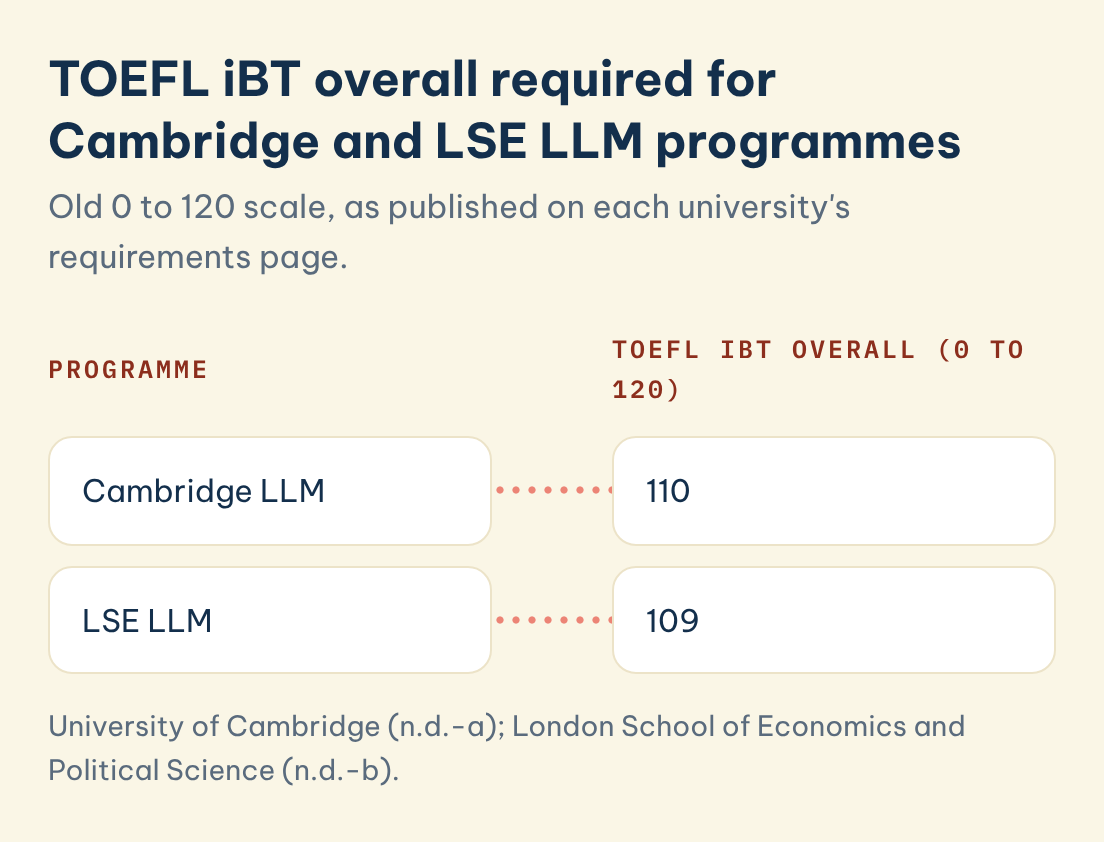
Cambridge asks for IELTS Academic 7.5 overall with 7.0 in each element, or TOEFL iBT 110 overall with at least 25 in each section. The scores must come from the same sitting, TOEFL MyBest is not accepted and there is no waiver (University of Cambridge, n.d.-a). LSE places its law programmes in its law band, requirement D: IELTS Academic 7.5 overall and 7.0 in reading, listening, writing and speaking, or TOEFL iBT 109 with 25 in reading, 24 in listening, 27 in writing and 27 in speaking. LSE also publishes a TOEFL score on the updated 1 to 6 scale, 5.5 overall. For comparison, its standard requirement A is IELTS 7.0 overall with 6.5 in each element, so the law band is half a point higher. LSE also states that tests must be less than two years old on 1 October 2027 (London School of Economics and Political Science, n.d.-b). If you are still choosing a test, our guide to TOEFL iBT scores for university admission explains the new scale.
◆ Question 6 / 8 · Duration and structure
How long is an LLM, and how is it structured?
Direct answer: Duration varies by university: 9 months full-time at Cambridge, 12 months full-time at LSE with part-time routes of 24 or 48 months for home students, and 12 to 24 months at the University of Law. Structure ranges from taught courses to a 10,000-word dissertation.
Cambridge describes its LLM as a 9-month taught programme, with applications open from 9 September 2026 until a deadline of 8 December 2026 and a course start on 1 October 2027. No ATAS certificate is required (University of Cambridge, n.d.-a). LSE runs its LLM full-time over 12 months, with home part-time routes of 24 or 48 months, a start in September 2027 and rolling admissions with no deadline. Students take a compulsory course, Legal Research and Writing Skills, assessed by a 10,000-word dissertation, then seven LLM courses chosen from around 80. A specialism can appear on the certificate if the required number of courses is taken (London School of Economics and Political Science, n.d.-a). The University of Law offers 12 to 24 months, full-time or part-time, with the next start in October 2026 (The University of Law, n.d.). A 10,000-word dissertation is a long piece of research writing, and our guide to OSCOLA referencing for UK law students covers the citation style law schools commonly expect.
| Feature | Cambridge | LSE | The University of Law |
|---|---|---|---|
| Duration, full-time | 9 months | 12 months | 12 to 24 months (full or part-time) |
| Intake | 1 October 2027 | September 2027 | October 2026 (next start) |
| Application window | 9 Sep to 8 Dec 2026 | Rolling, no deadline | Not stated here |
Source: university programme pages, read 22 October 2026.
◆ Question 7 / 8 · London or online
Can you take an LLM in London or online?
Direct answer: Yes to London. LSE teaches its LLM at Houghton Street, and the University of Law lists London Bloomsbury and London Moorgate among its sites. The University of Law page also mentions an online option, so check its page for the current delivery rules.
LSE gives its address as Houghton Street, London (London School of Economics and Political Science, n.d.-a). The University of Law lists London Bloomsbury and London Moorgate, together with Birmingham, Leeds, Manchester and other locations, and mentions an online or on-campus option for its general LLM. Its published fees start from £12,750 (The University of Law, n.d.). Treat that headline figure as a starting point and not a full cost of study. Which version suits you depends on your background. A general LLM suits a graduate who wants a broad law qualification at master's level, while a specialist LLM at a research-led law school suits a student with a strong law degree who wants a defined field. If a doctorate is your longer-term plan, read how an LLM fits next to the PhD, JD and SJD routes before you commit.
◆ Question 8 / 8 · How to prepare
How do you prepare a strong LLM application?
Direct answer: Work backwards from the university page: note the entry grade, the English band, the deadline and any document list, then write your own statement for each programme. Plan the English test first, because LSE, for example, needs a score less than two years old on 1 October 2027.
A short checklist built from the pages above helps. Cambridge has a firm deadline of 8 December 2026 and wants its English scores from a single sitting, so booking the test early leaves room to retake it. LSE has rolling admissions, but its tests must be less than two years old on 1 October 2027, so a score taken now remains valid for that intake. For a non-law graduate, the pages show that the route into LSE depends on a graduate diploma in law or on high professional or academic experience, which you should describe plainly in your own words. A clear research direction also helps, and the guide to a UK master's research proposal shows how to frame one. If you want an outside view on your plan, study-abroad advisory help on your personal statement and application lets an expert comment on your drafts, while you write and submit everything yourself.
Frequently asked questions
Is LLM a Master of Laws?
Yes. LLM is the abbreviation for Master of Laws, a postgraduate degree. In the UK it carries the credit weight of any master's, a typical minimum of 180 credits (QAA, 2020, p. 9).
Is LLM the same as LLB?
No. The LLB is the undergraduate law degree and the LLM is the postgraduate one. LSE asks for an LLB or equivalent for its LLM, and Cambridge describes its LLM as following a first law degree.
Does LLM make you a lawyer?
Not on its own. In England and Wales the SRA route needs a degree in any subject, passes in SQE1 and SQE2, two years of qualifying work experience and meeting character requirements.
What are the LLM entry requirements in the UK?
They vary: a First Class law degree in the top 10% at Cambridge, a very good LLB at LSE and a 2:2 at the University of Law, which welcomes non-law graduates on its general LLM.
How long is an LLM?
Cambridge runs 9 months full-time, LSE 12 months full-time with 24 or 48 month part-time routes for home students, and the University of Law 12 to 24 months.
What English score do I need for an LLM at Cambridge or LSE?
Both ask for IELTS Academic 7.5 overall with 7.0 in each element. TOEFL iBT is 110 at Cambridge and 109 at LSE.
Related guides
- PhD in Law, JD or SJD: which law doctorate do you need?: where an LLM sits next to the doctorates
- OSCOLA referencing for UK law students: the citation style for your dissertation
- UK master's research proposal example: framing a research plan
- Study-abroad personal statement and application advisory: outside feedback on your own drafts
References
- London School of Economics and Political Science. (n.d.-a). LLM, Master of Laws. Retrieved October 22, 2026, from https://www.lse.ac.uk/study-at-lse/graduate/llm
- London School of Economics and Political Science. (n.d.-b). English language requirements. Retrieved October 22, 2026, from https://www.lse.ac.uk/study-at-lse/graduate/prospective-students/entry-requirements/english-language-requirements
- Quality Assurance Agency for Higher Education. (2020). Characteristics statement: Master's degree. https://www.qaa.ac.uk/docs/qaa/quality-code/master%27s-degree-characteristics-statement.pdf
- Solicitors Regulation Authority. (2025). Solicitors Qualifying Examination (SQE) route. Retrieved October 22, 2026, from https://www.sra.org.uk/become-solicitor/sqe/
- The University of Law. (n.d.). LLM Master of Laws (General). Retrieved October 22, 2026, from https://www.law.ac.uk/postgraduate/llm/
- University of Cambridge. (n.d.-a). Master of Law (LLM): Requirements. Retrieved October 22, 2026, from https://www.postgraduate.study.cam.ac.uk/courses/directory/lwlwllll/requirements
- University of Cambridge. (n.d.-b). Master of Law (LLM). Retrieved October 22, 2026, from https://www.postgraduate.study.cam.ac.uk/courses/directory/lwlwllll
This article is part of the MAAS Journal series for international students. MAAS is an academic support partner: experts guide students through each stage of their own work, and we do not complete assessed work on a student's behalf.
Not sure how this guide applies to your own case? Talk it through with MAAS in a free 20-minute consultation.
Book a free consultation ▸