
◆ Citation & Formatting
How do you use OSCOLA referencing in a UK law assignment?
Category: citation-formatting
Last updated: 2026-10-22
A student who arrives at a UK law school after writing essays in Harvard or APA usually meets OSCOLA in the first assessed problem question. The marking guide asks for full OSCOLA referencing, and the habits that worked before, an author and a year in brackets inside the sentence, now look wrong on the page. OSCOLA follows a different logic, built around footnotes and the way lawyers read cases and statutes, and once that logic is clear the rules become predictable.
Direct answer: OSCOLA is the footnote style widely used in UK law schools. A superscript marker goes after the punctuation, and the citation sits in a footnote ending with a full stop. Cases follow their own report format, statutes their short title and section, and repeat references a short form with a cross-citation. The current fifth edition no longer uses ibid.
The guide below follows the fifth edition published by the Oxford Law Faculty (Faculty of Law, University of Oxford, 2026), and notes where university guides adapt it, because your marker will judge your work against your own law school's guide first.
◆ Question 1 / 7 · How OSCOLA works
How do you do OSCOLA referencing?
Direct answer: Each time you rely on a source, add a footnote marker at the end of the sentence and put the citation in the footnote. Give the full citation on first use and a short form with a cross-citation afterwards. Longer work also needs tables of cases and legislation and a bibliography of secondary sources.
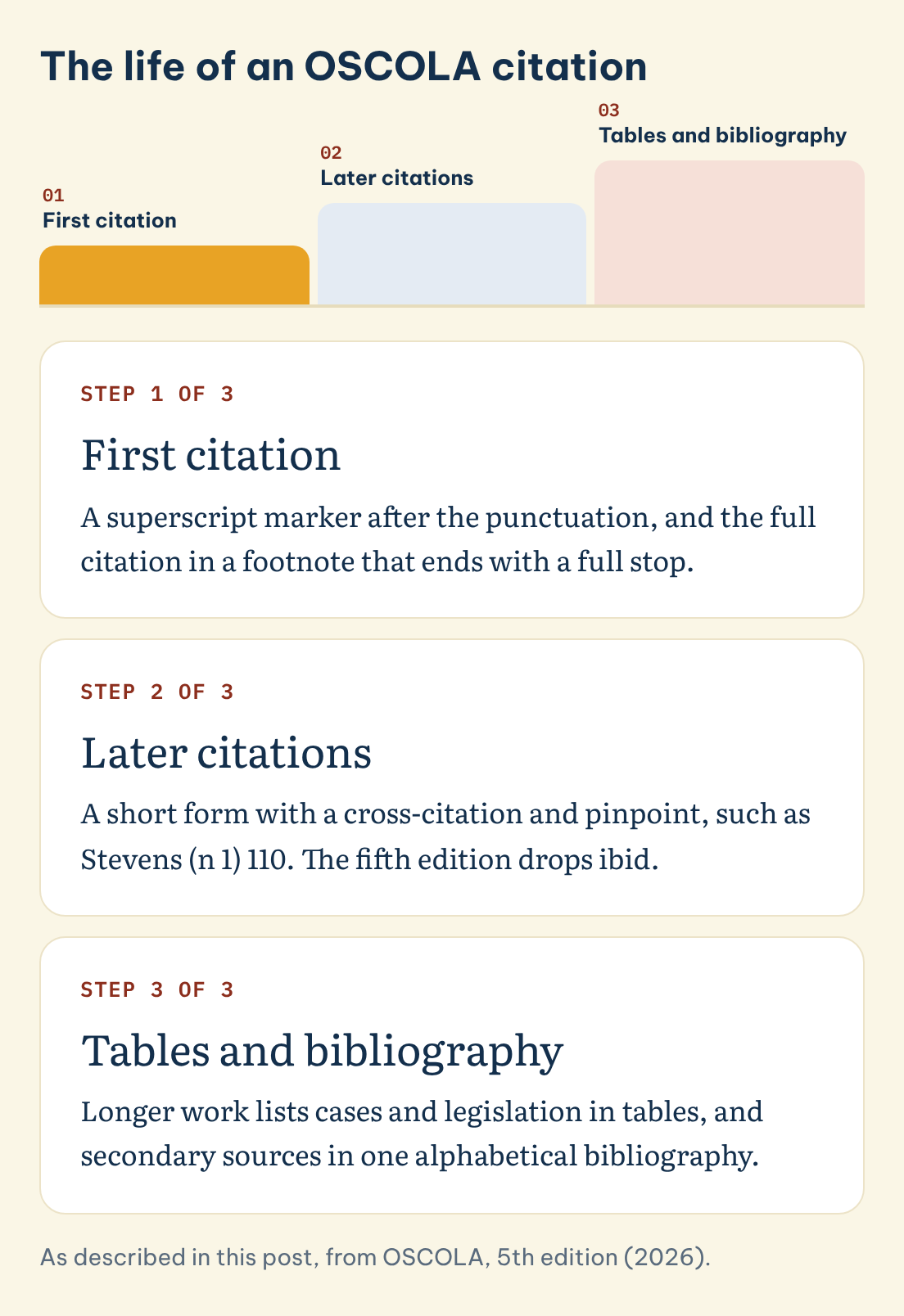
The life of an OSCOLA citation
Tap a step to see how the post says a source moves from your sentence to the end of your work.
Step 1 of 3
First citation
A superscript marker after the punctuation, and the full citation in a footnote that ends with a full stop.
Step 2 of 3
Later citations
A short form with a cross-citation and pinpoint, such as Stevens (n 1) 110. The fifth edition drops ibid.
Step 3 of 3
Tables and bibliography
Longer work lists cases and legislation in tables, and secondary sources in one alphabetical bibliography.
Save this figure
The Faculty of Law, University of Oxford (2026) opens the guide with its purpose: "There are two golden rules for the citation of legal authorities. One is consistency. The other is consideration for the reader" (p. 1). Almost every rule that follows serves one of those two aims, which is useful when you meet a source the guide does not cover. If you format it consistently and a reader can find it, you are working in the spirit of OSCOLA.
The mechanics of the footnote itself are set out in section 1.1. The marker goes "at the end of the sentence unless, for the sake of clarity, it is necessary to put it directly after the word or phrase to which it relates", and it is placed after any punctuation (Faculty of Law, University of Oxford, 2026, p. 3). Each footnote closes with a full stop, and two citations in one footnote are separated by a semicolon. In an essay the footnotes run consecutively from 1, while a thesis restarts the numbering in each chapter.
◆ Question 2 / 7 · OSCOLA vs Harvard
Are OSCOLA and Harvard referencing the same?
Direct answer: No. Harvard is an author-date style: the author and year sit in brackets inside your sentence, and every source appears in one alphabetical list at the end. OSCOLA is a footnote style: the citation sits in a numbered footnote, cases and legislation follow their own legal formats, and the bibliography lists secondary sources only.
The difference reflects what law students cite. A legal argument leans on cases, statutes and treaties, which do not have an "author" in the Harvard sense, and the reader needs the court, the report series and the paragraph to check the point. Footnotes carry that detail without breaking up the sentence. If you have used Harvard before, the Harvard referencing guide explains the author-date logic you are leaving behind.
| Feature | Harvard (Cite Them Right) | OSCOLA 5th edition |
|---|---|---|
| Where the citation goes | In brackets in the sentence | In a numbered footnote |
| Author names in citation | Surname and year | Full name as given, eg Robert Stevens |
| Punctuation | Full stops in abbreviations common | Minimal: no full stops in initials or abbreviations |
| Cases and statutes | Rarely covered in detail | Own formats, with report series and sections |
| Repeat citation | Author and year again | Short form and cross-citation, eg Stevens (n 1) 110 |
| End list | One alphabetical reference list | Footnotes only in essays and articles; longer works add tables of cases and legislation plus a bibliography |
Punctuation is the detail that most often gives away a Harvard habit. The Faculty of Law, University of Oxford (2026, p. 8) states that OSCOLA "uses minimal punctuation", so initials and abbreviations take no full stops: HLA Hart, not H.L.A. Hart, and WLR, not W.L.R.
◆ Question 3 / 7 · Worked examples
Can you provide an example of OSCOLA referencing style?
Direct answer: Yes. A case takes its name, neutral citation and best report, as in Patel v Mirza [2016] UKSC 42, [2017] AC 467. A statute takes its short title and section, as in Human Rights Act 1998, s 2. Books add edition, publisher and year in brackets, and articles add year, volume, journal and first page.
The table uses examples taken from the fifth edition itself, so you can compare your own footnotes against the official form.
| Source type | Pattern | Example from OSCOLA 5 |
|---|---|---|
| Case (reported, after 2001) | Case name [year] court number, [year] report page | Patel v Mirza [2016] UKSC 42, [2017] AC 467 |
| Case (older) | Case name [year] volume report page (court) | Caparo Industries plc v Dickman [1990] 2 AC 605 (HL) |
| Statute | Short title year, s number | Human Rights Act 1998, s 2 |
| Book | Author, Title (edition, publisher year) pinpoint | HLA Hart, The Concept of Law (2nd edn, Clarendon Press 1994) 135 |
| Journal article | Author, 'Title' (year) volume journal first page | Donal Nolan, 'Deconstructing the Duty of Care' (2013) 129 LQR 559 |
| Website or blog | Author, 'Title' (Website, date) link | Maximilian Steinbeis, 'A European Network of Constitutional Law Blogs' (VerfBlog, 17 March 2015) DOI: 10.17176/20181005-145902-0 |
Two rules about cases cost students the most marks. The first is the pinpoint. The guide calls it "essential (particularly when quoting)", and adds that where paragraph numbers exist they "should be used in preference to page numbers" and placed in square brackets, as in [21] (Faculty of Law, University of Oxford, 2026, p. 4). The second is the neutral citation. The fifth edition makes clear that neutral citations created retrospectively for cases decided before 2001 should not be used (Faculty of Law, University of Oxford, 2026, p. 3). For legislation, if the sentence already names the Act and the section, no footnote is needed at all.
◆ Question 4 / 7 · Second citations
How do you cite a source the second time in OSCOLA?
Direct answer: Give a short form of the source and a cross-citation to the footnote with the full citation, followed by the pinpoint. For a case, write Austin (n 1) [34]. For a book, write Stevens (n 1) 110. For legislation, give a short form at the first citation and use it alone afterwards. Do not use ibid.
The removal of ibid is the largest change for students who learned OSCOLA from older guides or seniors. The fourth edition allowed ibid for a source cited in the footnote immediately before. The fifth edition does not: "'ibid' should not be used" (Faculty of Law, University of Oxford, 2026, p. 6). In the guide's own example, a first footnote cites Austin v Commissioner of Police for the Metropolis as [2009] UKHL 5, [2009] AC 564, and the next reference reads Austin (n 1) [34], [39], [43]–[47], pinpointing several paragraphs (Faculty of Law, University of Oxford, 2026, p. 6). The guide goes further and asks writers to avoid Latin "gadgets" such as supra, infra, op cit and loc cit, while keeping eg, ie and cf (Faculty of Law, University of Oxford, 2026, p. 8).
Some universities soften the cross-citation rule for coursework. The University of Portsmouth (n.d.) tells its students that if cross-referencing feels confusing, they "can always just repeat the footnote citation instead", and asks them to keep the year in every short form of a statute so that CA 1985 and CA 2006 stay distinct. Neither variant is wrong in its own law school. What loses marks is mixing ibid from an old guide with cross-citations from the new one in the same essay.
◆ Question 5 / 7 · 5th edition changes
What changed in the OSCOLA 5th edition?
Direct answer: The fifth edition keeps the overall system and changes a set of details. Ibid has gone, the King's and Queen's Bench Divisions are identified as KBD and QBD, websites should be cited by persistent link or DOI where possible, and social media, podcasts and generative AI have new rules.
The editors say they deliberately avoided change for its own sake. The Faculty of Law, University of Oxford (2026) explains that "we generally resisted the temptation to make changes to the prescriptions of the fourth edition" (p. 1), because every new rule costs users time to learn. The official list of key changes is short, and the items that affect a typical undergraduate essay are these (Faculty of Law, University of Oxford, n.d.):
- Subsequent citations: ibid is removed and cross-citations are used instead.
- Court identifiers: the King's Bench Division is KBD and the Queen's Bench Division is QBD.
- Websites and blogs: cite a persistent link or DOI where available, in which case no access date is needed.
- New source types: book reviews, social media posts, podcasts and generative AI outputs now have their own rules.
- Bibliographies: secondary sources run in one alphabetical list by author surname, with no separate sections for books and articles.
Timing matters for current students. The Institute of Advanced Legal Studies (n.d.) notes that the fifth edition "became the current version as of the 2026/27 academic year", and that work begun under the fourth edition may still be accepted, but only after you confirm this with your law school.
◆ Question 6 / 7 · ChatGPT and generators
Is ChatGPT good for OSCOLA referencing?
Direct answer: Treat ChatGPT and OSCOLA generators as a first draft at most. They can add full stops to abbreviations, miss pinpoints, misdate case reports or still use ibid. Check every footnote against the report or statute and your law school's guide. If you cite an AI output itself, OSCOLA 5 sets a format for it.
The risk with legal citations is higher than in most styles, because a wrong report reference points the marker to a case that does not say what you claim, or does not exist. Your university's rules on AI use also apply before any formatting question does, so read the assessment brief first. Where an AI output is itself a source you discuss, the Faculty of Law, University of Oxford (2026, p. 44) asks you to cite the AI as the author, give your prompt in inverted commas, then the developer and the date, as in ChatGPT, response to 'Explain how artificial intelligence works', OpenAI (16 July 2023).
Citation tools help with the shape of each footnote but not with judgement. Reference management software can store your cases and articles, but a built-in OSCOLA style may still follow the fourth edition, so a final manual check is still part of the job.
◆ Question 7 / 7 · The bibliography
What does an OSCOLA bibliography look like?
Direct answer: A bibliography lists secondary sources only, such as books and articles, in one alphabetical list by author surname. Put the surname first, followed by initials with no comma between them and a comma after the final initial. Entries take the same form as footnotes and do not end with a full stop. Cases and legislation go in separate tables.
The Faculty of Law, University of Oxford (2026, pp. 12–13) sets out three differences from the footnote form: the surname comes first, initials replace forenames, and an unattributed work is preceded by a double em-dash. So the footnote Elizabeth Fisher, Risk Regulation and Administrative Constitutionalism (Hart Publishing 2007). becomes Fisher E, Risk Regulation and Administrative Constitutionalism (Hart Publishing 2007) in the bibliography, with no closing full stop. OSCOLA itself says that shorter works, such as articles and essays, only require footnotes (Faculty of Law, University of Oxford, 2026, p. 11). Some universities, such as Portsmouth, likewise do not expect tables of cases and legislation in standard coursework unless the brief asks for them (University of Portsmouth, n.d.), so check your module handbook before you spend time building them. Library guides can also depart from the Oxford text: the University of York (n.d.) describes a bibliography organised by type of source, with cases and legislation listed before books and articles, so follow your own school's guide where the two differ.
A short final check before submission catches most errors:
- Markers: every footnote marker sits after the punctuation, and every footnote ends with a full stop.
- Pinpoints: every quotation from a case or book has a paragraph or page pinpoint.
- Repeat citations: no ibid, and every short form points to the right footnote number.
- Punctuation: no full stops in initials or report abbreviations.
- Edition: the whole essay follows one edition of OSCOLA, the one your law school names.
Frequently asked questions
Does OSCOLA use in-text citations?
No. OSCOLA places citations in footnotes, not in brackets in the sentence. You may name a case or an author in your sentence, and if the sentence already gives all the information a reader needs, as with a named Act and section, no footnote is required.
Should I use the 4th or 5th edition of OSCOLA?
Use the edition your law school names in the module handbook. The fifth edition became current for the 2026/27 academic year, but some schools accept the fourth for work already under way. Never mix the two in one piece of work.
Is ibid allowed in OSCOLA?
Not in the fifth edition. Use a short form with a cross-citation, such as Stevens (n 1) 110, or repeat the citation if your university allows it. Older guides that show ibid follow the fourth edition.
Do OSCOLA footnotes end with a full stop?
Yes. Every footnote closes with a full stop, or a question or exclamation mark. Bibliography entries are the exception and do not end with a full stop.
Do I need a bibliography for a law essay?
Longer work such as a dissertation needs one, listing secondary sources alphabetically. OSCOLA says shorter works such as essays only require footnotes, but follow your module handbook, since many law schools set their own expectation for essays and problem questions.
Can I use an OSCOLA referencing generator?
You can use one for a first draft of a footnote, then check it against the case report, the statute and your law school's guide. Generators can add full stops, drop pinpoints or still produce ibid.
Related resources
- Harvard referencing guide: why author-date styles work differently from footnote styles
- Referencing in university assignments: how markers judge referencing across styles
- Reference management software: storing cases and articles, and what still needs a manual check
- Academic Support service: coaching through Outline, Draft and Final with a discipline-matched expert
Ready to start? Book a free 20-minute consultation. Bring your module handbook and your law school's OSCOLA guide, and we will match you to an expert in your subject.
References
- Faculty of Law, University of Oxford. (2026). OSCOLA: The Oxford University Standard for Citation of Legal Authorities (5th ed.). https://www.law.ox.ac.uk/sites/default/files/2026-03/OSCOLA%205.pdf
- Faculty of Law, University of Oxford. (n.d.). Key changes made in the fifth edition of OSCOLA. Retrieved October 22, 2026, from https://www.law.ox.ac.uk/sites/default/files/2026-04/OSCOLA%20key%20changes.pdf
- Institute of Advanced Legal Studies. (n.d.). Summary of changes in 5th ed: OSCOLA 5th edition. Retrieved October 22, 2026, from https://libguides.ials.sas.ac.uk/referencing/summary-of-changes
- University of Portsmouth. (n.d.). FAQs (OSCOLA 5). Retrieved October 22, 2026, from https://library.port.ac.uk/using-resources/referencing/oscola/faqs-oscola-5
- University of York. (n.d.). OSCOLA: Referencing styles. Retrieved October 22, 2026, from https://subjectguides.york.ac.uk/referencing-style-guides/oscola
Tools & resources
- OSCOLA home page, University of Oxford: the current edition, quick reference guide and FAQs
- UWE Bristol OSCOLA guide: a university guide with links to the quick reference guide
This article is part of the MAAS Journal series for Vietnamese international students. With MAAS Academic Support, a discipline-matched expert coaches you through the Outline, Draft and Final stages against your marking rubric. We guide students through worked examples, drafts and feedback so they reference their own work accurately against their own law school's guide, and we do not write or reference assignments on students' behalf.
Not sure how this guide applies to your own case? Talk it through with MAAS in a free 20-minute consultation.
Book a free 20-minute consultation ▸