
◆ Citation and referencing
How do you reference in Harvard style when every university differs?
Category: citation-formatting
Last updated: 2026-09-04
A student finishes an assignment, runs every source through a free Harvard generator, and submits with confidence. The feedback comes back with referencing marked down. Nothing in the list is careless, and every entry is internally consistent. The entries simply follow a different university's Harvard from the one her department publishes.
Direct answer: Harvard is a family of author-date styles, not one manual. No central body owns it, so each university publishes its own variant and two guides can format the same web page differently while both calling themselves Harvard. The rule that actually protects your marks is to reference from your own department's guide.
The variation is documented, not folklore. The Open University (n.d.) states plainly that "there are different versions of the Harvard referencing style" and that its own guide covers "the commonly used Cite Them Right version"; verified on 4 September 2026. The University of Leeds (n.d.) goes further and names its house variant Leeds Harvard, telling students that "each school in the University requires students to use a specific style of referencing"; verified on 4 September 2026.
This guide sets out the Cite Them Right pattern, the one most UK and Australian departments start from, then shows exactly where institutional variants diverge so you can spot the differences in your own guide rather than trusting a generator.
◆ Question 1 / 6 · No single Harvard manual
What is Harvard referencing, and why is there no single Harvard manual?
Direct answer: Harvard is a generic label for author-date referencing, where a short citation in the text points to a full alphabetical entry at the end. Unlike APA, which the American Psychological Association maintains as one manual, Harvard has no governing body, so authority passes down to each institution's own published guide.
The absence of an owner is the whole story. APA 7th exists in one place, the Publication manual of the American Psychological Association (2020), and a citation is either right or wrong against it. Harvard has no equivalent document. The nearest thing to a common reference point is Pears and Shields (2025), whose Cite them right is now in its thirteenth edition and is the version most UK institutions adopt or adapt. Everything beyond that is local.
Dawe et al. (2021) documented the practical cost of this arrangement at one university, where "local variations between faculty or discipline-based citation guides resulted in confusion for students." The institution's response was to reduce the number of endorsed styles rather than expect students to hold several variants in mind at once. When a style has no single owner, consistency has to be enforced somewhere, and the department is where that happens.
The scale of that local choice is easy to underestimate. The University of Leeds lists seven referencing styles in use across its schools, three of them maintained in house as Leeds Harvard, Leeds Numeric and MHRA, alongside APA, IEEE, OSCOLA and Vancouver; verified on 4 September 2026. A single Vietnamese student taking modules across two Leeds schools can therefore be required to use two different styles in the same semester, neither of which is negotiable at the point of marking.
◆ Question 2 / 6 · In-text citations
How do you format a Harvard in-text citation?
Direct answer: Give the author surname and year in round brackets at the point you use the source, and add a page number for a direct quotation. Cite Them Right places the year in brackets after the author with no comma in the reference list, but keeps the comma inside an in-text bracket.
The Open University's worked example shows the standard form in a sentence: "It has been emphasised that good referencing is an important academic skill (Harris, 2015)." The citation sits inside the sentence punctuation, and the full stop follows the closing bracket rather than preceding it.
Three variations account for most of the marks lost on in-text citations. The first is the comma, present in Cite Them Right as (Harris, 2015) but dropped by some institutional variants that write (Harris 2015). The second is how two authors are joined, with "and" in the running text and, in many variants, an ampersand inside the bracket. The third is the point at which a source with several authors collapses to "et al.", commonly after three named authors in Cite Them Right but set differently by other guides.
Naming the author in your sentence changes the shape but not the content. Where a bracketed citation reads (Harris, 2015), a narrative citation reads: Harris (2015) argues that referencing is a learned skill rather than an administrative chore. Use the narrative form when the author's identity matters to your argument, and the bracketed form when only the evidence matters.
◆ Question 3 / 6 · A reference list entry
What does a Harvard reference list entry contain?
Direct answer: A Cite Them Right entry carries four elements in fixed order: author surname and initial, year in round brackets, title in italics, and publisher. Online sources add two more, the location and the date you consulted it, written as "Available at: URL (Accessed: date)".
The Open University gives the book pattern as: Surname, Initial. (Year of publication) Title of book. Publisher. Its worked example is: Bell, J. (2014) Doing your research project. Open University Press. Every element earns its place, and the order does not change between source types even when extra elements are added.
Online material is where the Harvard family diverges most visibly from APA. Where APA 7th ends a web reference with a DOI or bare URL, Cite Them Right closes with an access date, on the reasoning that web pages change and the reader needs to know which version you read. The Open University's web page pattern is: Surname, Initial. (Year published/last updated) Title of web page. Available at: URL (Accessed: date).
Author counts diverge in the same way. APA 7th sets a single fixed rule, listing up to 20 authors before shortening, as specified in the American Psychological Association (2020) manual. Cite Them Right shortens far earlier, and other institutional Harvard variants set their own threshold, which is why a paper with 6 authors can be referenced three different ways across three departments that all describe their style as Harvard.
The clearest proof that Harvard varies sits in the punctuation of that same pattern. University College London (n.d.) publishes its web page pattern as "Author. Year (in round brackets). Title of web page (in italics). Available at: URL. (Accessed: date)"; verified on 4 September 2026. UCL places a full stop after the author and another after the URL. The Open University does neither. Both guides are called Harvard, both are published by respected UK institutions, and a reference list built to one will not match the other. Neither is wrong, and copying from the wrong one still costs marks.
◆ Question 4 / 6 · Other kinds of source
How do you reference sources that are not books or web pages?
Direct answer: Keep the same four-element spine of author, year, italicised title and source, then add whatever the reader needs to find that specific item. A PDF report needs the issuing organisation as author, a video needs the uploader and platform, and an image needs the creator and where it sits.
Corporate and organisational sources take the organisation in the author position. UCL's worked example demonstrates this with a 2014 BBC News article on the First World War centenary, referenced as BBC News (2014), followed by the italicised headline, then "Available at:" with the article URL, and closing with "(Accessed: 17 October 2022)". No individual journalist is named, so the organisation carries the entry, and the access date of 17 October 2022 does the work of identifying the version consulted eight years after publication.
Reports and PDFs follow the same logic with one addition. The issuing body sits in the author position, the report title is italicised, and where a report carries a series or document number, that number goes after the title so a reader can request the exact document. Government and agency publications almost always carry one.
Audiovisual sources need the element that makes them findable. A video reference names the uploader as author, the year of upload, the italicised video title, the platform, and the access date. An image needs the creator, the year, the italicised title or a description where no title exists, and the location, whether that is a gallery, a book page, or a URL. In each case the test is the same: could a reader find this exact item from your entry alone?
◆ Question 5 / 6 · Which variant to follow
Which Harvard variant should you actually follow?
Direct answer: The one your department publishes, without exception. If your school names a variant such as Leeds Harvard, that guide overrides every generator, textbook and website including this one. Where no local guide exists, Cite Them Right is the safe default because it is the version most UK institutions adapt.
Three places that hold the answer
Tap a place to read what the post says it holds, in descending order of authority. If the three disagree, follow the assignment brief and ask the module leader in writing.
Item 1 of 3
The assignment brief
It often names the style in the submission requirements, and where it does, that instruction overrides everything else.
Item 2 of 3
The module handbook
It sits on your virtual learning environment and carries the school-level rule.
Item 3 of 3
The library's referencing pages
They hold the full worked examples, usually organised by source type in the same order as the questions students actually ask.
Save this figure
Find the guide before you write rather than after. Leeds tells students to "check the referencing style used in your school before you begin your assignments", and the sequencing in that sentence is deliberate. Rebuilding a reference list to a different variant after drafting is slow and error-prone, while writing to the right pattern from the first source costs nothing extra.
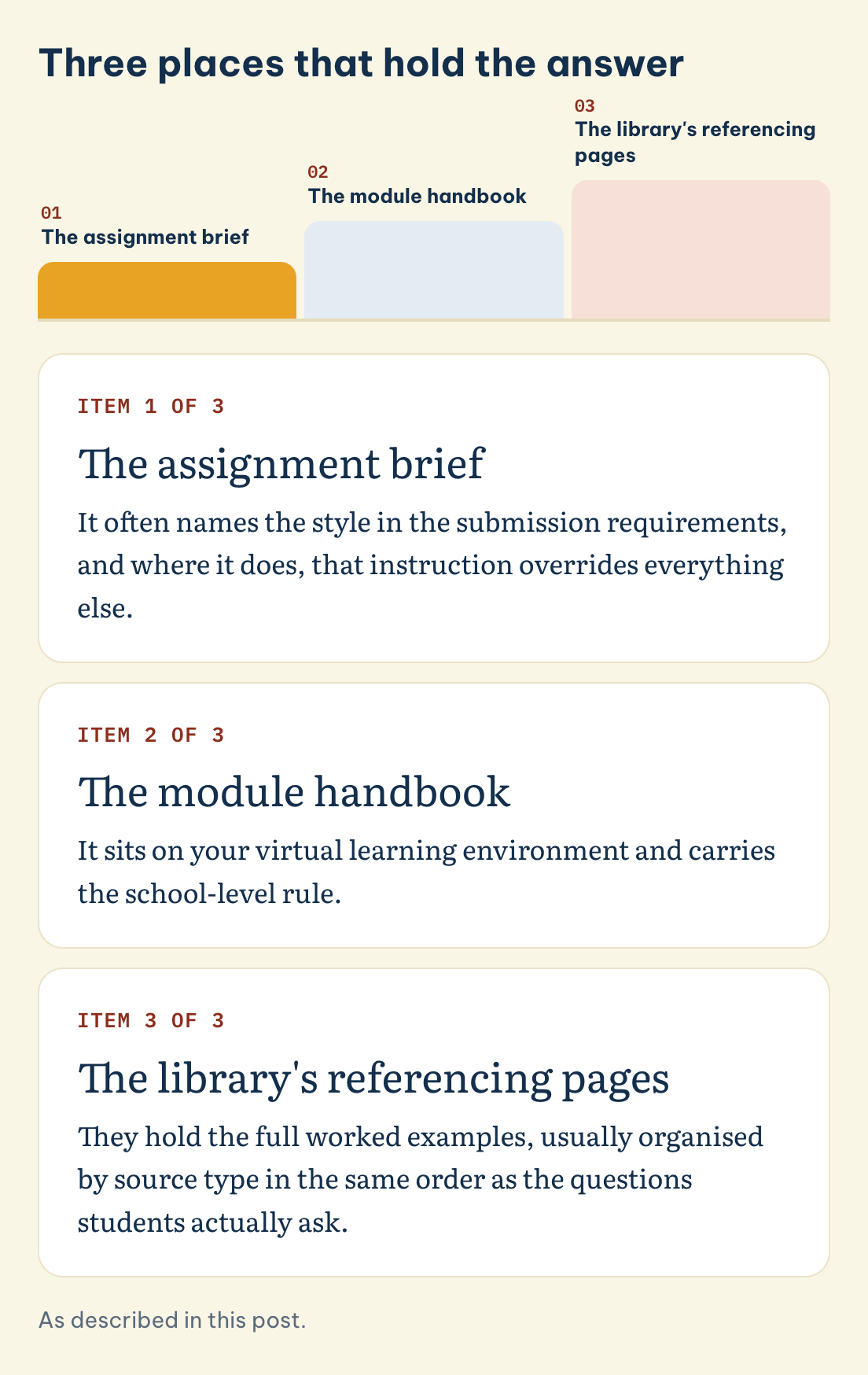
Three places hold the answer, in descending order of authority. The assignment brief itself often names the style in the submission requirements, and where it does, that instruction overrides everything else. The module handbook on your virtual learning environment carries the school-level rule, which is what Leeds means by a school requiring a specific style. The university library's referencing pages hold the full worked examples, usually organised by source type in the same order as the questions students actually ask, covering books, journal articles, web pages, videos and images. If those three disagree, follow the assignment brief and ask the module leader in writing.
Treat referencing generators as drafting aids rather than authorities. A generator produces one variant, usually without telling you which, and it cannot know what your department requires. The failure it produces is the one described at the top of this guide: a list that is internally consistent and uniformly wrong for its marker. Check a generator's output against two entries in your own guide before trusting it with forty.
Consistency inside one document matters more than picking the theoretically superior variant. A marker reading a list where half the entries carry access dates and half do not sees carelessness, whether or not either half matches the department guide. If you discover mid-assignment that you have been following the wrong variant, finish the draft in one style and convert the whole list in a single pass rather than switching partway.
◆ Question 6 / 6 · Common mistakes
What are the most common Harvard referencing mistakes?
Direct answer: Four errors account for most lost marks: mixing variants inside one list, citing in the text without a matching entry, omitting the access date on web sources when the local guide requires it, and letting a generator set a style the department does not use.
Mixing variants is the most frequent and the least visible to the writer. It happens when sources are collected over several weeks from several places, some copied from a database export, some from a generator, some typed by hand from a guide. The fix is mechanical rather than intellectual: build the list in one sitting against one guide, and treat every entry that arrived pre-formatted as a draft to be rewritten.
Orphaned citations and orphaned entries are the second pair. Every in-text citation needs an entry, and every entry needs at least one citation. Markers check this correspondence because it is quick to check and it reveals whether sources were read or decorated. Reading your finished list against your finished text, one entry at a time, catches this in a few minutes.
The last error is subtler and specific to second-language writers. A citation placed at the end of a long paragraph leaves the marker unable to tell which sentences came from the source and which are your own analysis. Place the citation at the point the borrowed idea appears, not at the paragraph boundary, so the boundary between your voice and the source's stays visible.
Frequently asked questions
Is Harvard the same as author-date?
Author-date describes the mechanism, a short in-text pointer resolved by an alphabetical list. Harvard is one family within that mechanism, and APA is another. Calling a style author-date is accurate but not specific enough to reference from.
Do I need an access date for every online source?
It depends on your variant. Cite Them Right requires one for web pages, and UCL and the Open University both include it in their patterns. Some variants drop it for sources with a stable DOI, on the reasoning that a DOI already fixes the version. Check your own guide.
Can I use a Harvard generator?
As a drafting aid, yes. As an authority, no. Verify its output against two entries in your department's guide before relying on it, because a generator cannot know which variant your marker expects.
What if my department has no Harvard guide?
Use Cite Them Right, the version Pears and Shields (2025) set out, and stay consistent. Where a guide is silent, a marker is looking for consistency and completeness rather than a specific punctuation choice.
Related resources
- APA 7th referencing guide: the full guide to the other major author-date system
- APA 7th vs Harvard referencing: a side-by-side comparison of where the two systems agree and diverge
- Referencing in university assignments: how referencing is actually marked, and what tutors look for
- Editing and proofreading checklist: the final pass that catches orphaned citations before submission
- Academic Support service: coaching through Outline, Draft and Final with a discipline-matched expert
Ready to start? Book a free 20-minute consultation. Bring your assignment brief and your department's referencing guide, and we will match you to a mentor in your discipline within 48 hours.
References
- American Psychological Association. (2020). Publication manual of the American Psychological Association (7th ed.). https://doi.org/10.1037/0000165-000
- Dawe, L., Stevens, J., Hoffman, B., & Quilty, M. (2021). Citation and referencing support at an academic library: Exploring student and faculty perspectives on authority and effectiveness. College & Research Libraries. https://crl.acrl.org/index.php/crl/article/view/25198
- Open University. (n.d.). Quick guide to Harvard referencing (Cite Them Right). Retrieved September 4, 2026, from https://university.open.ac.uk/library/referencing-and-plagiarism/quick-guide-to-harvard-referencing-cite-them-right
- Pears, R., & Shields, G. (2025). Cite them right: The essential referencing guide (13th ed.). Bloomsbury Academic.
- University College London. (n.d.). Web page: Harvard. Retrieved September 4, 2026, from https://library-guides.ucl.ac.uk/harvard/web-page
- University of Leeds. (n.d.). Referencing styles. Retrieved September 4, 2026, from https://library.leeds.ac.uk/referencing/
Tools & resources
- Cite Them Right Online: the subscription reference work behind the most widely adopted Harvard variant, available through most UK university libraries
- Leeds referencing styles: an example of a university publishing its own named Harvard variant
This article is part of the MAAS Journal series for Vietnamese international students. With MAAS Academic Support, a discipline-matched expert coaches you through the Outline, Draft and Final stages against your marking rubric. We guide students through worked examples, drafts and feedback so they reference their own work accurately against their own department's guide, and we do not write or reference assignments on students' behalf.
A free 20-minute consultation with MAAS Academic Support, to check your reference list against your own department's guide. You reference your own work and remain the author.
Book Free Discovery ▸