
◆ Citation & Formatting
How do you use IEEE referencing in engineering and IT assignments?
Category: citation-formatting
Last updated: 2026-10-20
An engineering student who has used Harvard or APA for two years opens a new unit outline and finds one line under assessment requirements: references must follow IEEE. The habits that served well so far, author names and years in brackets, an alphabetical list at the end, now cost marks. IEEE works on a different logic, and once that logic is clear the format is quicker to apply than any author-date style.
Direct answer: IEEE is a numbered style. Each source gets a number in square brackets, such as [1], in the order it is first cited, and the same number is reused every time that source appears again. The reference list at the end runs in that numerical order, not alphabetically, with initials before surnames and abbreviated journal titles.
The guide below follows the publisher's own IEEE reference guide (IEEE, 2025), then shows where Australian university guides adapt it, because your marker will judge you against your department's guide first.
◆ Question 1 / 6 · How IEEE differs
How does IEEE referencing differ from Harvard and APA?
Direct answer: Harvard and APA identify a source by author and year inside the sentence and sort the list alphabetically. IEEE identifies a source by a number in square brackets and sorts the list by order of first citation. Author names appear in the text only when you choose to make them part of the sentence.
The difference changes how you write as well as how you format. In an author-date style the citation carries information the reader can use without looking at the list. In IEEE the bracket is a pointer and nothing more, which keeps dense technical prose readable when a single paragraph draws on five or six papers. That is why the style is common in engineering and computing. The University of Melbourne (n.d.) describes IEEE as a numbered style "used widely in electronics, engineering, telecommunications, computer science, and information technology reports."
The table sets out the differences that most often catch students moving from Harvard.
| Feature | Harvard (Cite Them Right) | APA 7th | IEEE |
|---|---|---|---|
| In-text form | (Smith, 2021) | (Smith, 2021) | [1] |
| Order of reference list | Alphabetical by author | Alphabetical by author | Numerical, by first citation |
| Author names in list | Surname, initials | Surname, initials | Initials, then surname |
| Journal titles | Full title | Full title | Abbreviated, e.g. IEEE Trans. Biomed. Eng. |
| Repeat citation of same source | Author and year again | Author and year again | Same number again |
| Page for a direct quote | (Smith, 2021, p. 8) | (Smith, 2021, p. 8) | [1, p. 8] |
If you already know Harvard, the Harvard referencing guide explains why each university publishes its own variant, and the same caution applies to IEEE.
◆ Question 2 / 6 · In-text citations
How do you format an IEEE in-text citation?
Direct answer: Place the number in square brackets on the line of text, before any punctuation. Number sources in the order you first cite them, and reuse the original number for every later citation of the same source. Add a page, figure or section inside the bracket when you point to a specific part.
One source, one number
Tap a step to see how the post says an IEEE citation travels from your sentence to the reference list.
Step 1 of 3
First citation
The first new source you cite becomes [1], the next new source [2], in the order they appear in the text.
Step 2 of 3
Every later citation
The same source keeps its original number. Add a page or figure inside the bracket, such as [3, p. 8].
Step 3 of 3
Reference list
Entries run in numerical order, initials before surname, with only one source under each number.
Save this figure
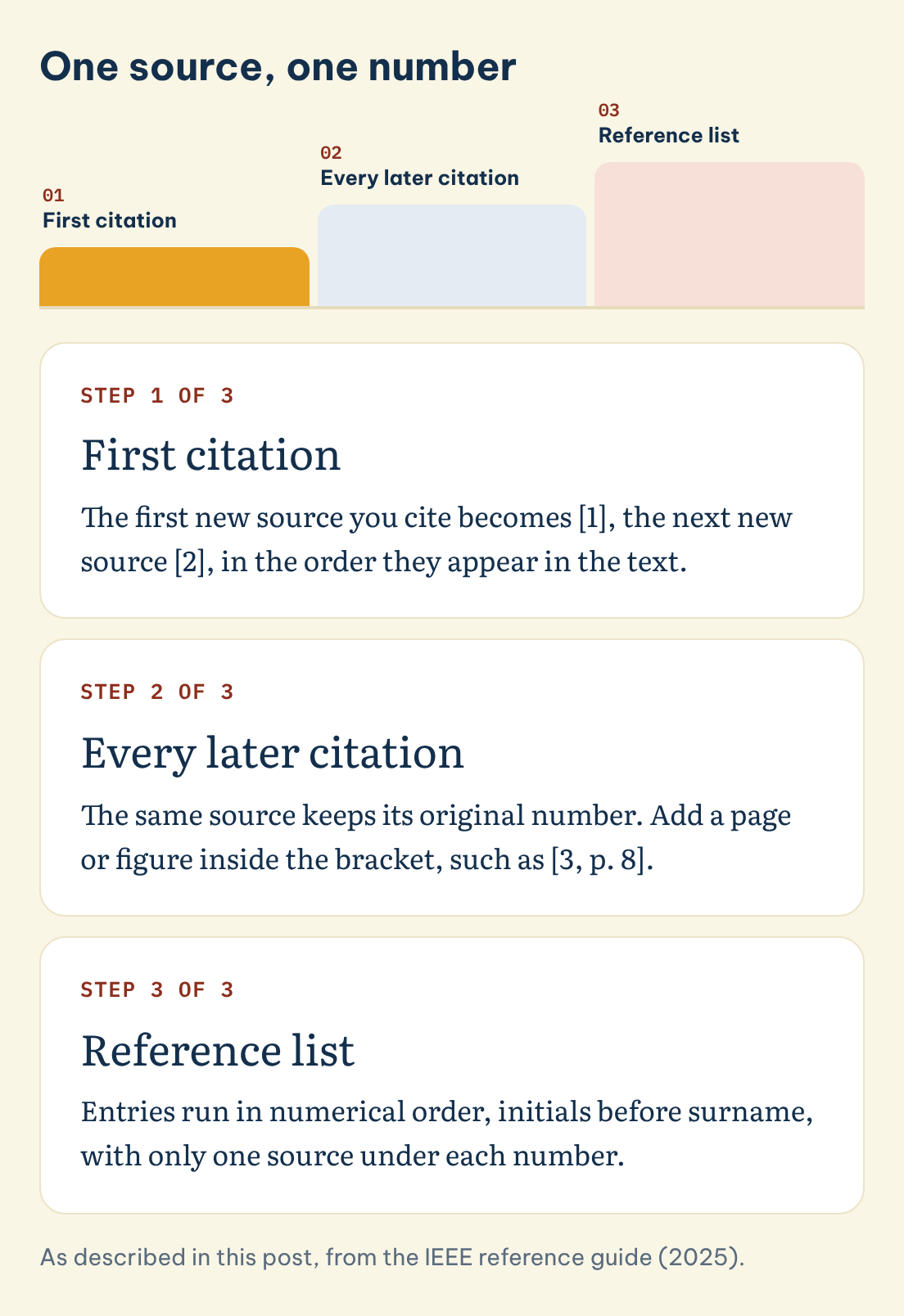
The publisher's rule is short. IEEE (2025) states that citations "appear on the line, in square brackets, inside the punctuation" (p. 4). James Cook University (2026) spells out the practical consequence: "Once a source has been cited, the same number is used in all subsequent references." A student who gives a source a new number each time it reappears produces a list with duplicate entries, which is an error markers often flag.
The bracket can sit in a sentence in two ways. It can follow an author's name, as in "Jones [2] has stated that the method fails under load", or it can act as a noun, as in "In [3], the authors test this at scale." James Cook University (2026) notes that "In [3] ..." is sufficient and you do not need to write "in reference [3]". When a source has three or more authors and you name them in the sentence, use the first surname followed by et al., as in "Brown et al. [8]".
To point to part of a source, put the detail inside the same bracket. IEEE (2025) gives forms such as [3, Fig. 1], [3, Sect. 4.5] and [3, Ch. 2, pp. 5–10] (p. 4). A direct quotation always needs the page, for example [3, p. 8]. IEEE also drops the Latin shortcuts: ibid. and op. cit. are not used, and you simply repeat the earlier number.
◆ Question 3 / 6 · Several sources at once
How do you cite several sources at once in IEEE?
Direct answer: List each number in its own brackets, separated by commas, such as [1], [3], [5]. The current IEEE guide asks writers to spell out a run of sources in full, [1], [2], [3], [4], instead of [1]–[4]. Many university guides still accept the range form, so check yours before you choose.
Range formatting is the one point where the publisher and many university guides now disagree, and it explains why two correct-looking assignments can be formatted differently. The 2025 edition of the IEEE guide says: "Reference ranges in text will not include an en dash. All references will be written out. For example, '[1]–[4]' will now be '[1], [2], [3], [4]'" (IEEE, 2025, p. 4). RMIT University (n.d.) has already adopted the change and tells students to list multiple citations "in ascending numerical order enclosing each citation number in brackets" without an en dash.
Other guides have not caught up. James Cook University (2026) still lists [1] - [5] as a preferred form and [1, 3, 5] as acceptable, while Murdoch University (2026) lists [1], [3], [5] and [1], [2], [3], [4], [5] as its forms. Neither approach is wrong in its own context. What loses marks is mixing them inside one assignment, so pick the form your department's guide shows and apply it every time.
| Situation | IEEE 2025 publisher guide | Example of an older university form |
|---|---|---|
| Three separate sources | [1], [3], [5] | [1, 3, 5] |
| A run of four sources | [1], [2], [3], [4] | [1] - [4] |
| Same source, second citation | Original number again | Original number again |
◆ Question 4 / 6 · A reference list entry
What does an IEEE reference list entry look like?
Direct answer: Each entry starts with its number in square brackets, flush left, followed by the author's initials and surname, the title, and the publication details. Article titles go in quotation marks, book and journal titles in italics, and journal titles are abbreviated. Entries appear in citation order, and each number holds exactly one source.
The general pattern for a journal article in the IEEE guide is "J. K. Author, 'Name of paper,' Abbrev. Title of Periodical, vol. x, no. x, pp. xxx-xxx, Abbrev. Month, year, doi: xxx" (IEEE, 2025, p. 15). Two details in that pattern are easy to miss. The author's given name is reduced to initials and placed before the surname, and for IEEE publications the guide asks writers to list every author up to six, using the first author followed by et al. beyond six (IEEE, 2025, p. 4). University guides usually apply the same rule to student work.
The publisher also forbids combining sources under one number: "Do not combine references. There must be only one reference with each number" (IEEE, 2025, p. 5). Students who come from styles that allow a single footnote to cite several works often break this rule without noticing.
The table gives the pattern for the four source types engineering and IT students cite most, using the publisher's own examples.
| Source type | Pattern | Example from the IEEE guide |
|---|---|---|
| Book | Initials Surname, Title. City, Country: Publisher, year. | B. Klaus and P. Horn, Robot Vision. Cambridge, MA, USA: MIT Press, 1986. |
| Journal article | Initials Surname, "Article title," Abbrev. Journal, vol., no., pp., Month year, doi. | M. M. Chiampi and L. L. Zilberti, "Induction of electric field in human bodies moving near MRI ...," IEEE Trans. Biomed. Eng., vol. 58, pp. 2787–2793, Oct. 2011, doi: 10.1109/TBME.2011.2158315. |
| Website | Initials Surname. "Page title." Website. Accessed: date. [Online]. Available: URL | J. Smith. "Obama inaugurated as President." CNN.com. Accessed: Feb. 1, 2009. [Online]. Available: URL |
| Source with no date | Add (n.d.) in place of the year | A datasheet with no publication date, followed by (n.d.) |
◆ Question 5 / 6 · Citing a website
How do you cite a website in IEEE?
Direct answer: Give the author or organisation, the page title in quotation marks, the website name, the date you accessed it, then [Online]. Available: and the URL. Online references end with the URL and no full stop. If the page has no publication date, IEEE asks you to write (n.d.) rather than leave the date out.
Websites are an easy place to lose marks, because students often copy the URL and stop. The IEEE pattern needs the accessed date because web pages change, and the reader needs to know which version you saw. IEEE (2025, p. 22) shows the form with an example by J. Smith on CNN.com: author, page title in quotation marks, site name, the accessed date, then the online availability label and the address. When an organisation publishes the page, the organisation takes the author position, and RMIT University (n.d.) adds that corporate authors should be written out in full in the list, so CSIRO becomes Commonwealth Scientific and Industrial Research Organisation.
IEEE (2025, p. 4) adds a check that matters for almost every website entry: a full stop closes every reference except one that ends with a URL.
◆ Question 6 / 6 · Common mistakes
What are the most common IEEE referencing mistakes?
Direct answer: Mistakes that commonly cost marks include numbering sources alphabetically instead of by first citation, giving one source two numbers, putting two sources under one number, leaving out page numbers for quotations, writing full given names, and mixing range formats. Each is easy to catch in a final check against your department's guide.
A short self-check before submission covers most of them:
- Order: Read through the text and confirm that the first new number you meet is [1], the next new one is [2], and so on with no gaps.
- Reuse: Search the list for any source that appears twice under different numbers, then merge it and renumber.
- One source per number: Split any entry that lists two works.
- Quotations: Every direct quotation carries a page inside the bracket, such as [4, p. 12].
- Names: Authors appear as initials before the surname, and every author is listed up to six unless your guide says otherwise.
- Ranges: Multiple citations follow one form throughout, either the publisher's spelled-out form or the form your department shows.
Generators help with the list but not with these checks. A citation tool numbers entries in the order you add them to its library, which is rarely the order they first appear in your final draft. If you use reference management software, let it build the list from the citations inside your document so the numbering follows the text.
Frequently asked questions
Is IEEE the same as a numbered style like Vancouver?
Both are numbered, citation-order styles, but the details differ. IEEE abbreviates journal titles using its own list, places [Online]. Available: before URLs, and uses square brackets in the text. Follow the style your unit outline names rather than treating them as interchangeable.
Do you put the year in an IEEE in-text citation?
No. The bracketed number is enough, and IEEE does not require the author or date in the sentence. You can name the author when it helps the argument, for example "Smith [4] showed", but the year stays in the reference list.
How do you cite the same source several times in IEEE?
Use the number you gave it the first time, every time. If you refer to a different page or figure, add it inside the bracket, such as [3, p. 15] or [3, Fig. 2]. Do not use ibid. or op. cit.
Should you write [1]–[4] or [1], [2], [3], [4]?
The 2025 IEEE reference guide asks for the spelled-out form, [1], [2], [3], [4]. Some university guides still accept a range. Check the guide your department links to in the unit outline, and use one form consistently.
Can you use an IEEE citation generator?
A generator is useful for the shape of each entry, but check its output against your department's guide. Generators often number entries in the wrong order, drop the accessed date for websites, or expand journal titles that IEEE abbreviates.
What if a source has no author or no date?
Use the organisation as the author when there is no named person. When there is no date, IEEE asks you to write (n.d.) instead of omitting it.
Related resources
- Harvard referencing guide: why each university publishes its own author-date variant
- Referencing in university assignments: how markers judge referencing across styles
- Reference management software: choosing a tool that numbers citations from your document
- Academic Support service: coaching through Outline, Draft and Final with a discipline-matched expert
Ready to start? Book a free 20-minute consultation. Bring your unit outline and your department's IEEE guide, and we will match you to an expert in your discipline.
References
- IEEE. (2025). IEEE reference guide. IEEE Publication Operations. https://journals.ieeeauthorcenter.ieee.org/wp-content/uploads/IEEE-Reference-Guide.pdf
- James Cook University. (2026). In-text citations: IEEE style guide. Retrieved October 20, 2026, from https://libguides.jcu.edu.au/IEEE/in-text-citations
- Murdoch University. (2026). Citing in the text: IEEE referencing guide. Retrieved October 20, 2026, from https://libguides.murdoch.edu.au/ieee/text
- RMIT University. (n.d.). IEEE style guide: Easy Cite referencing guide. Retrieved October 20, 2026, from https://www.lib.rmit.edu.au/easy-cite/?styleguide=styleguide-6
- University of Melbourne. (n.d.). IEEE. Retrieved October 20, 2026, from https://library.unimelb.edu.au/recite/referencing-styles/ieee
Tools & resources
- IEEE Reference Guide (PDF): the publisher's own guide, with the full abbreviation list for journal titles
- UWA IEEE referencing guide: a concise university guide with reference list tips
- University of Bath IEEE citations: a UK university guide with in-text examples
This article is part of the MAAS Journal series for Vietnamese international students. With MAAS Academic Support, a discipline-matched expert coaches you through the Outline, Draft and Final stages against your marking rubric. We guide students through worked examples, drafts and feedback so they reference their own work accurately against their own department's guide, and we do not write or reference assignments on students' behalf.
Not sure how this guide applies to your own case? Talk it through with MAAS in a free 20-minute consultation.
Book a free 20-minute consultation ▸