
◆ Admissions
What is a UK law conversion course, and do you need one?
A graduate in business, engineering or literature who decides to practise law in the UK meets a confusing list of abbreviations within minutes: GDL, PGDL, CPE, SQE, MA Law conversion. The rules changed in 2021, so older advice online often describes a route that no longer applies to new students. This guide separates what the law conversion course is, who still needs it, what it costs and how applications work.
Direct answer: A UK law conversion course (GDL or PGDL) is a postgraduate law course for graduates of other subjects. The SRA does not ask for a law degree to become a solicitor, because it requires a degree in any subject plus SQE1 and SQE2. The course remains one way to cover the academic stage of Bar training.
◆ Question 1 / 7 · What it is
What is a UK law conversion course, and what do GDL, PGDL and MA Law conversion mean?
Direct answer: A conversion course teaches the core legal subjects to someone whose first degree is not in law. GDL is the older name, PGDL (Postgraduate Diploma in Law) is the name many providers now use, and CPE is an older equivalent. "MA Law conversion" usually means a version that adds a master's-level element.
The Bar Standards Board gives the formal definition: A conversion course must include the foundations of legal knowledge subjects and follow the QAA benchmark statement for law. In the manual's words, "the most common type of conversion course is a Graduate Diploma in Law (GDL). Other types of conversion course include a Common Professional Examination (CPE) or Postgraduate Diploma in Law (PGDL)" (Bar Standards Board, 2020, p. 5). The same manual lists the seven foundations as Criminal Law, Equity and Trusts, Law of the European Union, Obligations 1 (Contract), Obligations 2 (Tort), Property/Land Law and Public Law (Bar Standards Board, 2020, p. 1). That manual is a 2020 copy, so check the current Bar Qualification Manual before you rely on the EU law item. The practical point is that the course name varies by provider, while the aim stays the same.
◆ Question 2 / 7 · Do you need one
Do you need a law conversion course to become a solicitor or a barrister?
Direct answer: Not for the solicitor route, which asks for any degree plus two SQE exams, work experience and a suitability check. Barristers are different: Bar training still needs the seven foundations of legal knowledge, and a non-law graduate usually covers them with a conversion course.
The SRA states the position directly: "To be admitted as a solicitor, you will need a degree (in any subject) or equivalent, in addition to passing the SQE and meet our other requirements" (Solicitors Regulation Authority [SRA], n.d.-a). It adds that candidates must pass both SQE1 and SQE2, complete "two years' full time or equivalent" of qualifying work experience, and meet its suitability requirements (SRA, n.d.-b). The old route of GDL, then the Legal Practice Course, survives only through transitional arrangements. For conversion graduates, the SRA lists people who have completed the CPE or GDL, accepted before 1 September 2021, and the LPC route allows applications for admission until 31 December 2032 (SRA, n.d.-c). A student starting from scratch in 2026 therefore uses the SQE. Many still choose a PGDL because it teaches the core subjects in a structured way before SQE preparation.
| Goal | Does it need a conversion course? | What the regulator asks for |
|---|---|---|
| Solicitor (new entrant) | No | Degree in any subject, SQE1, SQE2, two years' qualifying work experience, suitability |
| Solicitor (transitional route) | Possibly, under transitional rules | Old GDL and LPC route, admission open until the end of 2032 |
| Barrister | Yes, unless the first degree already covers the seven foundations | Academic component covering seven foundations of legal knowledge |
Source: SRA (n.d.-a, n.d.-b, n.d.-c); Bar Standards Board (2020).
◆ Question 3 / 7 · Requirements
What are the UK law conversion course requirements?
Direct answer: Expect a 2:2 or higher first degree, in any subject or an equivalent overseas qualification. The Bar Standards Board uses the same floor for UK and Irish degrees. The pages checked gave no English-language score, so ask your chosen provider for its exact test and section minimums.
The University of Law lists its entry route as "an undergraduate degree at 2:2 or above in any discipline (or equivalent)" (The University of Law, n.d.). The Bar Standards Board says that "the minimum standard for UK/Republic of Ireland undergraduate degrees for completion of the academic component of Bar training is lower second class honours (2:2)" (Bar Standards Board, 2020, p. 5). For an applicant with a Vietnamese or other overseas degree, the word "equivalent" is the part to test. Providers decide equivalence themselves, so send your transcript and degree certificate for assessment before you pay any deposit. We do not quote an IELTS figure here, because the pages checked for this guide did not state one, and third-party sites disagree with each other. Ask the provider for the exact test, overall score and section minimums for your intake, and ask whether a pre-sessional course can replace a retake.
◆ Question 4 / 7 · Fees
How much does a UK law conversion course cost?
Direct answer: At The University of Law, a PGDL starting between 1 July 2026 and 31 May 2027 costs £15,450 in London and £12,450 outside London, including a £250 deposit. The 2027/28 figures are £16,050 and £12,950. Other providers set their own fees, so compare current pages.
PGDL fees at The University of Law
First row 2026/27, second row 2027/28. Each 2026/27 figure includes a £250 deposit.
London
Outside London
£15,450
£12,450
£16,050
£12,950
Save this figure
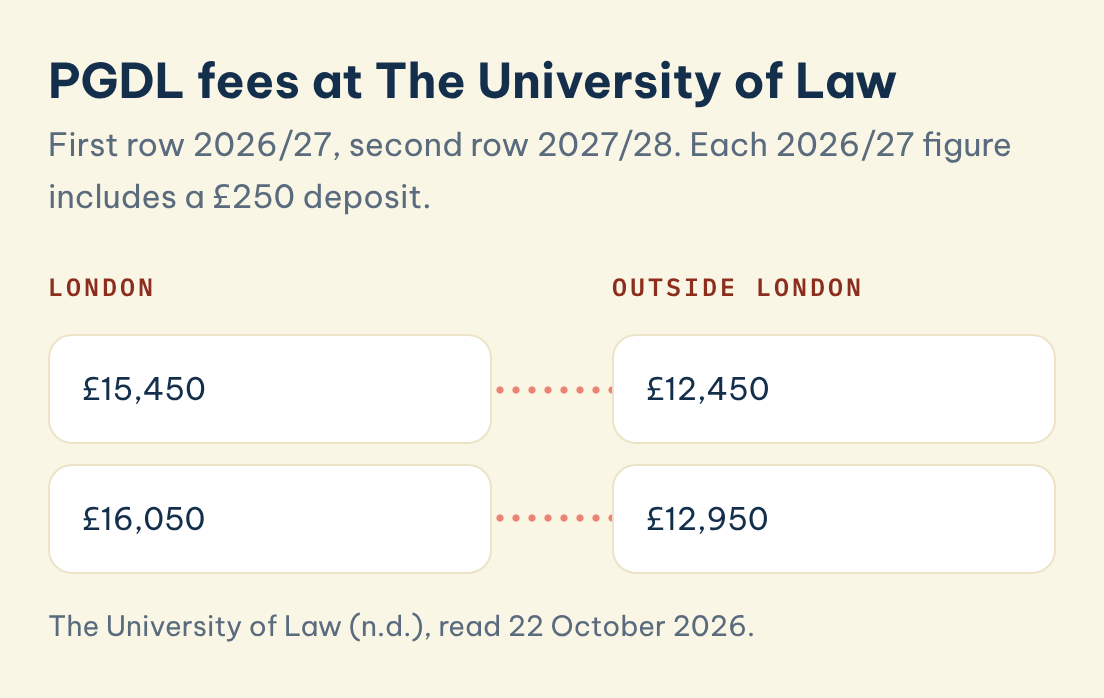
The University of Law publishes separate fees by location and by year, and the 2026/27 figures cover courses starting from 1 July 2026 to 31 May 2027 (The University of Law, n.d.). The difference between London and the rest of the country is £3,000 for 2026/27 and £3,100 for 2027/28. The same page lists an International Bursary of £1,000 for full-time international students, so check whether you qualify before you plan a budget (The University of Law, n.d.). Add the £30 central application fee that LawCabs charges, living costs for the length of your course, and visa-related costs that sit outside the tuition page. Third-party comparison sites sometimes show older numbers, so treat the provider page as the only reliable source and note the date you read it.
| Intake | London | Outside London |
|---|---|---|
| 2026/27 intake | £15,450 | £12,450 |
| 2027/28 | £16,050 | £12,950 |
Source: The University of Law (n.d.), read 22 October 2026. Each figure includes a £250 deposit.
◆ Question 5 / 7 · How to apply
How do you apply, and can you study a PGDL online or in London?
Direct answer: Full-time applicants apply through LawCabs, the Central Applications Board service, which charges £30 and allows one law-conversion application per academic year. Part-time and distance applicants usually apply directly to the provider. The University of Law lists an online PGDL with several start dates, and it also teaches in London.
LawCabs explains that applicants choosing "a PGDL, GDL, MA Law Conversion, Law conversion LLM etc" should select the GDL application form, that you can make only one GDL or law conversion, LPC or SQE application in an academic year, and that the application fee is currently £30 (LawCabs, n.d.). Providers usually respond in 5 to 10 working days (LawCabs, n.d.). BPP states the same split: full-time PGDL students "need to apply via LawCabs", while part-time students apply directly (BPP University, n.d.). The University of Law lists online PGDL start dates in January 2027, May 2027, September 2027, January 2028 and May 2028 (The University of Law, n.d.). Because you get only one application per year, rank your choices before you submit, and check whether the course location you want, such as London, is available at your preferred intake.
◆ Question 6 / 7 · Choosing a course
Which is the best law conversion course in the UK?
Direct answer: No ranking is published in the sources used here, and the best course depends on your plan. Compare four things: whether the provider is recognised for your route (SQE or Bar), the fee and location, full-time or online delivery, and the support offered to international applicants.
Rather than copy a league table, build your own comparison from facts you can check. Start with the route: if you intend to sit the SQE, ask how the provider links its PGDL to SQE1 preparation, and if you intend to go to the Bar, confirm that the course covers the seven foundations (Bar Standards Board, 2020, p. 1). Then compare delivery. The University of Law describes a full-time course of two terms with four modules per term, and a part-time course of four terms with two modules per term (The University of Law, n.d.), which helps you judge workload. LawCabs refers to "a full time 1 year GDL qualification" (LawCabs, n.d.), but only the provider's own timetable tells you the real length. Ask each provider about assessment style, class size and how recently its materials were updated.
| Question to ask | Why it matters |
|---|---|
| Does the course cover all seven foundations? | Needed for the Bar's academic component |
| Full-time, part-time or online? | Changes workload, application route and visa options |
| London or elsewhere? | Changes tuition and living costs |
| What English-language score is required? | Not stated on the pages checked; ask the provider |
Source: Bar Standards Board (2020); The University of Law (n.d.); LawCabs (n.d.).
◆ Question 7 / 7 · After the course
What can an international student do after the course?
Direct answer: Some students who finish a UK course can apply for the Graduate route to stay and work. GOV.UK lists a longer permission for applications made by the end of 2026 and a shorter one from January 2027. Confirm your own eligibility on GOV.UK before relying on it.
GOV.UK lists the Graduate route length as "2 years if you apply on or before 31 December 2026" and "18 months if you apply on or after 1 January 2027" (GOV.UK, n.d.). A PGDL that ends in 2027 will fall under the shorter period if you apply after that date, so do not assume the longer figure when you compare options. The page is the authority on who qualifies, and conditions can change, so read it on the day you plan to apply. Separately, a conversion course alone does not make you a solicitor: you still need SQE1, SQE2, two years of qualifying work experience and a character check (SRA, n.d.-b). If you are an applicant who wants a second pair of eyes on your motivation statement or study plan, a MAAS admissions adviser can review the drafts you write, while the choices and the final text remain yours.
Frequently asked questions
Is a law conversion course the same as the GDL?
The GDL is the older and best-known name. The Bar Standards Board treats the GDL, the CPE and the PGDL as types of conversion course, so the label depends on the provider and the date.
Do I need a conversion course to be a solicitor in England and Wales?
No. The SRA asks for a degree in any subject, SQE1 and SQE2, qualifying work experience and a suitability check. A conversion course is optional preparation for new entrants.
What degree classification do I need?
The University of Law asks for a 2:2 or above in any discipline, or equivalent. The Bar Standards Board also sets 2:2 as the minimum for UK and Irish degrees.
How much does a PGDL cost?
At The University of Law, 2026/27 fees are £15,450 in London and £12,450 outside London. Check the provider's current page, because fees change by intake.
Can I apply to more than one conversion course?
LawCabs allows one GDL or law conversion, LPC or SQE application per academic year, so choose and rank your providers before you submit.
Can I study the PGDL online?
The University of Law lists an online PGDL with start dates from January 2027 onwards. Check the provider page for visa and delivery details if you are an international applicant.
Related guides
- How do you use OSCOLA referencing in a UK law assignment?: the citation style you will meet in your first law assessment
- PhD in law vs JD vs SJD: which one fits you?: other law routes after your first degree
- UK Clearing for international students: how late UK applications work
- Admissions consulting: advisory help with your statement and application strategy
References
- BPP University. (n.d.). Applying for postgraduate law. Retrieved October 22, 2026, from https://www.bpp.com/study/postgraduate/applying
- Bar Standards Board. (2020). Bar qualification manual, Part 2: Academic component of Bar training. https://www.barstandardsboard.org.uk/uploads/assets/9cefedee-2877-438f-ba9ff4c3baa811c0/100c9260-38c6-49b5-b91ba6ae40d3e52b/Part-2-Academic-Component-of-Bar-Training.pdf
- GOV.UK. (n.d.). Graduate visa. Retrieved October 22, 2026, from https://www.gov.uk/graduate-visa
- LawCabs. (n.d.). Application process. Retrieved October 22, 2026, from https://lawcabs.ac.uk/application-process
- Solicitors Regulation Authority. (n.d.-a). Becoming a solicitor: SQE questions and answers. Retrieved October 22, 2026, from https://www.sra.org.uk/become-solicitor/sqe/qa/
- Solicitors Regulation Authority. (n.d.-b). The Solicitors Qualifying Examination (SQE). Retrieved October 22, 2026, from https://www.sra.org.uk/become-solicitor/sqe/
- Solicitors Regulation Authority. (n.d.-c). Becoming a solicitor: Legal Practice Course transitional requirements. Retrieved October 22, 2026, from https://www.sra.org.uk/become-solicitor/legal-practice-course-route/becoming-solicitor-legal-practice-course-transitional-requirements/
- The University of Law. (n.d.). Postgraduate Diploma in Law (PGDL). Retrieved October 22, 2026, from https://www.law.ac.uk/study/postgraduate/law/pgdl/
This article is part of the MAAS Journal series for international students. MAAS is an academic support partner: experts guide students through each stage of their own work, and we do not complete assessed work on a student's behalf.
Not sure how this guide applies to your own case? Talk it through with MAAS in a free 20-minute consultation.
Book a free consultation ▸