
◆ PhD Admissions
Can you enter a PhD in Vietnam without a master's degree?
Category: admissions
Last updated: 2026-09-03

Yes, and the route just widened. Circular 53/2026/TT-BGDĐT opened a door that its predecessor kept shut, and it did so in a way that says something about what the master's degree was ever standing in for.
Direct answer: Article 14 of Circular 53/2026/TT-BGDĐT admits holders of a master's and graduates of a bachelor's classed distinction or above. It adds a third route: a good-classification graduate may apply by meeting supplementary requirements on research output or work experience. Circular 18/2021 had no such route.
The third route is the interesting one, because it names outright what a master's degree was being used as a proxy for.
◆ Part 1 / 6 · What the previous rule said
What the previous rule said, and what changed
Direct answer: Circular 18/2021 admitted holders of a master's, a distinction-class bachelor's, or a level 7 equivalent, and separately required prior research evidence. Circular 53/2026 keeps the first two categories and adds a good-classification route conditional on research output or work experience, with the programme defining what counts.
Entry categories under Circular 18/2021 and Circular 53/2026
Each row sets one entry category beside what each circular does with it.
Entry category
What the circulars say
Holder of a master's degree
A master's holder is admitted under both circulars.
Distinction-class bachelor's or above
A distinction-class bachelor's or above is admitted under both circulars, and Circular 18/2021 also required "a suitable field".
Level 7 equivalent
Circular 18/2021 named it explicitly, for certain specialised fields. Circular 53/2026 restructures the entry categories, so ask your target institution.
Good-classification bachelor's
Circular 18/2021 had no such route. Article 14 of Circular 53/2026 adds it, subject to supplementary requirements on research output or work experience that the programme defines.
Save this figure
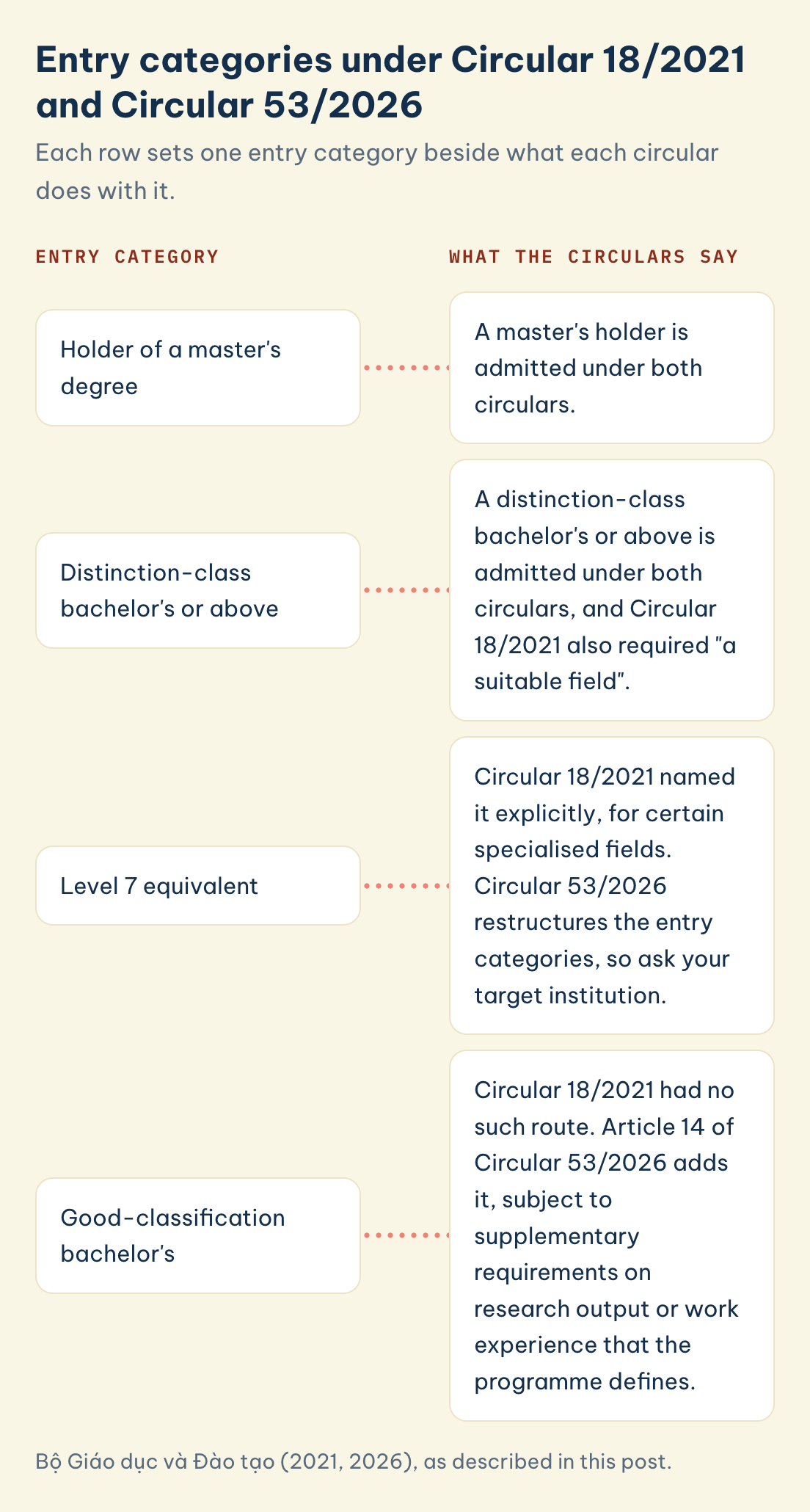
Circular 18/2021/TT-BGDĐT admitted applicants who had a master's, or a distinction-class bachelor's in a suitable field, or a qualification equivalent to level 7 of the Vietnamese Qualifications Framework in certain specialised fields (Bộ Giáo dục và Đào tạo, 2021). It also required prior research experience, evidenced through a research-oriented master's thesis, a published article or conference paper, or at least 24 months, that is 2 years, working as a lecturer or researcher at a training institution or a science and technology organisation (Bộ Giáo dục và Đào tạo, 2021).
Circular 53/2026/TT-BGDĐT restates the entry categories more simply and, in Article 14, adds the good-classification path with supplementary requirements on research output or work experience (Bộ Giáo dục và Đào tạo, 2026). Article 14 then hands the specifics to the institution: foundational knowledge, any supplementary coursework, research capability, language ability, work experience and research direction are all defined by the programme rather than nationally.
Note what survived the rewrite. The old rule asked for prior research evidence alongside the degree. The new rule keeps asking for it, and now uses it as the thing that opens the door for applicants whose classification falls short.
◆ Part 2 / 6 · Why the degree was a proxy
Why the degree was a proxy in the first place
Direct answer: A master's bundles coursework, supervision and a thesis into one line, which makes it a convenient signal of research capability. Evidence from 985 doctoral graduates suggests it is a weak signal: only research experience tied to the dissertation topic predicted a successful defence (Zhuchkova & Bekova, 2023).
Admissions panels cannot observe whether you can complete a doctorate. They observe signals, and a master's degree is a convenient one because it bundles coursework, supervision and a thesis into a single line on a transcript. The question worth asking is how well that signal actually predicts what it is used to predict.
Zhuchkova and Bekova (2023) put it to the test on 985 graduates of Russian doctoral programmes. Among the components of pre-doctorate experience they measured, only research experience related to the dissertation topic was significantly associated with successfully defending the dissertation, raising the probability by 27 per cent per standardised unit. Previous academic achievements, research experience unrelated to the dissertation, and teaching experience did not contribute significantly.
The second finding in Zhuchkova and Bekova (2023) is the one to sit with. That effect disappeared once Zhuchkova and Bekova (2023) controlled for the support students received from supervisors and departments, which suggests the support may be doing much of the work the prior experience appeared to be doing. The same models found non-academic motives cut the chance of defending by 39 per cent, and employment outside the university cut it by 51 per cent. Read together, the two results point away from credentials and towards a pairing: work already anchored in your topic, and a department willing to invest in you.
◆ Part 3 / 6 · What admissions actually
What admissions actually asks for
Direct answer: Degrees dominate but rarely stand alone. Across 13,562 doctoral advertisements posted on Euraxess between 2016 and 2019, the category covering degrees and achievements appeared in 81 per cent, while research experience was required in 45 per cent (Mantai & Marrone, 2022).
If a master's were indispensable, advertisements would say so. Mantai and Marrone (2022) analysed 13,562 doctoral advertisements posted on Euraxess between 2016 and 2019. They report that "the Degree and Achievements category was present in 81% of ads" (Mantai & Marrone, 2022, p. 2279), and that research experience is required in 45 per cent of the sample. Degrees dominate, but they do not stand alone, and nearly half the sample asks for evidence of research on top of whatever the applicant's degree says.
Vietnam is not Europe, and the Euraxess advertisements in that 2016 to 2019 sample describe funded positions rather than open applications. What transfers is the shape of the requirement rather than the numbers: a degree line and a research line, assessed separately (Mantai & Marrone, 2022).
◆ Part 4 / 6 · Whether the pathway itself
Whether the pathway itself changes the outcome
Direct answer: The comparative evidence does not show the master's route producing better doctoral outcomes. Nelson et al. (2026), studying Canadian doctoral pathways, describe entry directly from a bachelor's as the two-degree pathway and entry via a master's as the three-degree pathway, and argue that wider adoption of the two-degree model could improve the efficiency of doctoral training.
The Canadian study draws on the 2018 National Graduate Survey, where the three-degree route dominates outside science and engineering, and Vietnamese admissions work differently in almost every operational respect (Nelson et al., 2026). The transferable point is narrower and still useful: the two-degree pathway is a normal design in mature systems rather than a concession, and it is defended on efficiency grounds rather than tolerated as an exception.
A master's degree is not worthless on this evidence. A master's is one way of acquiring research capability, and research capability is what gets assessed.
◆ Part 5 / 6 · What to do if you are
What to do if you are on the third route
Direct answer: Start with the programme's own admission document, because Article 14 gives it the defining role over research capability, language, coursework and work experience. Then build evidence in your intended area rather than evidence in general, which is what the Russian data points to.
Read your target programme's own admission document before anything else, because Article 14 gives it the defining role. The national circular tells you which categories exist; the programme tells you what counts as sufficient research output, how much work experience substitutes for what, and which foundational subjects you may be asked to take.
Then look at what you can evidence. A conference paper in your intended area is worth more to this application than a stronger transcript in an unrelated one, which is the practical reading of the 27 per cent effect in Zhuchkova and Bekova (2023). If you have neither, the honest sequence is to build one before applying rather than to apply and hope the file reads as complete.
One timing point sits underneath all of this. Article 17 of Circular 53/2026/TT-BGDĐT requires your supervisor to propose your thesis topic for the rector's approval within 18 months of the admission decision, so a candidate who arrives without a settled research direction spends the opening stretch of the programme catching up on work that the master's route usually front-loads.
◆ Part 6 / 6 · Where MAAS fits
Where MAAS fits
The gap that blocks third-route applicants is usually research output rather than grades. Research output has a production time measured in months, set by journal review rather than by your own calendar, so it is the item to start earliest and the one least able to be rushed later.
If the gap in your file is research output, that is a publication problem before it is an admissions problem, and it is what MAAS Publishing Advisory works on: matching a study to a journal that fits it, restructuring the manuscript, and preparing reviewer responses, with you as sole author and sole submitter. For the application itself, including the research direction and the proposal you will be asked for, the phased coaching sits under academic mentoring. MAAS commits to process quality and cannot commit to an admission outcome, which belongs to the admissions council. The wider sequence is set out in our PhD application guide.
Frequently asked questions
Does a good-classification bachelor's degree admit me automatically?
No. Article 14 makes it conditional on supplementary requirements regarding research output or work experience, and the programme defines those. Ask the graduate office what specifically satisfies them.
Is the level 7 equivalence route still available?
Circular 18/2021 named it explicitly. Circular 53/2026 restructures the entry categories and refers instead to bachelor's programmes including specialised intensive programmes, so ask your target institution how it treats your specific qualification.
Which regulation applies to my intake?
Intakes announced from 1 January 2027 fall under Circular 53/2026. Candidates admitted earlier and enrolled before that date may continue under Circular 18/2021 under the transitional provisions in Article 34.
Do I need a publication before I apply?
Not necessarily at application. A publication is required later, before your thesis can be assessed, and programmes differ on whether research output is needed at entry for the third route.
Will I take extra coursework?
Possibly. Article 14 lets the institution set foundational knowledge requirements and supplementary modules, and applicants entering without a master's are the most likely to be given them.
References
Mantai, L., & Marrone, M. (2022). Identifying skills, qualifications, and attributes expected to do a PhD. Studies in Higher Education, 47(11), 2273-2286. https://research-management.mq.edu.au/ws/portalfiles/portal/213376328/196116930.pdf
Nelson, J., Walters, D., Jones, A., & Jacobs, S. (2026). PhD pathways in Canada: Sociodemographic and disciplinary influences that impact pathway, duration, and outcomes. International Journal of Higher Education, 15(1). https://www.sciedupress.com/journal/index.php/ijhe/article/download/29184/17533
Zhuchkova, S., & Bekova, S. (2023). Building a strong foundation: How pre-doctorate experience shapes doctoral student outcomes. PLOS ONE, 18(9), Article e0291448. https://doi.org/10.1371/journal.pone.0291448
Bộ Giáo dục và Đào tạo. (2021). Thông tư số 18/2021/TT-BGDĐT ban hành Quy chế tuyển sinh và đào tạo trình độ tiến sĩ. Công báo Chính phủ. https://congbao.chinhphu.vn/van-ban/thong-tu-so-18-2021-tt-bgddt-33987.htm
Bộ Giáo dục và Đào tạo. (2026). Thông tư số 53/2026/TT-BGDĐT ban hành Quy chế tuyển sinh và đào tạo sau đại học (Công báo số 447). Công báo Chính phủ. https://congbao.chinhphu.vn/van-ban/thong-tu-so-53-2026-tt-bgddt-470098/67203.htm
A free 20-minute consultation is a conversation about your situation and the programmes you are considering.
Book a free consultation ▸