
◆ Admissions
What is a Master of Public Administration (MPA) in the UK?
A Master of Public Administration, usually shortened to MPA, is a postgraduate degree for people who want to work on how governments and public services are run. In the UK the title covers programmes that look quite different from one another: a one-year taught course with a dissertation, a two-year degree built around a client project, or a version designed for public officials sponsored by their employer. This guide compares what five UK universities publish about length, entry requirements and fees, so you can read any MPA page with the right questions in mind.
◆ Question 1 / 7 · What an MPA is
What kind of degree is an MPA?
Direct answer: An MPA is a professional master's degree. QAA (2020) names it in its list of UK master's titles, and it fits the description of QAA's professional category, which covers courses meant to qualify people for a field of work or to develop people already working in a particular profession or employment setting.
The Quality Assurance Agency for Higher Education (QAA) sorts UK master's degrees into three broad forms: research, specialised or advanced study, and professional or practice. Its list of degree titles includes "Master of Public Administration (MPA)" (QAA, 2020, p. 13). The professional category is described this way: "Professional or practice master's degrees usually aim to enable graduates to qualify for entry into a profession, subject to any further conditions required by the PSRB; or to provide development opportunities related to particular professions or employment settings." (QAA, 2020, p. 6).
That description explains why MPA pages talk so much about careers and experience. QAA (2020) notes that courses in this category often attract entrants with an honours degree "or experience that may or may not be directly relevant to the particular profession" (p. 6), and that learning tends to be structured, sometimes with fieldwork, placements or a project done through independent study. Read an MPA page as a description of a professional training route first, and of an academic subject second.
◆ Question 2 / 7 · Length and structure
How long is an MPA in the UK, and how is it structured?
Direct answer: Most UK MPAs on the pages read for this guide run for one year full time, with part-time versions over two years. The LSE programme is the exception at 21 months, full time only, with a six-month Capstone Project for an external client in the second year.
A one-year MPA beside the LSE MPA
Each row sets a typical one-year UK MPA beside the 21-month LSE programme.
One-year MPA (York, Southampton)
LSE MPA
Length: 1 year full time, often 2 years part time
Length: 21 months, full time only
Structure: taught modules plus a dissertation or a 60-credit policy report
Structure: Year 1 core skills, Year 2 six-month Capstone Project with an external client
International fee: £28,200 (York) or £30,100 (Southampton), 2027 entry
International fee: £35,900 per year for two years
Save this figure
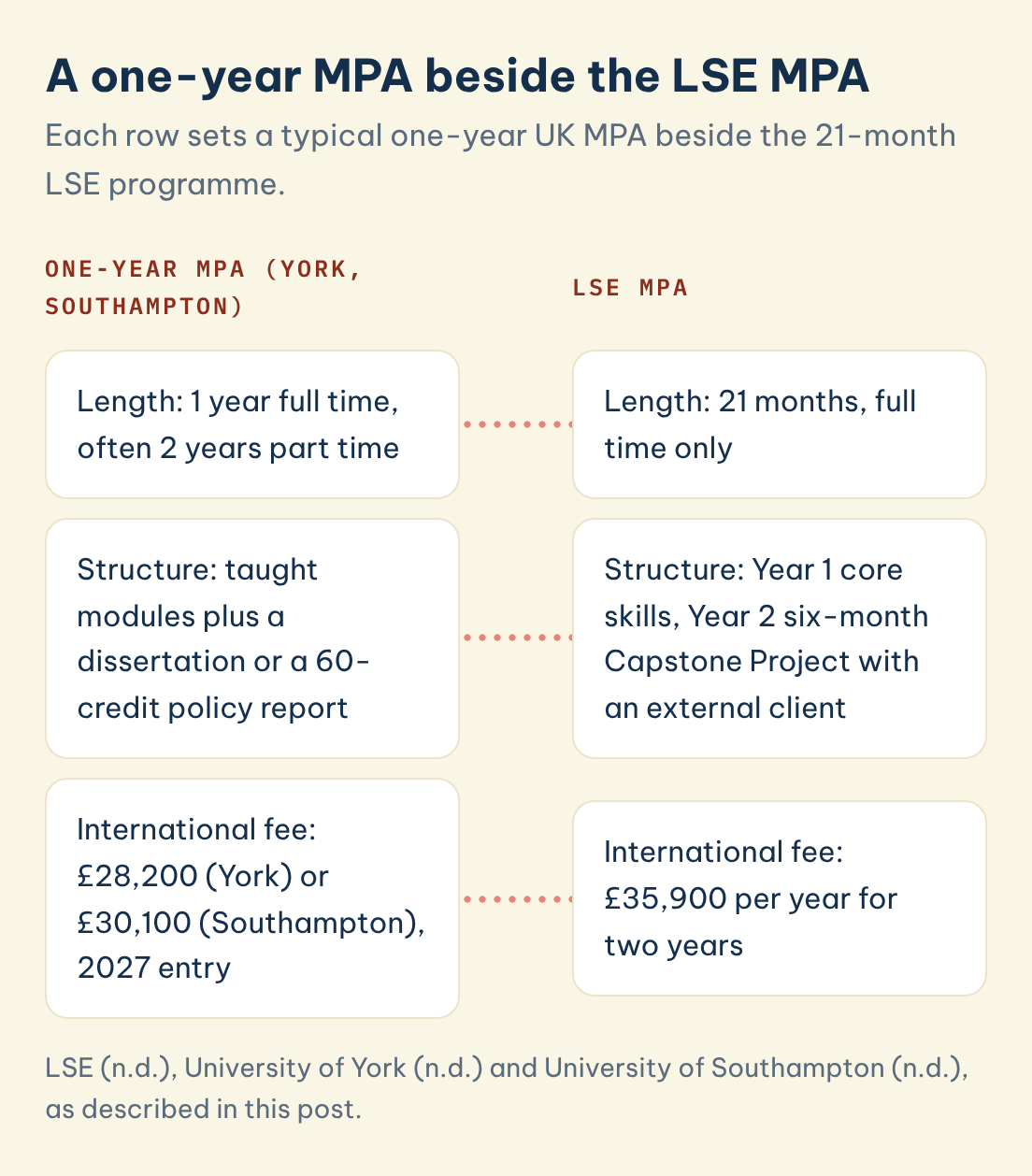
The one-year courses share a familiar shape. The University of York (n.d.) lists 180 credits made of four 20-credit core modules, two 20-credit option modules and a 60-credit independent policy report. The University of Southampton (n.d.) describes its MPA as 1 year across 2 semesters, with 6 modules and a dissertation. The University of Birmingham (n.d.) gives 12 months full time and 24 months part time, with starts in September or January.
The London School of Economics and Political Science (LSE) (n.d.) takes a different route. Its MPA lasts 21 months, full time only, with an expected intake of 70 to 90 students. The first year builds core academic skills, and the second year centres on a six-month consultancy-style Capstone Project hosted by an external client. If you are comparing a London MPA with a regional one, the difference in length is the first thing to weigh, because it changes the total cost and the time you spend out of work.
| University | Length (full time) | Structure noted on the page | Source |
|---|---|---|---|
| LSE | 21 months, full time only | Year 1 core skills, Year 2 six-month Capstone Project | LSE (n.d.) |
| Birmingham | 12 months (24 months part time, Home students only) | Starts September or January | University of Birmingham (n.d.) |
| Southampton | 1 year | 6 modules and a dissertation | University of Southampton (n.d.) |
| York | 1 year (2 years part time) | 180 credits, including a 60-credit policy report | University of York (n.d.) |
| Nottingham | Up to 12 months (up to 24 months part time) | Lectures and seminars over 10-week semesters | University of Nottingham (n.d.) |
◆ Question 3 / 7 · Entry requirements
What are the entry requirements for an MPA?
Direct answer: The usual academic bar on these pages is a 2:1 honours degree or equivalent, though York and Nottingham consider a 2:2, Nottingham when paired with a year of public or third sector work. English test minimums sit around IELTS 6.5 overall with 6.0 in each part where stated.
Entry rules vary more than the degree title suggests. LSE (n.d.) asks for a 2:1 or equivalent in any discipline, and says that there is no formal requirement for professional experience but that students "normally have one year of professional experience and many have two or more years of experience". The University of Nottingham (n.d.) accepts a 2:1 in any discipline, or a 2:2 plus one year of work in national or local government, the public sector or the third sector. The University of York (n.d.) gives a typical offer of 2:2 and says it will consider lower grades. The University of Southampton (n.d.) asks for a 2:1 with a social sciences background.
For applicants whose first language is not English, the stated test minimums on these pages are IELTS 6.5 with no less than 6.0 in each component at Nottingham, York and Southampton. Birmingham points to its general international requirements page, and LSE lists its requirement as "Higher". A Vietnamese degree is converted to a UK equivalent by each university, so check the country page of the specific university rather than assuming a GPA figure. For how master's admissions read a transcript more generally, see our guide on whether a taught master's makes you eligible for a PhD.
◆ Question 4 / 7 · Fees
How much does an MPA cost for international students?
Direct answer: On the 2027 entry pages read for this guide, one-year international fees range from £28,200 at York to £34,000 at Nottingham, while LSE charges £35,900 for each of its two years. Living costs, travel and visa costs come on top.
The table below copies the fees as each university states them. Figures are for full-time study and the year of entry each page shows. Fees change every year, so treat this as a snapshot from 22 October 2026, not a quote.
| University | International fee (full time) | Year shown | Source |
|---|---|---|---|
| LSE | £35,900 per year, two years | 2027/28 and 2028/29 | LSE (n.d.) |
| Nottingham | £34,000 | 2027 entry | University of Nottingham (n.d.) |
| Southampton | £30,100 | 2027 entry | University of Southampton (n.d.) |
| York | £28,200 | 2027 entry | University of York (n.d.) |
Birmingham's page, as read for this guide, showed only the UK and Ireland fee, £14,220 full time for the September 2027 intake, so check its fee page for the international figure before you budget. Two further cost points are easy to miss. LSE (n.d.) normally asks for a tuition fee deposit of 10 per cent of the first-year fee to secure a place, and the University of Southampton (n.d.) asks full-time international students for a £2,000 deposit. Southampton's page adds that accommodation and living costs are not included in tuition.
◆ Question 5 / 7 · Online and distance
Can you study an MPA online or by distance learning?
Direct answer: Distance and flexible formats are common for professional master's degrees in general, according to QAA (2020). Whether a particular online MPA suits you depends on the provider's own page, and on the visa position, which you should confirm with the university.
"Masters in public administration online" and "distance learning" are two of the searches Google suggests alongside the main query. QAA (2020, p. 8) notes that "Flexible and distance learning are common, in particular for professional or practice master's." Google's results for this query include online.york.ac.uk, so check each university's online pages directly.
An online degree solves a different problem from a campus degree. You keep your job and stay at home, but you do not get the time in the UK that some students want for networking or graduate work. Visa rules also differ by study mode: the University of Nottingham (n.d.) states that it does not sponsor a student visa for part-time courses. If living in the UK is part of your plan, confirm the visa position with the university before you choose a format.
◆ Question 6 / 7 · Jobs
What jobs does an MPA lead to?
Direct answer: LSE describes preparation for work in public, private and non-profit organisations, but none of the pages read publishes a job guarantee. Treat career statistics on any page as that university's own data, and ask how it was collected before relying on it.
LSE (n.d.) says its graduates are equipped to make an impact "for employers in public, private and non-profit organisations around the world". Birmingham's page carries a ranking line about being targeted by UK employers. These are statements about the university, not about the outcome for one student, and the degree title alone does not open a specific post. Civil service and international organisation roles usually run their own selection processes, separate from the degree.
A practical way to judge fit is to read the module list against the job you want. If your target role is analytical, look for quantitative methods and economics in the core. If it is management in a public body, look for options in leadership, finance or service delivery, and for a project or placement with a real organisation. The QAA (2020) description of professional master's, with structured learning and work-based elements, is a useful checklist for that comparison.
◆ Question 7 / 7 · Choosing and applying
How do you choose and apply for an MPA?
Direct answer: Start from your goal, then compare length, entry route, fee and project type across three or four programmes. Your personal statement should connect your experience to the public problem you want to work on, because several pages say they look for commitment to public service.
LSE (n.d.) says excellent candidates "will possess a strong academic record and be able to demonstrate a commitment to public service as well as a clear understanding of the MPA and how they'll benefit from the programme". That sentence is a fair summary of what most MPA statements need to show: what you have done, what problem you want to work on, and why this particular programme fits that plan. LSE (n.d.) also states an early deadline of 25 January 2027 and rolling admissions until places fill, so timing matters at selective programmes.
If you would like someone to talk through your programme shortlist and your statement with you, MAAS offers study abroad and statement of purpose consulting. An advisor discusses your goals and gives feedback on drafts you write, and the application decisions stay with you and the university. If you are already planning beyond the master's, our guide on how to use PhD personal statement examples shows how to learn from a sample without copying its story.
Frequently asked questions
Is an MPA a professional degree?
QAA (2020) lists the Master of Public Administration among UK master's titles, and the degree fits the description of its professional or practice category, which aims to prepare graduates for a profession or to develop people already working in one.
How long is an MPA in the UK?
Most programmes read for this guide run one year full time, often with a two-year part-time option. LSE's MPA is the exception at 21 months, full time only.
Do I need work experience for an MPA?
Not always. LSE (n.d.) has no formal requirement but says students normally have one year of experience, and the University of Nottingham (n.d.) accepts a 2:2 plus one year of public or third sector work.
What IELTS score do I need for an MPA?
Nottingham, York and Southampton state IELTS 6.5 with 6.0 in each component. Other universities publish their own levels, so check each page.
How much does an MPA cost for international students?
For 2027 entry, the pages read show £28,200 at York, £30,100 at Southampton and £34,000 at Nottingham for one year, and £35,900 per year for two years at LSE.
Can I get a Student visa for an online MPA?
Check with the university before you enrol. The University of Nottingham (n.d.) also states that it does not sponsor a student visa for part-time courses, so confirm with the university.
Related MAAS guides
- Is a taught master's enough to apply for a PhD? for how master's results are read later
- Should you use a PhD personal statement example? for writing a statement in your own voice
- Study abroad and SOP consulting for help with programme choice and your statement
References
London School of Economics and Political Science. (n.d.). Master of Public Administration. Retrieved October 22, 2026, from https://www.lse.ac.uk/school-of-public-policy/mpa
Quality Assurance Agency for Higher Education. (2020). Characteristics statement: Master's degree (3rd ed.). https://www.qaa.ac.uk/docs/qaa/quality-code/master's-degree-characteristics-statement.pdf
University of Birmingham. (n.d.). Masters in Public Administration MPA. Retrieved October 22, 2026, from https://www.birmingham.ac.uk/study/postgraduate/subjects/business-and-management-courses/public-administration-mpa
University of Nottingham. (n.d.). Master of Public Administration MPA. Retrieved October 22, 2026, from https://www.nottingham.ac.uk/pgstudy/course/taught/master-of-public-administration-mpa
University of Southampton. (n.d.). Public Administration (MPA). Retrieved October 22, 2026, from https://www.southampton.ac.uk/courses/public-administration-masters-mpa
University of York. (n.d.). MPA Public Administration. Retrieved October 22, 2026, from https://www.york.ac.uk/study/postgraduate-taught/courses/mpa-public-administration/
This guide is general information about UK MPA programmes. Fees and entry rules change each year, so always check the university's own page before you apply.
Not sure how this guide applies to your own case? Talk it through with MAAS in a free 20-minute consultation.
Book a free consultation ▸