
◆ PhD Admissions
Can you get a doctorate in clinical psychology in the UK or Australia?
Category: admissions
Last updated: 2026-10-20

Search for a doctorate in clinical psychology and the results mix two different things. In the UK it is a funded professional training that you apply for through a central clearing house, while in Australia the doctorate is one of several approved qualifications followed by a period of supervised practice. International students often compare them as if both were a research PhD, and that comparison hides the questions that decide the outcome: whether you have the right to work, which undergraduate degree you hold, and which English score the regulator accepts.
Direct answer: In the UK you need a psychology qualification that confers Graduate Basis for Chartered membership (GBC), then a place on a doctoral programme lasting at least 3 years, usually NHS-funded and open only to people with the right to work. In Australia you complete an approved qualification and then a supervised registrar program of 44 to 88 weeks.
◆ Question 1 / 9 · What UK training involves
What does a UK doctorate in clinical psychology involve?
Direct answer: The UK doctorate is a professional training programme, not a research degree. The British Psychological Society (BPS) requires at least 3 years of full-time study, 540 credits and a level 8 award, and graduates of accredited programmes can apply for registration with the Health and Care Professions Council (HCPC).
The BPS standards describe doctoral training in clinical psychology as "a postgraduate professional training programme, where the total period of study must be no less than three years full-time (or the equivalent part-time)" (British Psychological Society, 2025, p. 9). Programme standard 1.1 adds that programmes seeking accreditation must comprise 540 credits and result in a level 8 qualification, which is level 12 in Scotland (British Psychological Society, 2025, p. 16). Graduates of accredited programmes meet the requirements for Chartered membership of the Society and for full membership of the Division of Clinical Psychology, and they become eligible to apply for HCPC registration (British Psychological Society, 2025).
The accreditation structure changes how you should compare it with other doctorates. The length is set by an accreditation standard rather than by a thesis, so the 3-year minimum is a floor for the whole course, and how long academic doctorates usually run is covered separately in how long a PhD programme takes.
◆ Question 2 / 9 · UK entry requirements
What are the requirements to get a Doctorate in Clinical Psychology in the UK?
Direct answer: You must already hold a qualification that confers GBC, because the BPS makes this a condition of entry. Individual courses then add their own screening, such as a minimum average mark, relevant work experience, an English test score and the right to work in the UK.
The BPS standard is explicit that "This necessitates all candidates having acquired a qualification that confers GBC prior to entry to a doctorate programme." (British Psychological Society, 2025, p. 52). If your degree is not from a UK or Irish university, the Clearing House says you must have it assessed by the BPS, that GBC applications "can take 8 weeks or more to process", and that an applicant without enough psychology needs a conversion course (Clearing House for Postgraduate Courses in Clinical Psychology, 2026d).
Entry criteria beyond GBC vary by course. One example is the University of Essex, whose criteria published at the time of the 2022 study were a BPS-accredited psychology degree with a minimum average of 65% across third-year marks, at least 1 year of experience in a work setting relevant to clinical psychology, an average of 7 on IELTS or equivalent, and the right to work in the UK (McCormack et al., 2022). Treat those as one course's screening rules rather than national rules, and read the criteria of every course before you rank them. Applications for 2027 entry close at 1:00pm UK time on 18 November 2026 (Clearing House for Postgraduate Courses in Clinical Psychology, 2026d).
◆ Question 3 / 9 · NHS funding and visas
Is the UK doctorate NHS funded, and can international students apply?
Direct answer: NHS-funded places are the main route, but they require the right to work without restriction, so a student visa is not enough. International students without that right can look at the few courses offering self-funded places, which usually require overseas fee status and cost the full 3 years.
People accepted on NHS-funded places are employed by the NHS as Trainee Clinical Psychologists, start at the bottom of Band 6 on the Agenda for Change scale, which is £39,959 a year in England at the 2026 rate, and the NHS usually pays the course fees (Clearing House for Postgraduate Courses in Clinical Psychology, 2026b). For NHS places, the Clearing House states that "A student visa is not enough for an NHS-funded place." (Clearing House for Postgraduate Courses in Clinical Psychology, 2026c)
Some courses also have self-funded places, and these usually require overseas fee status. As of 7 September 2026 the Clearing House listed the universities of Bath, East Anglia, East London, Exeter, Hertfordshire, Manchester and University College London, with King's College London taking applications directly, and said you "need to fund all of your costs for the 3 years of training" (Clearing House for Postgraduate Courses in Clinical Psychology, 2026c). That list changes yearly, so check the Clearing House before you plan. What a doctorate costs and who sets each price is explained in the three price setters of a PhD.
◆ Question 4 / 9 · How competitive a place is
How competitive is a place on the UK course?
Direct answer: Increasingly competitive, because each year fewer applicants succeed. The Clearing House reports an 18% success rate for 2026 entry, down from 25% in 2022, with 1,133 NHS places for 6,236 applicants in 2026, and the number of places may change for 2027.
UK NHS-funded clinical psychology places, 2022 to 2026
Each row gives one entry year with the number of NHS places, the number of applicants and the success rate reported by the Clearing House.
Entry year
Places, applicants and success rate
2022
1,155 places, 4,655 applicants, 25%
2023
1,166 places, 4,990 applicants, 23%
2024
1,164 places, 5,603 applicants, 21%
2025
1,179 places, 5,910 applicants, 20%
2026
1,133 places, 6,236 applicants, 18%
Save this figure
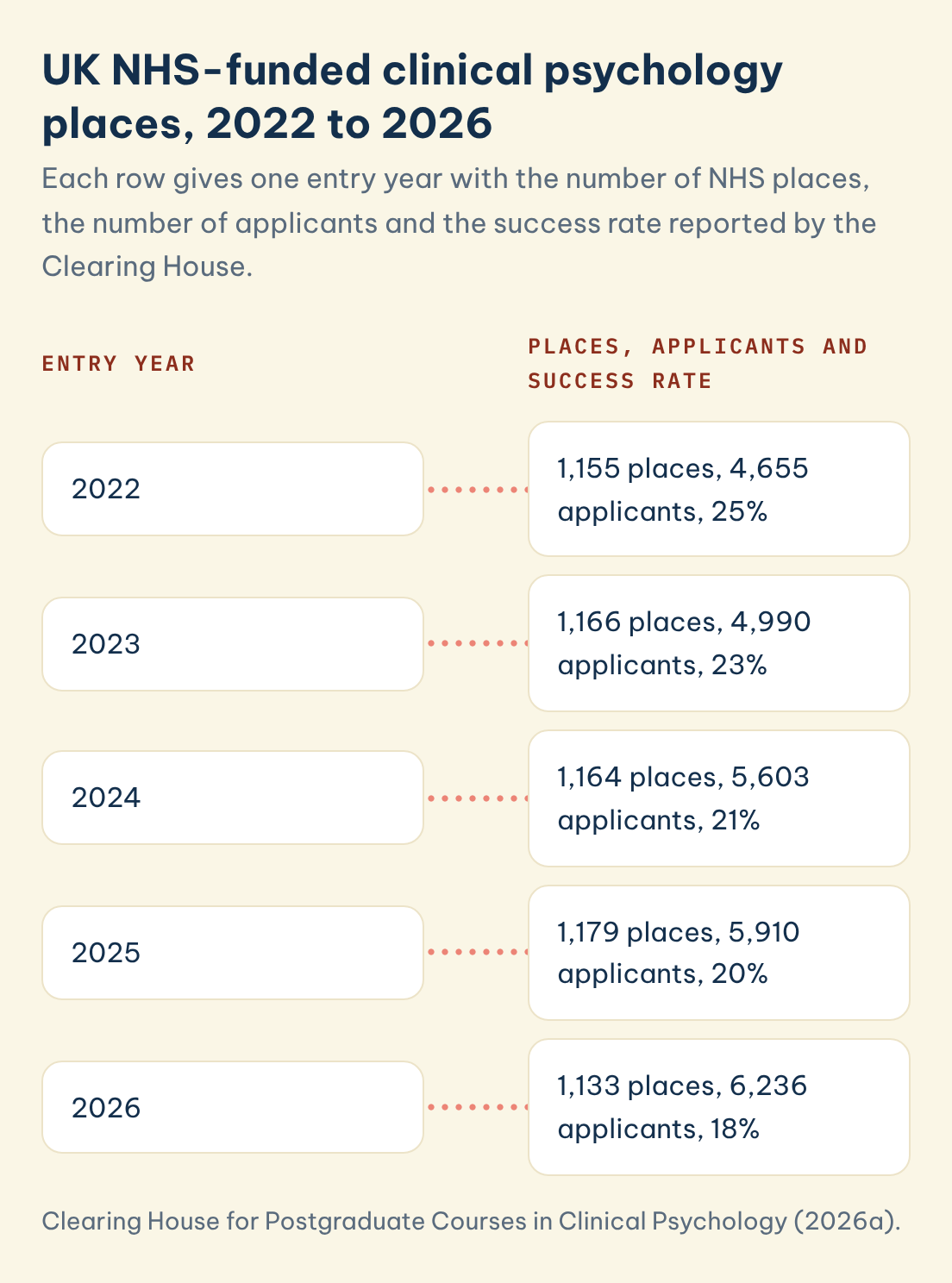
The Clearing House series for NHS places shows the trend clearly. In 2022 there were 1,155 places and 4,655 applicants, a 25% success rate. In 2023 there were 1,166 places for 4,990 applicants (23%), in 2024 1,164 places for 5,603 applicants (21%), in 2025 1,179 places for 5,910 applicants (20%), and in 2026 1,133 places for 6,236 applicants (18%) (Clearing House for Postgraduate Courses in Clinical Psychology, 2026a). The page adds that the number of places may change for the 2027 intake.
The totals above cover NHS-funded places only. The source does not state whether self-funded overseas places are counted, so nobody should read 18% as the odds for an international applicant on a self-funded course. What the series does show is that applications rose by roughly a third over five years while places stayed close to 1,150, which is why a competitive applicant treats the clearing-house form as a full project rather than a formality.
◆ Question 5 / 9 · The Australian route
Is there a doctorate in clinical psychology in Australia?
Direct answer: Yes, as one of several routes. The Psychology Board of Australia approves master's, combined master's and PhD, and doctoral qualifications in clinical psychology, and each is followed by a supervised registrar program whose length of 44, 66 or 88 weeks depends on the qualification.
The Board describes the registrar program as "a period of supervised practice in one of the nine approved areas of practice which follows the completion of an approved postgraduate qualification in the same area of practice" (Psychology Board of Australia, n.d.). Its table sets the requirement by qualification type, as shown below.
| Qualification | Minimum practice | Registrar program hours | Supervision hours | CPD hours |
|---|---|---|---|---|
| Master's degree, approved to sixth year | 88 weeks | 3,000 | 80 | 80 |
| Combined master's and PhD, with a doctoral thesis | 66 weeks | 2,250 | 60 | 60 |
| Doctoral degree, approved to seventh year or above | 44 weeks | 1,500 | 40 | 40 |
Doctoral candidates can apply for early general registration and start the registrar program once they have completed all coursework and placements and have made progress with the thesis (Psychology Board of Australia, n.d.). Use the weeks and hours in the table as published rather than converting them to years, because the Board sets both a duration and an hours total.
◆ Question 6 / 9 · English score for Australia
What English score does Australian registration require?
Direct answer: Ahpra's table for IELTS Academic sittings from 23 April 2026 asks for 7 overall and 7 in listening, reading and speaking, with 6.5 for writing. The IELTS minimums are the same as in the table for earlier sittings, but other accepted tests changed, so check the table for your test and date.
Ahpra states that "Changes to the minimum scores required are in effect from 23 April 2026", and its table for tests taken on or after that date sets 7 as the overall minimum for IELTS Academic, with 6.5 for the writing component and 7 for each of the other three (Australian Health Practitioner Regulation Agency, 2026). Tests taken on or before 22 April 2026 fall under an earlier table, so check which one applies to your result. The same page lists five accepted tests: Cambridge, IELTS Academic, OET, PTE Academic and TOEFL iBT.
Results come from one sitting, or from a maximum of two sittings in a 12-month period only when conditions are met, one of which is that no IELTS component falls below 6.5. Set this beside the average of 7 on IELTS that one UK course published (McCormack et al., 2022). The Australian figure is a regulator's registration minimum, while the Essex figure is one course's screening criterion, so meeting one does not settle the other.
◆ Question 7 / 9 · Which country is best
Which country is best for a doctorate in clinical psychology?
Direct answer: The sources do not rank countries, and "best" depends on your right to work, funding and timeline. The UK offers a funded 3-year training with a competitive entry, while Australia offers several qualification routes followed by a 44 to 88 week registrar program.
| Question | UK | Australia |
|---|---|---|
| Typical route | Accredited doctorate of at least 3 years (BPS) | Approved master's, combined or doctoral qualification, then registrar program (Psychology Board of Australia) |
| Entry check | GBC before entry | Accredited master's, combined master's and PhD, or doctorate, then the registrar program |
| Funding | NHS-funded places need the right to work; self-funded places for overseas fee status | Not covered here; check the Board and each university |
| After qualifying | HCPC registration eligibility | 44, 66 or 88 weeks of supervised practice |
| English score | Course-set, for example IELTS 7 average at Essex | IELTS 7 overall, 6.5 writing from 23 April 2026 |
If you do not have the right to work in the UK, the NHS route is closed to you and the choice becomes self-funded UK places or the Australian pathway. If you are weighing a research doctorate instead, the comparison in which degree to study for a PhD explains how admissions committees read your earlier degrees.
◆ Question 8 / 9 · Is a PsyD harder than a PhD
Is a PsyD harder than a PhD?
Direct answer: The sources used here do not measure difficulty, so no honest comparison exists. They show only that the two differ in structure: the Psychology Board of Australia lists doctoral degrees separately from combined master's and PhD programmes, with different registrar hours.
In the Board's classification, a doctoral degree is approved to seventh year or above and is followed by 44 weeks and 1,500 hours of registrar practice, while a combined master's and PhD with a doctoral thesis is approved to sixth year and is followed by 66 weeks and 2,250 hours (Psychology Board of Australia, n.d.). The figures above describe how much supervised practice remains after the degree, not how demanding the degree itself was.
Whether a degree is harder to complete depends on the course, the supervisor and the candidate, and none of the regulatory sources here measures it. A better question for an applicant is which structure matches the career you want, because the registrar hours, the funding and the entry checks differ. If you are weighing a research doctorate instead, PhD application: the full pathway shows how the stages fit together, and you should not assume that either label will be easier to finish.
◆ Question 9 / 9 · Planning the application
How should an international applicant plan the application?
Direct answer: Start with the entry condition that takes longest. For the UK that is the GBC assessment, which can take 8 weeks or more, and for Australia it is the English test and the approved qualification, so build the timeline backwards from the deadline.
A workable order has four steps. First, confirm whether your degree gives GBC or whether you need a BPS assessment or a conversion course. Second, check your right to work and decide whether NHS-funded or self-funded places apply to you. Third, list the courses whose criteria you meet, using the Clearing House pages, and note each deadline, since applications for 2027 entry close on 18 November 2026. Fourth, if Australia is on the list, schedule an IELTS Academic sitting that meets the April 2026 minimums.
MAAS advisors can help you organise this sequence, review your academic CV and personal statement, and challenge your course choices, while you review and approve every document and submit it yourself. MAAS does not provide clinical training, and no one can promise a place, since selection belongs to the courses. The advisory scope is described in PhD supervisor search and application strategy, and the general pathway is in the PhD application guide.
Frequently asked questions
What are the entry requirements for a clinical psychology doctorate in the UK?
You need a qualification that confers GBC before entry, as the BPS standard requires, and each course adds its own criteria. Essex, for example, published at the time of the 2022 study a 65% average, 1 year of relevant work experience, IELTS 7 on average and the right to work.
Is the UK doctorate in clinical psychology NHS funded?
NHS-funded places are the main route. Trainees are employed by the NHS from the bottom of Band 6, which is £39,959 a year in England at the 2026 rate, and the NHS usually pays the fees.
Can international students apply to the UK course?
Not for NHS-funded places, which need the right to work without restriction. A few courses offer self-funded places that usually require overseas fee status and the student pays all costs for 3 years.
Is there a doctorate in clinical psychology in Australia?
Yes, as one of several approved routes. A doctoral degree is followed by 44 weeks and 1,500 hours of registrar program practice, compared with 88 weeks and 3,000 hours after a master's degree.
What IELTS score does Australian registration need?
For tests taken on or after 23 April 2026, 7 overall, 7 in listening, reading and speaking, and 6.5 in writing (Australian Health Practitioner Regulation Agency, 2026).
How long does the UK course take?
At least 3 years full-time under the BPS standard, with 540 credits at level 8 (British Psychological Society, 2025).
Related MAAS guides
References
Australian Health Practitioner Regulation Agency. (2026). Accepted English language tests. https://www.ahpra.gov.au/Registration/Registration-Standards/English-language-skills/Accepted-English-language-tests
British Psychological Society. (2025). Standards for the accreditation of doctoral programmes in clinical psychology (September 2025 ed.). https://cms.bps.org.uk/sites/default/files/2022-07/Clinical%20Psychology%20-%20Standards%20for%20Accreditation.pdf
Clearing House for Postgraduate Courses in Clinical Psychology. (2026a). Number of places: Overview. https://www.clearing-house.org.uk/about-us/number-places
Clearing House for Postgraduate Courses in Clinical Psychology. (2026b). Funding. https://www.clearing-house.org.uk/welcome-clearing-house-postgraduate-courses-clinical-psychology/applications/funding
Clearing House for Postgraduate Courses in Clinical Psychology. (2026c). International applicants: Funding. https://www.clearing-house.org.uk/welcome-clearing-house-postgraduate-courses-clinical-psychology/applications/international-0
Clearing House for Postgraduate Courses in Clinical Psychology. (2026d). International applicants: Qualifications. https://www.clearing-house.org.uk/applications/international-applicants
McCormack, C., McPherson, S., & Blumenfeld, F. (2022). Diversity in clinical psychology training at the University of Essex. Clinical Psychology Forum, 1(352), 35-44. https://doi.org/10.53841/bpscpf.2022.1.352.35
Psychology Board of Australia. (n.d.). Registrar program. https://www.psychologyboard.gov.au/Endorsement/Registrar-program
Not sure how this guide applies to your own case? Talk it through with MAAS in a free 20-minute consultation.
Book a free consultation ▸