
◆ Admissions
Which UK universities are best for psychology, and how to choose?
Category: admissions
Last updated: 2026-10-23

Type "top universities for psychology UK" into a search engine and the first results are league tables, each with a confident number one. The trouble starts when you open two of them side by side, because they do not agree. A department that sits near the top of one table can fall out of the other entirely, and a student who trusts a single table can end up applying to the wrong shortlist. This guide does not offer a ranking of its own. It shows where the official tables disagree, explains why, and then gives you the one filter that matters more than any position.
Direct answer: No single list names the best UK psychology university, because the main tables measure different things for different readers. Use them as inputs, then filter for British Psychological Society accreditation, which makes you eligible for the Graduate Basis for Chartered membership (GBC), and build a shortlist around your own goals.
◆ Question 1 / 10 · What are the top 20
What are the top 20 universities for psychology in the UK?
Direct answer: The Complete University Guide's 2027 psychology table, updated on 2 June 2026, ranks 118 universities. Its top 20 runs Oxford, Cambridge, St Andrews, LSE, UCL, Bath, Exeter, Warwick, Loughborough, Durham, York, King's College London, Bristol, Cardiff, Birmingham, Sheffield, Glasgow, Leeds, Edinburgh and Liverpool.
The Complete University Guide (2026) table covers 118 universities in all and gives overall scores for the first five places: Oxford 100, Cambridge 98, St Andrews 96, LSE 95 and UCL 93. Its quick view shows five measures, which are overall score, entry standards, student satisfaction, research quality and graduate prospects, and the full table adds continuation, completion, student-staff ratio and spending on academic and student services. Everything in that list is a statement about one table in one year, and the same universities can sit in a different order in another publication. Treat the order as a conversation starter rather than a verdict. A department in 15th place and one in 5th place may differ by a margin that matters less to your degree than the modules, placement options and staff research that you will actually meet.
◆ Question 2 / 10 · Which universities are top
Which universities are top for psychology in 2026?
Direct answer: It depends on which table you open. The Times Higher Education (THE) World University Rankings 2026 by subject puts Cambridge first worldwide for psychology with a score of 93.9, and lists 92 UK institutions among the 694 universities from 64 countries and territories that it evaluated.
THE (2026) uses the same 18 performance indicators as its main world ranking, recalibrated for each subject, grouped under five pillars: teaching, research environment, research quality, international outlook and industry. Cambridge scores 93.9 overall, and THE says it leads the psychology ranking thanks to its exceptional performance in international outlook. The UK positions it lists are Cambridge 1, UCL 6, King's College London 9, Edinburgh 23, Glasgow 41, Bristol 49, LSE =50, Sussex 61, Birmingham 68, York =77, and Cardiff and Bath both =80. St Andrews appears only in the 101-125 band, and Oxford does not appear in the list at all. That last fact is the clearest warning against reading any one table as the final word on quality.
◆ Question 3 / 10 · Why do the two main tables
Why do the two main tables disagree?
Direct answer: The two tables answer different questions for different audiences, so they rarely agree. The Complete University Guide is a UK table built around entry standards, student satisfaction and graduate prospects. THE is a global table that weights research and adds international outlook and industry pillars, so departments rise and fall accordingly.
Compare the same universities in both tables and the gap becomes concrete.
| University | Complete University Guide 2027 position | THE 2026 world position |
|---|---|---|
| Oxford | 1st | Not in the list |
| St Andrews | 3rd | 101-125 band |
| Bath | 6th | =80 |
| King's College London | 12th | 9th (3rd UK) |
| Edinburgh | 19th | 23rd |
| Sussex | 36th | 61st |
Same university, two psychology tables
Position in the Complete University Guide 2027 table beside the THE 2026 world subject ranking.
Complete University Guide 2027 (UK)
THE 2026 by subject (world)
University of Oxford: 1st
Not in the list
University of St Andrews: 3rd
101-125 band
University of Bath: 6th
=80th
King's College London: 12th
9th
University of Edinburgh: 19th
23rd
University of Sussex: 36th
61st
Save this figure
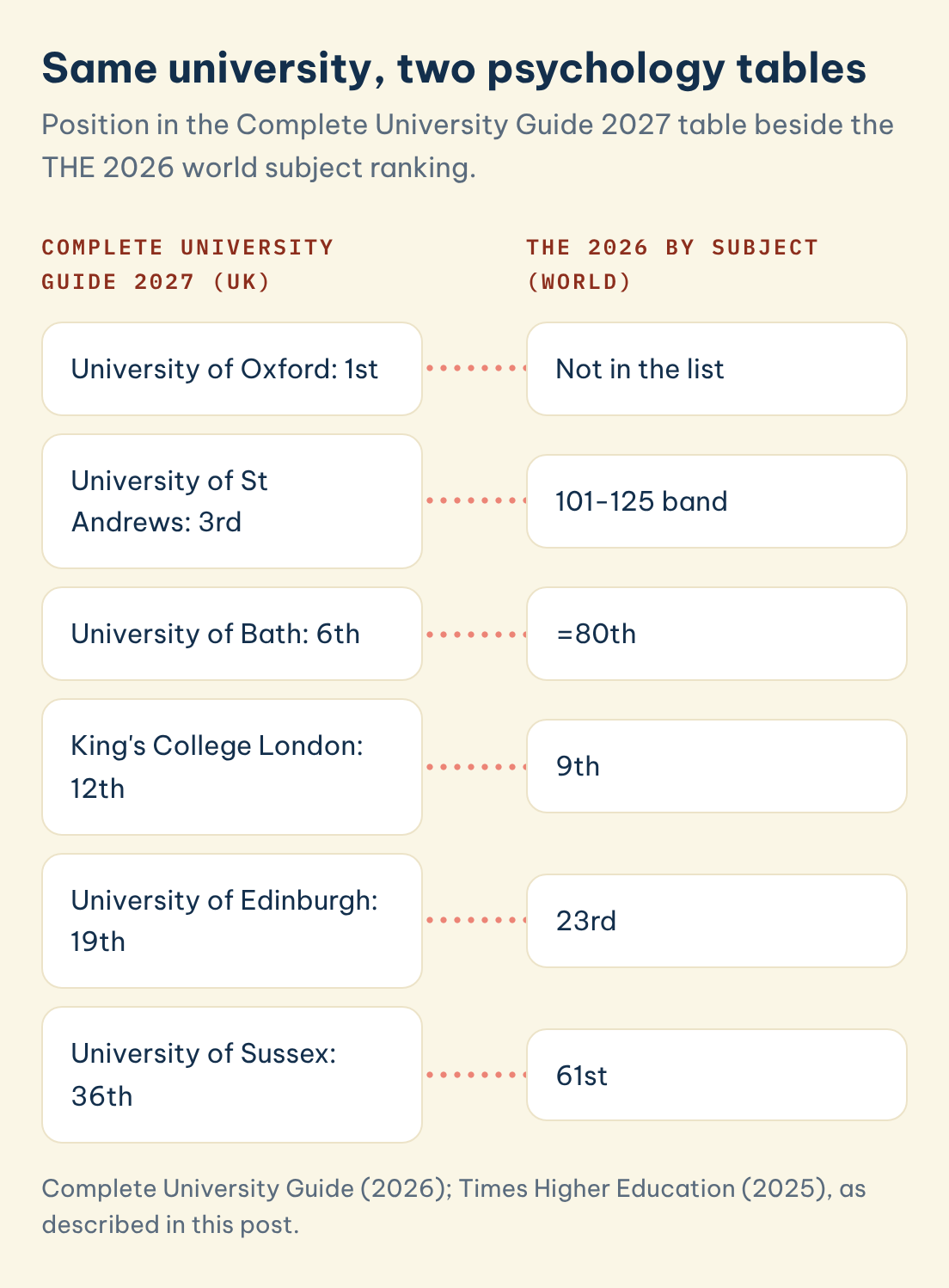
Oxford is first in one table and absent from the other. St Andrews is third in the UK table yet only in the 101-125 band in the world table, while King's moves the opposite way, from 12th to 9th in the world and third among UK institutions in THE. None of these gaps means that either publisher made an error. They reflect what each table counts, and the THE subject page does not show the weights in a form that would let a reader reconstruct the exact reason for each move. The practical lesson is that a position is a summary of someone else's priorities, and you need to know whether those priorities are yours.
◆ Question 4 / 10 · Do rankings really influence
Do rankings really influence which course you pick?
Direct answer: Research on British applicants suggests that they do, with a larger effect for more able students. Gibbons, Neumayer and Perkins (2015) found that student satisfaction scores have a small statistically significant effect on applications at university-subject level, and that the effect operates through subject league table position.
The authors write that this effect works through the subject-specific league table position, "suggesting that information contained in the league table rankings is more salient" (Gibbons et al., 2015). They also report that the impact is greater for more able students, for universities with entry standards in the upper-middle tier, and for subject departments facing more competition. The study is more than ten years old and covers Britain rather than psychology alone, so treat it as a classic account of how applicants behave rather than a current measurement. Its value here is the warning it implies: if tables shape where many applicants apply, then your own comparison work, such as checking two or three tables and reading course pages, gives you information that a lot of other applicants never collect.
◆ Question 5 / 10 · Which London universities
Which London universities rank highly for psychology?
Direct answer: Three London institutions appear near the top of both tables, but they sit in a different order in each one. UCL is 5th in the Complete University Guide and 6th in THE, LSE is 4th and =50, and King's College London is 12th and 9th.
London looks tidy in the national league table only until you set it beside the world table. LSE is fourth in the UK table and =50 in the world table, which is a long way apart, while King's is twelfth in one and ninth in the other, so King's actually does better in the global research-weighted view. UCL is stable across both (Complete University Guide, 2026; Times Higher Education, 2026). If you want to study in London, the table position cannot settle which of the three suits you, because it says nothing about modules, fees, accommodation or commuting. Use the position to confirm that a department is respected, then compare the course page, the final-year project options and the accreditation status described below.
◆ Question 6 / 10 · What matters most
What matters most for undergraduate psychology: accreditation?
Direct answer: For an undergraduate psychology degree, check British Psychological Society (BPS) accreditation before you look at any league table position. An accredited course makes you eligible for GBC once you gain a 2:2 and pass the project, and later postgraduate training in psychology expects GBC, so a high table place without it is a poor trade.
The wording in the standards is precise: "Accredited undergraduate, conversion and integrated Master's programmes meet the requirements for the Graduate Basis for Chartered membership (GBC)" (British Psychological Society, 2024, p. 6). Undergraduate programmes seeking accreditation must comprise at least 360 credits, and at least 50% of those must be psychology content and skills (British Psychological Society, 2024, p. 8). To be eligible for GBC, students "must pass the empirical psychology project, and gain at least a Lower Second Class Honours degree, or its equivalent" (British Psychological Society, 2024, p. 9). In plain terms, a 2:2 and a pass in the empirical project are the floor. The Quality Assurance Agency for Higher Education (QAA) benchmark for psychology makes the same split from the other side: it "sets out academic standards for all bachelor's degrees with honours, whether these are BPS accredited or not" (Quality Assurance Agency for Higher Education, 2023, p. 3), so an unaccredited degree can be academically sound and still lack GBC. A university that ranks well on a table but does not hold accreditation could leave you without the credential that later training requires.
◆ Question 7 / 10 · Which universities are good
Which universities are good for a psychology master's in the UK?
Direct answer: The subject tables used here do not rank master's programmes, so they cannot answer this directly. If you hold a degree in another subject, look for an accredited conversion master's, which gives GBC when you finish with an overall mark of 50% or more and pass the research project.
If your first degree is not in psychology, the BPS standards provide for conversion programmes. For a master's conversion, the threshold quoted on page 9 is an overall mark of 50% alongside the project requirement (British Psychological Society, 2024, p. 9). The standards also say that completion provides a basis for progression to postgraduate training in psychology and, in due course, eligibility for Chartered membership of the Society (British Psychological Society, 2024, p. 6). For a student aiming at a professional route, the longer pathway is described in the clinical psychology doctorate guide, and the research route in PhD in psychology supervisors. Choose the master's by checking accreditation first, then the staff, the project options and the cost.
◆ Question 8 / 10 · Which are the best
Which are the best psychology universities in the world?
Direct answer: The THE 2026 subject ranking puts Cambridge first worldwide for psychology, with UCL sixth and King's College London ninth among the UK entries. The other seven places in that top 10 go to US universities: Stanford, Berkeley, Princeton, Harvard, Yale, Pennsylvania and Chicago.
What the evidence supports is narrower than the search phrase suggests. THE evaluated 694 universities from 64 countries and territories, and it lists 92 UK institutions in the table, so the UK is heavily represented (Times Higher Education, 2026). Three of the UK positions, Cambridge 1, UCL 6 and King's 9, fall inside the top 10, and the remaining seven places are all held by US universities. If you are comparing the UK with another country, remember that a world table weights research and international outlook, and that your degree outcome depends on what you do inside one department. Open the current THE page for the full ordering rather than relying on a summary.
◆ Question 9 / 10 · How can international
How can international students choose a UK psychology course?
Direct answer: Build your shortlist in five steps: confirm BPS accreditation, compare at least two tables, read each course page, check that your entry requirements and English score fit, and ask what the project and placement options are. The Guardian University Guide is a third table to compare.
Start with accreditation, because the BPS allows up to one third of credits to be taken outside the UK only if the empirical project is supervised and assessed by the accredited provider (British Psychological Society, 2024, p. 8). Next, open the Complete University Guide and THE, and add the Guardian University Guide, which also publishes subject tables, then compare the current editions of each. Where a university ranks high in one and low in another, read the reason before dismissing it. After that, read the course page for modules, project options and entry criteria. Finally, check that your documents, funding and visa timeline work. MAAS advisors can challenge your shortlist, give feedback on your plan and review your drafts, while you choose the courses and write and submit your own personal statement; no one can promise an offer, since selection belongs to the universities. The advisory scope is in study abroad SOP consulting, and the UCAS route is in UCAS personal statement questions.
◆ Question 10 / 10 · How should a Vietnamese
How should a Vietnamese student compare psychology courses in practice?
Direct answer: Start from your goal rather than a rank. Decide whether you want a professional route, such as clinical practice, or a research route, then keep only accredited courses and compare their project options, support for international students and total cost.
A practical method is to write down what you need before you open a table. For a professional route, you need GBC, so only accredited courses stay on the list. For a research route, the supervisor and the department's research matter more than a table position, and which degree to study for a PhD explains how admissions committees read earlier degrees. For both, check whether you need a conversion master's, whether you meet the entry standards each course publishes, and how the university supports international students, including the arrival process described in UK Clearing for international students. Aim for a shortlist of three to five courses of different ambition, so that one table's quirks cannot decide the outcome. Keep a note of why each course made the list and of the evidence you used.
Frequently asked questions
Is there one official ranking of UK psychology universities?
No. The Complete University Guide, THE and the Guardian University Guide each publish their own subject table, and they use different measures. Oxford is first in the Complete University Guide 2027 table but absent from the THE 2026 psychology list.
Why is St Andrews third in one table but in the 101-125 band in another?
The Complete University Guide is a UK table built on entry standards, satisfaction, research quality and graduate prospects, while THE is a global table that adds international outlook and industry pillars. Different measures produce different positions for the same department.
What is GBC and why does it matter?
GBC is the Graduate Basis for Chartered membership. Accredited programmes meet its requirements, and it is the basis for progression to postgraduate training in psychology (British Psychological Society, 2024, p. 6).
What do I need to achieve to be eligible for GBC?
You must pass the empirical psychology project and gain at least a Lower Second Class Honours degree or its equivalent (British Psychological Society, 2024, p. 9).
Can I get GBC with a master's degree if my first degree is not in psychology?
Possibly, through an accredited conversion programme. The standards require a pass in the empirical project and an overall pass mark of at least 50% (British Psychological Society, 2024, p. 9).
Do rankings affect where applicants apply?
Research on British applicants found that league table position is more salient than the underlying satisfaction scores (Gibbons et al., 2015). Use tables as one input, not as the decision.
Can MAAS choose a university for me?
No. You choose the courses and write and submit your own personal statement. MAAS advisors challenge your shortlist and give feedback, and they do not guarantee an offer.
Related MAAS guides
References
British Psychological Society. (2024). Standards for the accreditation of undergraduate, conversion and integrated Master's programmes in psychology. https://cms.bps.org.uk/sites/default/files/2024-11/Standards%20for%20the%20accreditation%20of%20undergraduate%2C%20conversion%20and%20integrated%20MSc.pdf
Complete University Guide. (2026). Psychology rankings 2027. https://www.thecompleteuniversityguide.co.uk/league-tables/rankings/psychology
Gibbons, S., Neumayer, E., & Perkins, R. (2015). Student satisfaction, league tables and university applications: Evidence from Britain. Economics of Education Review, 48, 148-164. https://doi.org/10.1016/j.econedurev.2015.07.002
Quality Assurance Agency for Higher Education. (2023). Subject benchmark statement: Psychology. https://www.qaa.ac.uk/docs/qaa/sbs/sbs-psychology-23.pdf
Times Higher Education. (2026). World university rankings 2026 by subject: Psychology. https://www.timeshighereducation.com/world-university-rankings/2026/subject-ranking/psychology
Not sure how this guide applies to your own case? Talk it through with MAAS in a free 20-minute consultation.
Book a free consultation ▸