
◆ Writing Tips
Sociology paper or essay: what makes it sociological, not descriptive?
Category: writing-tips
Last updated: 2026-09-04
A student writes a 2,000-word sociology paper on youth unemployment for a second-year Sociology unit. The facts are accurate, the sources are recent, and the essay comes back in the credit band marked "descriptive". Nothing in it is wrong. What is missing is the thing that would have made it a sociology essay rather than an accurate report about society.
Direct answer: A sociology essay is defined by its perspective, not its topic. The University of North Carolina Writing Center (n.d.) puts it directly: "it is not the subject matter that makes a paper sociological, but rather the perspective used in writing it"; verified on 4 September 2026. The perspective connects individual outcomes to social structures.
The one distinction that decides your band. Description reports what is happening to people. Sociological analysis explains how social structures produce that outcome, using evidence and theory. An essay listing youth unemployment rates is descriptive, while one tracing how credential inflation and labour market segmentation generate those rates is sociological.
This guide covers what the sociological perspective requires, how evidence works in an empirical discipline, the 3 flawed arguments markers see most, the 4 theoretical traditions, and how to structure the essay.
◆ Question 1 / 5 · What does the sociological
What does the sociological perspective actually require?
Direct answer: It requires you to hold individual agency and social structure in view at once, explaining an outcome by how the 2 interact rather than by either alone. C. Wright Mills (1959) called this the sociological imagination, the capacity to connect private troubles to public issues.
Mills (1959) framed the core move as translating personal experience into a structural question. One person unemployed is a private trouble. A national youth unemployment rate of 14% sustained across a 5-year period is a public issue, and the sociological question is what social arrangements produce that pattern rather than what any single job seeker did wrong.
The UNC Writing Center describes the discipline as examining "the way that individuals and groups interact within a society" (University of North Carolina Writing Center, n.d.), and the word interact carries the weight. An essay explaining an outcome purely by individual choice drops the structural half, while one explaining it purely by "society" drops the human half.
The perspective changes your thesis statement, not your topic. A descriptive thesis says migrant workers face labour market difficulties. A sociological thesis says labour market segmentation channels them into secondary-sector jobs while visa conditions reduce their capacity to exit. The second names a mechanism, and a mechanism is what a marker assesses.
The move works on topics close to home. A Vietnamese student writing about international students in Australia can describe isolation, which stays a private trouble, or ask which structures produce it, such as student visa work limits, housing markets pushing new arrivals into shared rooms, and timetables separating cohorts. The second framing turns 1 observation into a researchable public issue, the translation Mills (1959) described.
◆ Question 2 / 5 · How does evidence work
How does evidence work in a sociology essay?
Direct answer: Sociology is an empirical discipline, so claims rest on documented evidence rather than on assertion. The UNC guide states that "your opinion alone is not sufficient support for a sociological argument" and that evidence should draw on "observed patterns and information from collected cases and experiences, not just from isolated, anecdotal reports"; verified on 4 September 2026.
The word empirical sets a standard higher than plausible. UNC demands "basing your conclusions on evidence that is documented and collected with as much rigor as possible", which rules out the anecdote used as proof. A single interview can illustrate an established pattern, not establish one, and the same limit applies to a survey of 5 classmates.
Evidence in an undergraduate sociology essay usually comes from 3 sources: peer-reviewed studies, official statistics from bodies such as the Australian Bureau of Statistics or the General Statistics Office of Vietnam, and qualitative data reported in published research. Each carries different weight, and a strong essay says which kind it is using.
Cite at the point the borrowed idea appears, not at the paragraph end. Swales and Feak (2012), published by the University of Michigan Press, note that citation placement lets a reader separate your analysis from your sources, which matters in sociology because its arguments are built from other people's data.
◆ Question 3 / 5 · What are the three flawed
What are the three flawed arguments markers see most?
Direct answer: The University of North Carolina guide names 3 recurring failures, namely the individual argument, the human nature argument, and the society argument. All 3 share one defect, in that they "assume exactly what they need to be explaining"; verified on 4 September 2026. Each ends inquiry instead of starting it.
The individual argument assumes outcomes "can be explained exclusively through the study of their ideas and decisions". Applied to youth unemployment, the individual argument produces the claim that young people lack motivation, which restates the outcome in the language of choice and never asks why motivation varies by region, class or cohort.
The human nature argument takes the form "Humans are by nature X, therefore it is not surprising that Y". It ends inquiry rather than starting it, because a constant cannot explain a variable. If human nature were the cause of a social pattern, that pattern would not differ across 2 countries or shift across 3 decades, and data from the Australian Bureau of Statistics and comparable agencies routinely show that it does.
The society argument is subtlest because it sounds sociological. UNC identifies it as "reification, which is when we turn processes into things" (University of North Carolina Writing Center, n.d.), converting human activity into an actor with intentions, as in "society expects women to". Name the mechanism instead, identifying which institutions, policies and enforcement produce the expectation.
◆ Question 4 / 5 · Which theoretical traditions
Which theoretical traditions will you be asked to apply?
Direct answer: Most undergraduate units draw on 4 traditions: conflict theory from Karl Marx, structural functionalism from Emile Durkheim, interpretive sociology from Max Weber, and symbolic interactionism from Erving Goffman. Later units add Pierre Bourdieu on capital and habitus, and feminist and postcolonial critiques of all 4.
Four theoretical traditions and the question each asks
Each row names a tradition and what it asks of the same evidence.
Tradition
What it asks
Conflict theory (Karl Marx)
Conflict theory asks who benefits and who bears the cost.
Structural functionalism (Emile Durkheim)
Structural functionalism asks what the arrangement does for stability.
Interpretive sociology (Max Weber)
Interpretive sociology asks what meaning participants attach to their action.
Symbolic interactionism (Erving Goffman)
Symbolic interactionism asks how that meaning is produced face to face.
Save this figure
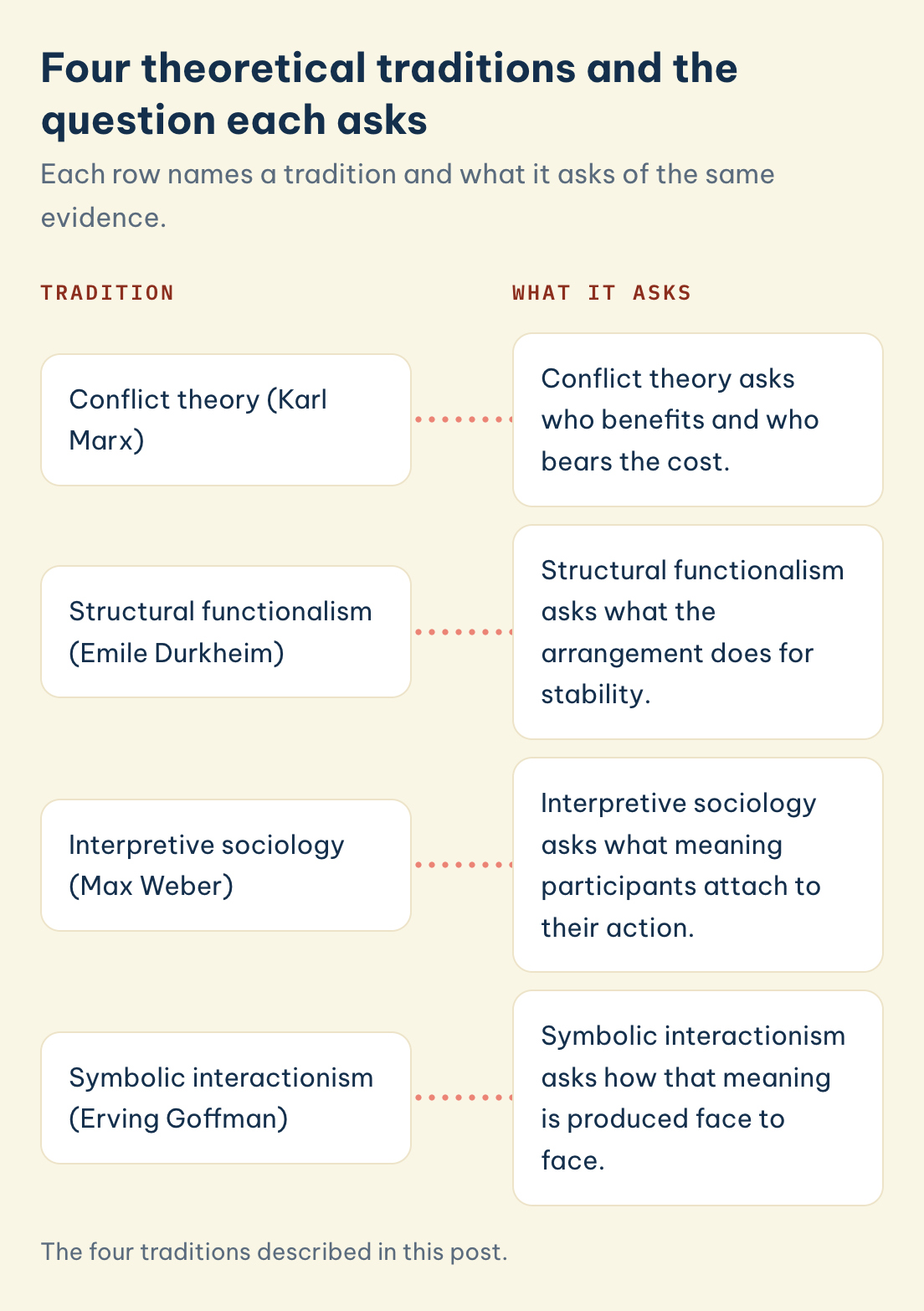
Each tradition asks a different question of the same evidence. Conflict theory asks who benefits and who bears the cost. Structural functionalism asks what the arrangement does for stability. Interpretive sociology asks what meaning participants attach to their action, and symbolic interactionism asks how that meaning is produced face to face.
Choosing a tradition is an analytical decision to defend in 1 sentence, not a label to attach. An essay on workplace surveillance framed through Karl Marx foregrounds control and extracted value, while the same evidence read through Erving Goffman foregrounds impression management by the watched. A marker rewards the essay saying why it chose one.
◆ Question 5 / 5 · How should you structure
How should you structure a sociology essay?
Direct answer: Use a 4-part structure of introduction, theoretical framing, evidence-led analysis, and conclusion. In a 2,000-word essay, allow roughly 200 words to the introduction, 400 to theory, 1,200 to analysis, and 200 to the conclusion, with theory carried into the analysis rather than sealed off from it.
How a 2,000-word sociology essay can roughly be shared
A worked allocation in four parts, with theory carried into the analysis.
Introduction
200
words
Theory
400
words
Analysis
1,200
words
Conclusion
200
words
Save this figure
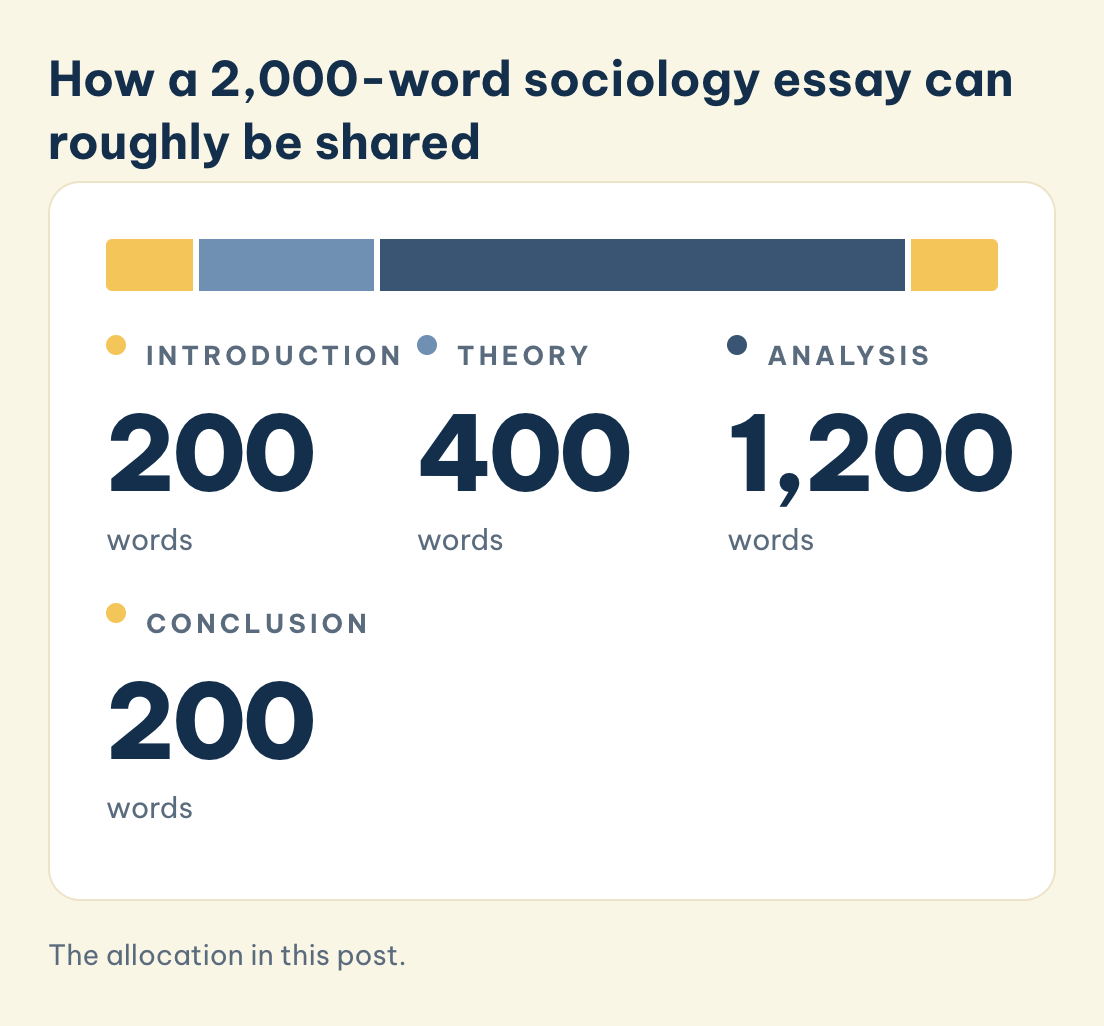
The most common structural error is quarantining theory. A student explains Pierre Bourdieu or Emile Durkheim in 400 words, then writes 1,200 words of evidence never mentioning either theorist again. Theory belongs in the analysis as the lens applied to each piece of evidence, and a marker checks whether the framework did any work.
Each analytical paragraph carries 3 moves: state the claim, present the evidence, then explain how the theoretical framework accounts for it. Paltridge and Starfield (2019), published by Routledge, note that second-language writers often complete the first 2 moves and omit the third, which produces paragraphs that are accurate and yet read as descriptive because the interpretive step is left implicit.
A worked version of those 3 moves runs to about 120 words, and the shape below is illustrative rather than a finding you may cite. The claim states that credential inflation pushes graduates into jobs below their qualification level. The evidence would then cite 2 real studies, one an Australian Bureau of Statistics release and one a peer-reviewed cohort study, giving the underemployment rate each actually reports. The interpretation applies Pierre Bourdieu on cultural capital to explain why the effect concentrates among first-generation students, whose families cannot supply the informal networks converting a degree into a graduate-level post. Move 3 carries the marks and takes roughly 40% of the paragraph.
Conclusions should return to the structural question rather than summarising paragraph by paragraph. State what the analysis showed about the mechanism named in your thesis, then state the limit of that claim. Mills (1959) argued the discipline's value lies in connecting biography and history, and a conclusion returning to that connection reads as finished.
Frequently asked questions
Can I use my own experience in a sociology essay?
Only as illustration, never as proof. The University of North Carolina guide is clear that opinion alone does not support a sociological argument, and a single personal case is no different. Use your experience to raise the question, then answer it with published evidence.
How many sources does an undergraduate sociology essay need?
Most 2,000-word essays cite between 8 and 15 sources across 3 source types, though the unit guide governs the count. What matters more than the count is the mix, because 12 sources of commentary with 0 data will not support an empirical argument. Databases such as JSTOR and Sociological Abstracts index the empirical work.
Do I need to pick one theory and stick with it?
Not necessarily, and comparing 2 frameworks is often stronger than defending 1. What fails is naming a theory and then not using it. If you introduce both Conflict Theory and Structural Functionalism, apply each to the same evidence and say which accounts for it better.
Is the sociological imagination the same as critical thinking?
No. Critical thinking is a general evaluative skill. The sociological imagination is the specific move Mills (1959) described in The Sociological Imagination, published by Oxford University Press, connecting a private trouble to a public issue by locating the individual inside a social structure.
Related resources
- How to write a university essay: the general essay structure this specialises
- How to write a theoretical framework: building the framework a sociology essay applies
- Assignment command words explained: what "analyse", "evaluate" and "discuss" require
- Referencing in university assignments: where to place citations so your voice stays visible
- Academic Support service: coaching through Outline, Draft and Final with a discipline-matched expert
Ready to start? Book a free 20-minute consultation. Bring your essay question and your reading list, and we will match you to a mentor in your discipline within 48 hours.
References
- Mills, C. W. (1959). The sociological imagination. Oxford University Press.
- Paltridge, B., & Starfield, S. (2019). Thesis and dissertation writing in a second language: A handbook for students and their supervisors (2nd ed.). Routledge.
- Swales, J. M., & Feak, C. B. (2012). Academic writing for graduate students: Essential tasks and skills (3rd ed.). University of Michigan Press.
- University of North Carolina Writing Center. (n.d.). Sociology. Retrieved September 4, 2026, from https://writingcenter.unc.edu/tips-and-tools/sociology/
This article is part of the MAAS Journal series for Vietnamese international students. With MAAS Academic Support, a discipline-matched expert coaches you through the Outline, Draft and Final stages against your marking rubric. We guide students through worked examples, drafts and feedback so they build their own sociological arguments from evidence, and we do not write essays on students' behalf.
A free 20-minute consultation is a conversation about your situation, with your essay question and reading list in hand.
Book a free consultation ▸