
◆ Writing Tips
What Is TEEL Paragraph Structure and How Do You Use It?
TEEL is a four-part paragraph pattern taught by Australian universities: Topic sentence, Explanation, Evidence, Link. You open with the point, explain why it matters, support it with a referenced source or example, then tie it back to your argument. RMIT, USC, La Trobe and Deakin teach slightly different wording of the same four moves.
◆ Question 1 / 8 · What TEEL stands for
What does TEEL stand for, and does every Australian university use the same version?
Direct answer: TEEL stands for Topic, Explanation, Evidence, Link. RMIT, USC and La Trobe use that order, while Deakin writes the second letter as Expand or Elaborate and offers a TEAL variant with Analysis. The four moves are the same, only the labels and emphasis change.
RMIT University Library (n.d.-b) teaches TEEL as topic sentence, explain, evidence or example, and link, and marks the final link as optional. The University of the Sunshine Coast (n.d.) asks for a topic sentence that states the main idea, then a second sentence that begins to develop, define and further explain it. La Trobe's library guide, listed under Tools & resources below, lists the same letters as topic sentence, elaboration or explanation, evidence and link. Deakin University (n.d.-a) names the structure either TEAL, meaning Topic, Evidence, Analysis, Link, or TEEL, meaning Topic, Expand or Elaborate, Evidence or Examples, Link. The table below sets the variants side by side so you can check which one your unit guide expects before you draft.
| University | Letter 1 | Letter 2 | Letter 3 | Letter 4 |
|---|---|---|---|---|
| RMIT | Topic sentence | Explain | Evidence or example | Link (optional) |
| USC | Topic | Explanation | Evidence | Link |
| La Trobe | Topic sentence | Elaboration or explanation | Evidence | Link |
| Deakin (TEEL) | Topic | Expand or elaborate | Evidence or examples | Link |
| Deakin (TEAL) | Topic | Evidence | Analysis | Link |
◆ Question 2 / 8 · Each part
How does each part of TEEL work?
Direct answer: The topic sentence states one idea, the explanation says why it matters, the evidence supports it with a referenced source or example, and the link closes the paragraph by returning to your argument or pointing to the next paragraph. Each part has one job, and a paragraph that skips one usually feels unfinished.
RMIT University Library (n.d.-b) describes the topic sentence as the topic of the paragraph and the explanation as the answer to why that topic is important. The same guide asks you to support the topic with references in the evidence step, and the link brings the reader back to the topic. Deakin University (n.d.-a) adds that the final sentence can conclude the paragraph and link back to the topic sentence or forward to the next paragraph. La Trobe's library guide says the same, linking back to the topic sentence or forward to the next paragraph in the final sentence. A useful check is to read only your topic sentences in sequence: RMIT University Library (n.d.-a) notes that you should be able to see the development of the argument from them alone. If those sentences read as a disconnected list of themes, the structure is not yet doing its work. Our guide to how to write a university essay shows where body paragraphs sit within the whole essay.
◆ Question 3 / 8 · Worked example
What does a TEEL paragraph example look like?
Direct answer: A TEEL paragraph usually runs four to seven sentences, with one sentence for the topic, one or two for explanation, one or two for evidence, and one for the link. The annotated example below uses a neutral topic and real sources so you can see each part in position.
Here is a worked paragraph, written for this guide and built on the sources reviewed above:
Formula-based paragraph structures are most useful to students who are still learning how to organise an argument. A structure such as TEEL gives a beginner a fixed order to follow, so each paragraph announces its point, develops it and returns to the question before the next one begins. The University of Queensland (n.d.) advises that beginner writers follow the TEEL acronym because it helps organise academic writing and makes the aim of each paragraph clear to the reader. McKnight (2021) adds a caution from classrooms in Victoria, where teachers experienced conflicts when teaching prescriptive formulas such as TEEL and PEEL, and concluded that formulaic approaches can both support and harm students' capacity to express themselves. Taken together, the two sources suggest the formula works best as a scaffold for early drafts rather than a rule for every paragraph. The structure therefore earns its place at the start of a student's writing, provided the writer later learns to vary it.
Read it part by part:
- Topic: sentence one makes a single claim, that formula structures suit learners.
- Explanation: sentence two says why, because a fixed order helps a beginner organise an argument.
- Evidence: sentences three and four bring in two sources, one supporting the claim and one qualifying it.
- Explanation of evidence: sentence five, close to the analysis move in Deakin's TEAL, tells the reader what the two sources mean together.
- Link: sentence six ties the point back to the claim and signals where the argument goes next.
◆ Question 4 / 8 · Length
How long should a TEEL paragraph be?
Direct answer: Most Australian study guides put a TEEL paragraph at about four to seven sentences, often near 150 to 250 words. USC sets the shorter range, while Deakin allows up to eight sentences, so treat the numbers as a guide and let one clear idea decide the final length.
The University of the Sunshine Coast (n.d.) puts the instruction plainly: keep your paragraph length to between 4 and 7 sentences. Deakin University (n.d.-b) gives a slightly wider rule of thumb, stating that it takes 4 to 8 sentences, or 150 to 250 words, to develop a point adequately, and its worked examples sit around 200 words. These are guides rather than limits, so a paragraph that needs a longer quotation or a worked calculation can run over, and a short transitional paragraph can run under. What matters more is that the paragraph carries one idea. If your draft reaches 10 sentences, check whether two ideas have merged, and if it stops at 2 sentences, check whether the explanation or evidence is missing. The University of Queensland (n.d.) puts the rule this way: each new paragraph usually keeps the same essay topic and changes the controlling idea.
◆ Question 5 / 8 · Controlling idea
What is the controlling idea, and how is it different from the topic?
Direct answer: The topic is the subject of the whole essay, and the controlling idea is the specific point a paragraph makes about it. The University of Queensland says the topic usually stays the same across paragraphs while the controlling idea changes, which keeps each paragraph focused.
The University of Queensland (n.d.) observes that "it is often taught that each new paragraph represents a new topic, though in actuality the topic remains the same and the controlling idea changes." For an essay on remote work, the topic stays remote work throughout, while one paragraph's controlling idea might be communication, another's might be productivity, and a third's might be wellbeing. Your topic sentence is where the controlling idea appears, so a good test is whether a reader could finish that single sentence and predict what the rest of the paragraph will contain. If the sentence announces two ideas, split the paragraph. If it announces a fact with no angle, add the angle. This is one reason RMIT University Library (n.d.-a) stresses that topic sentences alone should reveal how the argument develops.
◆ Question 6 / 8 · TEEL vs TEAL
How do TEEL and TEAL differ?
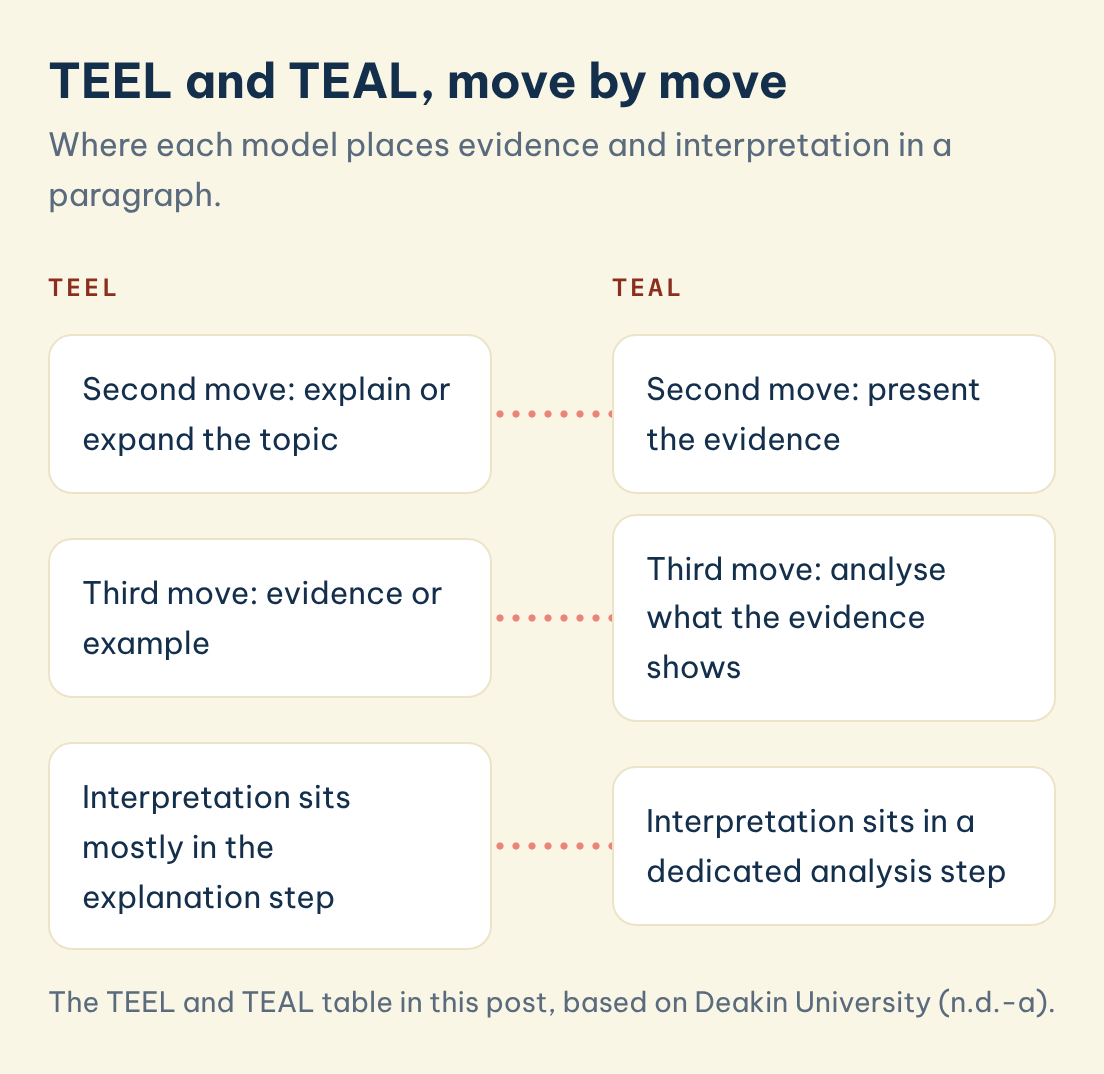
Direct answer: TEEL puts explanation before evidence, so the paragraph first says why the point matters and then proves it. Deakin's TEAL variant puts evidence before analysis, so you present a source and then say what it shows. Both end with a link, and your marker's preference decides which to use.
PEEL, the sibling formula that McKnight (2021) discusses alongside TEEL, is not defined in the guides reviewed for this post, so the comparison below sticks to the two versions that Deakin University (n.d.-a) sets out.
| Feature | TEEL | TEAL |
|---|---|---|
| Second move | Explain or expand the topic | Present the evidence |
| Third move | Evidence or example | Analyse what the evidence shows |
| Where interpretation sits | Mostly in the explanation step | In a dedicated analysis step |
| Best suited to | Building a claim in your own words first | Source-heavy or data-heavy paragraphs |
TEEL works well when you need to establish a concept before proving it. TEAL suits paragraphs where the source does most of the talking and your job is to interpret it. Neither is more correct, and the safest habit is to follow the labels used in your unit guide.
TEEL and TEAL, move by move
Where each model places evidence and interpretation in a paragraph.
TEEL
TEAL
Second move: explain or expand the topic
Second move: present the evidence
Third move: evidence or example
Third move: analyse what the evidence shows
Interpretation sits mostly in the explanation step
Interpretation sits in a dedicated analysis step
Save this figure
◆ Question 7 / 8 · Common mistakes
What are the most common TEEL mistakes?
Direct answer: The most common mistakes are a topic sentence that is too broad or too narrow, evidence dropped in without explanation, a link that repeats the topic sentence word for word, and treating the four steps as one sentence each regardless of what the point needs.
A topic sentence that names a subject but makes no claim leaves the paragraph with nothing to prove. A quotation without explanation forces the reader to guess why it appears, which is the gap that the explanation or analysis step exists to close. A link that simply restates the topic sentence adds length without adding anything, while a good link either connects to the essay question or points to the next paragraph, as La Trobe's library guide describes. Rigid application is a quieter problem. RMIT University Library (n.d.-b) calls the link optional, so a paragraph that has made its point does not need a ritual closing sentence. When you review a draft, underline each of the four moves in a different colour. A missing colour tells you what to add, and a repeated colour tells you where the paragraph may be doing two jobs.
◆ Question 8 / 8 · Criticisms
What are the criticisms of TEEL, and how do you move beyond the formula?
Direct answer: Critics argue that formulas can support writers while also limiting them. McKnight (2021) found that Victorian teachers face conflict teaching TEEL and PEEL, and Rodway (2017) argued that a topic sentence plus supporting sentences does not show writers how to develop an argument. Treat TEEL as a scaffold, not a rule.
Searches for Year 7 and Year 9 TEEL examples show that many students meet the model at school, long before university. McKnight (2021), writing in English in Education, reports that teachers in Victoria experience conflicts when teaching prescriptive paragraphing formulas such as TEEL and PEEL, and concludes that formulaic approaches can both support and harm students' capacity to express themselves. Rodway (2017) studied 22 paragraphs written by second-language business undergraduates, a small sample, and the model the study discusses is topic sentence plus supporting sentences rather than TEEL by name. The finding still applies: the model "fails to adequately make transparent the linguistic resources that are needed for the writer to progress and develop an argument" (Rodway, 2017, p. 137). In practice, moving beyond the formula means learning how paragraphs build an argument in your discipline: how to compare sources, concede a point, qualify a claim, and signal each shift to the reader. Use TEEL to get a draft onto the page, then revise for flow. If you want a second pair of eyes on paragraph structure, Academic Support at MAAS works through Outline, Draft and Final with expert guidance while you remain the author of every paragraph, and how to write an essay introduction is a good next read.
Frequently asked questions
Is TEEL the same as PEEL?
They are closely related formulas, and McKnight (2021) discusses both together as prescriptive paragraphing patterns. This guide only defines TEEL and TEAL, so check your unit guide for the exact labels your marker expects.
Is the link sentence compulsory?
No. RMIT University Library (n.d.-b) marks the link as optional. Include it when it helps the reader see how the paragraph connects to your argument or to the next paragraph, and leave it out when the point is already clear.
How many sentences should a TEEL paragraph have?
USC recommends 4 to 7 sentences, and Deakin says 4 to 8 sentences, or 150 to 250 words, to develop a point adequately. Treat these numbers as guides and adjust to the complexity of your point.
Where does my own analysis go in TEEL?
Mostly in the explanation step, where you say why the point matters. Deakin's TEAL variant gives analysis its own step after the evidence, which is helpful when you are interpreting data or a source.
Do I need TEEL in every paragraph?
No. McKnight (2021) notes that formulas can both support and harm student writing, so use the structure as a scaffold for early drafts and vary it as your control of argument grows.
Is there a TEEL template or sample PDF I can follow?
Yes. Deakin University (n.d.-b) publishes a study support guide with annotated TEAL and TEEL example paragraphs, and the worked example in this post can serve as a template: one topic sentence, one or two sentences of explanation, one or two of evidence, and a link.
Does every Australian university teach TEEL?
Not always under that name. Some guides describe a paragraph simply as a topic sentence, supporting sentences and a concluding or linking sentence. Check your own university's study support guide.
References
Deakin University. (n.d.-a). Paragraph structure. Study Support Guides. https://www.deakin.edu.au/students/study-support/study-resources/study-support-guides/paragraph-structure
Deakin University. (n.d.-b). Examples of TEAL/TEEL paragraphs [Study support guide]. https://www.deakin.edu.au/__data/assets/pdf_file/0025/86740/Examples-of-paragraph-structures_Deakin-Study-Support.pdf
McKnight, L. (2021). Since feeling is first: The art of teaching to write paragraphs. English in Education, 55(1), 37–52. https://doi.org/10.1080/04250494.2020.1768069
RMIT University Library. (n.d.-a). Structure of an essay. Learning Lab. https://learninglab.rmit.edu.au/assessments/essays/write/
RMIT University Library. (n.d.-b). Writing paragraphs. Learning Lab. https://learninglab.rmit.edu.au/writing-fundamentals/writing-paragraphs/
Rodway, C. (2017). Opening up dialogic spaces: Rethinking the prescriptive paragraph structure in L2 writing pedagogy. Asian EFL Journal, Quarterly March 2017, 136. https://hdl.handle.net/10072/392163
University of Queensland. (n.d.). Basic paragraph writing. In Academic writing skills. UQ Pressbooks. https://uq.pressbooks.pub/academicwritingskills/chapter/paragraph-writing/
University of the Sunshine Coast. (n.d.). Writing clear paragraphs. Academic writing, USC Library Guides. https://libguides.usc.edu.au/academic-writing/writing-clear-paragraphs
Tools & resources
Not sure how this guide applies to your own case? Talk it through with MAAS in a free 20-minute consultation.
Book a free consultation ▸