
APA
7th ed.Capital on every word of 4+ letters.
:
◆ Citation & Formatting
Category: citation-formatting
Last updated: 2026-10-09
A student writes a strong essay, then capitalises the title the way it looks right and loses formatting marks for it. The title sits at the top of the page where a marker sees it first, and the 3 major styles disagree about which words get a capital letter. The disagreement is not cosmetic, because each style measures a different thing.
Direct answer: Paste your title into the title case converter below. APA capitalises every word of 4 letters or more, Chicago capitalises prepositions of 5 letters or more, and MLA lowercases prepositions however long they are. So one title can come out 3 ways, and the tool shows all 3 with the reason for every word.
The rule that decides everything else. APA and Chicago count letters, while MLA counts function. The word "during" is capitalised under APA because it has 6 letters, and lowercased under MLA because it is a preposition in the middle of a title. Knowing which question your style asks removes most of the guesswork.
◆ Section 1 / 6 · Title case converter
Capital on every word of 4+ letters.
:
Lowercase prepositions, any length.
:
Capital on prepositions of 5+ letters.
:
Showing the words where the styles disagree or grammar decides. Tap any word above for its reason.
Has 4 or more letters, and APA capitalises every word of 4+ letters.Source: American Psychological Association (2022b)
A preposition of 4 letters or fewer, so Chicago 18 keeps it lowercase.Source: Chicago Manual of Style (2024)
Has 4 or more letters, and APA capitalises every word of 4+ letters.Source: American Psychological Association (2022b)
A preposition of 4 letters or fewer, so Chicago 18 keeps it lowercase.Source: Chicago Manual of Style (2024)
We keep any capitals you type inside a word, so names like McKinsey, iPhone and acronyms like COVID-19 stay as you wrote them. A name you type all in lowercase, like "van gogh", will be capitalised like any other word, so check proper names by eye.
Has 4 or more letters, and APA capitalises every word of 4+ letters.Source: American Psychological Association (2022b)
A preposition of 4 letters or fewer, so Chicago 18 keeps it lowercase.Source: Chicago Manual of Style (2024)
Has 4 or more letters, and APA capitalises every word of 4+ letters.Source: American Psychological Association (2022b)
A preposition of 4 letters or fewer, so Chicago 18 keeps it lowercase.Source: Chicago Manual of Style (2024)
Has 4 or more letters, and APA capitalises every word of 4+ letters.Source: American Psychological Association (2022b)
A preposition. MLA lowercases prepositions at any length, even a long one like this.Source: MLA Style Center (2019)
A preposition of 5 or more letters. Chicago 18 capitalises these.Source: Chicago Manual of Style (2024)
Has 4 or more letters, and APA capitalises every word of 4+ letters.Source: American Psychological Association (2022b)
CheckTreated as a preposition, which MLA lowercases.If a whole clause follows it, it is a conjunction and takes a capital.Source: MLA Style Center (2019)
CheckTreated as a preposition (a noun follows it), so Chicago lowercases it.If a whole clause follows "than", Chicago treats it as a conjunction and capitalises it.Source: The Chicago Manual of Style Online (n.d.-a)
Has 4 or more letters, and APA capitalises every word of 4+ letters.Source: American Psychological Association (2022b)
Part of the multi-word preposition "according to". MLA lowercases every word of it, however long.Source: MLA Style Center (2019)
Part of "according to". In Chicago only the preposition parts follow the preposition rule, so this word takes a capital, as in The Gospel According to Matthew and "as Well as".Source: The Chicago Manual of Style Online (n.d.-a)
CheckShort preposition of 3 letters or fewer, so APA keeps it lowercase.If "to" comes right before a verb (to read), APA’s page does not name this case. Other guides keep it lowercase, so the checker does too.Source: American Psychological Association (2022b)
Part of the multi-word preposition "according to". MLA lowercases every word of it, however long.Source: MLA Style Center (2019)
CheckChicago treats "to" as a preposition, and prepositions of 4 letters or fewer stay lowercase.If "to" comes right before a verb (to do), Chicago’s free pages do not state the rule. Other guides keep it lowercase, so the checker does too.Source: The Chicago Manual of Style Online (n.d.-a)
Short conjunction of 3 letters or fewer, so APA keeps it lowercase.Source: American Psychological Association (2022b)
Coordinating conjunction, so MLA keeps it lowercase.Source: Modern Language Association (2021, p. 54), as cited in Douglas College Library (n.d.)
Chicago's lowercase list of conjunctions stops at and, but, for, or, nor, so "yet" takes a capital.Source: The Chicago Manual of Style Online (n.d.-a)
Short conjunction of 3 letters or fewer, so APA keeps it lowercase.Source: American Psychological Association (2022b)
A principal word, so MLA capitalises it.Source: MLA Style Center (2021), citing MLA Handbook 2.90
A major word, so Chicago capitalises it.Source: The Chicago Manual of Style Online (n.d.-a)
Short conjunction of 3 letters or fewer, so APA keeps it lowercase.Source: American Psychological Association (2022b)
Last word of the title. MLA always capitalises it.Source: MLA Style Center (2021), citing MLA Handbook 2.90
Last word of the title. Chicago always capitalises it.Source: The Chicago Manual of Style Online (n.d.-a)
CheckFirst part of a hyphenated compound. The compound works as one word, so the checker capitalises it. A short minor word inside a hyphenated compound is kept lowercase.None of the style guides we checked covers a small word at the start of a compound (Up-to-Date). Most editors capitalise it; check your department guide.
CheckFirst part of a hyphenated compound. The compound works as one word, so the checker capitalises it. Not a principal word, so it stays lowercase after the hyphen.None of the style guides we checked covers a small word at the start of a compound (Up-to-Date). Most editors capitalise it; check your department guide.Source: Modern Language Association (2021, p. 54), as cited in Douglas College Library (n.d.)
CheckFirst part of a hyphenated compound. The compound works as one word, so the checker capitalises it. A minor word, so the general title rule keeps it lowercase after the hyphen.None of the style guides we checked covers a small word at the start of a compound (Up-to-Date). Most editors capitalise it; check your department guide.Source: The Chicago Manual of Style Online (n.d.-b), CMOS 18 section 8.162
CheckShort preposition of 3 letters or fewer, so APA keeps it lowercase.If "to" comes right before a verb (to read), APA’s page does not name this case. Other guides keep it lowercase, so the checker does too.Source: American Psychological Association (2022b)
MLA lowercases "to", both as a preposition and in an infinitive.Source: Modern Language Association (2021, p. 54), as cited in Douglas College Library (n.d.)
CheckChicago treats "to" as a preposition, and prepositions of 4 letters or fewer stay lowercase.If "to" comes right before a verb (to do), Chicago’s free pages do not state the rule. Other guides keep it lowercase, so the checker does too.Source: The Chicago Manual of Style Online (n.d.-a)
Has 4 or more letters, and APA capitalises every word of 4+ letters.Source: American Psychological Association (2022b)
A preposition. MLA lowercases prepositions at any length, even a long one like this.Source: MLA Style Center (2019)
A preposition of 5 or more letters. Chicago 18 capitalises these.Source: Chicago Manual of Style (2024)
CheckReads as an adverb here (part of the verb), and APA capitalises adverbs.If it is a preposition with an object after it, write it lowercase.Source: American Psychological Association (2022b)
CheckReads as an adverb here (part of the verb), which is a principal word in MLA.If it is a preposition with an object after it, write it lowercase.Source: Modern Language Association (2021, p. 54), as cited in Douglas College Library (n.d.)
CheckReads as an adverb here (part of the verb), and Chicago capitalises adverbs.If it is a preposition with an object after it, write it lowercase.Source: The Chicago Manual of Style Online (n.d.-a)
Short conjunction of 3 letters or fewer, so APA keeps it lowercase.Source: American Psychological Association (2022b)
CheckTreated as a preposition, which MLA lowercases.If a whole clause follows it, it is a conjunction and takes a capital.Source: MLA Style Center (2019)
Chicago keeps "as" lowercase in any grammatical function.Source: The Chicago Manual of Style Online (n.d.-a)
All three styles give the same result for this title.
CheckShort preposition of 3 letters or fewer, so APA keeps it lowercase.If "to" comes right before a verb (to read), APA’s page does not name this case. Other guides keep it lowercase, so the checker does too.Source: American Psychological Association (2022b)
MLA lowercases "to", both as a preposition and in an infinitive.Source: Modern Language Association (2021, p. 54), as cited in Douglas College Library (n.d.)
CheckChicago treats "to" as a preposition, and prepositions of 4 letters or fewer stay lowercase.If "to" comes right before a verb (to do), Chicago’s free pages do not state the rule. Other guides keep it lowercase, so the checker does too.Source: The Chicago Manual of Style Online (n.d.-a)
◆ Section 2 / 6 · Where does the title sit
Direct answer: An APA title page puts the title centred and bold, 3 to 4 lines down. An MLA paper usually has no title page, and the title is centred in plain text under your name block. Chicago student papers follow Turabian, with the title a third of the way down. The bold APA requires is the bold MLA forbids.
APA is precise about placement, instructing writers to "place the title three to four lines down from the top of the title page. Center it and type it in bold font. Capitalize major words of the title" (American Psychological Association, 2022c). A student title page carries 7 elements, in this order: the title, your name, your department and institution, the course number and name, the instructor, the due date, and the page number. Student papers have no running head unless your instructor asks for one (American Psychological Association, 2022c).
MLA takes the opposite default. Its formatting guidance says a research paper "does not normally need a title page", and where a paper is a group project you "create a title page and list all the authors on it instead of in the header on page 1 of your essay" (MLA Style Center, 2020). Your name, instructor, course number and date sit on separate double-spaced lines at the top left, then the title is centred, and your surname and the page number sit half an inch from the top, flush right (MLA Style Center, 2020).
MLA is equally specific about what not to do. On the first page you "center the title" and "do not italicize or underline your title, put it in quotation marks or boldface, or type it in all capital letters" (MLA Style Center, 2020). The bold that APA requires is the bold MLA forbids, which is why copying a template from the wrong style is a reliable way to lose marks. That handout reflects the 8th edition, so confirm against your department's current guide.
Chicago student papers follow Turabian 9, the student version of Chicago (Hope International University Library, n.d.). The title sits about a third of the way down the page, centred, with a subtitle on its own line after a colon, and your name, course and date sit several lines below. If your department's template differs, the template wins.
◆ Section 3 / 6 · How do APA, MLA and Chicago
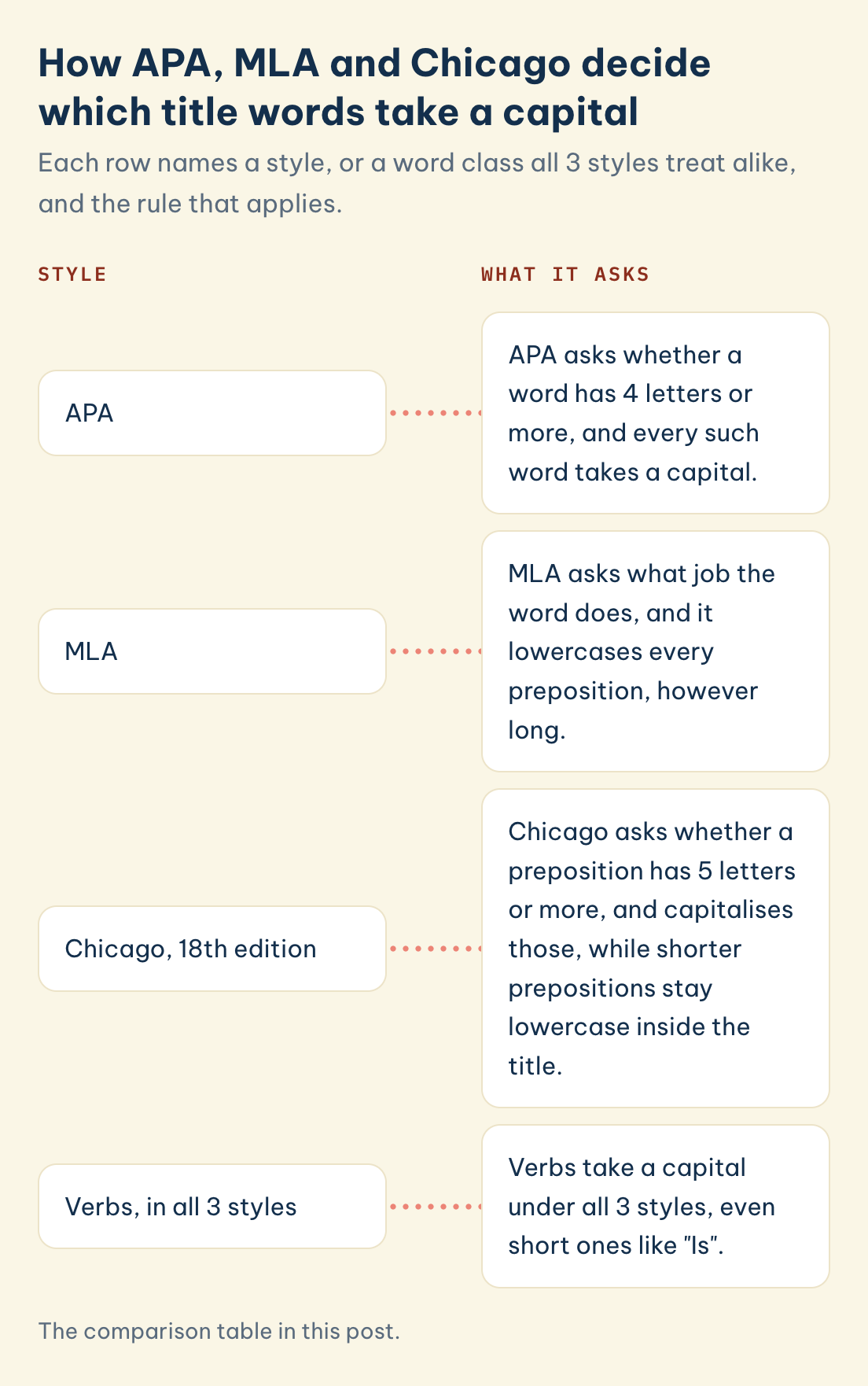
Direct answer: Title capitalisation rules differ by one question. APA asks whether a word has 4 letters or more. Chicago's 18th edition asks the same question about prepositions, but sets the bar at 5. MLA asks what job the word does and lowercases every preposition, however long. Verbs take a capital under all 3, even short ones like "Is".
How APA, MLA and Chicago decide which title words take a capital
Each row names a style, or a word class all 3 styles treat alike, and the rule that applies.
Style
What it asks
APA
APA asks whether a word has 4 letters or more, and every such word takes a capital.
MLA
MLA asks what job the word does, and it lowercases every preposition, however long.
Chicago, 18th edition
Chicago asks whether a preposition has 5 letters or more, and capitalises those, while shorter prepositions stay lowercase inside the title.
Verbs, in all 3 styles
Verbs take a capital under all 3 styles, even short ones like "Is".
MLA states the rule as a formula rather than a threshold, instructing writers to "capitalize the first word, the last word, and all principal words" (MLA Style Center, 2021). Function decides everything, which is why MLA writes "Errors Found during Testing" while APA would capitalise "During" on a letter count. MLA extends that logic to multi-word prepositions, holding that "a preposition that is not at the start or end of a title should be lowercased, no matter how many words compose it and no matter how long those words are" (MLA Style Center, 2019). That guidance page relates to the 8th edition of the handbook, so check your current edition before quoting it.
Chicago changed its threshold recently, and the change is worth knowing if you are working from an older handout. Announcing the 18th edition, the press wrote that "in titles of works, prepositions of five or more letters will now be capitalized (A Room with a View but Much Ado About Nothing). And we will now refer to this as title case rather than headline style" (Chicago Manual of Style, 2024). The earlier rule lowercased every preposition regardless of length.
Chicago also decides some words by grammar rather than by length. Its Q&A treats "than" as a preposition when an object follows it and as a conjunction when a clause follows, capitalising it only in the second case (The Chicago Manual of Style Online, n.d.-a). Verbs are the one point of agreement, and even a 2-letter verb takes a capital, which gives "Life Is Beautiful" (Chicago Manual of Style, 2021).
| Word | What it is | APA 7 | MLA 9 | Chicago 18 |
|---|---|---|---|---|
| with, from, into | preposition, 4 letters | With | with | with |
| about, toward, during | preposition, 5+ letters | About | about | About |
| according to | two-word preposition | According to | according to | According to |
| if | subordinating conjunction | if | If | If |
| so, yet | coordinating conjunction | yet | yet | Yet |
| than | before a noun | Than | than | than |
| as | before a noun ("as a learner") | as | as | as |
| up (in "giving up") | adverb, part of the verb | Up | Up | Up |
| for (last word) | preposition ending the title | for | For | For |
| is, be, are | verb | Is | Is | Is |
| self-report | hyphenated major word | Self-Report | Self-Report | Self-Report |
APA rules in the table come from American Psychological Association (2022b). MLA rules come from Modern Language Association of America (2021, p. 54, as cited in Douglas College Library, n.d.) and MLA Style Center (2019, 2021), with Lewis University Writing Center (n.d.) for "so" and "yet". Chicago rules come from Chicago Manual of Style (2024) and The Chicago Manual of Style Online (n.d.-a, n.d.-b). APA has no last-word rule, so a short preposition at the end of an APA title stays lowercase. Before a whole clause, "as" becomes a conjunction, and MLA then capitalises it while APA and Chicago keep it lowercase.
◆ Section 4 / 6 · What is the difference
Direct answer: Title case capitalises the major words of a title, while sentence case capitalises only the first word and any proper nouns. Both appear in the same APA paper, because APA uses title case for your own title and headings and sentence case for article and book titles in the reference list, which surprises most students.
The American Psychological Association (2022b) defines the boundary by word class, treating "nouns, verbs (including linking verbs), adjectives, adverbs, pronouns, and all words of four letters or more" as major words. That last clause is the operative one, because it converts a grammatical question into a counting question. The reverse rule is just as specific. APA instructs writers to "lowercase only minor words that are three letters or fewer in a title or heading", with exceptions for the first word of a title or subtitle (American Psychological Association, 2022b). So "of", "in", "to" and "up" stay lowercase, while "With", "Between" and "From" take a capital. Hyphenated major words take a capital on both halves, so the manual gives "Self-Report" rather than "Self-report" (American Psychological Association, 2022b).
Sentence case then applies where students least expect it. APA uses sentence case for "titles of articles, books, reports, webpages, and other works in reference list entries, even if title case was used in the original work" (American Psychological Association, 2022a). If your References list looks under-capitalised next to your own title, this is why. Our APA 7th referencing guide covers the rest of the entry format.
◆ Section 5 / 6 · Do I capitalise the word
Direct answer: Yes. The first word after a colon starts a subtitle, and all 3 styles capitalise it, even a small word like "a" or "the". So "Learning with AI: A Study of Feedback" takes a capital on "A" in APA, MLA and Chicago alike.
APA capitalises "the first word of a subtitle" and the first word after a colon (American Psychological Association, 2022b), and the MLA Handbook applies title capitalisation to "an English title or subtitle" (Modern Language Association of America, 2021, as cited in Douglas College Library, n.d.). Chicago's own Q&A gives the same answer for titles and headings: "cap the word after the colon" (The Chicago Manual of Style Online, n.d.-a).
◆ Section 6 / 6 · How long should a title be
Direct answer: Aim for 5 to 12 substantive words. A question title is allowed, but research links it to more downloads and fewer citations, so use one when engagement matters more than formality. Shorter titles are a good habit, though the evidence that they raise citations is weak.
The USC Libraries research guide sets the working range, advising that a good title "is limited to 5 to 12 substantive words" and "contains the fewest possible words needed to adequately describe the content and purpose of your research paper" (Labaree, n.d.). It also warns against openings such as "A Study to Investigate the..." because "these phrases are obvious and generally superfluous unless they are necessary to covey the scope, intent, or type of study" (Labaree, n.d.). A title that names the case, the population and the question shows the marker you narrowed the topic, and our guide to assignment command words covers reading the question behind it.
The evidence on length is weaker than it is usually reported. Letchford et al. (2015), in Royal Society Open Science, found that "for the top 20 000 most highly cited papers published in 2010, papers with shorter titles receive more citations" with a correlation of only 0.07. For 2011 to 2013 the association disappeared entirely once journal effects were accounted for, so treat short titles as a reasonable habit rather than a lever.
Question titles have a clearer and stranger pattern. Jamali and Nikzad (2011), in Scientometrics, found that "especially articles with question titles tended to be downloaded more but cited less than the others" across 2,172 papers from 6 PLoS journals. The same study reports that titles containing a colon "tended to be longer and receive fewer downloads and citations", so the device is not free. Question titles are also rising without becoming common. Ball (2009) examined "nearly 20 million scientific articles" and traced growth in question-mark titles across 40 years, attributing it to marketing pressure. Cook and Plourde (2016) then checked the pattern across 60 journals and concluded that "although patterns vary by discipline, titles with questions are posed infrequently overall".
To title an essay for college, start with the style your course names, because the capitalisation rules differ. If the course names no style, ask your instructor which one to use. Then make the title say your scope in 5 to 12 substantive words (Labaree, n.d.).
Put it on a separate title page, 3 to 4 lines from the top, centred and in bold, and capitalise every major word plus every word of 4 letters or more (American Psychological Association, 2022b, 2022c). Paste your title into the title case converter above to get the APA version.
Skip the title page. Type your name, instructor, course and date at the top left, then centre the title on the next line in plain text, with no bold, italics or quotation marks (MLA Style Center, 2020). Capitalise principal words and keep prepositions lowercase, however long (MLA Style Center, 2019).
Capitalise major words and prepositions of 5 letters or more, and keep shorter prepositions, articles and the conjunctions and, but, for, or and nor lowercase (Chicago Manual of Style, 2024; The Chicago Manual of Style Online, n.d.-a). For the title page itself, follow your department's template.
Some words change job with the sentence. Chicago capitalises "than" when a clause follows it and lowercases it before a noun (The Chicago Manual of Style Online, n.d.-a), and "up" in "Breaking Up" is an adverb, so it takes a capital (The Chicago Manual of Style Online, n.d.-a). The converter makes its best reading and tells you when a human should look.
Follow the department. Style manuals are defaults that faculties override. Start with the style your course names, and ask your instructor if it names none. Our Harvard referencing guide shows how far one named style can vary between schools.
Title sorted, but what about the essay under it? Book a free 20-minute consultation. Bring your assignment brief and your department's style guide, and we will match you to a mentor in your discipline within 48 hours.
This article is part of the MAAS Journal series for Vietnamese international students. We guide students through worked examples, drafts and feedback so they format their own work to their department's guide, and we do not write or format assignments on students' behalf. The converter follows the published rules of each style, and your department's own guide overrides it.
A free 20-minute consultation is a conversation about your assignment and your department's style guide.
Book a free consultation ▸