
◆ Writing Tips
How do you revise Macbeth for GCSE English Literature?
Direct answer: Start with what the exam rewards, then practise it. AQA gives you an extract and asks about the whole play, for 30 marks plus 4 for accurate writing. Build a short bank of quotations, test yourself from memory rather than rereading, and write timed answers against the mark scheme.
This guide follows the AQA GCSE English Literature specification (8702), where Macbeth is one of six set plays for Paper 1 Section A (AQA, 2022). If you sit Edexcel or OCR, check your own board's paper before relying on the marks and timings below, because this guide does not describe those boards. The advice is built from AQA's specification, its 2023 question paper and its 2023 mark scheme, plus one systematic review of retrieval practice.

◆ Question 1 / 7 · What does the AQA Macbeth
What does the AQA Macbeth question look like?
Direct answer: Paper 1 Section A prints a short extract from Macbeth and asks one question that starts from it and then widens to the whole play. AQA (2022) says students must write in detail about the extract and then about the play as a whole, in a closed-book exam.
AQA (2022) sets out the frame: Paper 1 is "Shakespeare and the 19th-century novel", a written exam of 1 hour 45 minutes worth 64 marks and 40% of the GCSE, with all assessments closed book. Students study one play from six set texts and, in AQA's words, "should study the whole text" (AQA, 2022). The paper also contains a question on a 19th-century novel, so the time is shared between two texts.
The 2023 paper shows how a question is built. It printed an extract from Act 5 Scene 3, where Macbeth hears that the English army is approaching and asks the Doctor about Lady Macbeth, and then asked: "Starting with this conversation, explore how far Shakespeare presents Macbeth as a male character who changes during the play." Two bullet points steered the answer towards "in this conversation" and "in the play as a whole" (AQA, 2023a). The extract changes every year, but the shape of the task is the same: begin with the printed lines, then move out across the play. The word "explore" is one of the command words covered in our guide to assignment command words.
◆ Question 2 / 7 · How are the marks split
How are the marks split between AO1, AO2, AO3 and AO4?
Direct answer: The 30-mark answer splits into 12 marks for AO1, 12 for AO2 and 6 for AO3, and AO4 adds a separate 4 marks for vocabulary, sentence structure, spelling and punctuation. AQA (2023b, p. 7) says AO4 is assessed on Section A only, the Shakespeare question.
How the Macbeth question's marks split across AO1 to AO4
The 2023 AQA mark scheme: 30 marks for AO1, AO2 and AO3, plus 4 for AO4
AO1
12
marks
AO2
12
marks
AO3
6
marks
AO4
4
marks
Save this figure
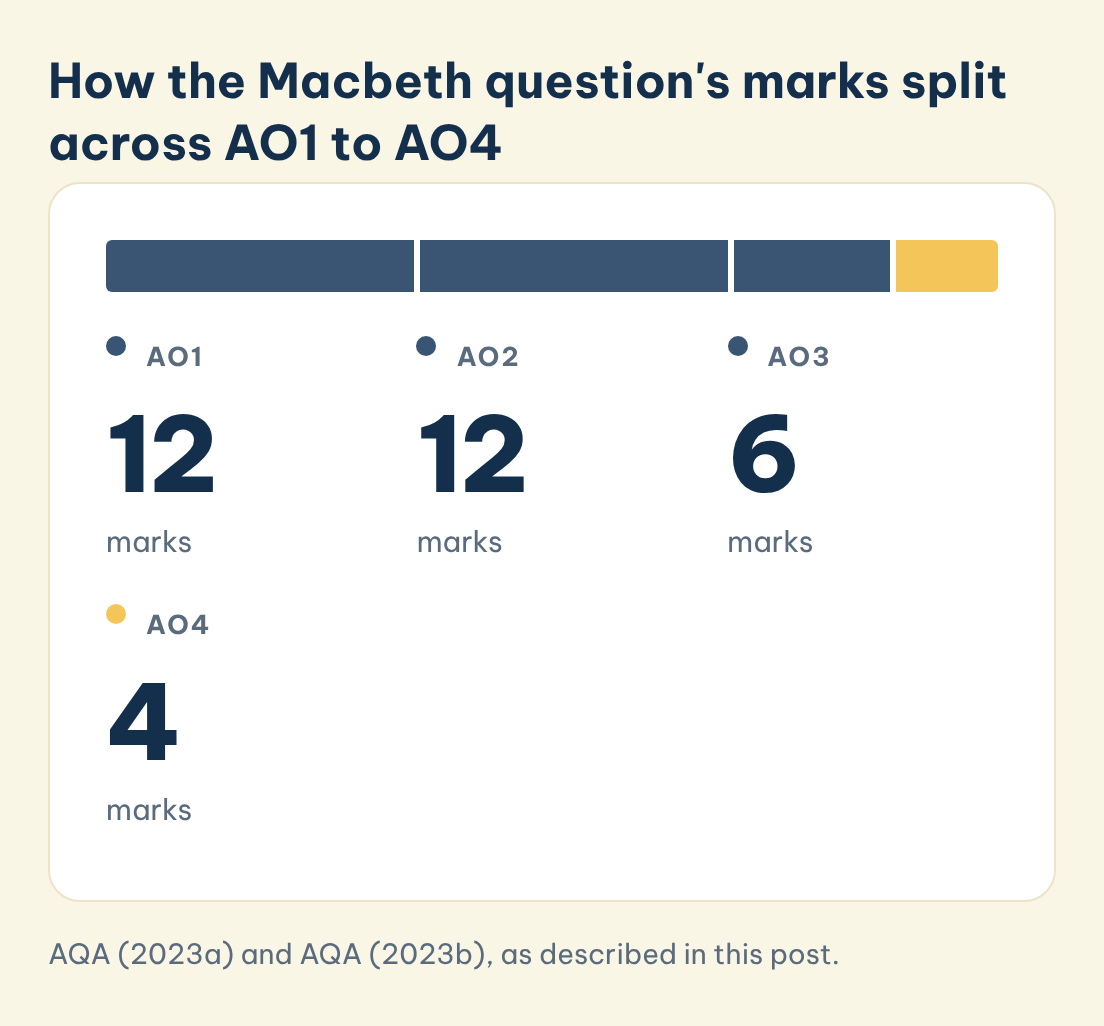
AQA (2022) defines the four objectives. AO1 is reading, understanding and responding, with a critical style, an informed personal response and textual references that include quotations. AO2 is language, form and structure, using subject terminology. AO3 is the relationship between texts and the contexts in which they were written. AO4 is accurate vocabulary, sentence structures, spelling and punctuation. The 2023 question paper states that "There are 4 marks available for AO4 in Section A in addition to 30 marks for answering the question" (AQA, 2023a, p. 1).
| Objective | What it rewards | Marks in the 2023 Macbeth question |
|---|---|---|
| AO1 | Informed personal response, with quotations | 12 |
| AO2 | Language, form and structure, with terminology | 12 |
| AO3 | Links between the play and its contexts | 6 |
| AO4 | Accurate spelling, punctuation and vocabulary | 4 (additional) |
The totals in the table come from the mark scheme, which sets questions 1 to 13 at 30 marks with AO1 at 12, AO2 at 12 and AO3 at 6, and which gives AO4 high performance 4 marks, intermediate 2 to 3 and threshold 1 (AQA, 2023b, pp. 7-8). Ofqual (2015, p. 6) sets AO4 at 5% across a GCSE English literature specification, and AQA (2022) puts Paper 1's share of it at 2.5% of the whole GCSE.
The practical reading is that context (AO3) carries the smallest share of the 30 marks. A paragraph on Jacobean history that never touches a quotation is working for 6 marks at most, while analysing Shakespeare's language earns up to 12.
◆ Question 3 / 7 · Which Macbeth themes should
Which Macbeth themes should you revise?
Direct answer: Revise themes as they appear in the mark scheme's indicative content: Macbeth's change, violence and ambition, conscience, the witches and the supernatural, kingship, and his relationship with Lady Macbeth. AQA (2023b) adds that valid interpretations beyond that list should be rewarded.
Searchers often ask for "Macbeth revision themes" and "Macbeth revision supernatural" as separate lists. The most reliable guide to what an examiner is looking for is the indicative content published with the 2023 mark scheme for the question above. It is specific to that question, so treat it as an example of how themes get tied to a task rather than as a prediction of next year's paper.
| Area to revise | What the 2023 indicative content mentions |
|---|---|
| Character and change (AO1) | Macbeth's despair in the extract, the brave warrior before he appears, brutality such as the murder of Duncan, conscience, Macbeth at the end |
| Language and form (AO2) | The language of despair, soliloquies that reveal inner thoughts, the changing relationship with Lady Macbeth |
| Context (AO3) | Violence in the context of war and ambition, the role of the witches and the supernatural, religious issues, kingship and expectations of it |
Source: AQA (2023b, p. 11).
The same page of the mark scheme gives the principle that protects your own ideas: "Examiners are encouraged to reward any valid interpretations." (AQA, 2023b, p. 11). So the list is a floor and not a ceiling. A good revision habit is to take each theme, such as ambition or the supernatural, and write one sentence for each of AO1, AO2 and AO3 about it, so that every theme is ready to be argued in all three directions.
◆ Question 4 / 7 · How do you learn Macbeth
How do you learn Macbeth quotations?
Direct answer: Learn a small bank of short quotations by testing yourself from memory instead of rereading them. Agarwal et al. (2021) reviewed applied research in schools and classrooms and concluded that retrieval practice consistently benefits student learning, which supports closed-book self-quizzing.
Because the exam is closed book, every quotation you use has to come from memory. Start by choosing quotations that can serve several themes, so that one short line can support ambition, guilt and the relationship with Lady Macbeth in different answers. Ten to twelve well-chosen lines you can recall exactly are more useful than forty you half remember, because a quotation is only worth marks when it is used to prove a point about language or structure.
Then practise by retrieving, not rereading. Cover the line, write down the next one, check it and mark what you missed; or give yourself a theme and write out every quotation you can recall for it, then compare with the text. Agarwal et al. (2021) is a systematic review of retrieval practice in real classrooms, and its overall finding is the one in its title, that retrieval practice consistently benefits student learning. This guide uses the review only at that general level: it does not claim a particular schedule or size of benefit for Macbeth. What it does give you is a reason to spend revision time producing answers from memory rather than only reading notes.
◆ Question 5 / 7 · Are Macbeth revision notes
Are Macbeth revision notes, PDFs and booklets enough?
Direct answer: Notes, PDFs, booklets, videos and lessons are useful inputs, but they are not practice. The exam asks you to write a response, so the revision that matches it is retrieving quotations and writing answers against the mark scheme, then checking your answers against the published criteria.
Many of the results for a "Macbeth revision pdf" or "Macbeth revision booklet" search are summaries, and a summary tells you what to think about the play. The exam asks something different: it asks you to make a case, with evidence, about a question you have not seen. So use a summary to find gaps, then close each gap by writing. If a theme note says that Macbeth's conscience troubles him after Duncan's murder, turn it into a paragraph that starts from a quotation and ends on a judgement.
The mark scheme is the best checking tool. AQA (2023b, p. 8) describes the top band, Level 6 at 26-30 marks, with the AO1 feature "Critical, exploratory, conceptualised response to task and whole text", and Level 5 at 21-25 marks as a "Thoughtful, developed response to task and whole text". Reading those descriptors and then marking one of your own answers against them shows you quickly whether you are describing the play or arguing about it. If you later move on to university essays, the same shift from description to argument is the one our guide to writing a comparative essay works through.
◆ Question 6 / 7 · What does a timed practice
What does a timed practice plan look like?
Direct answer: Plan around the 1 hour 45 minutes the paper allows for both texts. Practise one Macbeth question at a time, then a full paper, and mark each against the AO split. A marks-proportional guide gives Macbeth about 56 minutes, but that figure is arithmetic, not AQA advice.
The paper carries 64 marks in 105 minutes, and the Macbeth question is worth 34 of them (30 plus 4 for AO4). Sharing the time in proportion to marks gives roughly 56 minutes for Macbeth and the rest for the novel. That split is simple arithmetic from the figures in AQA (2022) and AQA (2023a), not guidance from the board, so adjust it to your own pace with your teacher.
A plan that builds in stages works well. In the first weeks, practise short pieces: plan a response in five minutes from a past question and an extract, with no writing. Next, write one opening paragraph and one paragraph on a later part of the play, timed. Then write a full Macbeth answer in one sitting and mark it against the 12/12/6/4 split, circling where each mark is earned. Finally, sit a full paper in 1 hour 45 minutes. After each piece, write down the one thing to change next time; a short list of fixes is more useful than a general feeling that it went badly.
◆ Question 7 / 7 · How does MAAS help with exam
How does MAAS help with exam preparation?
Direct answer: Your teacher and the published AQA mark scheme are the best guides for GCSE revision. MAAS's tutoring service is for university students and does not write answers; it carries no grade target or refund, though you can ask to switch expert if the fit is wrong.
If you later study literature at university, MAAS's one-to-one tutoring service works the same way: a tutor shows how assessment criteria are earned and comments on plans you draft, while the thinking and the writing stay yours. If you want to talk through what your own study should look like, a free 20-minute consultation is the place to start, and you can book one here.
Frequently asked questions
How many marks is the Macbeth question on AQA Paper 1?
It is 30 marks for the answer, plus 4 marks for AO4 (spelling, punctuation and vocabulary), so 34 in total (AQA, 2023a). The paper as a whole is 64 marks in 1 hour 45 minutes (AQA, 2022).
Do you get the Macbeth text in the AQA exam?
No. AQA (2022) states that all assessments are closed book, so quotations have to come from memory. You are given a printed extract on the question paper, but not the whole play.
How should you split your revision between AO1, AO2 and AO3?
Let the 2023 mark scheme guide you: 12 marks each for AO1 and AO2 and 6 for AO3 (AQA, 2023b). That means most of your practice should combine quotations with comments on language and structure.
Is there only one right reading of Macbeth?
No. The mark scheme says "Examiners are encouraged to reward any valid interpretations." (AQA, 2023b, p. 11). Back every reading with evidence from the text and tie it to the question.
Are revision PDFs and booklets enough?
They help you find gaps, but the exam asks you to write. Agarwal et al. (2021) found that retrieval practice consistently benefits student learning, so turn each note into a recalled quotation or a written paragraph.
Is this advice the same for Edexcel and OCR?
Not necessarily. This guide follows AQA 8702 only, so check your own board's paper for its format, marks and timings.
References
Agarwal, P. K., Nunes, L. D., & Blunt, J. R. (2021). Retrieval practice consistently benefits student learning: A systematic review of applied research in schools and classrooms. Educational Psychology Review, 33, 1409-1453. https://doi.org/10.1007/s10648-021-09595-9
AQA. (2022). GCSE English Literature (8702) specification (Version 1.3). https://filestore.aqa.org.uk/resources/english/specifications/AQA-8702-SP-2015.PDF
AQA. (2023a). GCSE English Literature Paper 1 Shakespeare and the 19th-century novel (8702/1) question paper, June 2023. https://filestore.aqa.org.uk/sample-papers-and-mark-schemes/2023/june/AQA-87021-QP-JUN23.PDF
AQA. (2023b). GCSE English Literature Paper 1 Shakespeare and the 19th-century novel (8702/1) mark scheme, June 2023. https://filestore.aqa.org.uk/sample-papers-and-mark-schemes/2023/june/AQA-87021-MS-JUN23.PDF
Ofqual. (2015). GCSE (9 to 1) subject level conditions and requirements for English literature (Version 3). https://www.gov.uk/government/publications/gcse-9-to-1-subject-level-conditions-and-requirements-for-english-literature
Not sure how this guide applies to your own case? Talk it through with MAAS in a free 20-minute consultation.
Book a free consultation ▸