
◆ Citation & Formatting
How do you create an MLA 9 citation for a humanities essay?
Category: citation-formatting
Last updated: 2026-10-20
A student in a literature seminar has spent a week on a close reading, and the argument is finally sound. Then she opens the style guide and finds a list of nine elements, a word she has never met called a container, and a page number that goes in brackets without a comma. None of it is hard, but all of it is unfamiliar if her previous coursework used APA or Harvard.
Direct answer: To create an MLA 9 citation, you collect nine core elements about the source, put them in a fixed order with fixed punctuation, and end the entry with the location. In the text you give only the author's surname and a page number, which then points to that Works Cited entry.
MLA is a template rather than a list of rules per source type. The Modern Language Association of America (n.d.-a) describes the ninth edition, published in April 2021, as a work that serves "as both a textbook and a reference guide", with "expanded, in-depth guidance on how to use the MLA template of core elements". Once you understand the template, a book, an article and a web page all follow the same logic.
This guide covers only MLA 9. For the other major author-date system, see the APA 7th referencing guide, and for its UK and Australian cousin, the Harvard referencing guide.
◆ Question 1 / 9 · What MLA 9 is
What is MLA 9 and who uses it?
Direct answer: MLA 9 is the ninth edition of the MLA Handbook, published by the Modern Language Association in 2021. It is the default style in literature, languages, cultural studies and many other humanities courses, and it works from a single template that adapts to any kind of source.
The handbook itself is cited as a book (Modern Language Association of America, 2021), and the association publishes the same guidance online through the MLA Style Center. The ninth edition added a new, easy-to-follow explanation of in-text citations and a new chapter with recommendations for using inclusive language (Modern Language Association of America, n.d.-a). Both additions matter to students because the in-text rules are now explained from first principles rather than by long lists of exceptions.
In practice, whether you use MLA depends on the department, not on the country. A literature or philosophy module in Australia or the United Kingdom may still ask for MLA while the business school next door asks for Harvard. Check the module handbook before you collect a single source, because rebuilding a Works Cited page into another style after drafting is slow and invites errors.
◆ Question 2 / 9 · The nine core elements
What are the nine core elements of an MLA citation?
Direct answer: The nine core elements are author, title of source, title of container, other contributors, version, number, publisher, publication date and location. Each is followed by a set punctuation mark, and any element that does not apply to your source is simply left out.
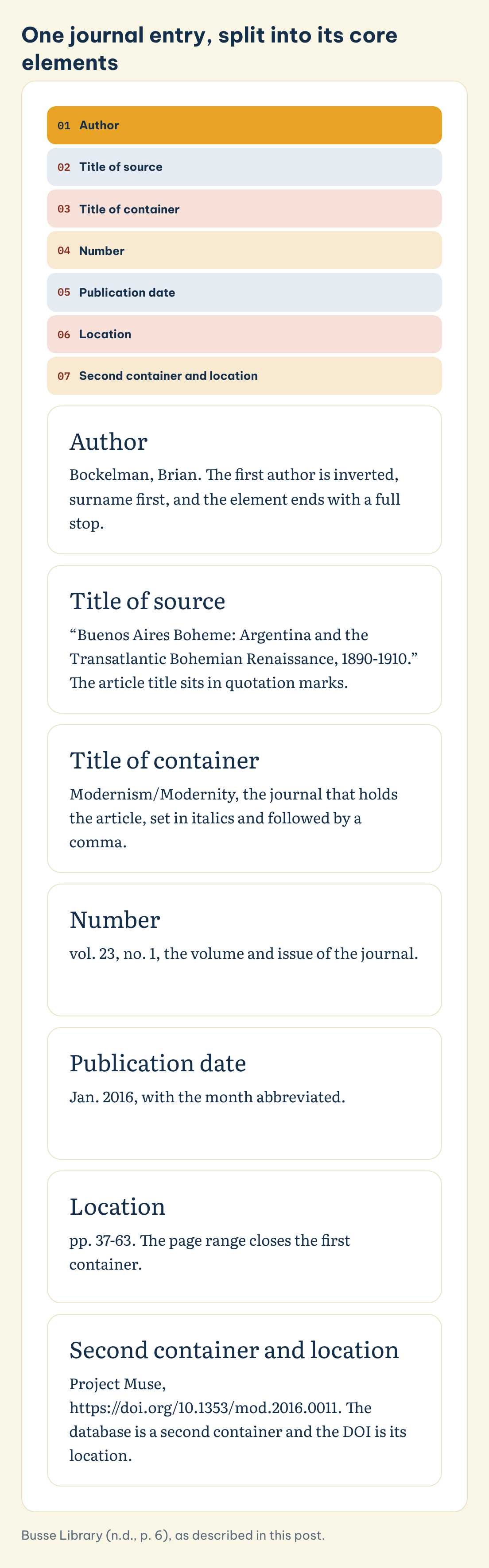
One journal entry, split into its core elements
Tap an element to see the part of the Bockelman entry it fills.
Author
Bockelman, Brian. The first author is inverted, surname first, and the element ends with a full stop.
Title of source
“Buenos Aires Boheme: Argentina and the Transatlantic Bohemian Renaissance, 1890-1910.” The article title sits in quotation marks.
Title of container
Modernism/Modernity, the journal that holds the article, set in italics and followed by a comma.
Number
vol. 23, no. 1, the volume and issue of the journal.
Publication date
Jan. 2016, with the month abbreviated.
Location
pp. 37-63. The page range closes the first container.
Second container and location
Project Muse, https://doi.org/10.1353/mod.2016.0011. The database is a second container and the DOI is its location.
Save this figure
Purdue Online Writing Lab (n.d.) lists the elements in the order below, and the Modern Language Association of America (n.d.-b) confirms that they are "assembled in a specific order". The values in the final column come from the teaching examples published by the Australian Catholic University Library (n.d.) and Busse Library (n.d.), so you can see how the template looks when it is filled in.
| # | Element | Punctuation after it | Example value |
|---|---|---|---|
| 1 | Author | Full stop | Abrahamson, Mark. |
| 2 | Title of source | Full stop | Urban Sociology: A Global Introduction. |
| 3 | Title of container | Comma | Modernism/Modernity, |
| 4 | Other contributors | Comma | translated by Edith Grossman |
| 5 | Version | Comma | 12th ed., |
| 6 | Number | Comma | vol. 23, no. 1, |
| 7 | Publisher | Comma | Cambridge UP, |
| 8 | Publication date | Comma | 2014, |
| 9 | Location | Full stop | pp. 37-63. |
The sequence is the same for every source. What changes is which rows you fill. A book usually uses author, title, version, publisher and date. A journal article uses nearly all nine, because the article is the source and the journal is the container that holds it.
◆ Question 3 / 9 · Containers
What is a container, and why does MLA use the idea?
Direct answer: A container is the larger whole that holds the source you are citing: a journal that holds an article, a website that holds a page, or an anthology that holds a chapter. MLA lets you nest containers, so a reader can trace exactly where you found the item.
The Modern Language Association of America (n.d.-b) puts it this way: "the larger whole can be thought of as a container that holds the source". A poem is the source, the anthology is its container, and if you read the anthology through a database, the database becomes a second container. Each container gets its own title and its own location.
This idea explains why one template covers everything. Instead of memorising a separate pattern for a podcast episode, a film clip and a database article, you ask two questions: what is the thing I am citing, and what is it inside? A book has no container, so its entry stays short. A journal article sits in a journal, and often in a database too, so the entry runs to a second container. The more layers between you and the source, the more of the nine slots you will use.
◆ Question 4 / 9 · Building an entry
How do you build a Works Cited entry step by step?
Direct answer: Identify the source and its container, list the nine elements in order, drop any that do not apply, and add the punctuation shown for each. Then invert the first author's name, because the entry is sorted alphabetically by surname on the Works Cited page.
Start with a book, the simplest case. The Australian Catholic University Library (n.d.) gives this pattern for a single-author book: Abrahamson, Mark. Urban Sociology: A Global Introduction. Cambridge UP, 2014. It has only four elements, and the instruction behind the first one is explicit: "Invert the first author's name, with surname first, for alphabetical sorting." A two-author book such as The Developing Child keeps the second name in normal order: Bee, Helen, and Denise Boyd. The Developing Child. 12th ed., Allyn and Bacon, 2014.
A journal article adds a container. Busse Library (n.d., p. 6) shows this one: Bockelman, Brian. "Buenos Aires Boheme: Argentina and the Transatlantic Bohemian Renaissance, 1890-1910." Modernism/Modernity, vol. 23, no. 1, Jan. 2016, pp. 37-63. Project Muse, https://doi.org/10.1353/mod.2016.0011. Here the article title sits in quotation marks, the journal title is italicised, the database Project Muse is a second container, and the DOI is the location. Purdue Online Writing Lab (n.d.) advises preferring a DOI to a plain URL.
A web page follows the same method. Name the author or organisation, give the page title in quotation marks, give the website as the container in italics, then the publisher, date and URL. Purdue Online Writing Lab (n.d.) adds that you should drop the "http://" or "https://" from the start of the address, so the location begins at the first character after the slashes.
◆ Question 5 / 9 · In-text citations
How do in-text citations work in MLA?
Direct answer: An MLA in-text citation gives the author's surname and the page number in brackets with no comma and no "p.", and it sits before the full stop. If you name the author in your own sentence, only the page number goes in the brackets.
Busse Library (n.d., p. 1) states the rule directly: the citation is "the author's last name and page number in parenthesis at the end of the sentence. If the author is mentioned by name in the sentence, then only the page number needs to be included in the parenthesis." Its two examples show both shapes: a bracketed form such as (Dennis 22), and a narrative form such as Michael Agar calls "languaculture" (60).
The page number is what makes MLA distinctive for humanities writing. Literature essays quote closely and often, so the reader needs to find the line, not just the book. Purdue Online Writing Lab (n.d.) summarises the same logic: the in-text citation is the author's surname plus the page. The surname you use must match the first word of the Works Cited entry exactly, because that match is how the marker links the two. Yuba College states the rule as a lookup: "Whatever comes first in the works cited entry is what you will include in the in-text citations" (Yuba College, 2021, p. 1). For a work with no page numbers, such as a web page, use the author only and leave the number out.
◆ Question 6 / 9 · Several authors
How do you cite sources with several authors?
Direct answer: With one or two authors you name both in the Works Cited entry and in the text. With three or more, you give only the first author's surname followed by "et al." in the text, and the Works Cited entry follows the same abbreviation logic after the first name.
The Australian Catholic University Library (n.d.) puts the rule in one sentence: "When citing a work with 3 or more authors, use only the first author's surname, followed by 'et al.'" Busse Library (n.d., p. 3) says the same from the in-text side: "If there are more than two authors, include only the first author's name and then et al."
The university's example is an edited collection: Brouillette, Sarah, et al., editors. Literature and the Global Economy. Palgrave Macmillan, 2017. In the text this becomes (Brouillette et al. xix), where the Roman numeral is simply the page in the preface. Notice that "et al." carries a full stop and no comma separates it from the page number.
Compare this with the author-date systems. APA and Harvard each set their own threshold for shortening a list of authors, and they differ from each other. MLA is simpler: from the third author onward, the list collapses to the first author and "et al.", with no exceptions to remember.
◆ Question 7 / 9 · DOIs, URLs and access dates
How do you cite a DOI, a URL or an access date in MLA?
Direct answer: MLA treats the access date as optional, and it matters most when an online source shows no publication date, which is why many marking guides ask for it. Drop "http://" and "https://" from ordinary URLs, and prefer a DOI, written as a full https://doi.org/ link, whenever the source provides one.
Purdue Online Writing Lab (n.d.) records the position carefully: for online sources the handbook "recommends including a date of access". That wording is a recommendation, not a requirement, so the safe course is to follow your department. If the module handbook asks for access dates, add one at the end of the entry; if it says nothing, being consistent across the whole list matters more than the choice itself.
Web pages change, which is why the date exists. A page can be edited or removed after you read it, and an access date tells the marker which version you consulted. A DOI avoids the problem for journal articles, because it points to one fixed record. This is why the Bockelman example above ends with a DOI and no access date, while a blog post or news page, which has no such identifier, is the case where the date earns its place.
◆ Question 8 / 9 · The Works Cited page
How do you format the Works Cited page?
Direct answer: Start a new page, centre the heading "Works Cited" at the top, double space every entry, sort entries alphabetically by the first word, and give each entry a half-inch hanging indent so that the first line sits flush left and every later line is indented.
Busse Library is precise about the indent: "if an entry requires more than one line, indent all succeeding lines one-half inch from the left margin. This is known as a hanging indent" (Busse Library, n.d., p. 2). The same page tells students to center the heading "Works Cited" at the top of the page and to double space all citations. In Word or Google Docs the hanging indent is a paragraph setting, so apply it to the whole list rather than pressing the tab key at each line break.
Sorting follows the first word of each entry, which is why the first author is inverted. If two entries start with the same surname, sort by the next element. Every in-text citation must have an entry on this page, and every entry must be cited at least once in the essay. Read the page against the finished text one entry at a time before you submit; it takes minutes and catches the problems markers check first.
◆ Question 9 / 9 · Common mistakes
What are the most common MLA mistakes?
Direct answer: Five errors come up again and again: writing a comma between surname and page number, using "p." in the brackets, forgetting the hanging indent, leaving out the second container for database articles, and mixing APA or Harvard habits into the Works Cited entries.
The first two come from habit. Students who learned APA first write (Dennis, 22) or (Dennis p. 22), but Busse Library (n.d., p. 1) shows the MLA shape as (Dennis 22). The third is a formatting problem; a Works Cited page without a hanging indent looks like a plain list and signals that the template was not followed.
The fourth is a conceptual miss. Many students cite the journal and forget that the database they read it in is a second container. Including it makes the entry longer, but it follows the nine-element template exactly. The fifth is the quiet one: a year placed in brackets after the author, or a title left in plain text where MLA wants italics or quotation marks. These are the signs of copying from a generator that produced a different style. Check any generated entry against the handbook pattern in the MLA Style Center guidance before it goes into your list.
If you are still building the essay itself, the how to write a university essay guide covers structure and argument, which is what the citations are there to support.
Frequently asked questions
Is MLA 9 the same as MLA 8?
The core-element template carried over from the eighth edition. The ninth edition, published in April 2021, expanded the guidance on using that template, added a clearer explanation of in-text citations and added a chapter on inclusive language (Modern Language Association of America, n.d.-a).
Do I put a comma between the author and the page number?
No. MLA writes the surname and the page with just a space, as in (Dennis 22). If you name the author in your sentence, only the page number goes in the brackets (Busse Library, n.d., p. 1).
How many authors can I list before using et al.?
Name one or two authors in full. From three authors onward, give only the first author's surname followed by "et al." (Australian Catholic University Library, n.d.).
Is the access date compulsory?
It is recommended for online sources rather than required, so follow your department's guide (Purdue Online Writing Lab, n.d.). When you do include it, place it at the end of the entry and keep the format consistent throughout.
What goes first in a Works Cited entry?
The first author's surname, followed by their given name. The surname comes first because the page is sorted alphabetically (Australian Catholic University Library, n.d.). If there is no author, the entry begins with the title of the source.
Can I use a citation generator?
As a drafting aid, yes. Check each output against the nine-element template, because a generator may produce another style or skip a container, and the marker will check your list against the MLA pattern rather than against the tool.
Related resources
- APA 7th referencing guide: the full guide to the other major author-date system
- Harvard referencing guide: how Harvard varies between universities, and how to follow your own department's version
- How to write a university essay: structure and argument for the essay your citations support
- Academic Support service: coaching through Outline, Draft and Final with a discipline-matched expert
Ready to start? Book a free 20-minute consultation. Bring your assignment brief and your department's referencing guide, and we will match you to a mentor in your discipline, usually within 48 hours.
References
- Australian Catholic University Library. (n.d.). MLA 9th: Author layout. https://libguides.acu.edu.au/mla/author-layout
- Busse Library, Mount Mercy University. (n.d.). Busse Library: Guide to MLA citation format [PDF]. https://www.mtmercy.edu/_documents/academics/library/MLA-9th-2021-Citation-Guide.pdf
- Modern Language Association of America. (2021). MLA handbook (9th ed.). Modern Language Association of America.
- Modern Language Association of America. (n.d.-a). What's new in the ninth edition. MLA Style Center. https://style.mla.org/ninth-edition-whats-new/
- Modern Language Association of America. (n.d.-b). Works cited: A quick guide. MLA Style Center. https://style.mla.org/works-cited/works-cited-a-quick-guide/
- Purdue Online Writing Lab. (n.d.). MLA formatting and style guide. Purdue University. https://owl.purdue.edu/owl/research_and_citation/mla_style/mla_formatting_and_style_guide/mla_formatting_and_style_guide.html
- Yuba College Academic Success and Writing Services. (2021). MLA 9th quick guide [PDF]. https://yc.yccd.edu/wp-content/uploads/2021/12/MLA-9th-Quick-Guide.pdf
Tools & resources
- MLA Style Center: the Modern Language Association's own site, with the works cited quick guide and the ninth-edition changes
- Purdue OWL MLA guide: worked examples for the nine core elements
This article is part of the MAAS Journal series for Vietnamese international students. With MAAS Academic Support, a discipline-matched expert coaches you through the Outline, Draft and Final stages against your marking rubric. We guide students through worked examples, drafts and feedback so they reference their own work accurately against their own department's guide, and we do not write or reference assignments on students' behalf.
Not sure how this guide applies to your own case? Talk it through with MAAS in a free 20-minute consultation.
Book a free 20-minute consultation ▸