
◆ Health & Education
EDUC9511 assignment: how do you approach Complex Communication Needs and AAC?
EDUC9511 Complex Communication Needs and AAC asks you to assess a communicator and feature-match an AAC system to their needs, not describe devices. Most students who struggle with this Flinders University topic are not short on compassion; they describe a person's disability and the technology well, but never argue why a particular AAC system fits that individual's competencies and context. This guide answers the questions Vietnamese students at Flinders ask MAAS mentors most often before they start an EDUC9511 assignment.

◆ Question 1 / 8 · About the topic
What is EDUC9511 Complex Communication Needs and AAC about?
Direct answer: EDUC9511 Complex Communication Needs and Augmentative and Alternative Communication is a 4.5-unit topic in Flinders University's Master of Inclusive and Specialised Education. It examines how people who cannot rely on speech alone, such as those with cerebral palsy, communicate using augmentative and alternative communication (AAC). The topic wants you to assess communication and match the right AAC supports.
Evidence: The foundational text is Beukelman and Mirenda, Augmentative and Alternative Communication: Supporting Children and Adults with Complex Communication Needs (Beukelman & Mirenda, 2013; now Beukelman & Light, 2020). Its structure, the Participation Model, assessment, symbol and vocabulary selection, aided and unaided systems, maps closely onto the topics most EDUC9511 assessments draw from.
Example: A Vietnamese student came to MAAS convinced EDUC9511 was "about choosing the best communication app." Her mentor reframed it: the topic is about assessing one person's communicative competence and context, then justifying an AAC system against that evidence. Once she saw every section through that lens, her draft stopped reviewing products and started arguing a defensible recommendation and her mark moved from Pass toward Distinction.
◆ Question 2 / 8 · The assignment
What does the EDUC9511 assignment usually involve?
Direct answer: Assessments in a Complex Communication Needs and AAC topic typically ask you to work from a case, a real or provided individual, assess their current communication, and recommend and justify AAC supports across home, school or community settings. Common forms include a communication assessment report, a case-based AAC plan, and a professional-application task linking your analysis to evidence-based practice and inclusive-education policy. Always confirm the exact brief, word count and weighting in your own Flinders topic.
Evidence: Postgraduate education assessments at Flinders are criterion-referenced, marks are awarded against published rubric criteria, not ranked against classmates. This is why decoding the rubric matters far more than writing length, and why every task expects an explicit evidence-to-practice link rather than a product review.
Example: A Vietnamese Flinders student spent more than half of a communication assessment report on a child's diagnosis and medical history. His MAAS mentor cut the background to a few framing sentences and reallocated the words to assessing the child's communicative competence and feature-matching a system, same case, higher band.
◆ Question 3 / 8 · Grading
How is the EDUC9511 assignment graded, what does the rubric reward?
Direct answer: AAC rubrics reward four things, roughly in order: (1) depth of analysis of the individual's communication and context, (2) correct, explicit use of AAC models and evidence, (3) practical recommendations matched to the person, and (4) academic writing and APA 7th referencing. Describing a disability or a device earns almost no marks, marks live in why a support fits this communicator and how you would implement it. Replace a descriptive sentence with an analytical one every time you can.
Evidence: Criterion-referenced rubrics in inclusive-education topics typically use bands such as Pass / Credit / Distinction / High Distinction, and the jump from Credit to Distinction is almost always defined by the word "critical", critical analysis of communication needs, critical application of evidence, not by adding more background.
Example: A MAAS mentor tagged a Vietnamese student's draft sentence by sentence as "describe" or "analyse"; it was roughly 80% describe. After one restructuring pass that flipped the ratio toward analysis, the same case and sources moved the mark up two full bands.
◆ Question 4 / 8 · AAC frameworks
Which AAC models and frameworks should you use in EDUC9511?
Direct answer: Anchor your analysis in two or three established AAC frameworks rather than name-dropping many. The most useful for EDUC9511 are Light's four domains of communicative competence (Light, 1989; Light & McNaughton, 2014) and the Participation Model and feature-matching process (Beukelman & Mirenda, 2013). Use a framework to reach a judgement about a real person's communication, do not force every model in.
Light's four domains of communicative competence and how to use each in EDUC9511
Each row sets one of Light's domains beside how to use it in the assignment, taken from the table in this post.
Communicative competence domain (Light)
Use it in EDUC9511 to…
Linguistic
Justify vocabulary and symbol choices for the individual
Operational
Match an access method to the person's motor abilities
Social
Plan partner training and authentic communication opportunities
Strategic
Build in repair strategies and prediction/clarification
Save this figure
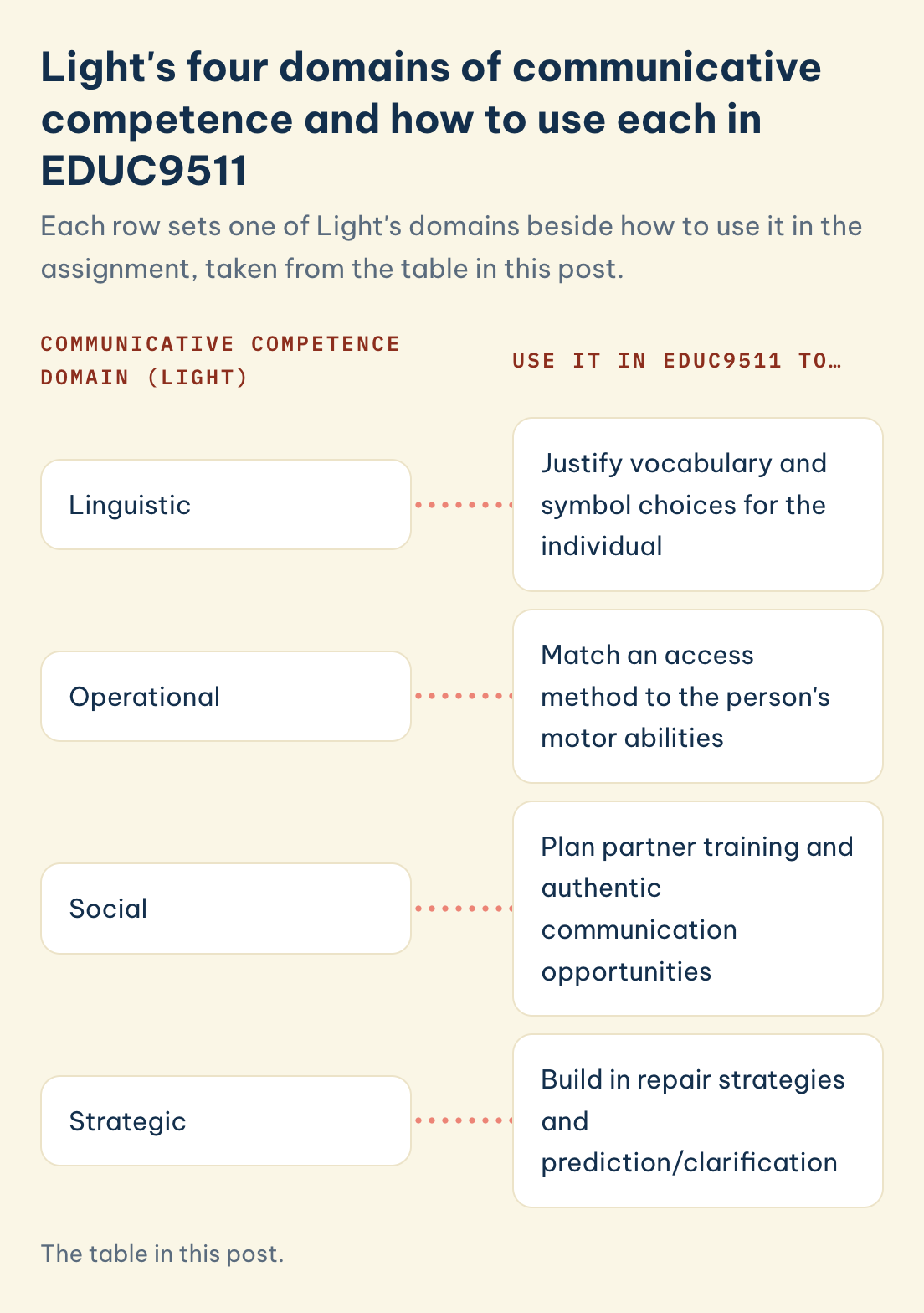
| Communicative competence domain (Light) | What it covers | Use it in EDUC9511 to… |
|---|---|---|
| Linguistic | Receptive and expressive language, plus the symbols/codes of the AAC system | Justify vocabulary and symbol choices for the individual |
| Operational | The technical skills to use the AAC tool (access method, navigation) | Match an access method to the person's motor abilities |
| Social | Initiating, maintaining and ending interaction appropriately | Plan partner training and authentic communication opportunities |
| Strategic | Compensatory strategies when communication breaks down | Build in repair strategies and prediction/clarification |
Evidence: Light (1989) defined communicative competence for AAC users as "a relative and dynamic, interpersonal construct based on functionality of communication, adequacy of communication, and sufficiency of knowledge, judgment and skill in four interrelated domains: linguistic competence, operational competence, social competence, and strategic competence" (Light, 1989, p. 137). Light and McNaughton (2014) expanded it to include psychosocial factors, motivation, attitude, confidence, resilience and environmental barriers and supports. Beukelman and Mirenda's Participation Model (2013) turns these domains into a feature-matched recommendation. These are foundational, examiner-recognised sources.
Example: A Vietnamese student analysing an autistic child's communication tried five models and explained each shallowly. Her mentor cut it to two, Light's competence domains to locate the breakdown, the Participation Model to feature-match a system. Fewer frameworks, deeper application, higher mark.
◆ Question 5 / 8 · AAC assessment
How do you carry out an AAC assessment and feature matching?
Direct answer: Feature matching means describing the individual first, their current communication, sensory and motor profile, language level, and the partners and settings they communicate in, then selecting AAC features that fit, rather than starting from a favourite device. The recommendation is strong when every feature you choose is traceable back to evidence about the person.
| AAC system type | Examples | Best fit when… |
|---|---|---|
| Unaided | Gesture, sign, facial expression, vocalisation | The person has reliable motor control and partners who understand the system |
| Aided, low-tech | Communication boards, books, PODD, symbol cards | Robust, low-cost, no power needed; good for early or back-up systems |
| Aided, high-tech | Speech-generating devices, AAC apps on a tablet | Voice output and large vocabularies are needed across many partners |
Evidence: Romski and Sevcik (2005) dismantled the persistent "myths" that hold AAC back, that AAC is a last resort, that there are prerequisite skills before it can begin, or that it hinders speech and argued for early, evidence-based intervention. Presuming competence and avoiding prerequisites is now standard AAC practice, and markers expect you to reflect it.
Example: A Vietnamese Flinders student recommended a high-tech speech-generating device because it was "the most advanced." His MAAS mentor pushed him to feature-match instead: the child's motor profile and need for a durable back-up pointed to a low-tech PODD book alongside an AAC app. The evidence-led recommendation earned full marks on the recommendations criterion.
◆ Question 6 / 8 · Structure
How should you structure the EDUC9511 assignment?
Direct answer: Use an assessment-led structure: (1) a brief introduction and case context (under 10% of the word count), (2) assessment of the individual's communication using your chosen frameworks, (3) feature-matched recommendations for AAC systems and strategies, (4) an implementation and partner-training plan linked to inclusive-education policy, and (5) a short conclusion. The biggest structural fix is shrinking the case description and expanding the assessment and recommendation sections, where the marks concentrate.
Evidence: Criterion-referenced rubrics weight "assessment and application of evidence" and "recommendations and implementation" far above "context and background." Calculator (2009) shows AAC recommendations are judged by how well they support genuine participation and inclusion, not by device sophistication.
Example: A Vietnamese student submitted a draft with a long case history and a two-sentence implementation plan. Her MAAS mentor inverted the ratio, and the final report, same case, same readings, moved from a borderline Credit to a Distinction because the partner-training plan was finally developed enough to be assessed.
◆ Question 7 / 8 · Length and referencing
How long is the EDUC9511 assignment and what referencing style does it use?
Direct answer: Confirm the exact word count and style in your assessment brief, postgraduate AAC reports at this level commonly sit between 2,000 and 3,000 words, and Flinders education topics use APA 7th referencing. Stay within the 10% tolerance band, cite every model and evidence claim, and make sure your in-text citations and reference list match exactly. Reference accuracy is a quick, reliable source of marks that many students leave on the table.
Evidence: APA 7th is the standard style across Flinders education topics, and markers routinely deduct marks for inconsistent or incomplete APA referencing even when the analysis is strong. Foundational AAC sources and any policy documents you draw on must each appear correctly in your reference list.
Example: A Vietnamese student kept losing marks for mismatched in-text citations and reference-list entries. A MAAS pre-submission audit caught more than a dozen APA errors in about an hour, and clean APA 7th referencing recovered marks on a criterion that requires no extra research.
◆ Question 8 / 8 · Common mistakes
What are the most common mistakes that lose marks in EDUC9511?
Direct answer: Three recurring mistakes show up across MAAS AAC coaching. First, students describe the disability or device instead of assessing the person's communication. Second, they recommend a system before feature-matching, so it is not traceable to evidence. Third, the implementation plan is generic ("provide a device and train staff") rather than specific about who, what, where and how. Fixing these three lifts most drafts by at least one band.
Evidence: Across MAAS inclusive-education coaching, marker feedback before intervention clusters on "more critical analysis needed" and "recommendations not sufficiently justified", the two phrases that most often separate a Credit from a Distinction.
Example: A Vietnamese student's recommendation read "the child should use an AAC app." Her mentor pushed her to specify which core vocabulary, which access method, which partners would be trained, and how progress would be monitored. The specific, feature-matched version earned full marks on the recommendations criterion.
Frequently asked questions
Is EDUC9511 a hard topic?
It is conceptually demanding rather than technically hard; there is no maths, but the topic expects you to assess a person's communication through evidence and frameworks rather than review devices. Students who treat it as "pick the best app" struggle; students who treat it as "feature-match a system to this individual" do well.
Do I need a real case or client for EDUC9511?
Many tasks use a provided case study, a video, or a person you already work with. Always follow your topic's ethics, consent and privacy guidance, and check whether your brief supplies the case or asks you to source it. The quality of your assessment matters more than the source of the case.
Which AAC model should I use in the assignment?
There is no single "correct" model, markers reward you for choosing frameworks that fit your case and using them critically. Light's competence domains plus the Participation Model, applied deeply, beats five models named in passing.
What is feature matching and why does it matter?
Feature matching is selecting AAC features to fit the individual's strengths, needs and contexts, rather than starting from a device. It matters because the rubric rewards recommendations that are traceable to evidence about the person, not device sophistication.
What referencing style does EDUC9511 use?
APA 7th is standard for Flinders education topics. Confirm in your brief, cite every model and policy document, and check that your in-text citations match your reference list exactly.
Can MAAS help me with EDUC9511?
Yes. MAAS Assignment & Essay Support coaches you through the assignment with the Outline, Draft, Final model, rubric decoding, framework selection, draft feedback, and a pre-submission APA audit, all with discipline-matched experts. We coach your work; we do not write it for you.
Ready to approach EDUC9511 with a clear strategy?
If you have the case but not the argument, that is exactly where a discipline-matched expert helps most. MAAS Assignment & Essay Support is an academic support partner; we work alongside you through Outline, Draft, Final so the assessment stays yours and the structure earns the marks.
Bring your EDUC9511 brief and we will match you to an inclusive-education mentor, 23% of our 100+ experts hold a PhD, within 48 hours when our network already covers that field. If it does not, MAAS opens a dedicated recruitment round for your case, which usually takes about two weeks.
Book a free 20-minute EDUC9511 consultation with MAAS Assignment & Essay Support →
Related guides
- PSY7079 assignment: how do you approach Applying Skills to Working with Children?: sibling working-with-children guide on evidencing psychological skills, theory, and ethics in practice
- NURS6028 assignment: how do you approach Health and Substance Misuse?: sibling applied-practice postgraduate guide on assessing a client and matching evidence-based interventions
- NURS6035 assignment: how do you approach Therapeutic Engagement and Psychosocial Interventions?: sibling University of Newcastle mental health nursing guide on critically appraising a psychosocial intervention
- EDET460 assignment: how do you approach data-informed assessment?: sibling education guide (ACU) on turning student assessment data into justified teaching decisions
- EDUC9513 assignment: how do you approach personalised curriculum design?: sibling Flinders inclusive-education guide on designing and justifying a personalised curriculum for learners with disabilities
- EDUC270 assignment: how do you do well in Educational Communication?: sibling Concordia education guide on writing instructional content for a specific reader
- ECE6011 assignment: how do you approach Languages of Children?: sibling education guide on analysing children's communication through theory rather than describing it
- BUSM7113 assignment: how do you approach Leading for Social Impact?: sibling guide on evidence-led recommendations and inclusive, stakeholder-focused practice
- How to write a reflection essay: essential for the professional-application and reflective parts of an EDUC9511 task
- How to write a methodology in an essay: for the assessment-and-analysis half of any case-based report
- How to write a theoretical framework: for applying AAC models with academic depth
- Academic Mentoring service: 1:1 coaching with PhD-level mentors in your discipline
- Tutoring service: 1:1 subject tutoring in 60- or 90-minute sessions with an expert matched on your course code, always inside your discipline
- Admissions Consulting service: SOP, personal statement, and application coaching for study-abroad applicants
- Course-code assignment coaching: pillar guide on tackling any unit assignment with a MAAS mentor
References
- Beukelman, D. R., & Light, J. C. (2020). Augmentative and alternative communication: Supporting children and adults with complex communication needs (5th ed.). Paul H. Brookes Publishing.
- Beukelman, D. R., & Mirenda, P. (2013). Augmentative and alternative communication: Supporting children and adults with complex communication needs (4th ed.). Paul H. Brookes Publishing.
- Calculator, S. N. (2009). Augmentative and alternative communication (AAC) and inclusive education for students with the most severe disabilities. International Journal of Inclusive Education, 13(1), 93–113.
- Light, J. (1989). Toward a definition of communicative competence for individuals using augmentative and alternative communication systems. Augmentative and Alternative Communication, 5(2), 137–144. https://doi.org/10.1080/07434618912331275126
- Light, J., & McNaughton, D. (2014). Communicative competence for individuals who require augmentative and alternative communication: A new definition for a new era of communication? Augmentative and Alternative Communication, 30(1), 1–18. https://doi.org/10.3109/07434618.2014.885080
- Romski, M., & Sevcik, R. A. (2005). Augmentative communication and early intervention: Myths and realities. Infants & Young Children, 18(3), 174–185.
Tools & resources
- Flinders University. (n.d.). APA 7th referencing guide. Retrieved June 16, 2026, from https://library.flinders.edu.au/students/referencing
- Speech Pathology Australia. (n.d.). Augmentative and alternative communication. Retrieved June 16, 2026, from https://www.speechpathologyaustralia.org.au/
This article is part of the MAAS Journal series for Vietnamese international students. MAAS Assignment & Essay Support is an academic support partner; we coach students through the Outline, Draft, Final delivery model with developmental feedback from discipline-matched experts. We do not write or submit work on a student's behalf.
A free 20-minute consultation is a conversation about where you are with EDUC9511.
Book a free consultation ▸