
PSY7079 Applying Skills to Working with Children asks you to evidence how psychological skills become ethical, child-centred practice, not just describe it. Most students who struggle with this postgraduate module are not short on care. They can describe what a skilled practitioner does but rarely justify why a particular skill, framework, or ethical decision fits the child in front of them. This guide answers the seven questions Vietnamese students in the UK ask MAAS mentors most often.
Author: MAAS Editorial Team
Last updated: 2026-06-30
Category: health-education

What is PSY7079 Applying Skills to Working with Children about?
Direct answer: PSY7079 is a level-7 postgraduate module, offered within Birmingham City University's Applied Child Psychology pathway, bridging psychological theory and the practical, relational skills used when working with children. It covers how practitioners build rapport, communicate developmentally, observe and assess, work ethically, and apply evidence-based approaches in schools, clinics, and family services.
Evidence: Applied child psychology modules at this level draw heavily on developmental and humanistic foundations, Bronfenbrenner's ecological systems model, Vygotsky's (1978) sociocultural theory, and Rogers' person-centred conditions, alongside professional standards such as the British Psychological Society's ethics framework. These are the recognised, examiner-credible sources that distinguish a critical assignment from a descriptive one.
Example: A Vietnamese student on a UK child-psychology pathway came to MAAS convinced PSY7079 was "just about being kind to children." Her MAAS mentor reframed it: the module assesses whether she can connect a specific skill (for example, using open questions to support a child's voice) to a specific theory and a specific ethical duty. Once she saw every reflection through that triangle, skill, theory, ethics, her draft stopped narrating and started arguing.
What assessment does the PSY7079 assignment usually involve?
Direct answer: Modules of this type are commonly assessed through a reflective, case-based, or applied report in which you analyse your own practice or a worked scenario of working with a child. You are typically asked to describe a skill or interaction briefly, then critically evaluate it against theory, evidence, and professional ethics, and finish with implications for your future practice. Always confirm the exact brief, weighting, and word count in your own module handbook, assessment structure changes by cohort and tutor.
Evidence: UK postgraduate psychology assessments are criterion-referenced, meaning marks are awarded against published learning outcomes (such as "critically apply psychological skills" and "demonstrate ethical reasoning") rather than ranked against classmates. Decoding those outcomes matters more than writing length.
Example: A Vietnamese student wrote 1,000 of his 2,500 words narrating a play-session with a child. His MAAS mentor cut the narration to 300 words and reallocated the rest to evaluating his communication choices against Rogers' core conditions and the BPS ethics code. Same scenario, same word count, the analysis-heavy version moved from a Pass-level draft to a Merit/Distinction.
How is the PSY7079 assignment graded, what does the rubric actually reward?
Direct answer: Applied-practice rubrics at this level reward four things, roughly in this order: (1) depth of critical reflection and analysis, (2) correct, explicit use of psychological theory and evidence, (3) sound ethical reasoning and safeguarding awareness, and (4) academic writing and APA referencing. Simply describing what you did with a child earns few marks on its own, the marks live in why you did it, what theory and evidence support it, and what you would do differently.
Evidence: In criterion-referenced psychology marking, the step from a Pass to a Distinction is almost always defined by the word "critical", critical evaluation of skills, critical use of evidence, critical ethical judgement, not by adding more anecdote. Reflective models such as Gibbs' (1988) reflective cycle are valued only when they drive analysis, not when they become a checklist.
Example: A MAAS mentor colour-coded a Vietnamese student's reflective draft sentence by sentence as "describe" or "analyse." It was 75% describe. After one restructuring pass that flipped the ratio toward analysis and tied each point to theory or ethics, the same scenario moved up two grade bands with no new content.
Which frameworks and skills should you use in PSY7079?
Direct answer: Anchor your analysis in a small number of established models rather than name-dropping many. The most useful for an applied child-practice assignment are: Rogers' person-centred core conditions (empathy, congruence, unconditional positive regard) for the relational skills; Bronfenbrenner's ecological systems model for understanding the child in context; Shier's pathways to participation for evidencing the child's voice; and a structured reflective model (such as Gibbs) to organise the critique. Choose models that fit your actual scenario, do not force all of them in.
| Skill / model | What it helps you analyse | What markers reward |
|---|---|---|
| Rogers' core conditions | Rapport, active listening, non-judgemental stance | Linking a specific verbal/non-verbal choice to empathy or congruence |
| Bronfenbrenner's ecological systems | The child's family, school, and wider context | Explaining behaviour through context, not in isolation |
| Shier's pathways to participation | How far the child's voice shaped decisions | Honest evaluation of which level you reached, and why |
| Gibbs' reflective cycle | Structuring description → analysis → action | Using it to drive critique, not as a box-ticking template |
| BPS ethics / safeguarding | Consent, confidentiality limits, child protection | Showing ethical reasoning during practice, not as an afterthought |
Evidence: Rogers (1951) defined the core conditions still central to helping relationships; Bronfenbrenner (1979) established the ecological model that frames the child-in-context; Shier (2001) operationalised children's participation into assessable levels, noting that "individuals and organisations may have differing degrees of commitment to the process of empowerment" (Shier, 2001, p. 110); the British Psychological Society (2021) sets the ethical standards UK practitioners are held to; and Geldard, Geldard, and Yin Foo (2018) translate these theories into the session-level counselling skills PSY7079 asks you to demonstrate. These are foundational, examiner-recognised sources, not blog-level references.
Example: A Vietnamese student analysing a one-to-one session with an anxious child tried to apply five models and explained each shallowly. Her MAAS mentor cut it to two, Rogers to evaluate her relational skills, and Shier to assess how genuinely she had involved the child. Fewer models, deeper application, higher mark.
How should you structure the PSY7079 assignment?
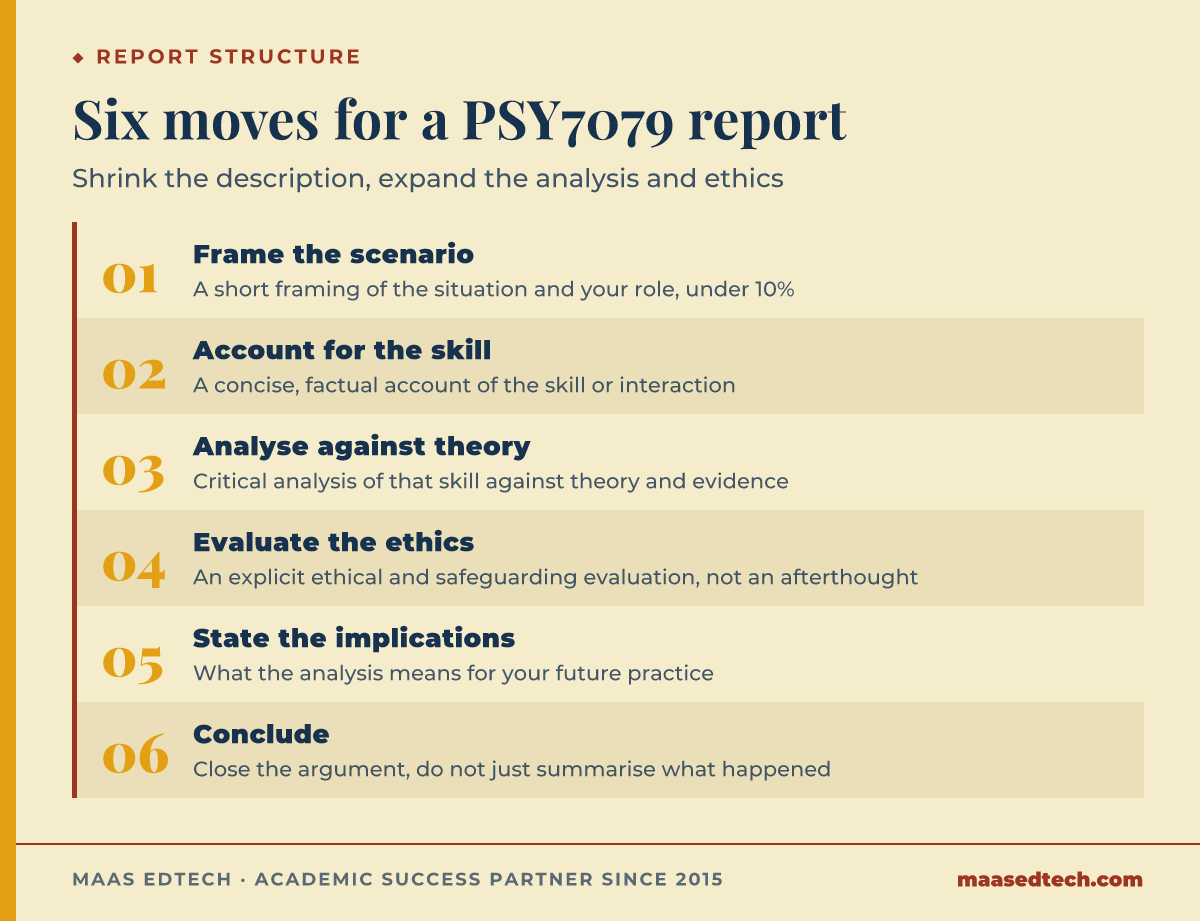
Direct answer: Use a reflection-led structure: (1) a brief introduction framing the scenario and your role (keep it under 10% of the word count), (2) a concise account of the skill or interaction, (3) critical analysis of that skill against theory and evidence, (4) an explicit ethical and safeguarding evaluation, (5) implications for future practice, and (6) conclusion. The single biggest structural fix is shrinking the description and expanding the analysis and ethics sections, where the marks concentrate.
Evidence: Criterion-referenced rubrics weight "critical analysis," "application of theory," and "ethical reasoning" far above "description of events." Structuring your word budget to match the rubric weighting is the most reliable way to lift a grade without new fieldwork.
Example: A Vietnamese student submitted a draft with a 700-word scene description and a 200-word implications section. His MAAS mentor inverted the ratio. The final report, same scenario, same sources, moved from a borderline Pass to a Merit because the implications for practice were finally developed enough to be assessed.
What are the most common mistakes that lose marks in PSY7079?
Direct answer: Three recurring mistakes show up across MAAS applied-psychology coaching. First, students describe instead of analyse, the scene narration crowds out the argument. Second, they treat theory as decoration, naming Rogers or Bronfenbrenner without using the model to reach a judgement about their practice. Third, ethics appears only as a closing paragraph rather than as live reasoning woven through the analysis. Fixing these three lifts most drafts by at least one grade band.
Evidence: Across MAAS applied-practice coaching, marker feedback before intervention clusters heavily on "needs more critical reflection" and "ethical reasoning underdeveloped", the two phrases that most often separate a Pass from a Distinction in UK postgraduate psychology rubrics.
Example: A Vietnamese student's reflection read "I made sure the child felt safe." His MAAS mentor pushed him to specify: which skill (matching the child's pace and using simple, open questions), which theory (Rogers' empathy and unconditional positive regard), and which ethical duty (gaining age-appropriate assent and being clear about the limits of confidentiality). The specific version earned full marks on the reflection criterion.
How long is the PSY7079 assignment and what referencing style does it use?
Direct answer: Confirm the exact word count and style in your module handbook, applied psychology reports at this level commonly sit between 2,000 and 3,000 words and use APA 7th referencing, the standard for UK and international psychology programmes. Stay within the tolerance band, cite every theoretical and evidential claim, and make sure your in-text citations and reference list match exactly. Reference accuracy is a quick, reliable source of marks that many students leave on the table.
Evidence: Psychology departments overwhelmingly use APA referencing, and markers routinely deduct marks for inconsistent or incomplete citations even when the analysis is strong. APA 7th also expects person-first, respectful language about children and families, itself an assessed element of professional writing.
Example: A Vietnamese student lost several marks across two modules for mismatched in-text citations and reference-list entries. A MAAS pre-submission audit caught 16 referencing errors in an hour. On her next PSY7079 task, clean APA referencing recovered the marks she had previously been losing on a criterion that requires no extra research at all.
Frequently asked questions
Is PSY7079 a hard module?
It is reflectively demanding rather than technically hard; there is no statistics, but the module expects honest, critical self-evaluation tied to theory and ethics, which many students find harder than memorisation. Students who treat it as "narrate a nice interaction" struggle; students who treat it as "argue why my practice was skilled and ethical" do well.
Can I write about a real child I worked with?
Only within your programme's ethics and consent rules. Anonymise fully, follow your placement's safeguarding policy, and confirm with your tutor what is permitted. Where direct practice is not possible, most briefs allow a provided case scenario, analyse it with the same rigour.
How many models should I use in the assignment?
Two or three, applied deeply, beats five applied shallowly. Markers reward critical application, using a model to reach a judgement about your practice, not the number of theories you can name.
What referencing style does PSY7079 use?
APA 7th is the psychology standard. Always confirm in your own handbook, and keep in-text citations and the reference list perfectly matched.
How do I show critical reflection rather than description?
For every action you report, add the "so what": which theory explains it, what evidence supports it, what ethical duty it served, and what you would change. If a sentence only says what happened, it is description; if it says why it mattered, it is analysis.
Can MAAS help me with PSY7079?
Yes. MAAS Assignment & Essay Support coaches you through the assignment with the Outline, Draft, Final model, rubric decoding, model selection, ethics framing, and a pre-submission referencing audit, all with discipline-matched experts. We coach your work; we do not write it for you.
Ready to approach PSY7079 with a clear strategy?
If you have the scenario but not the argument, that is exactly where a discipline-matched expert helps most. MAAS Assignment & Essay Support is an academic support partner; we work alongside you through Outline, Draft, Final so the reflection stays yours and the structure earns the marks.
Bring your PSY7079 brief and we will match you to an Applied Psychology mentor, 23% of our 100+ experts hold a PhD, within 48 hours when our network already covers that field. If it does not, MAAS opens a dedicated recruitment round for your case, which usually takes about two weeks.
Book a free 15-minute PSY7079 consultation with MAAS Assignment & Essay Support →
Related guides
- EDUC9511 assignment: how do you approach Complex Communication Needs and AAC?: sibling working-with-children guide on assessing a learner and feature-matching evidence-based supports
- ECE6011 assignment: how do you approach Languages of Children?: sibling guide on analysing children's communication through theory rather than describing it
- EDUC9513 assignment: how do you approach personalised curriculum design?: sibling inclusive-practice guide on designing and justifying support for learners with additional needs
- NURS6028 assignment: how do you approach Health and Substance Misuse?: sibling applied-practice postgraduate guide on assessing a client and matching evidence-based interventions
- NURS6035 assignment: how do you approach Therapeutic Engagement and Psychosocial Interventions?: sibling applied-practice guide on critically appraising a talking-based psychosocial intervention
- How to write a reflection essay: essential for the reflective and implications-for-practice core of a PSY7079 task
- How to write a theoretical framework: for applying developmental and humanistic theory with academic depth
- Academic Mentoring service: 1:1 coaching with PhD-level mentors in your discipline
- Tutoring service: 1:1 subject tutoring in 60- or 90-minute sessions with an expert matched on your course code, always inside your discipline
- Course-code assignment coaching: pillar guide on tackling any unit assignment with a MAAS mentor
References
- British Psychological Society. (2021). Code of ethics and conduct. British Psychological Society.
- Bronfenbrenner, U. (1979). The ecology of human development: Experiments by nature and design. Harvard University Press.
- Geldard, K., Geldard, D., & Yin Foo, R. (2018). Counselling children: A practical introduction (5th ed.). SAGE.
- Gibbs, G. (1988). Learning by doing: A guide to teaching and learning methods. Further Education Unit, Oxford Polytechnic.
- Rogers, C. R. (1951). Client-centered therapy: Its current practice, implications, and theory. Houghton Mifflin.
- Shier, H. (2001). Pathways to participation: Openings, opportunities and obligations. Children & Society, 15(2), 107–117.
- Vygotsky, L. S. (1978). Mind in society: The development of higher psychological processes. Harvard University Press.
Tools & resources
- British Psychological Society. (n.d.). Ethics and standards. Retrieved June 30, 2026, from https://www.bps.org.uk/guideline/ethics-and-standards
- UNICEF. (n.d.). Convention on the Rights of the Child. Retrieved June 30, 2026, from https://www.unicef.org/child-rights-convention
This article is part of the MAAS Journal series for Vietnamese international students. MAAS Assignment & Essay Support is an academic support partner; we coach students through the Outline, Draft, Final delivery model with developmental feedback from discipline-matched experts. We do not write or submit work on a student's behalf.