
NURS6028 Health and Substance Misuse asks you to assess and manage people whose substance use co-occurs with mental illness, and the rubric rewards clinical reasoning over description. Many Vietnamese nurses studying at the University of Newcastle find the content familiar but the academic argument hard; they explain what a drug does but never justify why a particular assessment or intervention fits the client. This guide answers the seven questions Vietnamese students ask MAAS mentors most often before they start NURS6028.
Author: MAAS Editorial Team · Reviewed by a MAAS subject mentor
Last updated: 2026-06-29
Category: health-education
What is NURS6028 Health and Substance Misuse about?
Direct answer: NURS6028 is a postgraduate University of Newcastle nursing course that prepares registered nurses to assess and manage people with substance misuse problems, especially those with co-occurring mental illness, or "dual diagnosis". It covers assessment, brief interventions, pharmacotherapy, prevention, pathophysiology of substance use, and the sociological forces, stigma, disadvantage, social determinants, that shape who develops a disorder and who gets help.
Evidence: The course sits inside Newcastle's Master of Mental Health Nursing, which is built for working registered nurses. That means the assessment expects you to write as a clinician applying evidence to practice, not as a student summarising a textbook. The learning outcomes emphasise assessment, evidence-based intervention, and critical appraisal of therapeutic options.
Example: A Vietnamese registered nurse studying NURS6028 online told her MAAS mentor the course was "just pharmacology of addiction". Her mentor reframed it: the course is really about integrated care, treating the mental illness and the substance use together, not as separate problems. Once she viewed every case through that integrated lens, her draft stopped describing substances one by one and started arguing a coherent plan of care.
What does the NURS6028 assignment usually involve?
Direct answer: Assessment in courses like NURS6028 is typically built around a client case study: you are given (or asked to choose) a clinical scenario involving co-occurring substance use and mental illness, and you must demonstrate comprehensive assessment, formulate the person's needs, and justify evidence-based interventions. A shorter written task, a critical appraisal of a therapy or a reflective piece on values and ethics, often sits alongside the main case study. Always confirm the exact brief, weighting, and word count in your own Canvas course shell, because assessment structure changes by semester.
Evidence: Newcastle's nursing assessments are criterion-referenced, marks are awarded against published criteria, not ranked against classmates. This is why decoding the marking rubric (next section) matters more than writing length, and why a strong case formulation outscores a long description of the substance.
Example: A Vietnamese student chose a case of a young man with cannabis use and emerging psychosis, then spent half the word count explaining the neurobiology of cannabis. His MAAS mentor cut the pharmacology to a tight paragraph and reallocated the words to a structured assessment and a staged intervention plan. Same case, same word count, the clinically reasoned version moved up two grade bands.
How is the NURS6028 assignment graded, what does the rubric reward?
Direct answer: Mental health nursing rubrics at this level reward four things, roughly in this order: (1) depth of clinical reasoning and case formulation, (2) correct, explicit use of assessment frameworks and evidence-based interventions, (3) safe, person-centred, justified recommendations, and (4) academic writing with accurate APA referencing. Describing what a substance does earns few marks on its own, the marks live in why you assess and intervene the way you do, and whether the evidence supports it.
Evidence: Newcastle nursing rubrics use criterion bands (Pass / Credit / Distinction / High Distinction). The jump from Credit to Distinction is almost always defined by the word "critical", critical appraisal of therapeutic options, critical application of evidence, rather than by adding more content.
Example: A MAAS mentor colour-coded one Vietnamese student's draft sentence by sentence as "describe" or "reason". The draft was 70% description. After one restructuring pass that flipped the ratio toward clinical reasoning, the same evidence and the same case lifted the mark by a full band, no new sources required.
Which frameworks and models should you use in NURS6028?
Direct answer: Anchor your case in two or three established models rather than name-dropping many. The most useful for NURS6028 are the biopsychosocial model (Engel) for holistic formulation, the transtheoretical "stages of change" model (Prochaska and DiClemente) to match your intervention to the client's readiness, motivational interviewing (Miller and Rollnick) as the core therapeutic approach, and Australia's harm-minimisation framework (supply, demand, and harm reduction) as the policy lens. Pick models that fit your client's actual presentation, do not force all of them in.
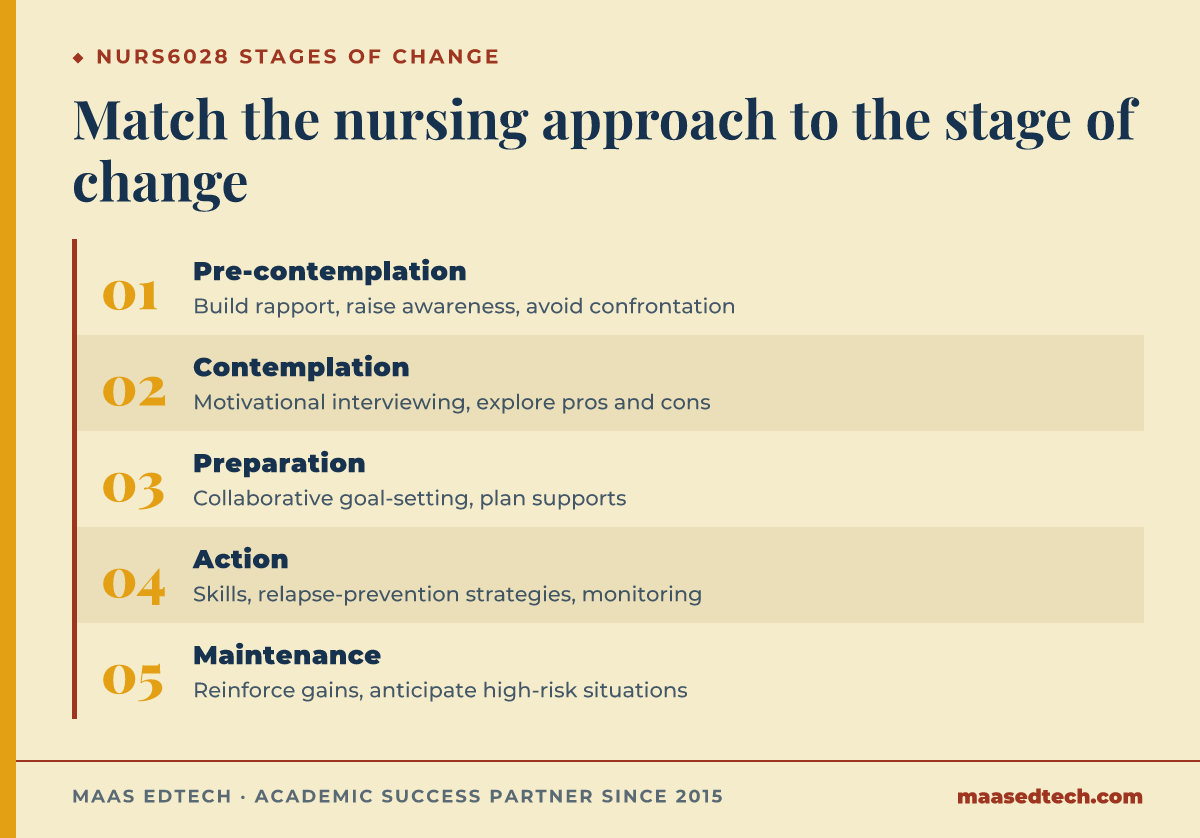
| Stage of change | Where the client is | Nursing approach that fits |
|---|---|---|
| Pre-contemplation | Not yet seeing use as a problem | Build rapport, raise awareness, avoid confrontation |
| Contemplation | Ambivalent about changing | Motivational interviewing, explore pros and cons |
| Preparation | Intending to act soon | Collaborative goal-setting, plan supports |
| Action | Actively changing behaviour | Skills, relapse-prevention strategies, monitoring |
| Maintenance | Sustaining the change | Reinforce gains, anticipate high-risk situations |
Evidence: Engel (1977) introduced the biopsychosocial model that still underpins holistic mental health assessment; Prochaska and DiClemente (1983) formalised the stages-of-change model used to time interventions; Miller and Rollnick (2013) define motivational interviewing, the most evidence-supported counselling style for substance use. These are foundational, examiner-recognised sources, not blog-level references.
Example: A Vietnamese student analysing a client with alcohol dependence tried to apply five models and explained each shallowly. Her MAAS mentor cut it to two, the biopsychosocial model to formulate the client's needs, and stages of change to justify a motivational rather than directive approach. Fewer models, deeper application, higher mark.
How should you structure the NURS6028 case study?
Direct answer: Use an assessment-led structure: (1) a brief introduction and case context (keep it under 10% of the word count), (2) comprehensive assessment using a recognised tool, (3) a case formulation that integrates the mental health and substance use picture, (4) evidence-based, staged interventions with rationale, and (5) a short conclusion on evaluation and safety. The single biggest structural fix is shrinking the background and pharmacology sections and expanding the assessment, formulation, and intervention sections, where the marks concentrate.
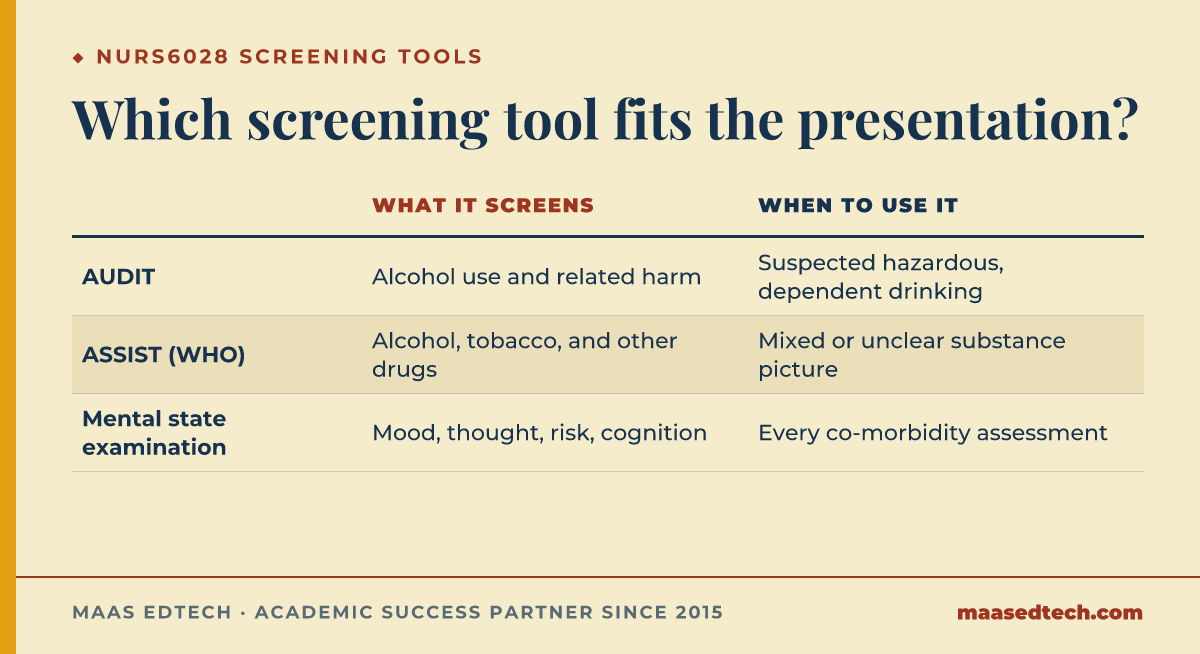
Evidence: Validated screening and assessment tools give your formulation credibility. The AUDIT identifies alcohol use disorders (Babor et al. 2001) and the WHO ASSIST screens across multiple substances (Humeniuk et al. 2010); naming and applying the right tool signals clinical literacy that markers reward.
| Tool | What it screens | When to use it |
|---|---|---|
| AUDIT | Alcohol use and related harm | Suspected hazardous or dependent drinking |
| ASSIST (WHO) | Alcohol, tobacco, and other drugs | Mixed or unclear substance picture |
| Mental state examination | Mood, thought, risk, cognition | Every co-morbidity assessment |
Example: A Vietnamese registered nurse submitted a draft with a 500-word substance-history section and a 200-word intervention section. Her MAAS mentor inverted the ratio. The final case study, same client, same evidence, moved from a borderline Credit to a Distinction because the interventions were finally developed enough to be assessed against the rubric.
What are the most common mistakes that lose marks in NURS6028?
Direct answer: Three recurring mistakes show up across MAAS mental health nursing coaching. First, students describe the substance instead of formulating the client, pharmacology crowds out clinical reasoning. Second, they treat the mental illness and the substance use as two separate essays rather than one integrated formulation, which is the whole point of dual-diagnosis care. Third, interventions are generic ("the nurse should provide education") rather than specific, staged, and tied to the assessment. Fixing these three lifts most drafts by at least one rubric band.
Evidence: Australian co-occurring-conditions guidelines stress integrated, concurrent treatment of mental health and substance use rather than sequential or parallel care (Marel et al., 2022). The Guidelines define integrated treatment as "the simultaneous treatment of a person's AOD use and mental health by a single provider or service" (Marel et al., 2022, p. 158). A draft that keeps the two problems in separate silos contradicts the evidence base the rubric expects you to apply.
Example: A Vietnamese student's recommendation read "the client should reduce drinking". Her MAAS mentor pushed her to specify: which stage of change the client was in (contemplation), which intervention fit (motivational interviewing plus an agreed harm-reduction goal), and why (to build readiness before pushing abstinence). The specific version earned full marks on the intervention criterion.
How long is the NURS6028 assignment and what referencing style does it use?
Direct answer: Confirm the exact word count and style in your assessment brief, postgraduate nursing case studies at this level commonly sit between 2,000 and 3,000 words and use APA 7th referencing, which is the standard for University of Newcastle health courses. Stay within the 10% tolerance band, cite every clinical claim, and make sure your reference list and in-text citations match exactly. Reference accuracy is a quick, reliable source of marks that many students leave on the table.
Evidence: Markers routinely deduct marks for inconsistent or incomplete APA referencing even when the clinical reasoning is strong. Health evidence also dates quickly, so prioritising recent guidelines and peer-reviewed sources over old textbooks protects your "currency of evidence" criterion.
Example: A Vietnamese Newcastle student lost several marks across two assignments for mismatched in-text citations and reference-list entries. A MAAS pre-submission audit caught more than a dozen referencing errors in an hour. On her next NURS6028 task, clean APA referencing recovered marks she had previously been losing on a criterion that needs no extra research at all.
Frequently asked questions
Is NURS6028 a hard course?
It is conceptually demanding rather than technically hard; there is little maths, but the course expects integrated clinical reasoning instead of memorising drug facts. Students who treat it as "describe the substance" struggle; students who treat it as "formulate and treat the whole person" do well.
Can I use a real patient I have nursed as my case study?
Only with care. Most briefs ask for a de-identified or hypothetical case to protect confidentiality. Never include identifying details, and follow your course's privacy and ethics guidance to the letter, confirm the requirement in your brief before you start.
How many frameworks should I use in the assignment?
Two or three, applied deeply, beats five applied shallowly. Markers reward critical application, using a model to reach a clinical judgement, not the number of theories you can name.
What referencing style does NURS6028 use?
APA 7th is the standard for University of Newcastle health courses. Always confirm in your own brief, and use the Newcastle Library referencing guide to format entries consistently.
Can MAAS help me with NURS6028?
Yes. MAAS Assignment & Essay Support coaches you through the assignment with the Outline, Draft, Final model, rubric decoding, framework selection, draft feedback, and a pre-submission referencing audit, all with discipline-matched experts. We coach your work; we do not write it for you.
Ready to approach NURS6028 with a clear clinical argument?
If you have the case but not the formulation, that is exactly where a discipline-matched expert helps most. MAAS Assignment & Essay Support is an academic support partner; we work alongside you through Outline, Draft, Final so the clinical reasoning stays yours and the structure earns the marks.
Bring your NURS6028 brief and we will match you to a mental health nursing mentor, 23% of our 100+ experts hold a PhD, within 48 hours when our network already covers that field. If it does not, MAAS opens a dedicated recruitment round for your case, which usually takes about two weeks.
Book a free 15-minute NURS6028 consultation with MAAS Assignment & Essay Support →
Related guides
- NURS6035 assignment: how do you approach Therapeutic Engagement and Psychosocial Interventions?: paired University of Newcastle mental health nursing guide on critically appraising a talking-based intervention
- EDUC9511 assignment: how do you approach Complex Communication Needs and AAC?: sibling applied-practice postgraduate guide on evidence-based intervention planning
- EDET460 assignment: how do you approach Assessment and Data-Informed Practice?: sibling guide on turning assessment evidence into a defensible plan
- EDUC9513 assignment: how do you approach Personalised Curriculum Design?: sibling guide on individualising support from an evidence base
- BIOL234 Nutritional Physiology: ACU health sciences unit guide on explaining a physiological mechanism and critiquing a popular health claim
- How to write a methodology in an essay: for the assessment-and-evidence half of any clinical report
- How to write a reflection essay: useful if NURS6028 includes a reflective or values-based component
- How to write a theoretical framework: for applying clinical models with academic depth
- MAAS Academic Mentoring service: 1:1 coaching with PhD-level mentors in your discipline
- Tutoring service: 1:1 subject tutoring in 60- or 90-minute sessions with an expert matched on your course code, always inside your discipline
- Course-code assignment coaching: pillar guide on tackling any unit assignment with a MAAS mentor
References
- Babor, T. F., Higgins-Biddle, J. C., Saunders, J. B., & Monteiro, M. G. (2001). AUDIT: The Alcohol Use Disorders Identification Test: Guidelines for use in primary care (2nd ed.). World Health Organization.
- Engel, G. L. (1977). The need for a new medical model: A challenge for biomedicine. Science, 196(4286), 129–136.
- Humeniuk, R., Henry-Edwards, S., Ali, R., Poznyak, V., & Monteiro, M. G. (2010). The Alcohol, Smoking and Substance Involvement Screening Test (ASSIST): Manual for use in primary care. World Health Organization.
- Marel, C., Siedlecka, E., Fisher, A., Gournay, K., Deady, M., Baker, A., Kay-Lambkin, F., Teesson, M., Baillie, A., & Mills, K. L. (2022). Guidelines on the management of co-occurring alcohol and other drug and mental health conditions in alcohol and other drug treatment settings (3rd ed.). Matilda Centre for Research in Mental Health and Substance Use, University of Sydney.
- Miller, W. R., & Rollnick, S. (2013). Motivational interviewing: Helping people change (3rd ed.). Guilford Press.
- Prochaska, J. O., & DiClemente, C. C. (1983). Stages and processes of self-change of smoking: Toward an integrative model of change. Journal of Consulting and Clinical Psychology, 51(3), 390–395.
Tools & resources
- University of Newcastle. (n.d.). NURS6028 Health and Substance Misuse course handbook. Retrieved June 29, 2026, from https://handbook.newcastle.edu.au/course/2025/NURS6028
- University of Newcastle Library. (n.d.). APA 7th referencing guide. Retrieved June 29, 2026, from https://libguides.newcastle.edu.au/apa7
This article is part of the MAAS Journal series for Vietnamese international students. MAAS Assignment & Essay Support is an academic support partner; we coach students through the Outline, Draft, Final delivery model with developmental feedback from discipline-matched experts. We do not write or submit work on a student's behalf.