
NURS6035 asks you to critically analyse one talking-based psychosocial intervention a mental health nurse can deliver, where reasoning beats description. Many Vietnamese registered nurses studying this University of Newcastle course know the interventions in practice but struggle to argue why one fits a particular client and that argument is exactly what the rubric rewards. This guide answers the seven questions Vietnamese students ask MAAS mentors most often before they start NURS6035.
Author: MAAS Editorial Team
Last updated: 2026-07-01
Category: health-education

What is NURS6035 Therapeutic Engagement and Psychosocial Interventions about?
Direct answer: NURS6035 is a postgraduate University of Newcastle nursing course developing two linked capabilities: how a mental health nurse builds a therapeutic relationship with a person experiencing mental distress, and how the nurse delivers psychosocial interventions such as motivational interviewing, behavioural activation, and psychoeducation. The course treats engagement and intervention as one continuous process.
Evidence: The course sits inside Newcastle's Master of Mental Health Nursing, delivered online for working registered nurses. That framing matters: the assessment expects you to write as a clinician who applies evidence to your own practice, not as a student summarising a textbook. The learning outcomes centre on therapeutic engagement, critical appraisal of psychosocial interventions, and safe, recovery-oriented application.
Example: A Vietnamese registered nurse studying NURS6035 online told her MAAS mentor the course was "just learning counselling techniques". Her mentor reframed it: the course is really about justifying a therapeutic choice, why this intervention, for this person, at this point in their recovery. Once she saw the assignment as an argument, her draft stopped listing steps and started defending a clinical decision.
What does the NURS6035 assignment usually involve?
Direct answer: The core written task in courses like NURS6035 asks you to select one talking-based psychosocial intervention that you could initiate as a health professional, and critically analyse it, its evidence base, how it works, when it is indicated, and its limitations in practice. A second written task and a quiz commonly sit alongside it.
The single most important instruction is the word "one": the assignment tests depth on a single intervention, not a survey of many. Always confirm the exact brief, weighting, and word count in your own Canvas course shell, because assessment structure changes by semester.
Evidence: Newcastle nursing assessments are criterion-referenced, marks are awarded against published criteria, not ranked against classmates. A recurring constraint in this course is a tight word budget (Assessment 1 sits around 1,400 words in recent offerings) and a currency rule: sources should generally be no older than ten years, with the last five preferred, unless a work is seminal. That combination punishes padding and rewards a sharply scoped, well-evidenced argument.
Example: A Vietnamese student chose motivational interviewing but spent half of a 1,400-word limit on its history and founders. His MAAS mentor cut the background to three sentences and reallocated the words to how MI resolves ambivalence and where the evidence is weaker. Same intervention, same limit, the critical version moved up two grade bands.
How is the NURS6035 assignment graded, what does the rubric reward?
Direct answer: Psychosocial-intervention rubrics at this level reward four things, roughly in this order: (1) depth of critical appraisal of the chosen intervention, (2) explicit links between the intervention, the therapeutic relationship, and the evidence, (3) safe, person-centred, recovery-oriented judgement about when not to use it, and (4) academic writing with accurate, current APA 7th referencing. Describing the steps of an intervention earns few marks on its own, the marks live in why it works, for whom, and what its limits are.
Evidence: Newcastle nursing rubrics use criterion bands (Pass / Credit / Distinction / High Distinction). The jump from Credit to Distinction is almost always defined by the word "critical", critical appraisal of the evidence, critical judgement about applicability, rather than by adding more content. Because the word limit is tight, every descriptive sentence you keep is a critical sentence you lose.
| Descriptive sentence (fewer marks) | Critical sentence (more marks) |
|---|---|
| "Motivational interviewing uses open questions and reflections." | "Because MI works by resolving ambivalence rather than delivering advice, it suits a client in the contemplation stage but may frustrate one already committed to change." |
| "Behavioural activation increases pleasant activities." | "Behavioural activation is defensible here because the client's withdrawal is maintaining low mood, though its evidence base is strongest for depression, not the client's comorbid anxiety." |
| "Psychoeducation informs clients about their condition." | "Psychoeducation builds the shared understanding the therapeutic alliance depends on, but on its own rarely changes behaviour without a skills-based intervention alongside it." |
Example: A MAAS mentor colour-coded one Vietnamese student's draft as "describe" or "appraise". It was 75% description; after one restructuring pass that flipped the ratio, the same sources lifted the mark by a full band, no new research required.
Which frameworks and models should you use in NURS6035?
Direct answer: Anchor your analysis in two or three established models rather than name-dropping many. The most useful for NURS6035 are Peplau's theory of interpersonal relations to explain the therapeutic relationship the intervention depends on; Bordin's working-alliance concept (bond, goals, tasks) to argue why engagement predicts outcome; and a recovery framework such as CHIME (connectedness, hope, identity, meaning, empowerment) to keep the intervention person-centred rather than clinician-driven. Then apply the evidence base specific to your chosen intervention, for example motivational interviewing or behavioural activation. Pick models that fit your case; do not force all of them in.
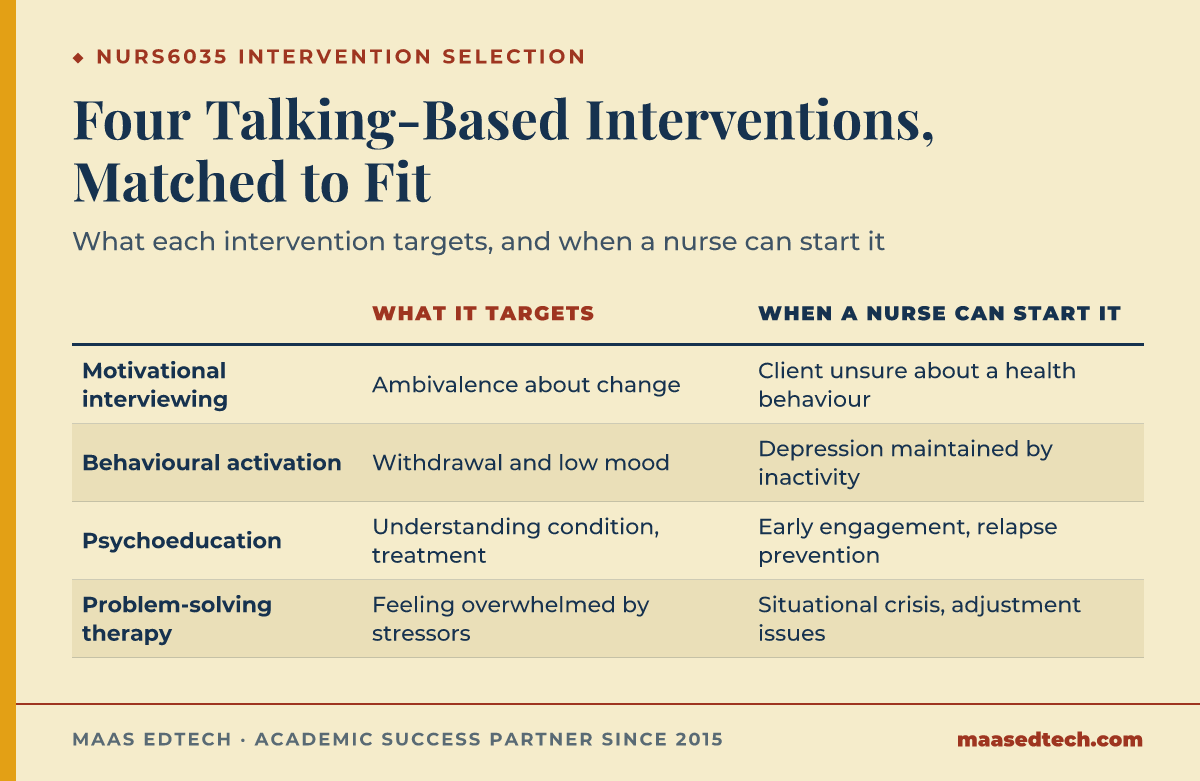
| Talking-based intervention | What it primarily targets | When a nurse can initiate it |
|---|---|---|
| Motivational interviewing | Ambivalence about change | Client unsure about a health behaviour (substance use, medication) |
| Behavioural activation | Withdrawal and low mood | Depression maintained by inactivity and avoidance |
| Psychoeducation | Understanding of condition and treatment | Early engagement, family involvement, relapse prevention |
| Problem-solving therapy | Feeling overwhelmed by stressors | Situational crisis, adjustment difficulties |
Evidence: Peplau (1988) established interpersonal relations as the foundation of psychiatric nursing; Bordin (1979) defined the working alliance whose strength still predicts therapeutic outcome across modalities; Leamy et al. (2011) synthesised the CHIME framework that underpins recovery-oriented practice. For the intervention itself, Miller and Rollnick (2013) define motivational interviewing, and Ekers et al. (2014) provide meta-analytic support for behavioural activation in depression. Their meta-analysis concludes that "the results in this meta-analysis support and strengthen the evidence base indicating Behavioural Activation is an effective treatment for depression" (Ekers et al., 2014). These are examiner-recognised sources, not blog-level references.
Example: A Vietnamese student analysing behavioural activation tried to apply five models and explained each shallowly. Her MAAS mentor cut it to two, Bordin's working alliance to argue that engagement had to come first, and behavioural activation's own evidence base to justify the intervention. Fewer models, deeper application, higher mark.
How should you structure the NURS6035 assignment?
Direct answer: Use an argument-led structure: (1) a brief introduction that names your chosen intervention and the client context (keep it under 10% of the word count), (2) how the intervention works and its link to therapeutic engagement, (3) a critical appraisal of the evidence, strengths and limitations, (4) applicability: for whom it is indicated, for whom it is not, and the safety and recovery considerations, and (5) a short conclusion. Within a 1,400-word limit, the biggest structural fix is shrinking the "how it works" description and expanding the appraisal and applicability sections, where the marks concentrate.
Evidence: Criterion-referenced rubrics weight "critical appraisal" and "application to practice" far above "background". Structuring your word budget to match the rubric weighting is the most reliable way to lift a grade without new research and in a tightly capped assignment it is often the only lever left.
Example: A Vietnamese Newcastle student submitted a draft with a 600-word description and a 150-word limitations section. Her MAAS mentor inverted the ratio, same intervention, same evidence and the critical appraisal was finally developed enough to lift the mark from a borderline Credit to a Distinction.
What are the most common mistakes that lose marks in NURS6035?
Direct answer: Three recurring mistakes show up across MAAS mental health nursing coaching. First, students describe the intervention instead of appraising it, the "how-to" crowds out the "why" and "for whom". Second, they treat therapeutic engagement and the intervention as two separate topics, when the whole point of the course is that the intervention only works through the relationship. Third, they ignore the limitations and contraindications, so the analysis reads as advocacy rather than critical judgement. Fixing these three lifts most drafts by at least one rubric band.
Evidence: Reviews of therapeutic engagement in mental health nursing show it is both hard to measure and central to outcome (McAndrew et al. 2014), so a draft that separates "the relationship" from "the technique" contradicts the evidence base the rubric expects. Recovery-oriented practice similarly requires interventions delivered with the person, not to them (Slade et al. 2014).
Example: A Vietnamese student's conclusion read "motivational interviewing is an effective intervention". Her MAAS mentor pushed her to qualify it: effective for whom (ambivalent clients), through what mechanism (resolving ambivalence, not persuading), and with what limit (weaker where insight is impaired). The qualified version earned full marks on the critical-appraisal criterion.
How long is the NURS6035 assignment and what referencing style does it use?
Direct answer: Confirm the exact word count and style in your assessment brief, the main written task in NURS6035 has recently sat around 1,400 words (with a 10% tolerance) and uses APA 7th referencing, the standard for University of Newcastle health courses.
Two rules bite harder here than in most courses: work well beyond the limit may not be marked, and sources should generally be no older than ten years (the last five preferred) unless they are seminal. Cite every clinical claim, keep your evidence current, and make sure in-text citations and the reference list match exactly.
Evidence: Markers routinely deduct marks for inconsistent or incomplete APA referencing even when the clinical reasoning is strong, and health evidence dates quickly so a reference list stacked with decade-old textbooks can cost you the "currency of evidence" criterion directly. Seminal works (Peplau, Bordin) are the accepted exception; use them for the concept, and recent studies for the evidence.
Example: A Vietnamese Newcastle student lost several marks for mismatched citations and out-of-date sources. A MAAS pre-submission audit caught more than a dozen referencing errors and three sources older than ten years in an hour. On her next NURS6035 task, clean, current APA referencing recovered marks on a criterion that needs no extra clinical work at all.
Frequently asked questions
Is NURS6035 a hard course?
It is conceptually demanding rather than technically hard; there is little maths, but the course expects you to argue a clinical judgement instead of memorising techniques. Students who treat it as "describe an intervention" struggle; students who treat it as "justify this intervention for this person" do well.
Which psychosocial intervention should I choose for the assignment?
Choose one you could realistically initiate as a nurse and for which there is a solid, recent evidence base, motivational interviewing, behavioural activation, psychoeducation, and problem-solving therapy are common, defensible choices. Depth on one beats breadth across several.
How many frameworks should I use in the assignment?
Two or three, applied deeply, beats five applied shallowly. Markers reward critical application, using a model to reach a clinical judgement, not the number of theories you can name.
What referencing style does NURS6035 use?
APA 7th is the standard for University of Newcastle health courses, and this course also expects current sources (generally within ten years). Always confirm in your own brief and use the Newcastle Library referencing guide to format entries consistently.
Can MAAS help me with NURS6035?
Yes. MAAS Academic Support coaches you through the assignment with the Outline → Draft → Final model, choosing and scoping your intervention, decoding the rubric, draft feedback, and a pre-submission referencing audit, all with discipline-matched experts. We coach your work; we do not write it for you.
Ready to approach NURS6035 with a clear clinical argument?
If you have chosen your intervention but not built the argument, that is exactly where a discipline-matched expert helps most. MAAS Assignment & Essay Support is an academic support partner; we work alongside you through Outline, Draft, Final so the clinical reasoning stays yours and the structure earns the marks within a tight word limit.
Bring your NURS6035 brief and we will match you to a mental health nursing mentor, 23% of our 100+ experts hold a PhD, within 48 hours when our network already covers that field. If it does not, MAAS opens a dedicated recruitment round for your case, which usually takes about two weeks.
Book a free 15-minute NURS6035 consultation with MAAS Assignment & Essay Support →
Related guides
- NURS6028 assignment: how do you approach Health and Substance Misuse?: sibling University of Newcastle mental health nursing guide on assessing and treating co-occurring substance use
- PSY7079 assignment: how do you approach Applying Skills to Working with Children?: sibling applied-practice guide on turning therapeutic skills into a defensible plan
- EDUC9511 assignment: how do you approach Complex Communication Needs and AAC?: sibling postgraduate guide on evidence-based intervention planning
- How to write a methodology in an essay: for the appraise-the-evidence half of any clinical assignment
- How to write a reflection essay: useful if NURS6035 includes a reflective or values-based component
- How to write a theoretical framework: for applying clinical models with academic depth
- MAAS Academic Mentoring service: 1:1 coaching with PhD-level mentors in your discipline
- Tutoring service: 1:1 subject tutoring in 60- or 90-minute sessions with an expert matched on your course code, always inside your discipline
- Course-code assignment coaching: pillar guide on tackling any unit assignment with a MAAS mentor
References
- Bordin, E. S. (1979). The generalizability of the psychoanalytic concept of the working alliance. Psychotherapy: Theory, Research & Practice, 16(3), 252–260.
- Ekers, D., Webster, L., Van Straten, A., Cuijpers, P., Richards, D., & Gilbody, S. (2014). Behavioural activation for depression: An update of meta-analysis of effectiveness and sub-group analysis. PLoS ONE, 9(6), e100100.
- Leamy, M., Bird, V., Le Boutillier, C., Williams, J., & Slade, M. (2011). Conceptual framework for personal recovery in mental health: Systematic review and narrative synthesis. The British Journal of Psychiatry, 199(6), 445–452.
- McAndrew, S., Chambers, M., Nolan, F., Thomas, B., & Watts, P. (2014). Measuring the evidence: Reviewing the literature of the measurement of therapeutic engagement in acute mental health inpatient wards. International Journal of Mental Health Nursing, 23(3), 212–220.
- Miller, W. R., & Rollnick, S. (2013). Motivational interviewing: Helping people change (3rd ed.). Guilford Press.
- Peplau, H. E. (1988). Interpersonal relations in nursing: A conceptual frame of reference for psychodynamic nursing. Macmillan.
- Slade, M., Amering, M., Farkas, M., Hamilton, B., O'Hagan, M., Panther, G., Perkins, R., Shepherd, G., Tse, S., & Whitley, R. (2014). Uses and abuses of recovery: Implementing recovery-oriented practices in mental health systems. World Psychiatry, 13(1), 12–20.
Tools & resources
- University of Newcastle. (n.d.). NURS6035 Therapeutic Engagement and Psychosocial Interventions course handbook. Retrieved July 1, 2026, from https://handbook.newcastle.edu.au/course/2025/NURS6035
- University of Newcastle Library. (n.d.). APA 7th referencing guide. Retrieved July 1, 2026, from https://libguides.newcastle.edu.au/apa7
This article is part of the MAAS Journal series for Vietnamese international students. MAAS Assignment & Essay Support is an academic support partner; we coach students through the Outline, Draft, Final delivery model with developmental feedback from discipline-matched experts. We do not write or submit work on a student's behalf.