
◆ Health & Education
EDET460 assignment: how do you approach data-informed assessment?
EDET460 Effective Teaching 5 asks you to turn assessment evidence into data-informed teaching decisions, not just describe types of assessment. Most students who struggle with this Australian Catholic University (ACU) unit explain diagnostic, formative and summative assessment accurately, then stop short of showing how the data would change what they teach next and that gap is where marks live. This guide answers the questions Vietnamese students at ACU ask MAAS mentors most often before they start an EDET460 assignment.

◆ Question 1 / 8 · About the unit
What is EDET460 Effective Teaching 5 about?
Direct answer: EDET460 is an initial teacher education unit at Australian Catholic University, part of the Effective Teaching sequence. It builds your understanding of assessment's role in teaching and learning, then asks you to collect, analyse, interpret and act on quantitative and qualitative student data. EDET460 wants a teacher who uses data to decide, not one who can define assessment terms.
Evidence: Foundational assessment scholarship frames the field around exactly this move from measurement to decision. Black and Wiliam (1998) showed that classroom assessment lifts achievement only when the evidence is acted on, and Masters (2013) argues that assessment should be reframed around supporting learning rather than only ranking it. EDET460 assessments are designed to test that logic.
Example: A Vietnamese ACU student came to MAAS sure EDET460 was "about explaining assessment for, as and of learning." Her mentor reframed it as a data-decision task, given this evidence, what would you teach next and why? Her mark moved from Pass toward Distinction once she argued teaching moves instead of listing categories.
◆ Question 2 / 8 · The assignment
What does the EDET460 assignment usually involve?
Direct answer: Assessment tasks in a unit on assessment and data-informed practice typically ask you to design or evaluate assessment, then demonstrate the data cycle. Common forms include an assessment plan for a unit or lesson sequence aligned to curriculum outcomes, an analysis of a provided student data set with recommendations for teaching, a rubric or feedback design with justification, and a written rationale that links every decision to evidence and to the Australian Professional Standards for Teachers (APST). Always confirm the exact brief, word count and weighting in your own ACU unit outline, because the Effective Teaching units vary the artefact across offerings.
Evidence: Initial teacher education assessment in Australia is mapped to the APST, and Standard 5, assess, provide feedback and report on student learning, is the standard EDET460 most directly addresses (AITSL, n.d.). Markers look for graduate-level evidence against that standard.
Example: A Vietnamese student treated a data-analysis task as a chance to summarise the numbers. His MAAS mentor cut the summary to a short table and reallocated the words to interpretation, what the pattern meant and which adjustment it justified.
◆ Question 3 / 8 · Grading
How is the EDET460 assignment graded, what does the rubric reward?
Direct answer: Assessment rubrics in this kind of unit reward four things, roughly in order: (1) depth of analysis and interpretation of student data, (2) correct, explicit use of assessment theory and the data-informed cycle, (3) practical, justified teaching decisions linked to that evidence and to the APST, and (4) academic writing and APA 7th referencing.
Describing an assessment type or naming a tool earns little. Marks concentrate in why the data points to a particular teaching move and how you would implement and re-check it. Replace a descriptive sentence with an analytical one wherever you can.
Evidence: Criterion-referenced rubrics in education units typically use bands such as Pass / Credit / Distinction / High Distinction, and the jump to the top bands is almost always defined by the word "critical", critical analysis of evidence, critical justification of decisions, not by adding more content (Brookhart, 2013).
Example: A MAAS mentor tagged a Vietnamese student's draft sentence by sentence as "describe" or "interpret." It was roughly 75% describe. One restructuring pass that flipped the ratio toward interpretation and justified action moved the same data set up two full bands.
◆ Question 4 / 8 · Frameworks
Which assessment concepts and frameworks should you use in EDET460?
Direct answer: Anchor your work in a few established frameworks rather than name-dropping many. The most useful for EDET460 are the assessment-for / as / of learning distinction, the feedback model that asks "Where am I going? How am I going? and Where to next?" (Hattie & Timperley, 2007, p. 88), and backward design so assessment aligns with intended outcomes (Wiggins & McTighe, 2005). Use each framework to reach a decision about a real or provided learner, never as a definition for its own sake.
| Assessment purpose | What it is for | Where it fits in EDET460 |
|---|---|---|
| Diagnostic | Identify starting points, prior knowledge and gaps | Before teaching, to set targeted goals |
| Assessment for learning (formative) | Generate evidence to adjust the next teaching step | The core of data-informed practice, most marks live here |
| Assessment as learning | Build student self-monitoring and self-regulation | When the task asks you to involve learners in their own data |
| Assessment of learning (summative) | Judge achievement against standards and report it | When you align tasks to curriculum outcomes and grading |
Evidence: Earl (2013) argues that classrooms over-rely on the summative of mode at the expense of the formative modes that actually shift learning, and Wiliam (2011) shows that embedded formative assessment is among the highest-impact, lowest-cost practices a teacher can adopt.
Example: A Vietnamese ACU student tried to apply five assessment models shallowly. Her mentor cut it to two, assessment for learning to frame the data cycle, and Hattie and Timperley's feedback questions to structure the recommendations.
To strengthen reading comprehension in class, see our guide to reciprocal reading and its four roles.
◆ Question 5 / 8 · Data cycle
How do you use student data to inform practice in EDET460?
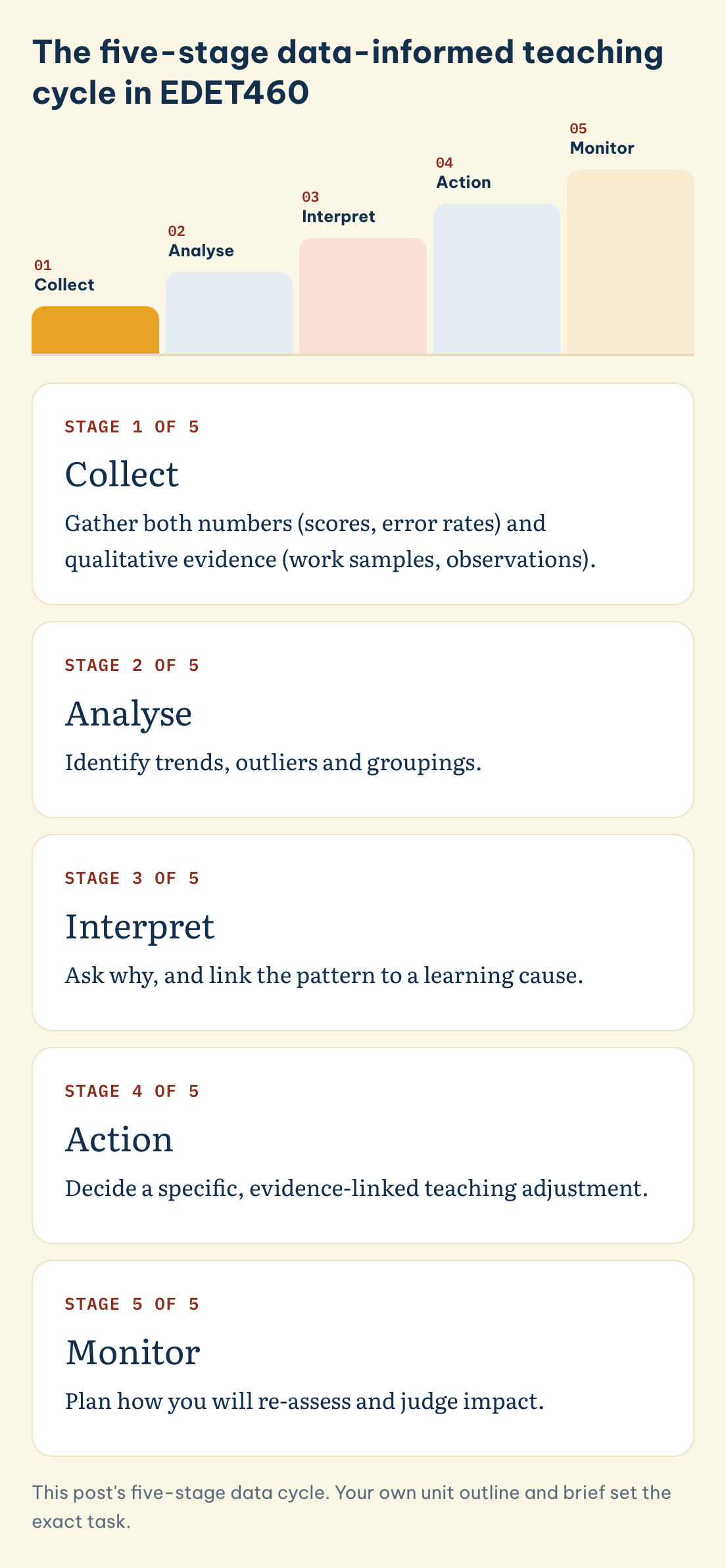
Direct answer: Show the full cycle, not just the collection step. A defensible data-informed argument moves through five stages: collect, analyse, interpret why the pattern appears, action a specific teaching adjustment, then monitor by re-assessing. Weak drafts stop at "analyse" and report what the data says; strong drafts reach "action" and "monitor" and explain the teaching change the evidence justifies.
The five-stage data-informed teaching cycle in EDET460
The bar heights and colours only mark the order and carry no weight.
Stage 1 of 5
Collect
Gather both numbers (scores, error rates) and qualitative evidence (work samples, observations).
Stage 2 of 5
Analyse
Identify trends, outliers and groupings.
Stage 3 of 5
Interpret
Ask why, and link the pattern to a learning cause.
Stage 4 of 5
Action
Decide a specific, evidence-linked teaching adjustment.
Stage 5 of 5
Monitor
Plan how you will re-assess and judge impact.
Save this figure
| Stage | What you do | What markers look for |
|---|---|---|
| Collect | Gather both numbers (scores, error rates) and qualitative evidence (work samples, observations) | Fit between the evidence and the learning question |
| Analyse | Identify trends, outliers and groupings | Accurate reading of the data, not just restating it |
| Interpret | Ask why, link the pattern to a learning cause | Critical reasoning, alternative explanations considered |
| Action | Decide a specific, evidence-linked teaching adjustment | A concrete move tied to the data and the APST |
| Monitor | Plan how you will re-assess and judge impact | A closed loop, evidence that you would check if it worked |
Evidence: Hattie and Timperley (2007) frame effective feedback as answering where the learner is going, how they are going, and where to next, the same loop a data-informed teacher runs on their own practice. Black and Wiliam (1998) confirm that the gains come from the action taken on evidence, not from the act of measuring.
Example: A Vietnamese student wrote "the data shows students struggled with fractions." His MAAS mentor pushed him through interpret–action–monitor until it read as a specific reteaching decision with a re-assessment plan.
◆ Question 6 / 8 · Structure
How should you structure the EDET460 assignment?
Direct answer: Use a decision-led structure: (1) a brief introduction and context, under 10% of the word count, (2) your assessment design or the data set and how it was generated, (3) analysis and interpretation of the evidence, (4) justified teaching decisions linked to assessment theory and the APST, and (5) a short monitoring and conclusion section. The biggest structural fix is shrinking the description of assessment types and expanding the interpretation and justification sections, where the marks concentrate.
Evidence: Criterion-referenced rubrics weight "analysis and application of evidence" and "justified decisions" far above "background and definitions." Backward design reinforces this order, start from the outcomes, decide what evidence would show them, then plan teaching (Wiggins & McTighe, 2005).
Example: A Vietnamese student submitted a draft with two pages defining assessment and a two-sentence recommendations section. Her MAAS mentor inverted the ratio, same data, same readings and the final report moved from a borderline Credit to a Distinction.
For a wider view of the classroom, see our guide to evidence based teaching strategies for teachers. A clear plan helps every lesson, and our guide on how to write a lesson plan shows a simple format.
◆ Question 7 / 8 · Common mistakes
What are the most common mistakes that lose marks in EDET460?
Direct answer: Three recurring mistakes show up across MAAS education coaching. First, students describe assessment types instead of analysing and acting on evidence. Second, recommendations are generic ("differentiate and give more feedback") rather than specific, data-linked and tied to the APST. Third, the data cycle stays open; they analyse but never show how they would re-assess to check the change worked. Fixing these three lifts most drafts by at least one band.
Evidence: Across MAAS education coaching, marker feedback before intervention clusters on "more critical analysis needed" and "recommendations not sufficiently justified or linked to evidence", the phrases that most often separate a Credit from a Distinction (Brookhart, 2013).
Example: A Vietnamese student's plan read "use formative assessment to improve learning." Her mentor pushed her to name which evidence, what it revealed, which adjustment it justified, and how she would re-check progress and the evidence-led version earned full marks.
◆ Question 8 / 8 · Length and referencing
How long is the EDET460 assignment and what referencing style does it use?
Direct answer: Confirm the exact word count and style in your assessment brief, assessment tasks at this level commonly sit between 1,500 and 3,000 words, and ACU education units use APA 7th referencing. Stay within the 10% tolerance band, cite every model, policy and data claim, and make sure your in-text citations and reference list match exactly. Reference accuracy is a quick, reliable source of marks that many students leave on the table.
Evidence: APA 7th is the standard style across ACU education units, and markers routinely deduct marks for inconsistent or incomplete APA referencing even when the analysis is strong. Assessment texts, the APST and any curriculum or policy documents you draw on must each appear correctly in your reference list.
Example: A Vietnamese student kept losing marks for mismatched in-text citations and reference-list entries. A MAAS pre-submission audit caught more than a dozen APA errors in about an hour, marks recovered on a criterion that needs no extra research.
Frequently asked questions
Is EDET460 a hard unit?
It is conceptually demanding rather than technically hard; there is no advanced maths, but the unit expects you to interpret evidence and justify teaching decisions rather than define assessment terms. Students who treat it as "explain assessment" struggle; students who treat it as "use this data to decide what to teach next" do well.
Do I need a real class or data set for EDET460?
Many tasks provide a data set or case; others draw on your placement. Follow your unit's ethics, consent and privacy guidance, and check whether your brief supplies the data or asks you to source it. The quality of your interpretation matters more than the source of the data.
What is assessment for, as and of learning?
Assessment for learning is formative evidence used to adjust teaching; assessment as learning builds students' own self-monitoring; assessment of learning is summative judgement against standards. EDET460 rewards drafts that show the formative modes shaping teaching, not only the summative mode reporting grades.
How do I link my assignment to the APST?
Standard 5, assess, provide feedback and report on student learning, is the most relevant for EDET460. Reference the specific focus areas your decisions demonstrate rather than listing all standards, and show graduate-level evidence for each claim.
What referencing style does EDET460 use?
APA 7th is standard for ACU education units. Confirm in your brief, cite every model and policy document, and check that your in-text citations match your reference list exactly.
Can MAAS help me with EDET460?
Yes. MAAS Assignment & Essay Support coaches you through the assignment with the Outline, Draft, Final model, rubric decoding, framework selection, data-interpretation feedback, and a pre-submission APA audit, all with discipline-matched experts. We coach your work; we do not write it for you.
Ready to approach EDET460 with a clear strategy?
If you have the data but not the decision argument, that is exactly where a discipline-matched expert helps most. MAAS Assignment & Essay Support is an academic support partner; we work alongside you through Outline, Draft, Final so the analysis and teaching decisions stay yours and the structure earns the marks.
Bring your EDET460 brief and we will match you to an education mentor, 23% of our 100+ experts hold a PhD, within 48 hours when our network already covers that field. If it does not, MAAS opens a dedicated recruitment round for your case, which usually takes about two weeks.
Book a free 20-minute EDET460 consultation with MAAS Assignment & Essay Support →
Related guides
- NURS6028 assignment: how do you approach Health and Substance Misuse?: sibling applied-practice postgraduate guide on assessing a client and matching evidence-based interventions
- EDUC9513 assignment: how do you approach personalised curriculum design?: sibling education guide on designing and justifying decisions for a learner rather than describing them
- EDUC9511 assignment: how do you approach Complex Communication Needs and AAC?: sibling education guide on assessing a learner and matching evidence to supports
- ECE6011 assignment: how do you approach Languages of Children?: sibling early childhood guide on analysing children's learning through theory rather than describing it
- How to write a methodology in an essay: for the data-collection-and-analysis half of any evidence-based report
- How to write a reflection essay: useful for the professional-application and reflective parts of an EDET460 task
- How to write a theoretical framework: for applying assessment models with academic depth
- Academic Mentoring service: 1:1 coaching with PhD-level mentors in your discipline
- Tutoring service: 1:1 subject tutoring in 60- or 90-minute sessions with an expert matched on your course code, always inside your discipline
- Course-code assignment coaching: pillar guide on tackling any unit assignment with a MAAS mentor
References
- AITSL. (n.d.). Australian professional standards for teachers. Australian Institute for Teaching and School Leadership. Retrieved June 28, 2026, from https://www.aitsl.edu.au/standards
- Black, P., & Wiliam, D. (1998). Assessment and classroom learning. Assessment in Education: Principles, Policy & Practice, 5(1), 7–74. https://doi.org/10.1080/0969595980050102
- Brookhart, S. M. (2013). How to create and use rubrics for formative assessment and grading. ASCD.
- Earl, L. M. (2013). Assessment as learning: Using classroom assessment to maximize student learning (2nd ed.). Corwin.
- Hattie, J., & Timperley, H. (2007). The power of feedback. Review of Educational Research, 77(1), 81–112. https://doi.org/10.3102/003465430298487
- Masters, G. N. (2013). Reforming educational assessment: Imperatives, principles and challenges (Australian Education Review No. 57). Australian Council for Educational Research.
- Wiggins, G., & McTighe, J. (2005). Understanding by design (2nd ed.). ASCD.
- Wiliam, D. (2011). Embedded formative assessment. Solution Tree Press.
Tools & resources
- Australian Catholic University. (n.d.). APA referencing guide. ACU Library. Retrieved June 28, 2026, from https://libguides.acu.edu.au/referencing
- Australian Curriculum, Assessment and Reporting Authority. (n.d.). Assessment. Retrieved June 28, 2026, from https://www.australiancurriculum.edu.au
This article is part of the MAAS Journal series for Vietnamese international students. MAAS Assignment & Essay Support is an academic support partner; we coach students through the Outline, Draft, Final delivery model with developmental feedback from discipline-matched experts. We do not write or submit work on a student's behalf.
A free 20-minute consultation is a conversation about where you are with EDET460.
Book a free consultation ▸