
ECE6011 Languages of Children asks you to explain how young children acquire language, and the rubric rewards theory linked to real observation. Most students who struggle with this early childhood education course are not short on care for children; they describe what a child says and does well, but never argue which theory of language development explains it. This guide answers the seven questions Vietnamese students ask MAAS mentors most often before they start an ECE6011 assignment.
Author: MAAS Editorial Team
Last updated: 2026-06-09
Category: health-education

What is ECE6011 Languages of Children about?
Direct answer: ECE6011 Languages of Children is an early childhood education course (commonly offered in Australian programs such as Victoria University's) examining how children from birth to around eight years develop language, first words, grammar, multilingual and bilingual development, non-verbal communication, and social contexts. It wants you to read a child's communication through a theoretical lens, not report what the child did.
Evidence: Australian early childhood courses are anchored in Belonging, Being and Becoming: The Early Years Learning Framework for Australia (Australian Government Department of Education, 2022), which names communication as one of its five learning outcomes and explicitly values children's home languages and Aboriginal and Torres Strait Islander perspectives. An ECE6011 assignment almost always expects you to connect language-development theory back to this framework.
Example: A Vietnamese student preparing an ECE6011 task came to MAAS sure the course was "just about how kids talk." Her MAAS mentor reframed it: the course is about why a child communicates the way she does, and what an educator should do next. Once she viewed every observation through that lens, her draft stopped narrating cute moments and started analysing them against theory and the mark moved from a Pass-level draft toward a Distinction.
What does the ECE6011 assignment usually involve?
Direct answer: Assessments in a Languages of Children course typically ask you to observe or sample a young child's communication, analyse it using language-development theory, and connect your analysis to early childhood frameworks and inclusive practice. Common forms include an observation-and-analysis report, a child language sample analysis, a written statement explaining a creative or multimodal representation, or a reflective essay on supporting multilingual learners. Always confirm the exact task, word count and weighting in your own unit shell, assessment design changes by semester and lecturer.
Evidence: Early childhood assessments are criterion-referenced: marks are awarded against published rubric criteria rather than ranked against classmates. This is why decoding your rubric matters more than writing length, and why every assignment expects an explicit theory-to-practice link rather than free description.
Example: A Vietnamese student spent more than half a short ECE6011 statement describing a classroom activity in detail. Her MAAS mentor cut the description to a few framing sentences and reallocated the words to analysing the child's non-verbal cues against theory and the EYLF. Same activity, same word count, the analysis-led version earned a clearly higher band.
How is the ECE6011 assignment graded, what does the rubric reward?
Direct answer: Languages of Children rubrics reward four things, roughly in this order: (1) depth of analysis of children's language and communication, (2) correct and explicit use of language-development theory, (3) clear links to the EYLF and inclusive, culturally responsive practice, and (4) academic writing and APA 7th referencing. Describing what a child did earns almost no marks on its own, marks live in why it happens developmentally and what an educator should do. If you can replace a descriptive sentence with an analytical one, do it every time.
Evidence: Criterion-referenced rubrics in early childhood units typically use bands such as Pass / Credit / Distinction / High Distinction, and the jump from Credit to Distinction is almost always defined by the word "critical", critical analysis of communication, critical application of theory, not by adding more anecdotes.
Example: A MAAS mentor mapped a Vietnamese student's draft sentence by sentence and tagged each as "describe" or "analyse." The draft was roughly 80% describe. After one restructuring pass that flipped the ratio toward analysis, the same observation and the same sources moved the mark up two full bands.
Which language-development theories should you use in ECE6011?
Direct answer: Anchor your analysis in two or three established theories rather than name-dropping many. The most useful for Languages of Children are the sociocultural, nativist, interactionist and functional accounts and you score highest when you use a theory to reach a judgement about a real child's communication, including non-verbal and multilingual behaviour. Choose theories that fit your observation; do not force all of them in.
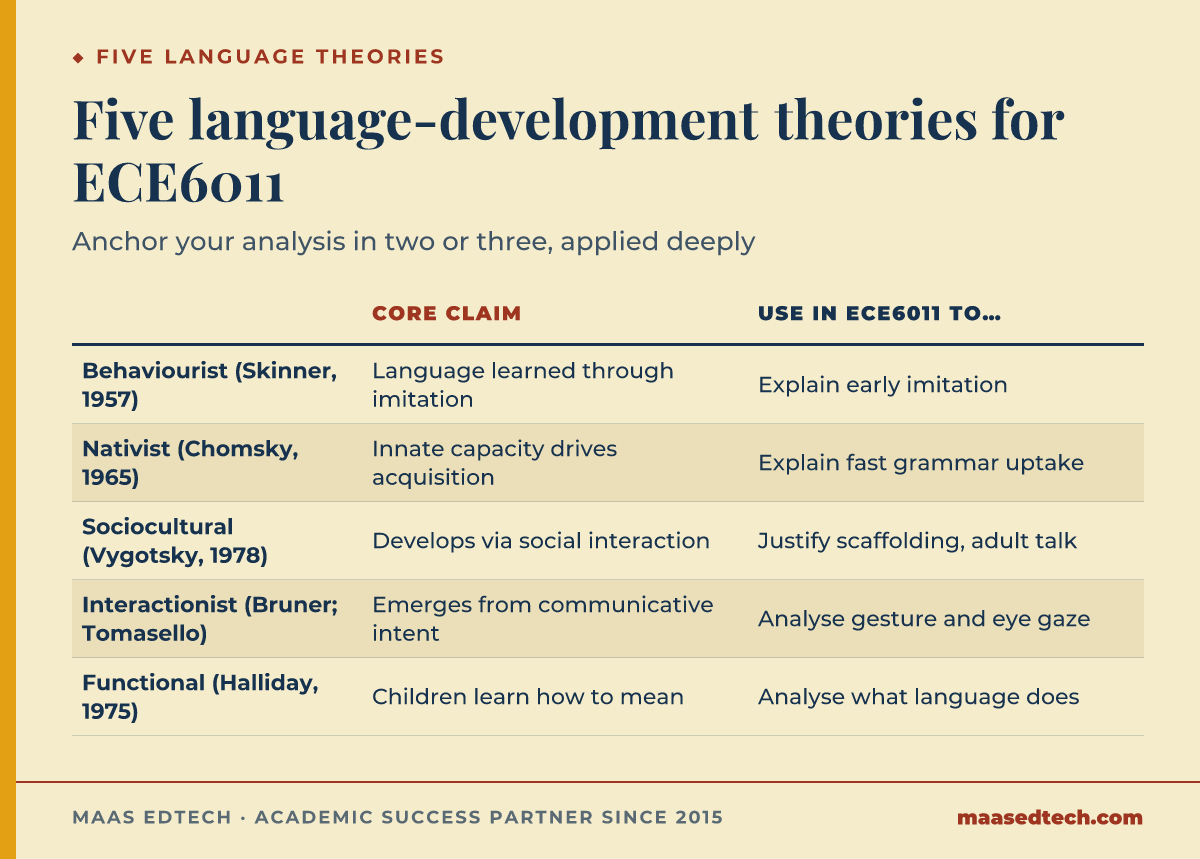
| Theory (theorist) | Core claim | Use it in ECE6011 to… |
|---|---|---|
| Behaviourist (Skinner, 1957) | Language is learned through imitation and reinforcement | Explain early imitation, then critique it as incomplete |
| Nativist (Chomsky, 1965) | An innate capacity ("universal grammar") drives acquisition | Account for how fast children pick up grammar |
| Sociocultural (Vygotsky, 1978) | Language develops through social interaction within the zone of proximal development | Justify scaffolding and rich adult–child talk |
| Interactionist / usage-based (Bruner, 1983; Tomasello, 2003) | Language emerges from communicative intent and joint attention | Analyse gesture, eye gaze and non-verbal turn-taking |
| Functional (Halliday, 1975) | Children "learn how to mean" by using language for purposes | Analyse what a child's language does, not just its form |
Evidence: Skinner (1957) framed early language as learned behaviour; Chomsky (1965) countered that acquisition is too rapid and creative to be imitation alone; Vygotsky (1978) located language in social interaction; Bruner (1983) and Tomasello (2003) showed how joint attention and communicative intent build language; and Halliday (1975) described how children learn language by using it to make meaning. These are foundational, examiner-recognised sources, not blog-level references.
Example: A Vietnamese student analysing a bilingual toddler's gestures tried to apply five theories and explained each shallowly. Her MAAS mentor cut it to two, Vygotsky to explain the role of the caregiver's scaffolding, and Halliday to analyse what the child's pointing and vocalising were doing communicatively. Fewer theories, deeper application, higher mark.
How do you connect ECE6011 to the EYLF and First Nations perspectives?
Direct answer: Strong ECE6011 work does not treat theory and framework as separate sections; it threads them together. Link your language analysis to the EYLF learning outcome on communication, show how you would support a child's home language and multilingual identity, and embed Aboriginal and Torres Strait Islander perspectives as a genuine part of the analysis rather than a bolted-on paragraph. Culturally responsive practice means recognising that language carries culture, identity and connection to Country.
Evidence: The Early Years Learning Framework (Australian Government Department of Education, 2022) embeds Aboriginal and Torres Strait Islander ways of being, knowing and doing across its principles and practices, and treats children's home languages as assets. The framework states this directly: "Children's sense of belonging is strengthened when their language, interaction styles and ways of communicating are valued" (Australian Government Department of Education, 2022). The "funds of knowledge" approach (González et al. 2005) gives you a defensible academic lens for valuing the language and cultural knowledge children bring from home, useful for the multilingual and inclusive parts of any Languages of Children task.
Example: A Vietnamese student writing about supporting multilingual children initially mentioned First Nations perspectives in a single closing line. Her MAAS mentor showed her how to weave them through the analysis, connecting a child's storytelling to oral language traditions and to the EYLF's emphasis on culture and identity. The integrated version read as genuine cultural responsiveness, and the rubric rewarded it.
How should you structure an ECE6011 assignment?
Direct answer: Use a theory-led structure: (1) a brief introduction and context for the child or scenario (keep it under 10% of the word count), (2) your observation or language sample, summarised tightly, (3) analysis using your chosen theories, (4) links to the EYLF and inclusive practice, (5) implications for your own teaching, and (6) a short conclusion. The single biggest structural fix is shrinking the description and expanding the analysis and implications, where the marks concentrate.
Evidence: Criterion-referenced rubrics weight "analysis and application of theory" and "links to practice" far above "context and background." Matching your word budget to the rubric weighting is the most reliable way to lift a grade without gathering new material.
Example: A Vietnamese student submitted a draft with a long activity description and a two-sentence implications section. Her MAAS mentor inverted the ratio. The final piece, same observation, same readings, moved from a borderline Credit to a Distinction because the implications for practice were finally developed enough to be assessed.
How long is the ECE6011 assignment and what referencing style does it use?
Direct answer: Confirm the exact word count and style in your assessment brief, early childhood tasks range widely, from short written statements of a few hundred words to analytical reports of 2,000–3,000 words, and Australian education courses use APA 7th referencing. Stay within the 10% tolerance band, cite every theoretical claim and every framework reference, and make sure your in-text citations and reference list match exactly. Reference accuracy is a quick, reliable source of marks that many students leave on the table.
Evidence: APA 7th is the standard style across Australian education faculties, and markers routinely deduct marks for inconsistent or incomplete APA referencing even when the analysis is strong. The EYLF and any lecture readings you draw on must each appear correctly in your reference list.
Example: A Vietnamese student lost several marks across two tasks for mismatched in-text citations and reference-list entries. A MAAS pre-submission audit caught more than a dozen APA errors in about an hour. On her next ECE6011 task, clean APA 7th referencing recovered marks she had been losing on a criterion that requires no extra research at all.
Frequently asked questions
Is ECE6011 a hard course?
It is conceptually demanding rather than technically hard; there is no maths, but the course expects you to analyse children's communication through theory instead of describing it. Students who treat it as "report what the child did" struggle; students who treat it as "explain why, using theory" do well.
Do I need to observe a real child for ECE6011?
Many tasks use an observation, a provided language sample, or a video scenario. Always follow your unit's ethics and consent guidance, and check whether your brief supplies the data or asks you to gather it. The analysis matters more than the source of the sample.
Which theory of language acquisition is "correct" for the assignment?
None is the single right answer, markers reward you for choosing theories that fit your evidence and using them critically. Two theories applied deeply beats five named in passing.
How do I include First Nations perspectives properly?
Embed them in the analysis rather than adding a final paragraph. Connect language to culture, identity and connection to Country, and link to the EYLF's emphasis on Aboriginal and Torres Strait Islander ways of knowing and being.
What referencing style does ECE6011 use?
APA 7th is standard for Australian education courses. Confirm in your brief, cite every framework and reading, and check that in-text citations match your reference list exactly.
Can MAAS help me with ECE6011?
Yes. MAAS Assignment & Essay Support coaches you through the assignment with the Outline, Draft, Final model, rubric decoding, theory selection, draft feedback, and a pre-submission APA audit, all with discipline-matched experts. We coach your work; we do not write it for you.
Ready to approach ECE6011 with a clear strategy?
If you have the observation but not the argument, that is exactly where a discipline-matched expert helps most. MAAS Assignment & Essay Support is an academic support partner; we work alongside you through Outline, Draft, Final so the analysis stays yours and the structure earns the marks.
Bring your ECE6011 brief and we will match you to an early childhood education mentor, 23% of our 100+ experts hold a PhD, within 48 hours when our network already covers that field. If it does not, MAAS opens a dedicated recruitment round for your case, which usually takes about two weeks.
Book a free 15-minute ECE6011 consultation with MAAS Assignment & Essay Support →
Related guides
- PSY7079 assignment: how do you approach Applying Skills to Working with Children?: sibling working-with-children guide on evidencing psychological skills, theory, and ethics in practice
- EDET460 assignment: how do you approach data-informed assessment?: sibling education guide (ACU) on turning student assessment data into justified teaching decisions
- EDUC9513 assignment: how do you approach personalised curriculum design?: sibling Flinders inclusive-education guide on designing and justifying a personalised curriculum for learners with disabilities
- EDUC9511 assignment: how do you approach Complex Communication Needs and AAC?: sibling education guide on assessing communication and feature-matching AAC supports for learners with complex needs
- How to write a reflection essay: essential for the reflective and implications-for-practice parts of an ECE6011 task
- How to write a theoretical framework: for applying language-development theory with academic depth
- How to write a methodology in an essay: for the observation-and-analysis half of any early childhood report
- Academic Mentoring service: 1:1 coaching with PhD-level mentors in your discipline
- Tutoring service: 1:1 subject tutoring in 60- or 90-minute sessions with an expert matched on your course code, always inside your discipline
- Admissions Consulting service: SOP, personal statement, and application coaching for study-abroad applicants
- Course-code assignment coaching: pillar guide on tackling any unit assignment with a MAAS mentor
References
- Australian Government Department of Education. (2022). Belonging, being and becoming: The early years learning framework for Australia (V2.0). Australian Government Department of Education for the Ministerial Council.
- Bruner, J. (1983). Child's talk: Learning to use language. Norton.
- Chomsky, N. (1965). Aspects of the theory of syntax. MIT Press.
- González, N., Moll, L. C., & Amanti, C. (2005). Funds of knowledge: Theorizing practices in households, communities, and classrooms. Routledge.
- Halliday, M. A. K. (1975). Learning how to mean: Explorations in the development of language. Edward Arnold.
- Skinner, B. F. (1957). Verbal behavior. Appleton-Century-Crofts.
- Tomasello, M. (2003). Constructing a language: A usage-based theory of language acquisition. Harvard University Press.
- Vygotsky, L. S. (1978). Mind in society: The development of higher psychological processes. Harvard University Press.
Tools & resources
- Australian Children's Education & Care Quality Authority. (n.d.). National Quality Standard. Retrieved June 9, 2026, from https://www.acecqa.gov.au/nqf/national-quality-standard
- Victoria University. (n.d.). APA referencing guide. Retrieved June 9, 2026, from https://library.vu.edu.au/referencing
This article is part of the MAAS Journal series for Vietnamese international students. MAAS Assignment & Essay Support is an academic support partner; we coach students through the Outline, Draft, Final delivery model with developmental feedback from discipline-matched experts. We do not write or submit work on a student's behalf.